Althaea officinalis is a perennial herb of the Malvaceae family that has made a home of ground almost no other broad-leaved plant can hold: brackish marshes, coastal drainage ditches, waterlogged meadows and the narrow band where salt marsh gives way to fresh water. English speakers call it marsh mallow, a name that describes the habitat with almost literal precision and that ended up, by a long historical detour, on the label of an entire confectionery product.
The natural range of the species covers a broad arc of the Old World, running from western Europe to central Siberia and western Pakistan, with an extension into northwest Africa. Across that territory it behaves as a facultative halophyte: it tolerates salt concentrations that eliminate most competing herbs without actually needing salt to survive. That combination of salinity tolerance, resistance to periodic flooding and a thick, fleshy taproot explains why marsh mallow tends to appear in dense patches precisely where the ground is waterlogged, brackish and unstable.
Botanically the plant can be recognised from a distance by the velvety covering of stellate hairs that clothes stems and leaves and gives the whole clump a greyish cast, unusual among European mallows. This profile brings together the classification confirmed in IPNI and Plants of the World Online, the morphology as given in primary floristic treatments, the documented distribution, the agronomic behaviour, the phenology, the descriptive chemical composition, the historical record and the conservation status of the species.
The marsh-mallow is a perennial herb of the Malvaceae family that holds ground almost no other broad-leaved plant can take, from brackish marshes and coastal drainage ditches to waterlogged meadows.
The English name marsh-mallow describes that habitat with almost literal precision, and by a long historical detour it later ended up on the label of a whole confectionery.
Taxonomy
The binomial Althaea officinalis was published by Carl Linnaeus in the second volume of Species Plantarum, page 686, in 1753, and it stands as the accepted name both in the International Plant Names Index, under identifier 558872-1, and in Plants of the World Online at the Royal Botanic Gardens Kew. Unlike several other genera of Malvaceae, this species has never been seriously contested and has crossed two and a half centuries of revision without a change of combination.
- Kingdom: Plantae
- Division: Tracheophyta
- Class: Magnoliopsida
- Order: Malvales
- Family: Malvaceae Juss.
- Subfamily: Malvoideae
- Tribe: Malveae
- Genus: Althaea L.
- Species: Althaea officinalis L., Sp. Pl. 2: 686 (1753)
Synonyms
Plants of the World Online reduces only a small set of names to synonymy under Althaea officinalis, nearly all of them published during the nineteenth century from local populations that European authors took to be distinct before the morphological variation of the species was properly understood:
- Althaea balearica J.J.Rodr.
- Althaea kragujevacensis Pančić
- Althaea sublobata Stokes
- Malva officinalis (L.) K.F.Schimp. & Spenn.
One borderline case turns up often enough in the literature to be worth flagging. Althaea taurinensis DC., described from northern Italy and frequently handled in older floras as a variety or subspecies of marsh mallow, is kept as an autonomous species in Plants of the World Online, with a range of its own from Slovenia to Afghanistan. Anyone working from older regional treatments will find the name written as an infraspecific taxon of A. officinalis, and the disagreement is one of circumscription rather than of the identity of the Linnaean type.
Infraspecific Taxa
IPNI records three valid infraspecific names whose acceptance varies with the flora consulted, and which describe mainly eastern European and Balkan populations:
- Althaea officinalis subsp. micrantha Dostál (1984), with smaller flowers
- Althaea officinalis subsp. pseudoarmeniaca (Polgár) Kárpáti ex Soó (1973)
- Althaea officinalis var. pseudarmeniaca Polgár (1941), basionym of the preceding combination
Etymology
The generic name Althaea comes from the Greek althaia, linked to the verb althainein, to heal, and was already applied by ancient Greek authors to mucilaginous mallows. The epithet officinalis derives from the Latin officina, the storeroom in which medieval monasteries kept their plant raw materials, and in the Linnaean tradition it marks the species that appeared on the official lists of the European apothecaries.
Morphological Description
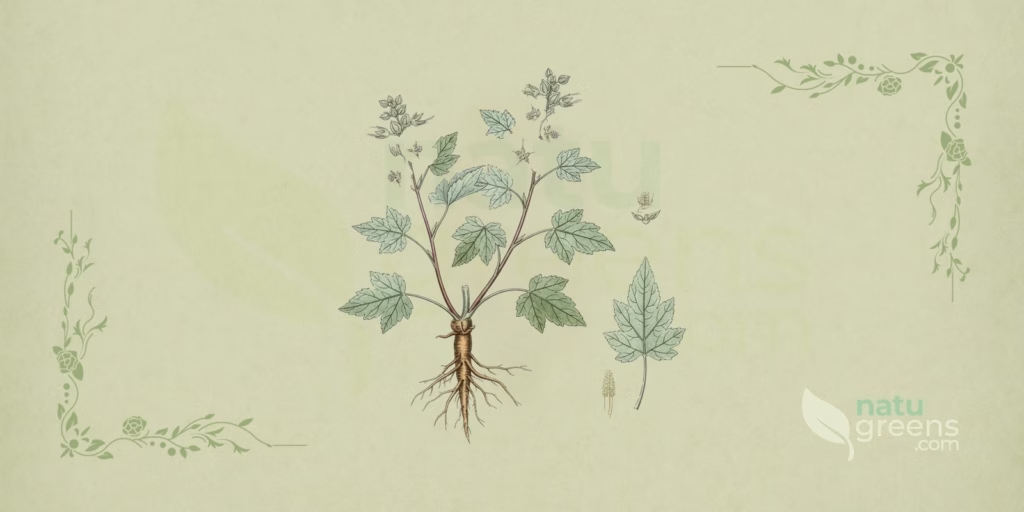
Marsh mallow is an erect, sturdy perennial herb that in most populations stands between 60 and 150 centimetres tall and passes 180 centimetres on fertile, permanently moist ground. The aerial parts die back in winter and regrow in spring from the crown and from buds on the root system, a habit that lets the plant sit out long frosts and seasonal flooding alike. Its most immediate feature is the dense coat of stellate hairs covering the entire plant, which produces a velvety texture and an even greyish green quite distinct from the clear green of most European mallows.
Leaves
The leaves are alternate, simple and petiolate, with deciduous linear stipules at the base of the petiole. The blade ranges from ovate to triangular or almost orbicular, with three to five shallow lobes on the lower leaves and an outline that becomes progressively narrower and less lobed towards the top of the stem. Typical dimensions run from 3 to 10 centimetres long by 1.5 to 6 centimetres wide, with an irregularly crenate to serrate margin and a cordate or truncate base. Both surfaces are densely pubescent, which makes the blade thick, soft to the touch and grey when held against the light.
Flowers
The flowers are hermaphrodite and actinomorphic, gathered in short axillary clusters on the upper half of the stem, and they seldom open all at once, which stretches out the flowering display of the clump. The calyx has five sepals fused at the base and is preceded by an epicalyx of six to nine linear bracteoles, a diagnostic character that separates marsh mallow from the other British and central European mallows. The five petals are obcordate, measure 1.5 to 2 centimetres and run from white to pale pink with darker veining; the open corolla reaches 2.5 to 4 centimetres across. The stamens are numerous and fused into a staminal column that sheathes the style, with purplish anthers that stand out against the pale petals.
Fruits and Seeds
The fruit is a flattened, disc-shaped schizocarp up to 8 to 10 millimetres across, made up of 15 to 40 mericarps arranged in a ring around a central axis. Each mericarp is indehiscent, rounded on the back and flat on the sides, and encloses a single reniform seed of 2 to 3 millimetres, dark brown at maturity. The whole thing resembles a miniature cheese wheel, a likeness that earned the plant the English country names cheeses and pancake plant along the coasts of England.
Root and Stem
The stems are erect, cylindrical and sparingly branched, hardened at the base and herbaceous above. Below ground the plant develops a fleshy cylindrical taproot that reaches 30 to 50 centimetres long and up to 3 centimetres thick in mature specimens, accompanied by finer lateral roots. On the outside the root has greyish to brown bark and a longitudinally striated surface; inside it is white, fibrous and distinctly mucilaginous when fresh, a property that follows from the accumulation of water-soluble polysaccharides in the storage tissue.
Distribution and Habitat
The native range of the species, as given by Plants of the World Online, extends from Europe to central Siberia and western Pakistan, taking in northwest Africa. Within Europe marsh mallow occurs from southern Scandinavia to the Mediterranean and is native in Great Britain and the Channel Islands; in Ireland it is treated as a neophyte. Eastwards the distribution follows the Caucasus, Anatolian and Iranian basins as far as central Asia.
Beyond its native range the species is naturalised in parts of eastern North America, where Go Botany records it as introduced in Connecticut, Massachusetts and Vermont, associated with salt marshes and wetland margins. Established populations also exist in Australia and at scattered points in eastern Asia. In none of these regions does marsh mallow figure among invasive species requiring priority management: it behaves as a localised naturalised plant, confined to specific wet habitats, and does not build aggressive stands on dry ground.
Its typical habitat takes in brackish marshes, the banks of coastal drainage ditches, pasture subject to saline intrusion, damp meadows and low-lying land that floods periodically, generally from sea level up to moderate altitudes. The plant does best on clay to clay loam soils that are fertile, hold moisture well and are neutral to slightly alkaline. Tolerance of moderate salinity accounts for its frequency in estuaries, while a documented intolerance of grazing and of frequent cutting restricts British populations to lightly managed stretches, which makes the species a useful indicator of well conserved transitional marsh.
Marsh-mallow Cultivation
Marsh mallow has been grown in Europe for centuries and presents no real agronomic difficulty so long as soil moisture is secured. Seed is the usual route at any scale: germination responds well to alternating temperatures between 20 and 30 degrees Celsius with exposure to light, and agronomic trials record a gain in uniformity when seed is given a brief heat scarification before sowing. Seed-raised plants reach full size in their second growing season. Dividing clumps in spring or autumn, and taking root cuttings laid horizontally, both shorten that wait and keep productive selections genetically uniform.
As for requirements, the species asks for full sun to partial shade and a deep, fertile, moist soil, and it puts up with both temporary waterlogging and moderate salinity, which makes it a natural candidate for pond edges, canal banks and rain gardens. Dry sandy soils, on the other hand, hold back root development. Cold hardiness is high and winter dormancy is a normal part of the plant cycle, so lowland tropical climates simply do not supply the conditions it needs.
The phytosanitary problems most often recorded in cultivation are anthracnose caused by Colletotrichum malvarum, flea beetles of the genus Podagrica, which pit leaves and petals, aphids colonising young shoots, and mallow rust, caused by Puccinia malvacearum and by some margin the most destructive disease of the group, able to coat the undersides of leaves with orange pustules and strip a whole plant of foliage in wet years. Roots are lifted in the autumn of the second or third year, once the storage tissue has reached commercial bulk; the material is washed, peeled, sliced and dried at low temperature in the shade, a standard agricultural processing step that preserves the integrity of the tissue.
Phenology
In the northern hemisphere flowering runs from July to September, peaking in August across most of the range and concentrating in August and September in the British Isles, where the summer is shorter. Fruiting follows from August to October, and the schizocarps ripen progressively up the stem, in the same order in which the flowers opened. The aerial parts wither at the end of autumn and the plant passes the winter with its underground organs alone.
Pollination is entomophilous and depends above all on long-tongued bees. Bumblebees of the genus Bombus are the steadiest visitors, joined by honey bees, hoverflies and butterflies, drawn as much by the nectar as by the abundant pollen produced on the staminal column. The structure of the flower, with exposed stamens and an open corolla, puts no mechanical barrier in the way of a visitor, which widens the range of effective pollinators.
Dispersal is passive: the mericarps break away from the central axis as the fruit dries and fall close to the parent plant. Since the species inhabits ditches, river margins and ground subject to periodic flooding, transport of the mericarps by water during floods is the mechanism that best accounts for its distribution in linear patches along channels and estuaries.
Related Species and Confusions
The genus Althaea is small and confined to Europe, North Africa and western and central Asia. The boundary between Althaea and Alcea is one of the most debated points in the tribe Malveae: molecular analyses published from 2009 onwards showed that Alcea comes out as sister to the perennial species of Althaea, and that the characters traditionally used to separate the two genera, above all the number and degree of fusion of the epicalyx bracts, have evolved in a highly homoplastic way. The practical consequence is that names have migrated between the two genera over time and that old combinations still circulate in commercial catalogues.
Four species account for most confusion in the field:
- Alcea rosea L. (hollyhock): the Althaea rosea of nineteenth-century floras is much taller, reaching 250 centimetres, carries flowers of 8 to 12 centimetres in red, yellow, pink or purple and arranges them in a terminal spike, whereas marsh mallow has smaller flowers, always white to pale pink, in axillary clusters.
- Althaea cannabina L.: immediately told apart by leaves deeply cut into narrow segments, hemp-like in outline, and by a far sparser covering of hairs.
- Althaea hirsuta L.: an annual, much smaller in stature, with long stiff bristles instead of the soft velvety pubescence of marsh mallow.
- Malva sylvestris L. (common mallow): bears pinkish purple flowers with strongly marked dark veins, an epicalyx of only three bracteoles and clear green foliage without the greyish cast typical of A. officinalis.
In field practice the most reliable key combines three observations: count the epicalyx bracteoles, which in marsh mallow number six to nine; check the even velvety texture of the foliage; and look at the habitat, since none of the species above shares the preference of marsh mallow for brackish, waterlogged ground.
Phytochemistry
The chemical signature of the species is the accumulation of water-soluble polysaccharides in the roots and, to a lesser degree, in the leaves and flowers. Dried root typically holds 5 to 11 percent of these polysaccharides, with higher figures reported in individual analyses depending on the age of the plant, the season of harvest and the extraction method used. The fraction is heterogeneous and brings together arabinans, arabinogalactans, galacturonorhamnans and glucans; structural characterisation describes main chains alternating 1,4-linked D-galacturonic acid with 1,2-linked L-rhamnose, carrying glucuronic acid branches.
Beyond the polysaccharides, the species accumulates further classes of metabolites, unevenly distributed among the organs:
- Coumarins: scopoletin and derivatives, in small amounts.
- Flavonoids: glycosylated derivatives of kaempferol and quercetin, among them hyperoside, isoquercitrin and tiliroside, concentrated in the flowers and leaves.
- Free amino acids: asparagine, at high concentration in the root.
- Phenolic acids: caffeic acid, ferulic acid and p-coumaric acid, mainly in the aerial parts.
- Phytosterols and lipids: beta-sitosterol, lanosterol and lauric acid, together with the lactone altheahexacosanyl.
- Tannins and pectins: condensed tannins at low concentration and cell-wall pectins associated with the mucilaginous fraction.
Starch and sucrose complete the profile of the root and account for a sizeable share of its dry matter, which makes the underground organ, in biochemical terms, a storage tissue of dual nature, with storage carbohydrates and structural carbohydrates coexisting in a proportion uncommon among the mallows.
History and Ethnobotany
Marsh mallow is among the earliest plants of Europe and the Near East to enter the written record. Texts attributed to the Hippocratic school, in the fifth century before the common era, mention the root of the plant in the context of wound care, and Dioscorides described the species in detail in De Materia Medica in the first century. Pliny the Elder documented a use of a different order: in Rome the young leaves were gathered and eaten as a vegetable, a practice he recorded among the ordinary dietary habits of his day.
In medieval Europe the root appeared on the official lists of the monastic apothecaries and gave its name to a pharmacy preparation, the unguentum althaeae, which turns up in Latin recipe books alongside other plant compounds of the period. The species stayed monographed in the European pharmacopoeias that followed, and the epithet officinalis itself is a record of that institutional standing.
The best known ethnobotanical episode in the history of the plant is the one that tied its name to a confection. Historical accounts credit ancient Egypt with a sweet made from the mucilaginous root extract and honey, reserved for the ruling classes, and in the nineteenth century French confectioners developed the pâte de guimauve, which combined that same extract with sugar and egg white to obtain an aerated paste. Industrialisation of the sweet in the twentieth century replaced the plant extract with gelatine and starch, so that the marshmallow sold today keeps nothing of the plant but the name, although small artisan producers have gone back to the original formula.
In coastal regions of eastern Europe and central Asia, ethnographic records from the nineteenth and twentieth centuries also document the young leaves in peasant food preparations and the stem fibres in rough cordage, the latter of marginal importance and confined to particular riverside communities.
Conservation
In the European IUCN Red List assessment carried out in 2013, Althaea officinalis was classified as Least Concern, a category that reflects the breadth of the continental distribution and the stability of the populations taken as a whole. The species is not listed in the CITES appendices and is subject to no restriction on international trade. It is worth noting, however, that the aggregate assessment conceals rather different regional pictures, and that in Great Britain populations have retreated since the 1930s to the point where the plant is now locally scarce.
The documented threats have to do with habitat degradation rather than collection:
- Coastal urbanisation: building over estuaries and shoreline strips directly removes the transitional environments in which the species occurs.
- Drainage of wetlands: the historical conversion of marshes and flood meadows into farmland is the single greatest impact on native populations.
- Eutrophication: nutrient enrichment of coastal waters favours fast-growing competing herbs that displace the species.
- Grazing and mowing management: the intolerance of the plant to heavy grazing and frequent cutting wipes out populations in wetlands under continuous use.
Widespread commercial cultivation in central and eastern Europe takes pressure off wild populations, and the most effective conservation measures on record are the hydrological restoration of marshes and a lighter management regime on coastal pasture.
Interesting Facts
- The English name of the plant describes its habitat with literal precision: marsh means bog and mallow is the everyday name of the family, so the best selling industrial sweet in the world carries on its label the name of a European salt marsh herb.
- Asparagine, the first amino acid isolated from a plant source, was obtained in 1806 from asparagus juice, and marsh mallow root is among the plant tissues in which it occurs at highest concentration.
- The disc-shaped fruits earned the species English country names such as cheeses and pancake plant, direct references to the flat wheel shape of the ripe schizocarp.
- Its intolerance of grazing makes marsh mallow a useful ecological indicator: its presence in a British marsh signals a transitional stretch that has escaped intensive management long enough for the plant to establish.
- The split between Althaea and Alcea remains under revision, and the garden hollyhock, today Alcea rosea, appears in older catalogues and floras as Althaea rosea, a recurring source of confusion in seed listings.
Notice: this content is for informational purposes and does not replace professional medical advice. Consult a physician or herbal practitioner before using medicinal plants, especially during pregnancy, breastfeeding, or alongside medication.
References and Scientific Studies
View All 10 Cited References
- 2026 Botanical Society of Britain and Ireland. Althaea officinalis L. Species account, BSBI Online Plant Atlas. Accessed 2026.
- 2009 Escobar García, P., Schönswetter, P., Fuertes Aguilar, J., Nieto Feliner, G., Schneeweiss, G. M. Five molecular markers reveal extensive morphological homoplasy and reticulate evolution in the Malva alliance (Malvaceae). Molecular Phylogenetics and Evolution, 50(2), 226-239. 2009.
- 2012 Escobar García, P., Pakravan, M., Schönswetter, P., Aguilar, J. F., Schneeweiss, G. M. Phylogenetic relationships in the species-rich Irano-Turanian genus Alcea (Malvaceae). Taxon, 61(2), 324-332. 2012.
- 2026 International Plant Names Index. Althaea officinalis L., Sp. Pl. 2: 686 (1753). Record 558872-1. The Royal Botanic Gardens Kew, Harvard University Herbaria and Australian National Herbarium. Accessed 2026.
- 2013 Khela, S. Althaea officinalis. The IUCN Red List of Threatened Species, European assessment. 2013.
- Linnaeus, C. Species Plantarum, volume 2, page 686. Stockholm: Laurentius Salvius. 1753.
- 2026 Native Plant Trust. Althaea officinalis L., common marsh mallow. Go Botany, Flora of New England. Accessed 2026.
- 2026 Plants of the World Online. Althaea officinalis L. Royal Botanic Gardens Kew. Accessed 2026.
- 2021 Polysaccharide extracted from Althaea officinalis L. root: new studies of structural, rheological and antioxidant properties. International Journal of Biological Macromolecules. 2021.
- 1968 Tutin, T. G., Heywood, V. H., Burges, N. A., et al. Flora Europaea, volume 2: Rosaceae to Umbelliferae. Cambridge University Press. 1968.