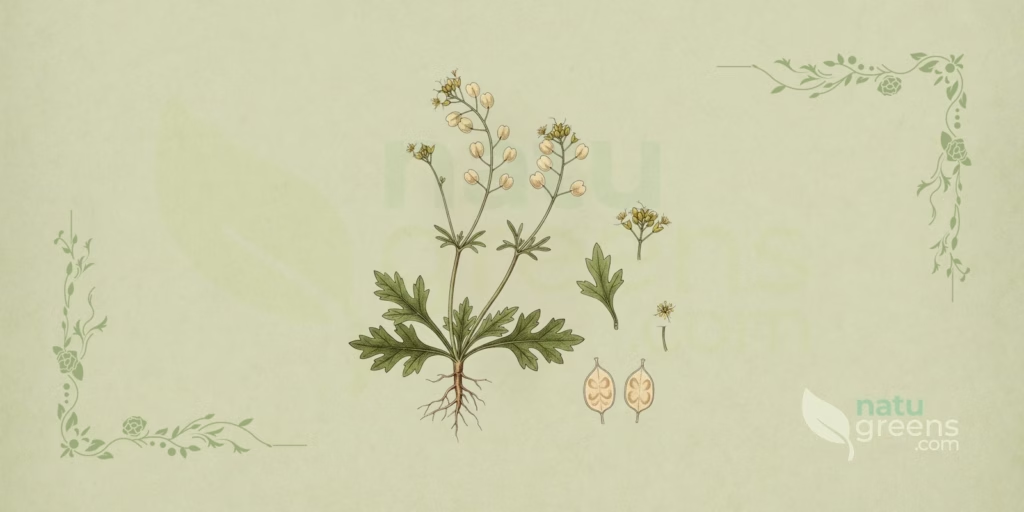
Capsella bursa-pastoris (L.) Medik. / Shepherd’s Purse, popularly known as shepherd’s purse, lady’s purse, or mother’s heart, is an annual or biennial herbaceous plant of the Brassicaceae family, described by Carl Linnaeus in 1753 as Thlaspi bursa-pastoris and transferred to the genus Capsella by Friedrich Kasimir Medikus in 1792. Native to Eurasia, this species has spread across every continent and is considered a common ruderal plant in many parts of the world, especially in cooler climates. Shepherd’s purse has been used for millennia in traditional medicine, mentioned in ancient texts for its ability to stanch bleeding. Its small white flowers and triangular fruits, which resemble an old shepherd’s pouch, are harvested for the preparation of infusions, tinctures, and other herbal products.
In the European and Asian herbal traditions, shepherd’s purse holds a prominent place as an astringent and hemostatic plant. Its recorded applications range from topical use on superficial wounds and light bleeding to the relief of menstrual disorders. The plant is recognized for its rich phytochemical composition, especially flavonoids, polypeptides, and organic acids, which account for its anti-inflammatory, antioxidant, and antimicrobial properties. Modern scientific research has validated many of shepherd’s purse’s traditional uses, consolidating its position among the most studied medicinal plants in the world.
Popular and International Names of Shepherd’s Purse
- English: shepherd’s purse, lady’s purse, mother’s heart, pick-pocket.
- Spanish: bolsa de pastor, calzoncitos, pan y quesillo, zurrón de pastor.
- Portuguese: bolsa-de-pastor, bolsa-do-pastor, erva-bolsa, erva-do-bom-pastor.
- French: bourse-à-pasteur, boursette, capselle bourse à pasteur.
- Italian: borsa del pastore.
- German: Hirtentäschel.
Botanical Synonyms of Shepherd’s Purse
Thlaspi bursa-pastoris L., Bursa bursa-pastoris (L.) Shull, Bursa pastoris (L.) Weber.
Botanical Family: Brassicaceae
The Brassicaceae family, also known as Cruciferae, is one of the largest families of flowering plants, comprising about 370 genera and more than 4,000 species distributed worldwide. This family is characterized by flowers with four petals arranged in the shape of a cross, hence its alternative name of crucifers. The Brassicaceae include plants of great economic, food, and medicinal importance, such as cabbage, broccoli, mustard, and radish.
Shepherd’s purse shares morphological features typical of the family, including flowers with four petals and six stamens, and flattened, triangular silicles. The Brassicaceae family is known for producing bioactive compounds, especially glucosinolates, flavonoids, and phenolic acids, which confer medicinal properties on many of its species. The chemical diversity of this family has been the subject of intense pharmacological research, contributing to the development of phytomedicines and dietary supplements.
Parts of Shepherd’s Purse Used
- Aerial parts
- Flowers
- Leaves
- Roots
- Seeds
Ethnobotanical and Traditional Uses of Shepherd’s Purse
- Application to superficial wounds and light bleeding (historical record; suspected internal bleeding requires emergency medical care)
- Control of excessive menstrual bleeding (menorrhagia)
- Reduction of postpartum bleeding (an obstetric emergency that requires immediate hospital care)
- Treatment of diarrhea
- Use as food in several Asian cultures
Therapeutic Properties of Shepherd’s Purse
- Antihemorrhagic (reduces and prevents bleeding)
- Anti-inflammatory (reduces inflammation)
- Antimicrobial (fights pathogenic microorganisms); traditional use, without established clinical efficacy
- Antioxidant (fights free radicals)
- Astringent (helps tighten tissues and stanch bleeding)
- Diuretic (increases urine production)
- Hepatoprotective (protects the liver); traditional use, without established clinical efficacy
- Oxytocic (stimulates uterine contractions); traditional record, without established clinical efficacy
- Poorly defined effect on coagulation (laboratory assays record both hemostatic and antithrombotic activity, depending on the extract)
- Sedative (promotes relaxation)
- Wound healing (promotes wound healing)
Detailed Phytochemical Profile of Shepherd’s Purse
- Choline
- Flavonoids (acacetin, apigenin, diosmin, kaempferol, luteolin, quercetin, rutin)
- Fumaric acid
- Glucosinolates (with sulforaphane among the hydrolysis products)
- Histamine
- Organic acids
- Polypeptides
- Tyramine
- Vitamin K
Preparation and Administration Forms of Shepherd’s Purse
- Extracts
- Tea (infusion)
- Tinctures
Synergy with Other Medicinal Plants
Antibacterial Activity
Shepherd’s purse shows synergistic antibacterial activity when combined with licorice (Glycyrrhiza glabra). This combination can be effective against oral pathogens, suggesting potential use in oral health formulations. The synergy between the bioactive compounds of both plants can amplify the antimicrobial effects, offering a natural approach to fighting infections.
Recipes and Usage Protocols of Shepherd’s Purse
Infusion for Minor Bleeding
Ingredients: 1 teaspoon of dried shepherd’s purse aerial parts, 200 ml of boiling water.
Preparation: Place the plant in a cup and add the boiling water. Cover and steep for 10 minutes. Strain and drink. Drinking 2 to 3 cups a day is recommended to help control minor bleeding, such as nosebleeds or heavy menstruation. This infusion draws on the plant’s astringent and hemostatic properties.
Tincture for Internal Use
Ingredients: 50 g of fresh shepherd’s purse aerial parts, 250 ml of 70% grain alcohol.
Preparation: Finely chop the plant and place it in a dark glass jar. Cover with the alcohol, making sure the plant is fully submerged. Close tightly and let macerate for 2 to 4 weeks in a cool, dark place, shaking daily. Strain and store the tincture in a dark bottle. Take 10 to 20 drops diluted in water, 2 to 3 times a day, as directed by a health professional. The tincture is a concentrated, effective form for conditions requiring the plant’s systemic properties.
Associated Therapies
Herbal Medicine
In herbal medicine, shepherd’s purse is valued for its hemostatic and astringent properties. It is traditionally cited for menorrhagia, metrorrhagia, and postpartum bleeding, the last of these being an obstetric emergency that requires immediate hospital care. Standardized extracts of the plant are employed to guarantee precise dosing of the active compounds. Modern phytotherapy recognizes the importance of shepherd’s purse as a natural resource for the management of various bleeding- and inflammation-related conditions, integrated into complementary treatment protocols.
Homeopathy
In homeopathic tradition, Capsella bursa-pastoris is cited for bleeding states, particularly uterine bleeding with clots and intense pain, and also for urinary complaints in which blood appears in the urine. The remedy is prepared from the fresh plant, following the dilutions and dynamizations specific to the method, and the choice of potency and frequency is usually left to a qualified practitioner. There are no clinical studies demonstrating the effectiveness of these preparations. Heavy uterine bleeding, with clots or intense pain, and blood in the urine require immediate medical assessment, which must never be replaced by any homeopathic preparation.
Contraindications and Side Effects of Shepherd’s Purse
General Contraindications
Shepherd’s purse is contraindicated during pregnancy because of its oxytocic activity, which can stimulate uterine contractions and potentially induce miscarriage or premature labor. Breastfeeding women should avoid it, given the lack of safety data for the infant. Individuals with heart disease, kidney disease, or blood clotting disorders should use the plant with caution and under medical supervision, as it can affect blood clotting and blood pressure. Its vitamin K content can reduce the effect of anticoagulants such as warfarin, which is why anyone on that treatment should avoid the plant. Because of its tyramine content, the plant should also be avoided by anyone taking MAO inhibitor antidepressants, given the risk of a hypertensive crisis. People with a known allergy to Brassicaceae plants should also avoid its use.
Side Effects
At high doses, shepherd’s purse can cause gastrointestinal irritation, nausea, and vomiting. Because of its diuretic properties, prolonged use can lead to electrolyte imbalances. Rare cases of allergic skin reactions have been reported. It is essential to respect the recommended doses and seek medical advice if adverse reactions occur. Interaction with thyroid medications is also a concern, since the plant contains glucosinolates that can interfere with thyroid function.
Historical Notes and Interesting Facts
A Protocarnivorous Plant
One of the most fascinating curiosities of shepherd’s purse is its classification as a protocarnivorous plant. Its seeds produce a mucilaginous substance that attracts and traps nematodes, small soil worms. The hypothesis under discussion is that the mucilage releases enzymes capable of partially digesting the nematodes, with the nutrients taken up by the germinating seedling. This ingenious mechanism is an adaptation for thriving in poor soils.
Global Distribution
Capsella bursa-pastoris is among the most widely distributed ruderal plants on the planet, present in nearly every temperate region. It occurs in strikingly different ecosystems, from cultivated fields to roadsides and meadows, and that plasticity explains its persistence as a successful species in varied climates and conditions.
Popular Names and Legends
The popular name shepherd’s purse derives from the triangular, flattened shape of its fruits, which resemble the leather pouches shepherds once used to carry their food. In England and Scotland, it was known as mother’s heart, associated with a children’s game in which the fruit was picked and, when it burst, the child was accused of breaking their mother’s heart. These names reflect popular observation and cultural interaction with the plant throughout history.
Continuous Flowering
Unlike most flowering plants, shepherd’s purse blooms almost all year round. This trait, combined with its ability to produce several generations per year and a long-lasting soil seed bank, contributes to its remarkable adaptability and reproductive success. Its constant presence in diverse environments demonstrates its resilience and its ecological importance as a pioneer species on disturbed soils.
Frequently Asked Questions about Shepherd’s Purse Tea
What Is Shepherd’s Purse Tea Good for?
Shepherd’s purse tea is traditionally used for excessive menstrual bleeding. Postpartum hemorrhage is a medical emergency: call emergency services immediately, never try to control it with tea. It has astringent, anti-inflammatory, and antioxidant properties and is also employed to relieve diarrhea and urinary complaints. Its hemostatic action is the most recognized and studied, making it a popular remedy for various bleeding conditions.
Are There Contraindications for Shepherd’s Purse Tea?
Yes, shepherd’s purse tea is contraindicated during pregnancy because of its potential to stimulate uterine contractions. Breastfeeding women and people with heart disease, kidney disease, or blood clotting disorders should avoid it or consult a doctor. Individuals allergic to Brassicaceae plants should also abstain. Following dosage recommendations and seeking professional advice is crucial.
How Do I Prepare Shepherd’s Purse Tea?
To prepare the tea, use 1 teaspoon of dried shepherd’s purse aerial parts per 200 ml of boiling water. Add the plant to the water, cover, and steep for about 10 minutes. Strain and drink. Drinking 2 to 3 cups a day is recommended, as needed and always with guidance. Correct preparation ensures effective extraction of the plant’s therapeutic compounds.
What Are the Side Effects of Shepherd’s Purse Tea?
At high doses, shepherd’s purse tea can cause gastrointestinal irritation, nausea, and vomiting. Prolonged use can lead to electrolyte imbalances because of its diuretic properties. Rare cases of allergic skin reactions have been reported. Respecting the dosage and consulting a health professional if adverse reactions occur is essential. Interaction with thyroid medications is also a concern.
Can Shepherd’s Purse Be Used in Cooking?
Yes, shepherd’s purse is edible and used in the cuisine of several cultures, especially in Asia. The young leaves can be eaten raw in salads, and the plant is a common ingredient in soups, congee, and fillings in China. In Korea, the roots are used in dishes such as namul. Its culinary versatility adds nutritional value and a unique flavor to many traditional recipes.
Notice: this content is for informational purposes and does not replace professional medical advice. Consult a physician or herbal practitioner before using medicinal plants, especially during pregnancy, breastfeeding, or alongside medication.
References and Scientific Studies
Peer-Reviewed Scientific Studies (1)
- PMC2014 Choi, W. J. (2014). Anti-inflammatory and anti-superbacterial properties of sulforaphane from shepherd’s purse. Korean Journal of Physiology & Pharmacology.
Supplementary Readings (5)
- Royal Botanic Gardens, Kew. Capsella bursa-pastoris (L.) Medik. Plants of the World Online.
- 2024 Łukaszyk, A. (2024). Traditional Uses, Bioactive Compounds, and New Findings on Pharmacological, Nutritional, Cosmetic and Biotechnology Utility of Capsella bursa-pastoris. Nutrients.
- 2018 Cha, J. M. (2018). Phytochemical Constituents of Capsella bursa-pastoris and Their Anti-inflammatory Activity. Natural Product Sciences.
- 2015 Al-Snafi, A. E. (2015). The chemical constituents and pharmacological effects of Capsella bursa-pastoris – A review. International Journal of Pharmacology & Toxicology.
- 2013 Soleimanpour, S. (2013). Synergistic antibacterial activity of Capsella bursa-pastoris and Glycyrrhiza glabra against oral pathogens. Jundishapur Journal of Microbiology.