Adiantum capillus-veneris is a rhizomatous fern in the family Pteridaceae, recognizable from a distance by the contrast between its pale, almost translucent pinnules and the glossy black stalks that hold them up. That single image earned the species the name Venus’s hair in nearly every European language, and maidenhair in English, while in Brazil it settled as avenca, a label later stretched to cover much of the genus. Few plants manage to look so fragile while enduring so much: the same frond that falls apart at a touch has been colonizing limestone walls exposed to the Mediterranean wind for thousands of years.
The species has one of the widest distributions of any fern. Plants of the World Online describes its native range simply as cosmopolitan, which means natural occurrence in warm temperate and humid tropical regions of every continent except Antarctica. That breadth does not come from generalist tolerance but from the opposite: the southern maidenhair fern depends on a very specific microhabitat, rock permanently fed by seeping water and shielded from direct light, and such rock happens to occur in scattered pockets almost everywhere on the planet. Wherever a spring trickles down a limestone face, it is reasonable to go looking for it.
Botanical interest in the species reaches well beyond gardening. Because it germinates readily, completes its cycle in roughly a hundred days under laboratory conditions and responds predictably to light stimuli, Adiantum capillus-veneris became one of the classic model organisms in the study of fern development, with literature accumulating since the nineteenth century on spore germination, gametophyte formation and photomorphogenesis. This profile brings together the taxonomy, morphology, ecology, cultivation, descriptive phytochemistry, cultural history and conservation status of the species.
Taxonomy
Carl Linnaeus described the species in 1753, in the first edition of Species Plantarum, and the name has remained stable ever since, with no significant generic recombinations. The International Plant Names Index records the protologue at Sp. Pl. 2: 1096, published on 1 May 1753, under identifier 325030-2. Plants of the World Online keeps the binomial as the accepted name.
- Kingdom: Plantae
- Division: Polypodiophyta
- Class: Polypodiopsida
- Order: Polypodiales
- Family: Pteridaceae
- Subfamily: Vittarioideae
- Genus: Adiantum L.
- Species: Adiantum capillus-veneris L., 1753
The family placement deserves a word of explanation, because the sources look as though they disagree. IPNI indexes the species under Adiantaceae, following the nomenclatural tradition that set the maidenhair ferns apart in a family of their own. The classification of the Pteridophyte Phylogeny Group, published in 2016 and now adopted by most floras and by Kew itself, places Adiantum in Pteridaceae, in the subfamily Vittarioideae, where the genus appears as sister group to the simple-leaved vittarioids. Both spellings point to the same plant, and Pteridaceae is the current reading.
Synonyms
The synonymy of the species is extensive, a consequence of the morphological variation between distant populations that led nineteenth and twentieth century botanists to describe local forms as independent taxa. Among the names now treated as synonyms are the following:
- Adiantum capillus-veneris f. dissectum (M.Martens & Galeotti) Ching
- Adiantum capillus-veneris f. rimicola (Sloss.) Fernald
- Adiantum capillus-veneris var. modestum (Underw.) Fernald
- Adiantum capillus-veneris var. protrusum Fernald
- Adiantum capillus-veneris var. trifidum (Willd. ex Bolle) Milde
- Adiantum cuneifolium Stokes
- Adiantum emarginatum Bory ex Willd.
- Adiantum fumarioides Willd.
None of the varieties above is recognized as a valid taxon under the current Kew treatment, even though the epithets keep circulating in horticultural catalogues and in older regional literature. Anyone consulting floras published before the 2000s will often find var. protrusum applied to North American material and var. trifidum to material from the western Mediterranean.
Etymology
The generic name comes from the Greek adianton, built from the privative prefix a plus the verb diainein, to wet, and it means literally that which does not get wet. The choice describes an observable phenomenon: the cuticle of the pinnules is strongly hydrophobic, and a frond held under water comes out dry, the water rolling off in whole drops without ever clinging to the tissue. Theophrastus was already using the term in the fourth century before the common era.
The epithet capillus-veneris translates as hair of Venus and alludes to the thin, black, shining stipes, which look like strands of wet hair. The two-word hyphenated epithet is a survival of the pre-Linnaean descriptive phrases that Linnaeus retained in a handful of cases, and the hyphenated spelling is the correct form under the International Code of Nomenclature.
Morphological Description
A perennial herbaceous fern, rhizomatous and caespitose in habit, forming dense tufts or loose mats depending on the slope and fissuring of the substrate. Usual height falls between 15 and 45 centimetres, with specimens reaching 60 centimetres in well shaded, permanently humid tropical shelters. Growth is slow and continuous, with no marked dormant period in tropical populations, and the spread of a colony owes far more to rhizome branching than to the establishment of new sporophytes.
Leaves
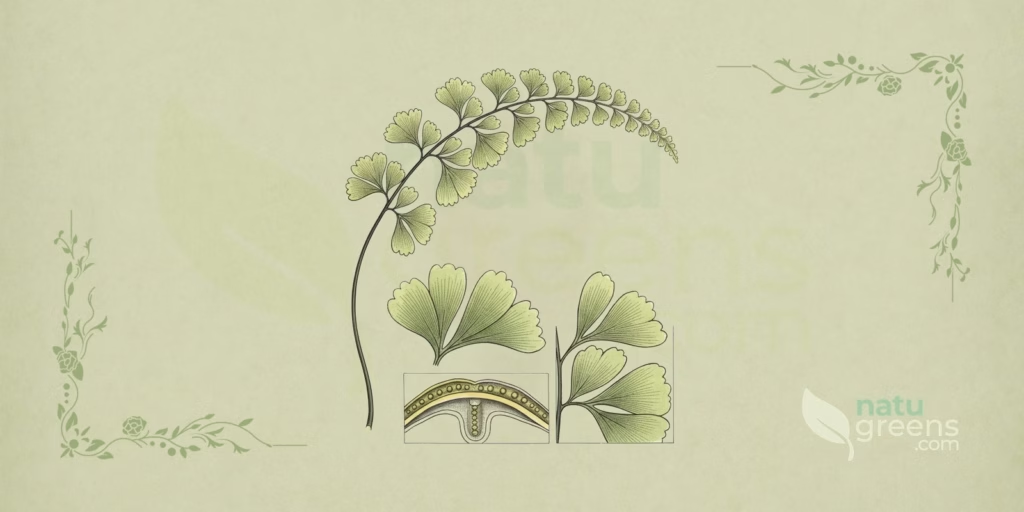
The fronds are the diagnostic structure of the species and carry practically every character useful for field identification. They emerge at irregular intervals along the rhizome, with circinate vernation, and unroll progressively from base to apex over several weeks.
- Blade: ovate-triangular, 6 to 25 centimetres long by 8 to 16 centimetres wide, bipinnate in the lower portion and pinnate towards the apex
- Colour: bright pale green on the adaxial face, slightly paler on the abaxial one
- Overall length: 15 to 45 centimetres including the stipe, exceptionally up to 60 centimetres
- Pinnules: flabellate, cuneate at the base, 12 to 20 by 10 to 15 millimetres, the upper margin rounded and divided into 2 to 4 shallow lobes
- Rachis: black and lustrous, slightly flexuous, branched, with hair-fine stalks articulating each pinnule
- Stipe: 5 to 15 centimetres, purplish black to dark brown, terete, smooth and glossy
- Texture: membranaceous, translucent against the light, with a hydrophobic cuticle
The sori sit on the abaxial face of fertile pinnules, 3 to 10 per pinnule, occupying the upper margin. There is no true indusium: protection of the sporangia falls to a false indusium formed by the folded margin of the pinnule itself over the sporogenous tissue. This false indusium is yellowish green while the sporangia ripen and darkens to brown at maturity, which gives fertile fronds a darker upper edge visible to the naked eye. The spores are trilete, 40 to 50 micrometres in diameter, with a rugulate surface.
Flowers
The species produces no flowers. Like every fern, it belongs to a lineage of seedless vascular plants that diverged from the seed plants long before the flower appeared, and its sexual reproduction takes place in an independent, microscopic generation, the gametophyte, described in the phenology section below. Structures occasionally called flowers in gardening texts correspond in fact to the sori on the underside of the fronds.
Fruits and Seeds
There are no fruits and no seeds either, for the same reason. The dispersal unit of the maidenhair fern is the spore, a haploid cell with a resistant wall produced by the thousand inside each sporangium. The sporangium bears a ring of cells with unevenly thickened walls that works as a catapult: as it loses water the ring contracts, tears the capsule open and flicks the spores a few centimetres away, far enough for air currents to take over the transport from there.
Rhizome and Roots
The rhizome is short, creeping and branched, a few millimetres thick, clothed in brown lanceolate scales with entire margins and about 2 to 4 millimetres long. In anatomical section, young rhizomes show an amphiphloic siphonostele, while mature ones display the perforated tubular structure characteristic of polypodialean ferns, a character used in comparative anatomical studies of the group. The roots are adventitious, fasciculate, fine and dark, 5 to 15 centimetres long, anchoring themselves in crevices, mosses and organic matter trapped on the rock, and forming a shallow system that exploits a very small volume of substrate.
Distribution and Habitat
Plants of the World Online describes the native range of the species as cosmopolitan, a rare situation among ferns and shared by very few vascular plants. Natural occurrence covers the whole Mediterranean basin, Macaronesia, northern and eastern Africa, the Middle East, the Indian subcontinent, East Asia as far as Japan, Southeast Asia, Australia, New Zealand, the southern half of the United States, Mexico, Central America, the Caribbean and much of South America. In Atlantic Europe the species reaches sheltered spots in southern England, Wales and Ireland, where it lives at the thermal limit of its tolerance.
The habitat is remarkably uniform in spite of that geographical breadth. The fern occupies rock with permanent water seepage, limestone and marl above all, at cave mouths, waterfall walls, spring margins, wells, aqueducts and old walls with infiltration. The required combination brings together high and constant atmospheric humidity, weak diffuse light, firm alkaline substrate and no waterlogging at root level, since the plant prefers wet rock to saturated soil. This dependence on limestone is the main limiting factor of its distribution at regional scale and explains why the species can be absent for hundreds of kilometres inside a climatically suitable area.
The altitudinal range runs from sea level to about 1500 metres in Europe, with records up to 2800 metres in tropical Asia. Preferred climate is warm temperate to humid subtropical with mild winters, and the species is sensitive to frost, which restricts high latitude populations to thermally buffered microclimates. Two disjunct populations far north of the continuous range, in South Dakota and British Columbia, survive precisely because they are tied to hot springs that keep substrate temperature above what the surroundings would allow.
In Brazil the situation calls for caution when reading the sources. Recent surveys of Brazilian Pteridaceae exclude Adiantum capillus-veneris from their natural distribution analyses on the grounds that it is introduced or cultivated in the country, which means national records should be read as naturalization from ornamental cultivation rather than native occurrence. The plant escapes easily onto damp walls, garden gutters and shaded embankments in urban areas of the Southeast and South, behaviour also documented in several cities with a Mediterranean climate. There is no record of the species behaving as an aggressive invader in natural environments, probably because the microhabitat it requires is scarce and usually already occupied by native pteridophytes.
Adiantum Cultivation
The maidenhair fern has a well deserved reputation as a difficult houseplant, and the reason is nearly always the same: relative air humidity. Everything else in its management is straightforward, and a plant settled in a suitable spot will thrive for decades with minimal intervention. The classic mistake is to answer desiccation with more water in the substrate, which merely trades death by drying out for death by rhizome rot.
The basic requirements are as follows:
- Air humidity: 60 to 80 per cent, the critical factor. Rooms with air conditioning or central heating are hostile to the species
- Light: partial to full shade, with diffuse light. Direct sun scorches the pinnules within hours
- pH: neutral to alkaline, between 6.5 and 8.0, which sets the species apart from most cultivated ferns, adapted as they are to acid substrates
- Substrate: porous and free draining, rich in organic matter, with added calcareous material such as dolomitic limestone or limestone grit
- Temperature: a comfortable range between 16 and 25 degrees, with no exposure to frost and no prolonged drops below 12 degrees
- Ventilation: gentle air movement, enough to discourage fungi, without direct draughts that would dry the fronds out
Propagation by clump division is the usual and the quickest method. The adult plant is divided in early spring, each portion keeping a segment of rhizome with roots and a few fronds, and replanted at once in moist substrate, the new division being kept in deeper shade for a few weeks until growth resumes. Rhizome fragments carrying viable buds also root in warm, moist substrate.
Propagation by spores is slower, yet it is the route that yields the greatest number of plants and the only one that generates genetic variability. Fertile fronds are collected once the false indusium has turned dark brown and left on smooth paper in a dry room for one or two days so the spores are released, then sown on sterilized moist substrate in a closed translucent container. Germination occurs within days under favourable conditions, the heart-shaped prothalli become visible after a few weeks, and the first transplantable sporophytes demand patience of several months to over a year.
Recurrent phytosanitary problems include scale insects, which attach at the base of the stipes and on the rhizome; foliar nematodes of the genus Aphelenchoides, responsible for dark interveinal blotches and spread by overhead watering; and slugs and snails outdoors. Among the diseases, Botrytis cinerea advances in very humid, poorly ventilated conditions, while Rhizoctonia and Pythium attack rhizomes and seedlings in waterlogged substrate. Abiotic disorders are often mistaken for disease: brown pinnule tips point to dry air or water with high residual chlorine, and general yellowing with scorched edges points to excess light.
There is no significant agricultural harvest of the species. What does exist is the gathering of fronds from wild populations for the ornamental trade and for traditional markets in parts of the Mediterranean and Asia, a practice that pressures local populations and one the conservation section takes up further on.
Phenology
The phenology of a fern is organized around the alternation of generations rather than around a flowering calendar. The visible generation, the sporophyte, produces sporangia on fertile fronds that ripen mainly between late spring and summer, which corresponds to June and August in the northern hemisphere and to November and March in southern hemisphere populations. In humid tropical climates without a marked dry season, spore production can be practically continuous through the year.
There are no pollinators and no pollination syndrome, since there are no flowers. Dispersal is anemochorous: the sporangial ring expels the spores through desiccation, and from that point air currents take over the transport, with a reach that runs from a few centimetres to intercontinental distances when the spores rise into the upper atmosphere. This long distance dispersal capacity is the most widely accepted explanation both for the cosmopolitan range of the species and for the low morphological differentiation of highly isolated populations.
A spore that lands on moist, lit substrate germinates within days and gives rise to a free living gametophyte, green and laminar, which develops into the characteristic heart shape over a few weeks, with a dozen or so rhizoids fixing it to the substrate. The gametophyte is monoecious and bears antheridia on the ventral face, among the rhizoids, and archegonia near the apical notch. Fertilization requires liquid water: the flagellate antherozoids swim across the film of moisture covering the prothallus to reach the archegonium, which makes rain or constant dripping a mandatory condition for sexual reproduction and helps explain the fidelity of the species to rock with permanent seepage. The new sporophyte develops from the zygote, and the complete cycle can close in about a hundred days under controlled laboratory conditions, a considerably longer span in the field.
Related Species and Confusions
The genus Adiantum gathers some two hundred species distributed above all through the tropics and subtropics, and several of them circulate in the ornamental trade under the same common name of maidenhair fern. The most frequent confusion in Brazil does not even involve difficult identification, but labelling: a good share of the maidenhair ferns sold in Brazilian florists is Adiantum raddianum, a native Brazilian species marketed under a generic tag.
- Adiantum aethiopicum L.: an African and Australasian species with smaller pinnules and more erect fronds, its long creeping rhizome forming open colonies instead of compact tufts
- Adiantum caudatum L.: simply pinnate fronds, long and arching, rooting at the tip and forming propagules, a character absent in A. capillus-veneris
- Adiantum pedatum L.: a pedate blade, the segments fanning out from the apex of the stipe like the fingers of an open hand, an unmistakable architecture with no parallel in the species of this profile
- Adiantum raddianum C.Presl: smaller, more numerous and densely set pinnules, more compact fronds and tolerance of acid substrates, contrary to the calcareous preference of A. capillus-veneris
- Adiantum reniforme L.: a simple, undivided kidney-shaped blade, restricted to Macaronesia and to a few Asian localities
Outside the genus, two confusions deserve attention. Asplenium trichomanes shares the dark stipe and the rupicolous habit on damp rock, but its blade is simply pinnate, with oblong pinnules set in regular pairs along an unbranched rachis, a herringbone pattern that has nothing of the divided rachis and fan-shaped pinnules of the maidenhair. The species of Davallia, also grown in pots, display thick aerial rhizomes densely covered in hairy scales and exposed over the rim of the container, a structure Adiantum never shows.
There are no relevant toxic lookalikes for this species. The ferns it can be confused with in the field belong to genera with no documented history of acute toxicity, a different situation from the one seen among flowering plants, where mistaken identity can have serious consequences.
Phytochemistry
The chemical composition of Adiantum capillus-veneris is well documented, and the genus as a whole ranks among the most thoroughly investigated ferns from the standpoint of natural product chemistry. The description that follows is strictly compositional and implies no effect on any organism.
Triterpenoids are the most characteristic class. Adiantone is a triterpenoid of wide occurrence in the genus, found in most chemically examined species, and the fronds of A. capillus-veneris have also yielded isoadiantone, isoadiantol B, filicene and filicane derivatives such as 3,4-dihydroxyfilicane and 3-methoxy-4-hydroxyfilicane. Filicene concentrates above all in the epicuticular wax, the layer responsible for the water repellency already mentioned under morphology.
Among the flavonoids, the ethyl acetate fraction of the fronds yields quercetin, quercetin-3-O-glucoside, also known as isoquercitrin, and quercetin-3-O-rutinoside, known as rutin. Kaempferol and its glycoside astragalin have likewise been recorded in leaf material. To these are added phenolic acids such as gallic acid and hydroxycinnamic derivatives of caffeic acid, along with proanthocyanidins, which are condensed tannins.
Broader profiling analyses further describe triacylglycerols, phospholipids, carotenoids, chlorophylls, phytosterols and volatile organic compounds, unevenly distributed among the organs. Secondary metabolite concentration is highest in the fronds, notably in young tissue, and lowest in the rhizome and roots. One environmental note belongs here: the species accumulates heavy metals when it grows on contaminated substrate, and measurable levels of these elements have been detected in material collected near pollution sources, which reflects the composition of the collecting site and not a constituent of the plant itself.
History and Ethnobotany
Few ferns have accumulated so long a documentary record. Dioscorides described the plant in the first century of the common era, in De Materia Medica, under the Greek name adianton, and from there the species ran through the whole European herbal tradition, appearing in Pliny, in the medieval herbals and in the Renaissance pharmacopoeias. Ancient authors linked the plant to the underworld and to Pluto, most likely because of its occurrence at cave mouths.
In the European apothecary trade of the sixteenth to nineteenth centuries, the maidenhair belonged to the group French texts called the five capillaries, a set of delicate looking ferns that also brought together Asplenium trichomanes, Asplenium ceterach, Asplenium scolopendrium and Polypodium vulgare. From that group derived the sirop de capillaire, a commercial preparation that figured for three centuries in French and English apothecary catalogues and that eventually lost its link with the plant: by the nineteenth century the name frequently designated a flavoured syrup with no maidenhair content at all, sold as a drink.
Outside Europe the ethnographic record is equally broad. In the Chinese medical tradition the species carried the name tie xian jue, written 铁线蕨, literally iron wire fern, in reference to the black stipes, and it was listed among the plants employed in traditional pharmacopoeial preparations. In India, where it is called hansraj, it belonged to the Ayurvedic repertoire and figured in formulations directed at hair and skin. Navajo communities of the North American Southwest used infusions of the plant against insect bites, according to twentieth century ethnobotanical records, and Iranian traditional medicine associated it with jaundice.
In Brazil the maidenhair arrived by the Portuguese ornamental route and settled into domestic culture in a role that has little to do with therapeutics. The plant is traditionally associated with the spiritual protection of the home and occupies verandas, windows and eaves as a symbolic guardian against envy, a presence that made it one of the most recognizable pots on the Brazilian veranda. The demanding care it imposes fed a body of domestic knowledge of its own, passed on orally between generations, and saying that someone has a good hand with maidenhair still works as a gardening compliment.
For the correct reading of everything above, let it be recorded that all of it is cultural history. Nothing here describes current practice or supports any attribution of effect.
Conservation
Adiantum capillus-veneris is assessed as Least Concern, category LC, on the IUCN Red List, a result consistent with its cosmopolitan distribution, its large total population and the absence of any detectable global decline. The species appears in no CITES appendix.
That reassuring global picture coexists, however, with marked local fragility, and this is the relevant information for anyone working with the species at regional scale. Populations occupy minute, isolated patches of habitat, each one dependent on a particular spring or outcrop, so a single localized intervention can wipe out an entire population without any perceptible effect on the global status. The main documented threats are the capture and channelling of springs, the drainage of wetlands, the destruction or facing over of rock walls during infrastructure works, the contamination of seepage water by effluents and agrochemicals, and the collection of fronds from wild populations for trade.
Several European countries include the species on regional protection or watch lists, above all at the northern limits of its range, where populations are small and peripheral. Warming and reduced water availability in the Mediterranean basin figure as an additional pressure on precisely those edge populations, which already live at the limit of their thermal and hydric tolerance. In Brazil, since it is not considered native, the species receives no specific protection status.
Interesting Facts
- The generic name is a verifiable physical description rather than a poetic metaphor. A frond dipped in water and pulled out again emerges completely dry, because the epicuticular wax stops the film of water from adhering to the tissue. Theophrastus recorded the observation more than twenty three centuries ago.
- Populations of the species exist far beyond its natural climatic belt, in South Dakota and British Columbia, surviving exclusively around hot springs that warm the substrate and keep the air saturated through the winter.
- The maidenhair is one of the historic model organisms of plant developmental biology. Because it germinates fast, forms gametophytes of large transparent cells and responds predictably to specific wavelengths, it became standard material for studies of photomorphogenesis and of red light responses in ferns.
- The sirop de capillaire ended up outliving the ingredient that gave it its name. From the nineteenth century onwards, much of the product sold under that label in France and England was an orange flower flavoured syrup with no plant material in it at all, and the term migrated for good from the apothecary shop to the confectioner.
- Despite its delicate build, colonies established on rock walls can persist for decades or centuries in the same spot, expanding slowly through rhizome branching, as long as the spring that feeds them keeps running.
Notice: this content is for informational purposes and does not replace professional medical advice. Consult a physician or herbal practitioner before using medicinal plants, especially during pregnancy, breastfeeding, or alongside medication.
References and Scientific Studies
View All 12 Cited References
Peer-Reviewed Scientific Studies (6)
- DOI2016 PPG I (Pteridophyte Phylogeny Group). A community-derived classification for extant lycophytes and ferns. Journal of Systematics and Evolution, 54(6), 563-603. 2016. ↗
- DOI2004 Pryer, K. M., Schuettpelz, E., Wolf, P. G., Schneider, H., Smith, A. R., Cranfill, R. Phylogeny and evolution of ferns (monilophytes) with a focus on the early leptosporangiate divergences. American Journal of Botany, 91(10), 1582-1598. 2004. ↗
- DOI1999 Banks, J. A. Gametophyte development in ferns. Annual Review of Plant Physiology and Plant Molecular Biology, 50, 163-186. 1999. ↗
- DOI2013 Ito, M. Studies on the behavior of meiotic protoplasts and the development of Adiantum capillus-veneris: an experimental system to study fern development. Journal of Systematics and Evolution, 51(1), 12-26. 2013. ↗
- DOI2001 Reddy, V. L. N., Ravikanth, V., Rao, T. P., Diwan, P. V., Venkateswarlu, Y. A new triterpenoid from the fern Adiantum capillus-veneris. Chemical and Pharmaceutical Bulletin, 49(10), 1348-1351. 2001. ↗
- DOI2015 Prado, J., Sylvestre, L. S., Labiak, P. H., et al. Diversity of ferns and lycophytes in Brazil. Rodriguésia, 66(4), 1073-1083. 2015. ↗
Supplementary Readings (6)
- International Plant Names Index. Adiantum capillus-veneris L., Sp. Pl. 2: 1096 (1753). ID 325030-2. Royal Botanic Gardens Kew, Harvard University Herbaria and Australian National Herbarium. ↗
- Plants of the World Online. Adiantum capillus-veneris L. Royal Botanic Gardens, Kew. ↗
- IUCN. Adiantum capillus-veneris. The IUCN Red List of Threatened Species, Least Concern (LC) category. ↗
- Flora e Funga do Brasil. Adiantum capillus-veneris L. Rio de Janeiro Botanical Garden. ↗
- 1993 Tutin, T. G., Heywood, V. H., Burges, N. A., et al. (eds.) Flora Europaea, vol. 1: Psilotaceae to Platanaceae. 2nd ed. Cambridge University Press, 1993.
- 1993 Flora of North America Editorial Committee (eds.) Flora of North America North of Mexico, vol. 2: Pteridophytes and Gymnosperms. Oxford University Press, 1993.