Lemon verbena is a woody shrub whose narrow, rough leaves give off a sharp citrus scent at the slightest touch, even though the plant is no relation at all to orange and lemon trees. It belongs to the Verbenaceae, the family of lantana and of the garden verbenas, and one detail sets it apart from almost everything growing around it, a detail anyone can check with the naked eye: the leaves emerge in groups of three at the same node, arranged in a whorl around the stem, rather than in opposite pairs as in the overwhelming majority of cultivated aromatic shrubs.
The original range of the species is surprisingly narrow for a plant so widely grown today. It occupies the sub-Andean valleys running from southern Bolivia into north-western Argentina, a belt of dry subtropical climate with cool winters. It left that region in the late eighteenth century, carried by Spanish naturalists, and within a few decades it already featured in the royal gardens of Europe and in the distillation fields of Provence. Today it is cultivated in Mediterranean and subtropical climates across four continents, almost always from cuttings, which explains the narrow genetic base of commercial plantings.
Lemon verbena is also remarkable for its troubled nomenclature. The name accepted today is Aloysia citrodora Paláu, yet the spelling Aloysia citriodora and the binomial Lippia citrodora keep circulating on labels, in nursery catalogues and in technical literature, sustaining a confusion that has run for more than two centuries. This page brings together what formal taxonomy, comparative morphology, agronomy and descriptive phytochemistry record about the species.
Taxonomy
The name accepted by IPNI and by Plants of the World Online is Aloysia citrodora Paláu, published in 1784 in the Parte Práctica de Botánica (volume 1, page 768), the work in which the Spanish botanist Antonio Palau y Verdera adapted the Linnaean system for an Iberian readership. The full classification is as follows:
- Kingdom: Plantae
- Division: Magnoliophyta (angiosperms)
- Class: Magnoliopsida (eudicots)
- Order: Lamiales
- Family: Verbenaceae J. St.-Hil.
- Tribe: Lantaneae
- Genus: Aloysia Paláu
- Species: Aloysia citrodora Paláu, 1784
The spelling Aloysia citriodora, which many people take to be the correct form, is in fact a later orthographic variant, attributed in IPNI to Ortega ex Persoon and published in the Synopsis Plantarum in 1806. Both forms designate the same taxon, and the nomenclatural record gives priority to the original spelling used by Paláu. It is worth knowing both, because the version with the extra i dominates the English-language literature and commercial labelling.
Accepted Synonyms
The species has changed genus several times over two centuries, and the result is one of the longest sets of synonyms among the cultivated Verbenaceae. The main ones are these:
- Aloysia sleumeri Moldenke
- Aloysia triphylla (L’Hér.) Britton
- Aloysia triphylla f. serrulata Moldenke
- Lippia citrodora (Paláu) Kunth
- Lippia triphylla (L’Hér.) Kuntze
- Verbena citrodora (Paláu) Cav.
- Verbena triphylla L’Hér.
- Zappania citrodora (Paláu) Lam.
Two of those names deserve particular attention. Lippia citrodora was the dominant designation in the pharmacognostic and cosmetic literature until the 2000s, and it survives on tea packets and essential oil labels all over the world. Aloysia triphylla, in turn, is the form preferred by a good share of North American authors and still appears in veterinary and agronomic databases. Phylogenetic studies using multiple molecular markers, published from 2009 onwards, confirmed that Aloysia and Lippia are distinct lineages within the tribe Lantaneae, settling a dispute that had dragged on since the nineteenth century.
Etymology
The genus Aloysia was erected by Paláu in honour of Maria Luisa of Parma, then Princess of Asturias and later queen consort of Spain alongside Charles IV. Aloysia is the learned Latin form of Luisa, and the same root explains the Iberian common names of the plant, such as hierba luisa in Spanish and bela-luísa in European Portuguese. The epithet citrodora combines the Latin citrus, the lemon tree and its relatives, with odorus, that which gives off a smell, in a direct reference to the scent of the leaves.
The common names follow the historical spread of the species. In Brazil it is called cidrão, erva-cidreira-do-reino and lúcia-lima; in Portugal bela-luísa and lúcia-lima prevail; in Argentina, Peru and Uruguay people speak of cedrón and hierba luisa; in France it is the verveine odorante, raw material of regional liqueurs; and in the English-speaking world lemon verbena became established, alongside the curious lemon beebrush, which records how strongly the flowers attract bees.
Morphological Description
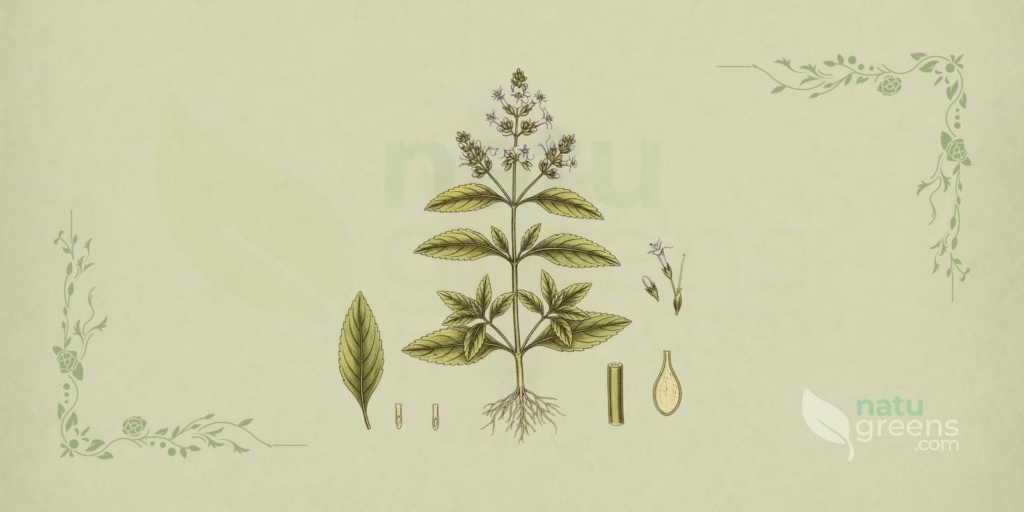
This is a perennial, woody, erect shrub with open branching, usually reaching 2 to 3 metres in cultivation and up to 5 metres in sheltered situations under mild climates. The habit is deciduous wherever winters are cold, with complete leaf fall and vigorous regrowth in spring from buds on mature branches, and tends towards semi-evergreen in warm subtropical regions. Well-managed plants remain productive for one or two decades, which makes lemon verbena a long-cycle perennial crop.
Leaves
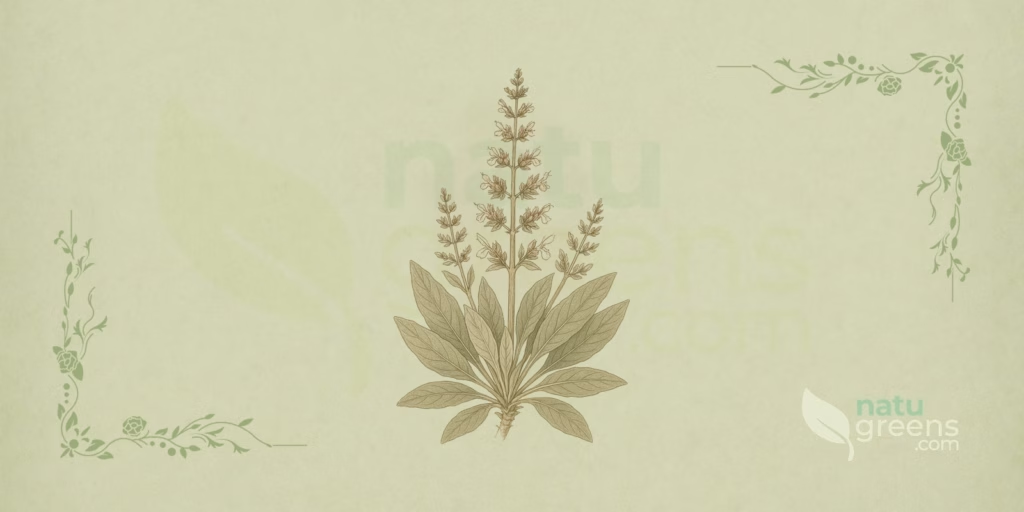
The leaves are the most reliable diagnostic character of the species. They emerge in whorls of three, rarely four, around each node, an arrangement that is uncommon among aromatic garden shrubs. The blade is lanceolate to oblong-lanceolate, 5 to 12 centimetres long by 1 to 2.5 centimetres wide, with an acute apex and an attenuate base. The margin is entire or slightly serrate in the upper half, and the venation is pinnate, with the midrib clearly raised on the lower surface. The texture is firm, almost leathery, and the surface feels noticeably rough because of the density of trichomes. The petiole measures only 3 to 5 millimetres, so the leaves look almost sessile. The intense citrus odour, released at the merest rub, comes from glandular trichomes distributed mainly on the abaxial surface.
Flowers
The inflorescence is an elongated terminal panicle, 10 to 25 centimetres long, made up of slender spikes arising from the axils of the upper leaves. The individual flowers are tiny, 3 to 5 millimetres, with a slightly zygomorphic tubular corolla ranging from white to very pale lilac, sometimes with a pinkish cast. Each flower carries four didynamous stamens inserted in the corolla tube and a superior bicarpellate ovary. Flowering runs from summer into early autumn, which corresponds to December through March in the southern hemisphere and June through September in the northern hemisphere.
Fruits and Seeds
The fruit is a dry schizocarp that breaks at maturity into two one-seeded mericarps, each about 2 to 3 millimetres long and dark brown when ripe. The calyx persists around the pair and falls with the mericarps. Fruiting is irregular and often sparse in commercial plantings, a situation made worse by the fact that most fields consist of genetically identical clones, which limits cross-pollination.
Root and Stem
Young branches are quadrangular in cross section, pale green and sometimes washed with purple, and they gradually lose their edges until they turn cylindrical and woody with age. The trunk of mature plants has greyish bark with longitudinal fissures. The root system is taproot-based in the first years and turns into an abundant lateral system in mature plants, with most of the fine roots concentrated in the top 60 to 100 centimetres of soil, which gives good resistance to dry spells once the plant is established.
Distribution and Habitat
The native range recognised by Plants of the World Online is far more restricted than popular literature tends to suggest: it runs from southern Bolivia, in the departments of Chuquisaca and Tarija, into north-western Argentina, in the provinces of Jujuy, Salta and Tucumán. The frequent mentions of Chile, Peru and Uruguay as territory of origin reflect very old cultivation and local naturalisation, not original spontaneous distribution. The error is repeated so often that it is worth correcting explicitly in any reference material.
Within its native territory the species occupies sub-Andean slopes and valleys with a subtropical climate and a marked dry season, at altitudes ranging from a few hundred metres up to around 2,000 metres. It prefers medium to light textured soils, well drained and neutral to slightly alkaline, with a pH between 6.5 and 7.5, and it tolerates stony ground that would be unsuitable for more demanding crops. Rainfall in these areas typically falls between 600 and 1,200 millimetres a year, with dry periods of several months that the plant rides out by reducing its leaf area.
Outside the native range, Plants of the World Online records introduced or cultivated occurrence in Albania, Argentina, Bolivia, Brazil (the South and Southeast regions), central Chile, Cuba, France, Mexico, Paraguay, Peru, Puerto Rico, Sardinia, Spain, Uruguay and Venezuela. In Brazil lemon verbena is a plant of backyards and smallholdings, found mainly in the southern and southeastern states, where it escapes cultivation here and there without forming aggressive populations. The species does not appear on official lists of invasive plants of national importance, and its behaviour outside cultivation is considered discreet, most likely because of irregular fruiting and difficult germination.
Lemon Verbena Cultivation
Vegetative propagation is the standard route. Semi-hardwood cuttings 10 to 15 centimetres long, with three or four nodes, taken at the end of summer and kept in a moist, sheltered substrate, root in about 30 to 60 days, and treating the base with a synthetic auxin speeds up the process and makes it more uniform. Layering, which involves bending a low branch and burying part of it until it puts out roots, is the traditional method of family gardens and needs no structure at all. Direct sowing is little used because germination is slow and uneven, and because many ornamental cultivars fruit poorly.
As for requirements, full sun is practically mandatory: shade drastically reduces essential oil production and leaves the plant drawn and leggy. The soil must be well drained, since waterlogging is the commonest cause of losing mature plants. The comfortable thermal range runs from 15 to 28 degrees Celsius, and the species withstands light frosts by shedding its leaves, but it succumbs to harsh, prolonged winters. Organic fertiliser at planting gives good results, while excess nitrogen as a top dressing encourages vegetative mass at the expense of oil concentration. In commercial cultivation, usual spacing is 1.0 to 1.5 metres within the row by 1.5 to 2.0 metres between rows.
Among the commonest pests are the two-spotted spider mite (Tetranychus urticae), which builds up in heat and drought and causes chlorotic mottling, scale insects on woody branches, aphids (Aphis spp.) on spring shoots and thrips in dry environments. Among diseases, the notable ones are leaf spots caused by Cercospora during long humid spells, powdery mildew caused by Erysiphe spp. and root rot caused by Phytophthora in poorly drained soils. In general terms, lemon verbena is regarded as a rustic crop with low phytosanitary demands.
Harvesting is done by hand, cutting the branches 30 to 50 centimetres above the ground so as to preserve the regrowth structure, and the ideal moment coincides with full development of the young leaves before the flowers open, when essential oil content reaches its peak. In favourable climates two to four harvests a year are possible. The cut material goes on to dry in the shade in a well-ventilated place, because direct sun exposure degrades the volatile components quickly. Formative pruning at the end of winter removes old branches and organises the canopy for the following season.
Phenology
The annual cycle of lemon verbena tracks temperature closely. In regions with cold winters the plant goes dormant and loses all its foliage, resuming growth once minimum temperatures settle above ten degrees. Spring flushing is rapid and produces the branches that will carry the summer flowering. The panicles open gradually over several weeks, so a single plant displays buds, open flowers and developing fruits at the same time.
Pollination is entomophilous and bees are the dominant visitors, drawn by the nectar that accumulates at the bottom of the corolla tube. The English name lemon beebrush records precisely that association, and flowering stands often work as a forage source during lean periods. Butterflies and small flies complete the cast of floral visitors.
Dispersal is passive. The mericarps, wrapped in the dry calyx, fall by gravity close to the mother plant and may be moved a few metres by wind or runoff. There are no long-distance dispersal structures, which helps explain the restricted native range and the poorly invasive behaviour of the species beyond it.
Related Species and Confusions
The genus Aloysia is exclusively American and gathers a few dozen species of aromatic shrubs, most of them concentrated in subtropical South America and in the arid north of Mexico. Among the closest relatives that turn up in cultivation or in the field are the following:
- Aloysia chamaedryfolia Cham.: a low shrub of southern Brazil and Argentina, with much smaller, crenate leaves.
- Aloysia gratissima (Gillies & Hook.) Tronc.: the whitebrush of the southern grasslands, with intensely fragrant white flowers and considerable value as a honey plant, bearing opposite rather than whorled leaves.
- Aloysia polystachya (Griseb.) Moldenke: known as burrito in the River Plate region, with leaves of similar scent but sharper and more camphoraceous.
- Aloysia virgata (Ruiz & Pav.) Pers.: grown as an ornamental for its long fragrant white spikes, with far larger and rougher leaves.
- Aloysia wrightii (A. Heller ex Abrams) A. Heller: a species of the south-western United States and northern Mexico, adapted to desert environments.
Outside the genus, the commonest confusions involve other plants with a citrus scent. Lemongrass (Cymbopogon citratus) is a tufted grass with no woody stem and with linear leaves that reach a metre in length, so the distinction is immediate. Bushy lippia (Lippia alba), from the same family, has opposite, small, oval leaves as well as a lower and untidier habit. Lemon balm (Melissa officinalis) belongs to the Lamiaceae, is herbaceous and has opposite, ovate-cordate leaves on a stem that stays distinctly square to the tip. Oregano-scented lippia (Lippia origanoides) likewise bears opposite leaves and an aroma that leans towards oregano.
One confusion deserves redoubled attention in gardens: Lantana camara, also in the Verbenaceae, grows as a shrub of similar size, has rough aromatic leaves and often occurs in the same beds. Lantana bears opposite leaves, inflorescences in dense heads of yellow, orange or red flowers, and dark fleshy fruits. Those fruits are toxic, and the foliage contains triterpenes that cause liver poisoning in cattle and sheep. The practical rule for telling them apart is simple and safe: lemon verbena has leaves in groups of three per node and tiny white flowers in elongated spikes, whereas lantana has leaves in pairs and colourful flowers in flat-topped clusters.
Phytochemistry
The dominant chemical feature of the species is the accumulation of essential oil in glandular leaf trichomes, with yields ranging from 0.3 to 0.8 percent of fresh leaf weight depending on provenance, cutting date and distillation method. The major component is citral, a mixture of the isomers geranial and neral, which accounts for a broad fraction of the oil and varies considerably between provenances, from about thirty to more than fifty percent in many analysed samples. Alongside citral come limonene, geraniol, linalool, 1,8-cineole, alpha-pinene and a sesquiterpene fraction in which beta-caryophyllene and spathulenol stand out.
That composition is not fixed. The literature on essential oils of Aloysia citrodora describes distinct chemotypes according to the geographical origin of the material, with European, South American and North African samples showing appreciably different proportions of citral, limonene and sesquiterpenes. Within a single plant, young leaves in full development concentrate more oil than old leaves, and the content drops once the flowers open.
In the non-volatile fraction of the leaves, the most characteristic compounds are glycosylated phenylpropanoids, with verbascoside in a prominent position, and rosmarinic acid, both frequent in the Verbenaceae. To these are added flavones such as apigenin, luteolin-7-O-glucoside and salvigenin, bitter-tasting iridoids, tannins at low to moderate levels and mucilages. The distribution of these compounds is heavily concentrated in the leaves; woody stems and roots show far lower levels.
There is one animal safety fact that goes with this chemical profile. The ASPCA classifies the species, listed in its databases under the synonym Aloysia triphylla, as toxic to dogs, cats and horses, attributing the effect to the essential oil. Ingestion of the foliage by these animals causes gastrointestinal discomfort and colic. The risk is tied to animals gnawing on the living plant, not to incidental contact.
History and Ethnobotany
Before the Europeans arrived, Andean populations of the valleys where the plant is native already knew the shrub and kept it close to their dwellings. Ethnographic records for that period are indirect and scarce, but the presence of the plant in domestic settings of north-western Argentina and southern Bolivia is old and well documented through place names and local vocabulary, in which cedrón became the current designation.
The European trajectory of the species begins between the 1760s and the 1780s, when Spanish expeditions sent live material and seeds from the New World to the botanical gardens of the peninsula. In 1784 Antonio Palau y Verdera published the formal description in the Parte Práctica de Botánica and named the genus in honour of Princess Maria Luisa of Parma. The plant became fashionable in royal gardens and, over the course of the nineteenth century, moved down from aristocratic borders into the urban kitchen gardens of the whole Mediterranean Europe.
It was also in the nineteenth century that the shrub took on an industrial dimension. Growers in Provence began cultivating it at scale for distillation, and verveine established itself as a raw material of French perfumery and as a flavouring for regional liqueurs, the best known of which is Verveine du Velay, produced in the Massif Central since the middle of that century. In Spain, plantings in Murcia, Valencia and Andalusia served the same market, and in Morocco the crop consolidated itself as a supplier to the fragrance industry.
Ethnobotanical records from the nineteenth and early twentieth centuries document that rural families in the Southern Cone and in Mediterranean Europe kept the shrub in the yard and used its dried leaves to scent hot drinks served at the end of the day, a habit that settlers and immigrants carried with them to southern Brazil. In Brazil the species arrived by that same domestic route and never came to support a significant productive sector, so that the aromatic derivatives consumed in the country come largely from France, Morocco and Spain.
Conservation
Aloysia citrodora has no published assessment on the IUCN Red List, a situation recorded as Not Evaluated (NE). The absence of an assessment is common in widely cultivated species, whose survival as a taxon does not depend on wild populations. The species is likewise absent from the CITES appendices, and its international trade, in dried leaf as much as in essential oil, is not subject to specific restrictions.
That does not mean there is nothing to watch. The spontaneous populations of the sub-Andean valleys of Bolivia and Argentina live alongside habitat fragmentation driven by the expanding agricultural frontier and by grazing, and they have never been the subject of a systematic population survey. Because the native range is naturally small, local losses weigh proportionally more than they would in widely distributed species.
There is also the matter of genetic erosion in cultivation. Propagation by cuttings means that large planted areas are occupied by a handful of clones, a uniformity that leaves the crop fragile in the face of new pests and limits the material available for breeding. Germplasm banks in Argentina and Europe hold accessions from different provenances precisely in order to preserve that variation, and in situ conservation in the areas of origin remains the most complete strategy, even if it is the least structured.
Interesting Facts
- The name of the genus immortalises a queen. Paláu honoured Maria Luisa of Parma while she was still Princess of Asturias, and the choice proved durable: the sovereign fell into historical disgrace, but the botanical genus has crossed two and a half centuries intact.
- The correct spelling is the less used one. Aloysia citrodora is the valid name, and Aloysia citriodora, with the extra i, is an orthographic variant from 1806 that ended up becoming more popular than the original across nearly all the English-language literature.
- The aroma survives drying better than that of almost any other aromatic leaf. Well-dried samples kept away from light and heat hold a perceptible scent for more than a year, something rare among plants rich in volatile monoterpenes.
- Bees named the plant in English. Lemon beebrush, the second vernacular name of the species in English, records how intensely hives visit the flowering panicles.
- A French liqueur has depended on it since 1859. Verveine du Velay, produced in the Puy-en-Velay region, counts the leaf of this shrub among its aromatic components and helped to establish the crop in the Massif Central.
Notice: this content is for informational purposes and does not replace professional medical advice. Consult a physician or herbal practitioner before using medicinal plants, especially during pregnancy, breastfeeding, or alongside medication.
References and Scientific Studies
View All 9 Cited References
Peer-Reviewed Scientific Studies (2)
- DOI2013 Lu-Irving, P.; Olmstead, R. G. Investigating the evolution of Lantaneae (Verbenaceae) using multiple loci. Botanical Journal of the Linnean Society, 171(1), 103-119. 2013. ↗
- DOI2009 Olmstead, R. G. et al. A molecular phylogeny and classification of Verbenaceae. American Journal of Botany, 96(8), 1457-1480. 2009. ↗
Supplementary Readings (7)
- ASPCA. Toxic and Non-Toxic Plants: Lemon Verbena (Aloysia triphylla). American Society for the Prevention of Cruelty to Animals. ↗
- IPNI. Aloysia citrodora Paláu. International Plant Names Index. Royal Botanic Gardens Kew, Harvard University Herbaria and Australian National Botanic Gardens. ↗
- IUCN. The IUCN Red List of Threatened Species. Query for the taxon Aloysia citrodora, with no published assessment. ↗
- 2016 O’Leary, N.; Lu-Irving, P.; Moroni, P.; Siedo, S. J. Taxonomic revision of Aloysia (Verbenaceae) in South America. Annals of the Missouri Botanical Garden. 2016.
- Palau y Verdera, A. Parte Práctica de Botánica del caballero Cárlos Linneo, volume 1, p. 768. Madrid, 1784. ↗
- POWO. Aloysia citrodora Paláu. Plants of the World Online, Royal Botanic Gardens Kew. ↗
- World Flora Online. Aloysia citrodora Paláu. ↗