Coffea arabica L. / Arabica Coffee, popularly known as coffee, is a species of the Rubiaceae family. Native to Ethiopia and Yemen, it is the primary source of coffee beans, accounting for 60% of world production. Its history spans centuries of cultivation, and it is valued for both its economic importance and its medicinal properties.
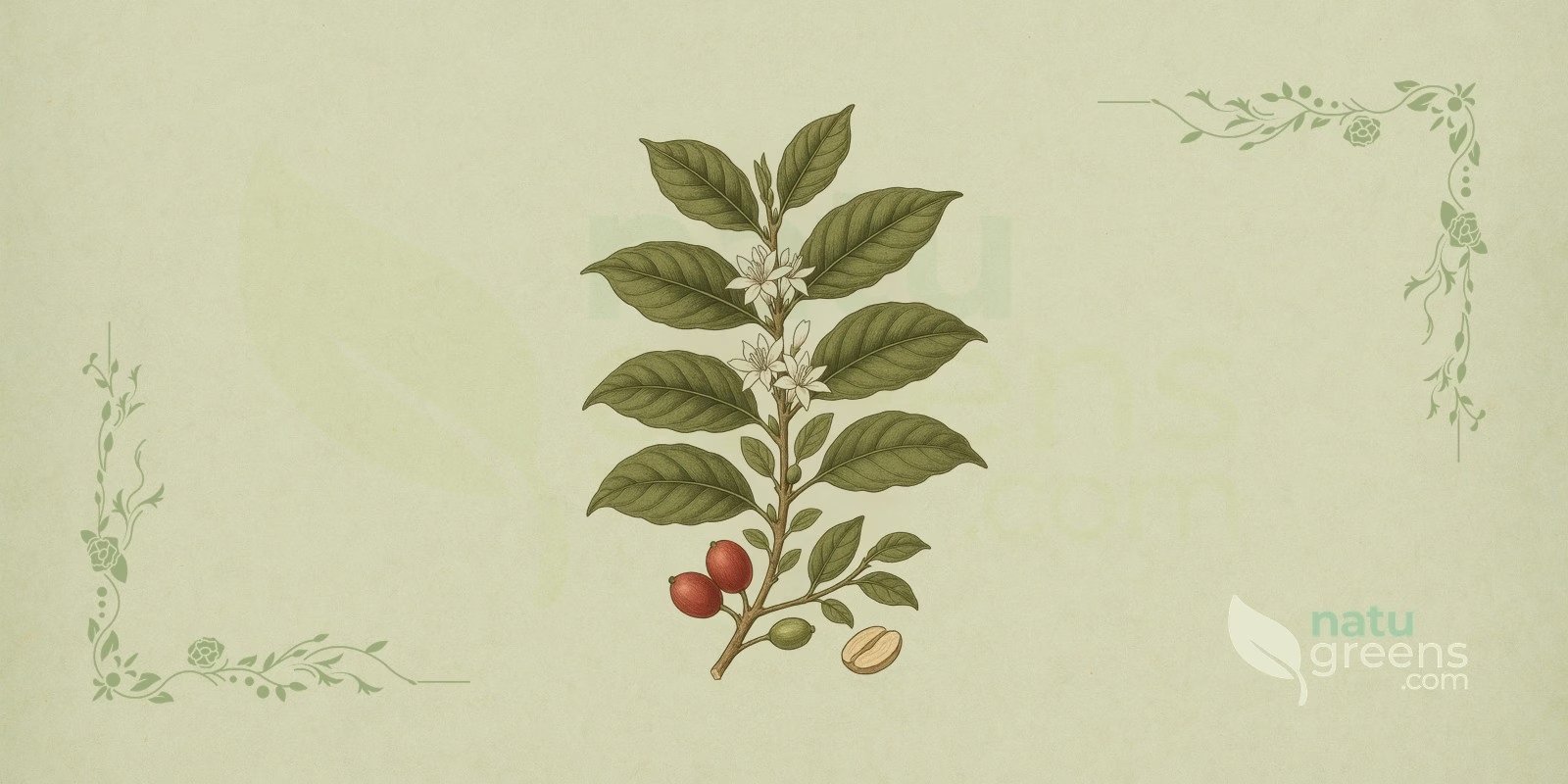
Coffea arabica stands out for its complex flavor and aroma, which make it the preferred choice for specialty coffee production, and it contains bioactive compounds with health benefits explored in both traditional medicine and modern scientific research aimed at investigating these applications.
Popular and International Names of Arabica Coffee
- English: Arabica Coffee, Arabian Coffee, Coffee Plant, Mountain Coffee.
- Spanish: Café, Cafeto, Cafeto Arábigo, Café de Arabia.
- Portuguese: café, café-arábica, cafeeiro-arábica, cafeeiro-comum, cafezeiro.
- French: Caféier, Caféier d’Arabie, Café Arabica.
- Italian: Caffè Arabica, Pianta del Caffè.
- German: Arabica-Kaffee, Kaffeebaum.
Botanical Synonyms of Coffea arabica
The scientific name Coffea arabica L. is widely accepted, although several varieties exist whose sources may refer to specific designations; even so, the species name remains consistently Coffea arabica L.
Botanical Family: Rubiaceae
The Rubiaceae family is one of the largest families of flowering plants, with more than 13,000 species distributed across 600 genera, of cosmopolitan distribution and greatest diversity in the tropics. It is characterized by opposite or whorled leaves, interpetiolar stipules, and tetramerous or pentamerous flowers.
Within Rubiaceae, the genus Coffea holds great economic importance, with Coffea arabica L. being the most widely cultivated species, alongside other ornamental and medicinal plants that also belong to the family. The phytochemical diversity of Rubiaceae, with alkaloids, glycosides, and tannins, contributes to the biological properties observed across its species.
Parts of Arabica Coffee Used
- Leaves
- Seeds (coffee beans)
Ethnobotanical and Traditional Uses
- Central nervous system stimulant, improving concentration and alertness.
- Febrifuge, helping to reduce fever.
- General tonic for body and mind.
- Headache and migraine relief.
- Use as a social and cultural beverage across various civilizations.
Therapeutic Properties of Arabica Coffee
- Analgesic (traditional use for pain relief, such as migraines)
- Anti-inflammatory (effect studied in reducing inflammation, especially in the mouth and pharynx)
- Antioxidant (activity studied against free radicals due to the presence of polyphenols)
- Bronchodilator (helps dilate the bronchi)
- Central Nervous System Stimulant (effect studied on alertness and concentration)
- Depurative (helps eliminate toxins)
- Diuretic (effect studied on fluid elimination)
- Hepatoprotective (protective effect studied on the liver against disease)
- Hypoglycemic (effect studied on blood sugar levels)
- Hypolipidemic (contributes to lowering cholesterol); traditional use, without established clinical efficacy
Detailed Phytochemical Profile of Arabica Coffee
- Caffeine
- Chlorogenic Acid
- Diterpenes
- Phenolic Acids
- Polyphenols
Preparation and Administration Forms of Arabica Coffee
- Beverage (infusion of roasted, ground beans, such as filtered or espresso coffee)
- Infusion (leaf tea)
- Topical Use (in cosmetics)
Synergy with Other Medicinal Plants
Potentiation of Stimulant Effects
Due to its caffeine content, Arabica coffee has synergy with stimulant plants such as guarana (Paullinia cupana) and Camellia sinensis green tea. The combination heightens alertness and concentration, improving mental and physical performance. Caution is needed to avoid excess stimulants, which can cause nervousness and insomnia.
Modulation of Digestive Effects
To modulate coffee’s digestive effects, combining it with chamomile (Matricaria chamomilla) or lemon balm (Melissa officinalis) is beneficial. Their calming and anti-inflammatory properties soothe the gastrointestinal tract, minimizing irritation from coffee’s acidity and promoting comfortable digestion.
Recipes and Usage Protocols of Arabica Coffee
Traditional Stimulant Beverage
For the traditional beverage, use roasted and ground Arabica coffee beans. Add one tablespoon of coffee per 180 ml of hot water (90-96°C). Prepare by infusion using a filter or French press. Consume in moderation, without sugar, to obtain the benefits. The recommended daily caffeine intake for adults is up to 400 mg.
Coffee Leaf Infusion
Coffee plant leaves are also used as an infusion. Place one teaspoon of dried leaves in a cup of boiling water. Let steep for 5-7 minutes, strain, and drink. It is used for medicinal purposes, such as a diuretic or for headaches, and contains less caffeine than coffee.
The preparations above follow traditional records and do not replace professional guidance. Before any internal use, consult the contraindications and interactions described in this article.
The preparations above follow traditional records and do not replace professional guidance. Before any internal use, check the contraindications and interactions described in this article.
Associated Therapies
Herbal Medicine
Coffea arabica is valued in herbal medicine for its stimulant, antioxidant, and hepatoprotective properties, being used in extracts, tinctures, or infusions to combat fatigue, improve cognition, and help prevent metabolic conditions, a subject that ongoing research continues to explore in investigating the potential of its phytochemicals.
Contraindications and Side Effects of Arabica Coffee
Consumption of Coffea arabica carries contraindications related to caffeine, which can cause insomnia, nervousness, anxiety, and palpitations in sensitive individuals. People with gastrointestinal issues should consume it in moderation, since coffee’s acidity can aggravate gastritis, ulcers, or reflux.
Excessive caffeine consumption can lead to dependence, with withdrawal causing headache, fatigue, and irritability. Pregnant and breastfeeding women, children, and people with heart disease, hypertension, or anxiety should consult a doctor before regular consumption, as coffee can also interact with medications and alter their effectiveness.
Historical Notes and Interesting Facts
The Legendary Discovery
The legend of coffee’s discovery dates back to Kaldi, an Ethiopian goat herder who noticed his goats becoming more energetic after eating the fruit of an unfamiliar plant; intrigued, he tried them himself and felt invigorated, sharing the discovery with local monks, who began using it to stay awake during prayers. This story, though legendary, highlights coffee’s ancient origin in Ethiopia.
Coffee and the Islamic World
Coffee gained popularity in the Islamic world, particularly in Yemen, where it was cultivated on a large scale, its use documented by Arab scholars who relied on it to extend their studies. Coffeehouses, or qahveh khaneh, became social and intellectual centers, crucial to spreading coffee culture around the world.
Varieties and Quality
Coffea arabica has many varieties, such as Typica, Bourbon, and Catuaí, each with unique sensory characteristics. The superior quality of its beans, with complex aromas and balanced acidity, makes it ideal for specialty coffee, and Arabica has 50% less caffeine than Robusta, resulting in a smoother flavor.
Frequently Asked Questions about Arabica Coffee
What Is the Difference between Arabica and Robusta Coffee?
The difference lies in flavor, caffeine content, and growing conditions: Arabica has a smooth, aromatic, and complex flavor, with more acidity and less caffeine (1.5%), and is grown at high altitudes, while Robusta has a strong, bitter, and full-bodied flavor, with twice the caffeine (2.5%+), proves more resistant, and is grown at lower altitudes.
Can Arabica Coffee Help with Weight Loss?
Arabica coffee may contribute to weight loss thanks to caffeine, which boosts metabolism and fat burning, and to chlorogenic acids, which help regulate glucose; even so, this effect is only meaningful when coffee is part of a balanced diet and an active lifestyle.
Is It Safe to Drink Arabica Coffee during Pregnancy?
Caffeine consumption during pregnancy requires moderation, and studies suggest that up to 200 mg per day (1 to 2 cups of coffee) may be safe, although pregnant women should always consult a doctor, since excess intake may be associated with risks such as low birth weight or preterm birth.
What Are the Main Benefits of Arabica Coffee?
Among the main benefits traditionally attributed to Arabica coffee are its stimulant effect on the central nervous system, which improves alertness and concentration, along with antioxidant properties linked to its polyphenol content. The bean is also associated, in preliminary studies, with anti-inflammatory, hepatoprotective, and hypoglycemic effects, always understood as a traditional use or laboratory finding, never replacing medical follow-up.
Can Coffee Leaves Be Used to Make Tea?
Yes, coffee plant leaves can be used as an infusion, prepared with one teaspoon of dried leaves per cup of boiling water, left to steep for 5 to 7 minutes before straining. This infusion contains less caffeine than the traditional beverage and is used traditionally as a diuretic or to relieve headaches.
What Are the Contraindications for Drinking Arabica Coffee?
Drinking Arabica coffee is contraindicated, or should be strictly moderated, for people sensitive to caffeine, who may experience insomnia, nervousness, anxiety, and palpitations, as well as for those with gastrointestinal issues, since coffee’s acidity can aggravate gastritis, ulcers, or reflux. Pregnant and breastfeeding women, children, and people with heart disease, hypertension, or anxiety should consult a doctor before drinking coffee regularly.
Notice: this content is for informational purposes and does not replace professional medical advice. Consult a physician or herbal practitioner before using medicinal plants, especially during pregnancy, breastfeeding, or alongside medication.
References and Scientific Studies
Peer-Reviewed Scientific Studies (1)
- DOI1985 Charrier A, Berthaud J (1985). “Botanical Classification of Coffee”. In Clifford MH, Wilson KC (eds.). Coffee: Botany, Biochemistry and Production of Beans and Beverage. Westport, Connecticut: AVI Publishing. p. 14. ISBN 978-0-7099-0787-9. ↗
Supplementary Readings (4)
- 2020 Moat, J., O’Sullivan, R.J., Gole, T.W., et al. (2020). “Coffea arabica”. IUCN Red List of Threatened Species. 2020 e.T18289789A174149937. doi:10.2305/IUCN.UK.2020-2.RLTS.T18289789A174149937.en. Retrieved 19 November 2021.
- 1999 Lashermes P, Combes MC, Robert J, et al. (1 March 1999). “Molecular characterisation and origin of the Coffea arabica L. genome”. Molecular and General Genetics. 261 (2): 259-266. doi:10.1007/s004380050965. ISSN 0026-8925. PMID 10102360. S2CID 7978085.
- 2020 Bawin Y, Ruttink T, Staelens A, et al. (2020). “Phylogenomic analysis clarifies the evolutionary origin of Coffea arabica”. Journal of Systematics and Evolution. 59 (5): 953-963. doi:10.1111/jse.12694. S2CID 234481707.
- 2024 Salojärvi J, Rambani A, Yu Z, et al. (2024). “The genome and population genomics of allopolyploid Coffea arabica reveal the diversification history of modern coffee cultivars”. Nature Genetics. 56 (4): 721-731. doi:10.1038/s41588-024-01695-w. PMC 11018527. PMID 38622339.