



Quick summary
Quassia amara L., commonly known as quassia, bitter-ash, or bitterwood, is a perennial shrub or small tree in the Simaroubaceae family. The species is native to the tropical regions of South America and Central America, where it grows in the understory of humid forests, and it is now cultivated in many parts of the…
Main caution: Quassia is a plant with a potent bitterness, and high doses can cause gastric irritation and vomiting; this limit of tolerance is, in fact, one of the reasons traditional use has always recommended small doses. Use is…
Quassia amara L., commonly known as quassia, bitter-ash, or bitterwood, is a perennial shrub or small tree in the Simaroubaceae family. The species is native to the tropical regions of South America and Central America, where it grows in the understory of humid forests, and it is now cultivated in many parts of the world because of its traditional use and the presence of extremely bitter compounds in its wood and bark. Much of what is known about the plant comes from popular observation and preclinical studies, so the effects described here should be understood as traditional use or experimental findings, not as a treatment validated in humans.
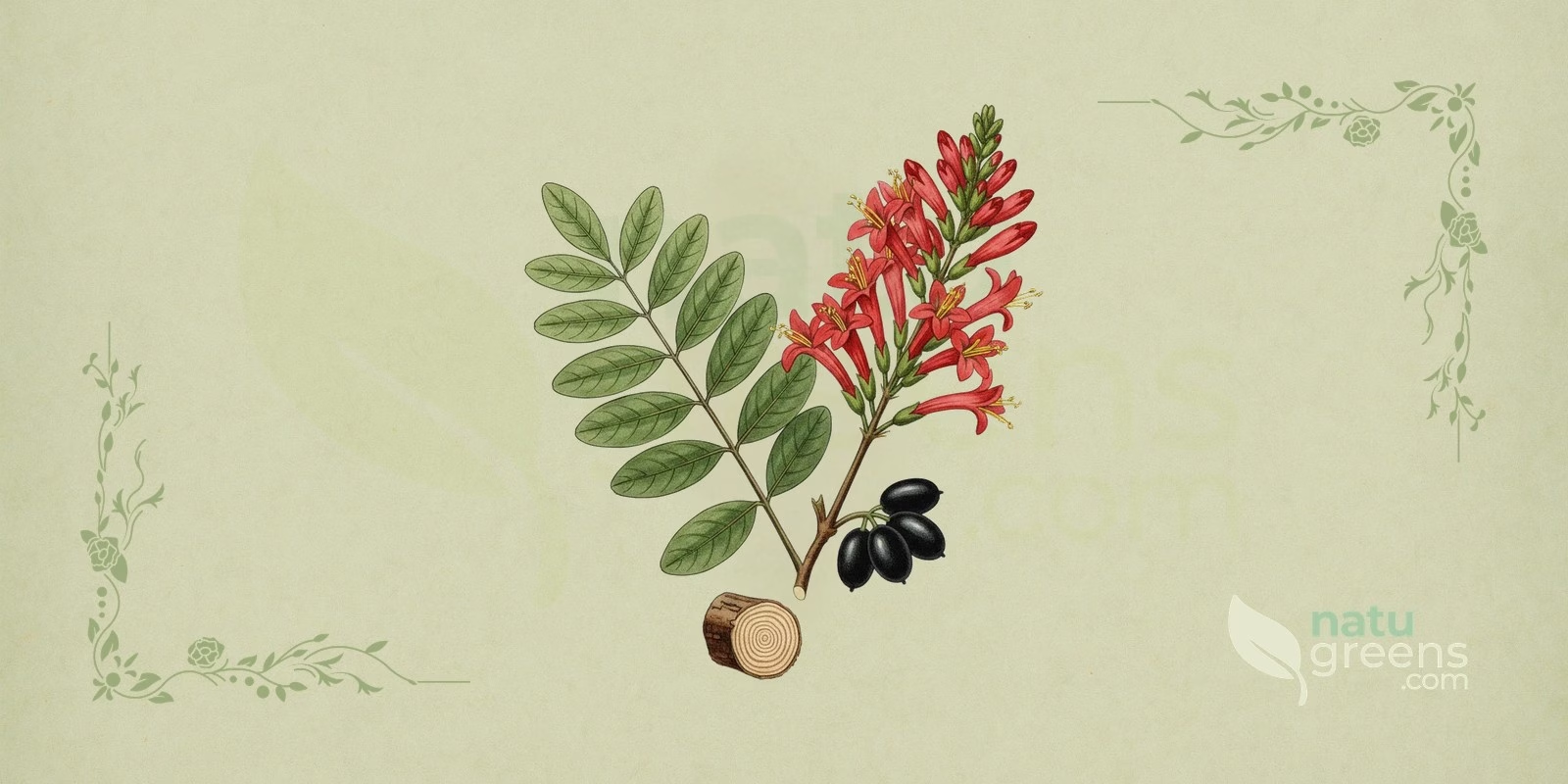
The genus name was given by the botanist Carl Linnaeus in honor of Graman Quassi, a Surinamese healer who, in the eighteenth century, taught Europeans how to use the plant against fevers. This historical origin helps explain why quassia appears in so many old records of folk medicine from tropical America, Africa, and Asia, regions where it came to be cultivated after being introduced. The phytochemical composition of the species is dominated by quassinoids, substances responsible for the extreme bitterness of the wood and associated, in preclinical research, with digestive, antiparasitic, and insecticidal actions.
Popular and International Names of Quassia
- English: quassia, bitter-ash, bitterwood, Surinam quassia.
- French: quassia, bois amer, bois de quassia, quassier.
- German: Quassiaholz, Bitterholz, Fliegenholz, Quassie.
- Italian: quassia, legno amaro, quassio.
- Portuguese (Brazil): quássia, amargo, pau-amargo, quássia-de-caiena.
- Spanish: cuasia, amargo, hombre grande, crucete.
Not to Be Confused with Picrasma and Simarouba amara
Quassia is often confused with other plants that carry a similar name, so it is worth carefully telling each one apart. Picrasma quassioides and Picrasma excelsa, the latter known as Jamaica quassia, belong to a different taxonomic genus within the same family, even though they are also bitter and used in a similar way in old pharmacopeia records; data from studies on these species should not be transferred to Quassia amara. Simarouba amara, in turn, is a separate genus within the Simaroubaceae family, with its own properties, and should not be treated as the same plant.
Botanical Synonyms of Quassia
The botanically accepted name is Quassia amara L., though older literature also records the synonyms Quassia alatifolia Stokes and Quassia officinalis Rich. Because of the shared common name "quassia," the species is often confused in older texts with the so-called Jamaica quassia, now classified under the genus Picrasma, which is taxonomically distinct within the same family.
Botanical Family: Simaroubaceae
Quassia amara belongs to the Simaroubaceae family, a group of tropical trees and shrubs known for the consistent presence of bitter compounds, especially quassinoids. Most species in this family occur in tropical and subtropical regions of the Americas, Africa, and Asia, and many of them carry some tradition of medicinal or insecticidal use tied precisely to this pronounced bitterness. Because it brings together secondary metabolites of varied chemical structure, Simaroubaceae is frequently studied in plant phytochemistry and pharmacology.
Parts of Quassia Used
Practically the whole plant can be used, depending on the purpose of the preparation:
- Bark
- Flowers
- Leaves
- Roots
- Seeds
- Stems
- Trunk wood
Ethnobotanical and Traditional Uses of Quassia
In folk medicine across different tropical regions, the wood and bark of quassia are associated, by tradition and without confirmation in human clinical studies, with a fairly wide range of uses:
- Appetite stimulation
- Control of lice, fleas, mosquito larvae, and intestinal worms
- Dandruff
- Digestive support
- Diuretic effect
- Fever, as a febrifuge
- Fevers associated with malaria
- Liver congestion
- Liver problems
- Relief of back spasms
- Rheumatism
- Rosacea
- Snake bite, in old popular records
- States of general weakness, used as a tonic
- Stomach and intestinal discomfort
Medicinal Properties of Quassia
The properties listed below come from preclinical studies, generally laboratory or animal research, and from the plant's traditional use; none of them has been confirmed in a robust clinical trial in humans, and the list should not be read as a treatment indication.
- Anthelmintic (traditional and preclinical action against intestinal worms)
- Anti-amoebic (action observed against amoebas in laboratory studies)
- Anti-anemic (associated, in preclinical studies, with an increase in red blood cells and hemoglobin)
- Antibacterial (action observed against certain bacteria in laboratory studies)
- Antidiabetic (associated, in preclinical studies, with reduced glucose levels and greater glucose tolerance)
- Antifungal (action observed against fungi in laboratory studies)
- Anti-inflammatory (reduction of inflammatory markers observed in preclinical studies)
- Antimalarial (quassinoids with activity described against the Plasmodium parasite in preclinical studies)
- Antiparasitic (traditional and preclinical action against different parasites)
- Antiulcerogenic (protection of the gastric mucosa observed in preclinical studies)
- Digestive (traditional stimulation of gastric acid and bile secretion)
- Diuretic (traditional increase in urine output)
- Febrifuge (traditional use for lowering fever)
- Sedative and muscle relaxant (calming effect reported in traditional use)
- Tonic (traditional use as a general invigorator)
Detailed Phytochemical Profile of Quassia
The chemical composition of quassia brings together more than thirty identified substances, with quassinoids accounting for the extreme bitterness and for much of the biological activity studied in the laboratory. Among the compounds described in the literature, the following stand out:
- Beta-carbolines
- Beta-sitostenone
- Beta-sitosterol
- Dehydroquassins
- Gallic acid
- Gentisic acid
- Hydroxyquassins
- Isoparaine and isoparaines
- Isoquassins
- Malic acid
- Methoxycanthins
- Methylcanthins
- Nigakilactone A
- Nor-neoquassin
- Paraine and paraines
- Quassialactol
- Quassimarin
- Quassin
- Quassinol
- Quassol
- Simalikalactone D
- Simalikalactone E
Preparation and Administration Forms of Quassia
Depending on the intended traditional use, quassia is usually prepared in different ways:
- Aqueous or alcoholic extract, used in a more concentrated preparation
- Infusion made with young leaves, with scraped wood macerated in cold water, or with wood powder in boiling water
- Spray based on wood extract, for agricultural and insecticidal use
- Tincture
- Topical gel
Synergy with Other Medicinal Plants
Specific research on combining quassia with other plants is still scarce, but the species' bitter, digestive profile tends to guide a few combinations in popular tradition.
Combination for Digestive Support
Bitter, aromatic plants such as gentian, wormwood, and boldo are traditionally combined with quassia in digestive formulas, in the popular expectation of boosting appetite and gastric juice secretion. This combination follows only popular custom, with no clinical study confirming any advantage over using each plant on its own.
Combination for External and Insecticidal Use
In natural pest control, quassia extract is sometimes combined with another plant-based repellent, such as neem or pepper extract, in a popular attempt to broaden the range of action against insects. As with any homemade mixture, the final dilution and concentration should be tested on a small scale before use across an entire planting.
Recipes and Usage Protocols for Quassia
Traditional Bitter Digestive Tonic
Ingredients: half a teaspoon of quassia wood powder; one cup of boiling water.
Add the wood powder to the boiling water and let it steep for 10 to 15 minutes. Strain and drink a small amount before meals, following the popular custom of using the bitter drink to stimulate appetite and digestion. The taste is intensely bitter, even in a small amount.
Natural Insecticidal Spray Based on Quassia
Ingredients: 200 grams of quassia wood chips; two liters of water for maceration; 10 to 20 liters of water for diluting afterward.
Soak the wood chips in the two liters of water for 24 hours, then simmer the mixture for 30 minutes, strain the liquid, and dilute it with the indicated amount of water. The resulting spray is traditionally used against aphids and caterpillars in vegetable gardens and orchards, always starting with a small test area before applying it across the whole planting. These uses follow traditional records and do not replace professional guidance.
The preparations above follow traditional records and do not replace professional guidance. Before any internal use, check the contraindications and interactions described in this article.
Therapies Associated with Quassia
Clinical Herbal Medicine
In folk herbal medicine, quassia holds the place of a bitter plant recommended, by custom, for digestive, antiparasitic, and insecticidal use, always depending on dose and preparation; practitioners tend to reserve it for adults, avoiding high doses because of the risk of stomach irritation and vomiting that the intense bitterness can cause.
Homeopathy
Quassia is also used in homeopathy, in the dilutions and potentizations proper to that system, aimed mainly at digestive complaints and loss of appetite; as with all homeopathy, this is its own therapeutic system, distinct from conventional herbal medicine and without the type of clinical evidence required for a registered medicine.
Contraindications and Side Effects of Quassia
Quassia is a plant with a potent bitterness, and high doses can cause gastric irritation and vomiting; this limit of tolerance is, in fact, one of the reasons traditional use has always recommended small doses. Use is contraindicated during pregnancy, lactation, and in people with ulcers, situations in which irritation of the digestive mucosa and a possible effect on uterine muscle represent additional risk. Anyone with a known allergy to a plant in the Simaroubaceae family should also avoid using it, as should anyone with a bleeding disorder, because of the possible potentiation of anticoagulant effects. Children and infants should not receive quassia without medical supervision. In a study with rodents, the plant's quassinoids reduced male fertility; this is a finding observed in animals, which should not be extrapolated directly to humans, but it reinforces the need for caution in anyone planning to become pregnant or undergoing fertility treatment. Topical use of quassia against lice appears in some reports, but this indication relies on small trials, which considerably limits the confidence that can be placed in that result.
Drug Interactions
Quassia can interact with anticoagulants, such as warfarin, increasing the risk of bleeding, so anyone already using this type of medication should take extra caution. There are also reports of potentiation of sedative effects and of medication used to lower glucose, which calls for redoubled attention in diabetic patients. Before combining quassia with any ongoing medication, it is best to consult a healthcare professional.
Curiosities and Historical Facts
The Unmatched Bitterness
The epithet amara, from the Latin for "bitter," sums up the plant's most striking feature well: its intensely bitter taste, attributed to quassinoids, considered among the most bitter compounds ever identified in nature. This intensity is exploited both in folk medicine and in the beverage industry, where a small amount of quassia is enough to lend a bitter touch to certain products.
A Natural Insecticide
Extracts of quassia wood and bark have well-documented insecticidal properties in agronomic studies, which makes the plant an interesting alternative for pest control in organic farming. Quassin and neoquassin act by contact and tend to be effective against aphids, beetles, and caterpillars, with impact on beneficial insects reported as low.
A Substitute for Hops
In the nineteenth century, quassia was used in some regions as a hop substitute to give beer its bitterness, although records from that period did not always distinguish it from Jamaica quassia. Hops remained the industry standard, but the historical record of this use survives as a curiosity about the plant's versatility.
Frequently Asked Questions about Quassia
What Is Quassia Traditionally Used For?
By tradition, quassia is used as a digestive, antiparasitic, febrifuge, and tonic, besides appearing in insecticidal preparations; any more specific therapeutic use should be evaluated by a healthcare professional, since most of these indications come from popular practice and preclinical study, not from human clinical trials.
Is Quassia Safe to Consume?
In a small dose and under guidance, quassia tends to be well tolerated, but excessive or prolonged use is not advised because of the risk of vomiting and, according to some reports, visual disturbance in rare cases. Pregnant women, breastfeeding women, and people with ulcers should avoid use.
What Side Effects Can Quassia Cause?
The most common effects are nausea and vomiting, especially at high doses, due to the intense bitterness and irritation of the digestive mucosa. In rare cases, skin irritation after topical use has been reported, and prolonged use at a high dose has been associated, in an isolated report, with altered vision.
How Does Quassia Act against Malaria, According to Studies?
In preclinical studies, quassinoids such as simalikalactone D and E, quassin, and neoquassin have shown activity against Plasmodium falciparum, the parasite responsible for malaria, also interfering with a form of the parasite linked to disease transmission. These results come from laboratory and animal models, and do not yet amount to a validated treatment for humans.
Can Quassia Be Used as a Natural Insecticide?
Yes, this is one of the best-documented traditional uses: an extract of the wood and bark, applied as a spray, acts by contact against aphids, beetles, and caterpillars, making it an option considered in organic farming.
Does Quassia Interact with Other Medications?
Yes, it can interact. There are reports of potentiation of anticoagulant effects, such as with warfarin, as well as possible interaction with sedatives and diabetes medication. Because of this, anyone using any of these medications should talk to a healthcare professional before trying quassia.
Notice: this content is for informational purposes and does not replace professional medical advice. Consult a physician or herbal practitioner before using medicinal plants, especially during pregnancy, breastfeeding, or alongside medication.
How to cite this article
NATUGREENS. Quassia (Quassia amara): Uses, Properties, and Risks. Natugreens, 21 Nov. 2026. Disponível em: https://natugreens.com/quassia-quassia-amara/. Accessed: Nov. 21, 2026.
Natugreens. (2026). Quassia (Quassia amara): Uses, Properties, and Risks. Natugreens. https://natugreens.com/quassia-quassia-amara/
References and Scientific Studies
View All 15 Cited References
Peer-Reviewed Scientific Studies (1)
- PEER ScienceDirect. (n.d.). Quassia amara, an overview. Retrieved from ScienceDirect
Supplementary Readings (14)
- Wikipedia. (n.d.). Quassia amara. Retrieved from Wikipedia
- WebMD. (n.d.). Quassia: Overview, Uses, Side Effects, Precautions, Interactions, Dosing and Reviews. Retrieved from WebMD
- 2024 Drugs.com. (2024). Quassia Uses, Benefits & Dosage. Retrieved from Drugs.com
- 2022 Acharya Balkrishna, S. S. (2022). Quassia amara L. Phytopharma Journal, 11(3), 10.
- 2011 Raji, Y. (2011). Antiulcerogenic Effects and Possible Mechanism of Action. PMC, 3746530.
- 2025 Mostafa, M. E. (2025). Quassia amara Linn. (Simaroubaceae): phytochemical. Springer.
- 2019 Planet Ayurveda. (2019). What are the Uses and Benefits of Quassia Amara, Herb? Retrieved from Planet Ayurveda
- PFAF Plant Database. (n.d.). Quassia amara Bitterwood, Amargo Bark. Retrieved from PFAF Plant Database
- 2025 ResearchGate. (2025). Novel Antibacterial, Antifungal and Antiparasitic Activities of Quassia amara Wood Extract.
- 2022 SpringerOpen. (2022). Quassia amara bioactive compounds as a Novel DPP-IV.
- Rain-Tree. (n.d.). Amargo, Quassia Bark database file in the Tropical Plant. Retrieved from Rain-Tree
- OISAT. (n.d.). Quassia. Retrieved from OISAT
- UnionBio. (n.d.). Natural pesticide: the bitter Quassia wood. Retrieved from UnionBio
- Biostratege. (n.d.). The Couachi, Quassia amara. Retrieved from Biostratege
You May Also Like
 Simarouba amara: Properties, Benefits and UsesSimarouba amara
- Desmodium (Desmodium adscendens): Uses, Risks and ChemistryDesmodium adscendens
- Anemarrhena (Zhi Mu): Uses, Properties and SafetyAnemarrhena asphodeloides
- Sambong (Blumea balsamifera): Uses and PrecautionsBlumea balsamifera
- Vasaka (Justicia adhatoda): Traditional Uses and SafetyJusticia adhatoda
Take your time and tell us everything you think, details included. Every response is read by someone on our editorial team and goes into the article's revision. An honest critique helps us more than a polite compliment.
Take your time and tell us everything you think, details included. Every response is read by someone on our editorial team and goes into the article's revision. An honest critique helps us more than a polite compliment.