Krameria lappacea (Dombey) Burdet & B.B.Simpson / Rhatany, popularly known as Peruvian rhatany, is a small shrub belonging to the Krameriaceae family. Native to the Andes, especially Peru, Bolivia, Ecuador, northern Chile, and northwestern Argentina, this plant has been valued for its remarkable medicinal properties since time immemorial. Rhatany is recognized for its root, the only part of the plant with significant therapeutic properties, which has traditionally been used by indigenous peoples for various healing purposes.
The history of rhatany in traditional medicine goes back centuries, with records of its use by Andean communities to treat a variety of ailments. Its introduction to Europe in the 18th century by Hipólito Ruiz consolidated its place in the Western pharmacopoeia. The plant is particularly celebrated for its astringent, antiseptic, and antidiarrheal qualities, attributed to the high concentration of tannins in its root. Modern scientific research has corroborated many of these ancestral uses, highlighting the potential of Krameria lappacea as a valuable phytotherapeutic resource.
Popular and International Names of Rhatany
- English: para rhatany, Peruvian rhatany, rhatany root, rhatany, payta.
- Spanish: mapato, ratania.
- Portuguese: ratânia, ratânia-do-peru, ratânia-da-terra (BR).
- French: ratania.
- Italian: ratania.
- German: Ratanhia.
Botanical Synonyms of Rhatany
Krameria triandra Ruiz & Pav. is a botanical synonym frequently associated with Krameria lappacea, although there are taxonomic distinctions. Other synonyms include Krameria canescens Willd. ex Schult., Krameria linearis Poir., Krameria pentapetala Ruiz & Pav., Krameria triandra var. humboldtiana Chodat, and Landia lappacea Dombey ex Vitman. The complexity of Krameria taxonomy reflects the morphological diversity and geographical distribution of the species, which at times overlap in characteristics and uses.
Botanical Family: Krameriaceae
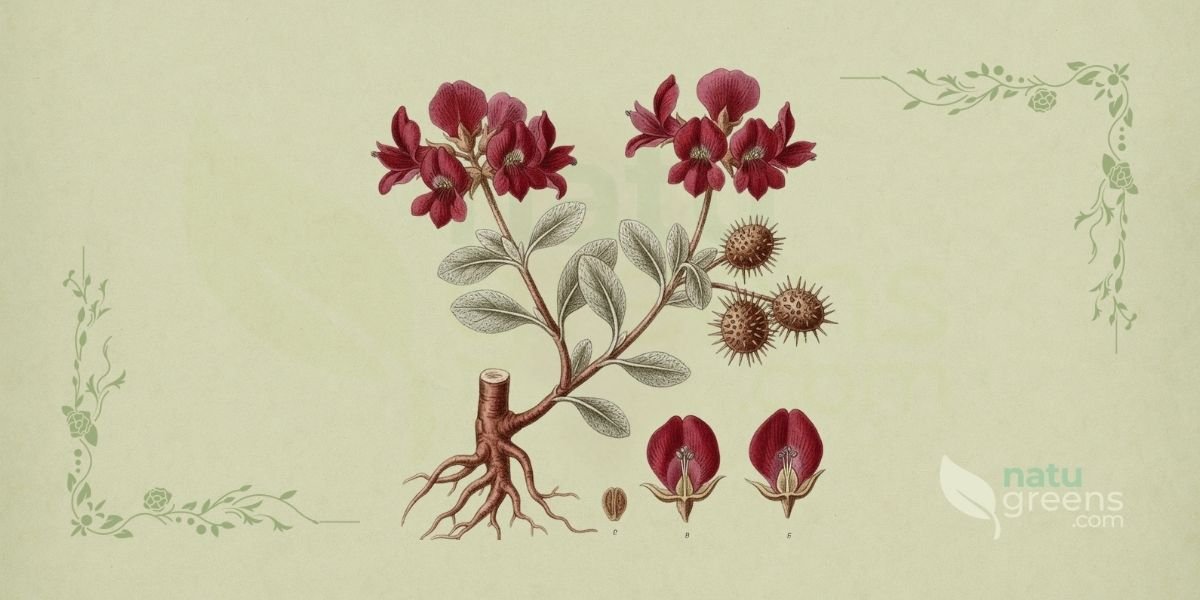
Botanical illustration of Krameria lappacea (Dombey) Burdet & B.B.Simpson (rhatany, Peruvian rhatany), a hemiparasitic shrub of the Krameriaceae family, native to the South American Andes, showing the complete plant with reddish flowers, small leaves, and the taproot, in 19th-century botanical encyclopedia style on a herbarium paper background, detailing the plant’s structure and its arid habitat.
The Krameriaceae family is monogeneric, containing only the genus Krameria, which comprises about 18 species. These plants are perennial, hemiparasitic shrubs that attach themselves to the roots of other plants to obtain nutrients. The family is characterized by flowers with four or five petals and dry fruits, often with spines. The Krameriaceae are native to the arid and semi-arid regions of the Americas, from the southwestern United States to South America. The presence of compounds such as tannins and neolignans is a distinctive phytochemical characteristic of the family, giving them the astringent and anti-inflammatory properties for which they are known.
Parts of Rhatany Used
- Root
Ethnobotanical and Traditional Uses of Rhatany
- Antidiarrheal
- Canker sores
- Diarrhea
- Discharges
- Dysentery
- Healing agent
- Hemorrhage
- Hemorrhoids
- Leukorrhea
- Mouth and gum conditions
- Oral antiseptic
- Oral hygiene
- Sore throat
- Sweating of the feet and armpits
Therapeutic Properties of Rhatany
- Anticancer (antitumor activity observed in laboratory studies)
- Anticoccidial (fights coccidia, parasitic protozoa)
- Antifungal (fights fungi)
- Anti-inflammatory (reduces inflammation)
- Antimicrobial (fights microorganisms); traditional use, without established clinical efficacy
- Antioxidant (fights free radicals)
- Antiseptic (prevents infections); traditional use, without established clinical efficacy
- Astringent (contracts tissues and blood vessels)
- Locally hemostatic astringent (reduces superficial bleeding of irritated gums and mucous membranes)
- Tonic (invigorates and strengthens)
Detailed Phytochemical Profile of Rhatany
- Lignans
- Neolignans
- Tannins (10-20% condensed tannins)
Preparation and Administration Forms of Rhatany
- Decoction
- Extract
- Gargles
- Infusion
- Mouth rinses
- Ointment
- Powder (for oral hygiene)
- Suppository
- Tincture
Synergy with Other Medicinal Plants
Gastrointestinal Disorders
For the treatment of diarrhea and dysentery, rhatany can be paired with guava (Psidium guajava) and carqueja (Baccharis trimera). Guava is known for its leaves, rich in tannins and flavonoids with antidiarrheal action, while carqueja has digestive and anti-inflammatory properties. Combining these plants can offer a synergistic effect in regulating intestinal transit and reducing inflammation of the gastrointestinal tract.
Oral and Gum Health
Rhatany, with its astringent and antiseptic properties, can be combined with sage (Salvia officinalis) and calendula (Calendula officinalis) to enhance its effects on oral health. Sage offers additional antimicrobial action, while calendula contributes healing and anti-inflammatory properties. This synergy is beneficial for the treatment of gingivitis, stomatitis, and canker sores, promoting healing and reducing inflammation of the oral mucosa.
Treatment of Hemorrhoids
In the topical treatment of hemorrhoids, rhatany can be used together with witch hazel (Hamamelis virginiana) and horse chestnut (Aesculus hippocastanum). Witch hazel is a potent astringent and venotonic, while horse chestnut strengthens the walls of blood vessels and reduces inflammation. This combination can relieve the pain, swelling, and bleeding associated with hemorrhoids, promoting the recovery of the affected tissues.
Recipes and Usage Protocols of Rhatany
Astringent Mouth Rinse for Gingivitis
Ingredients: 1 teaspoon of dried, crushed rhatany root, 200 ml of water.
Preparation: Boil the rhatany root in the water for 10 minutes. Strain and let cool. Use the liquid as a mouth rinse and gargle 2 to 3 times a day, especially after meals. This rinse helps reduce gum inflammation and bleeding, in addition to fighting microorganisms in the mouth.
Decoction for Diarrhea
Ingredients: 1 tablespoon of dried, crushed rhatany root, 500 ml of water.
Preparation: Place the root in the water and boil for 15 minutes. Strain and consume 1 cup (200 ml) up to twice a day, for up to 3 days. Diarrhea that persists beyond that requires medical evaluation. Rhatany decoction has a local astringent action and is traditionally used for mild, short-lived diarrhea; stools with blood, fever, or signs of dehydration require immediate medical evaluation and must not be treated at home.
Natural Tooth Powder
Ingredients: Dried, powdered rhatany root.
Preparation: Use the rhatany root powder directly on the toothbrush, or mixed with a little water to form a paste. Brush the teeth and gums gently. This traditional method helps strengthen the gums, prevent bleeding, and maintain oral hygiene. It was known as the “root of the teeth” in Lima, Peru.
Ointment for Hemorrhoids
Ingredients: 10 g of dry rhatany extract, 50 g of ointment base (e.g., solid petroleum jelly or shea butter).
Preparation: Mix the dry rhatany extract into the ointment base until smooth. Store in a clean, dry container. Apply a small amount to the area affected by hemorrhoids, 2 to 3 times a day. This ointment provides relief from pain, inflammation, and bleeding.
Tincture for Topical Use
Ingredients: 50 g of dried, crushed rhatany root, 250 ml of 70% grain alcohol.
Preparation: Place the root in the alcohol in a dark jar and let macerate for 14 days, shaking daily. Strain and store in a dropper bottle. Apply a few drops diluted in water to intact skin or external hemorrhoids, twice a day; do not use the tincture on genital mucosa or to treat discharge, which requires a medical diagnosis. The tincture offers a concentrated form of rhatany’s astringent and antiseptic properties.
Associated Therapies
Clinical Phytotherapy
In clinical phytotherapy, rhatany is employed mainly for its astringent and anti-inflammatory properties. Standardized root extracts are recognized in official monographs only for local use, in mild inflammation of the mucous membranes of the mouth and throat; their use for diarrhea and hemorrhoids follows traditional practice, without the same level of validation. Dosage and form of administration are adjusted according to the patient’s condition and the concentration of active principles. Rhatany is applied locally, in short courses and with attention to the risk of sensitization.
Homeopathy
In homeopathy, Krameria lappacea, known as Ratanhia, is cited for symptoms such as anal fissures, a burning sensation in the rectum, intense anal pain, and painful hemorrhoids, and the tradition points to it above all for people who report relief when they lean back while sitting or apply cold compresses. Homeopathic Ratanhia is prepared from the mother tincture of the root, following the dilutions and dynamizations specific to that tradition, and homeopathic doctrine holds that the preparation would stimulate the body’s self-healing capacity. There are no clinical studies confirming the effectiveness of these preparations for the indications mentioned. Anal pain that does not improve, blood mixed with the stool, changes in bowel habits, and persistent or recurrent rectal bleeding call for medical evaluation, as they may indicate conditions that require a specific diagnosis.
Contraindications and Side Effects of Rhatany
Drug Interactions
Rhatany can interact with medications that affect nutrient absorption, due to its astringent property. It can reduce the absorption of iron and other minerals if consumed concomitantly. An interval of at least two hours between the ingestion of rhatany and other medications or supplements is recommended. Patients using anticoagulants should be cautious, as tannins can influence blood coagulation, although this effect is not well established for rhatany.
General Contraindications
Rhatany is a known contact sensitizer: mouthwashes, tinctures and toothpastes made with the root can set off an allergic reaction in the lining of the mouth and lips, with burning, peeling and swelling, and use should be stopped at the first sign. Do not keep up local use for more than two weeks at a time. Rhatany is also contraindicated in cases of known hypersensitivity to any component of the plant. Due to its high concentration of tannins, prolonged use or high doses can cause gastrointestinal irritation, nausea, and constipation. It is not recommended for pregnant or breastfeeding women, as there are not enough studies proving its safety in these groups. Young children should also avoid its use, unless under medical guidance. Individuals with liver or kidney problems should use it with caution and under professional supervision.
Interesting Facts about Rhatany
A Hemiparasitic Plant
An interesting botanical curiosity about Krameria lappacea is its hemiparasitic habit. This means that, although the plant performs photosynthesis, it also connects to the roots of other host plants to extract water and nutrients. This survival strategy allows rhatany to thrive in the arid and semi-arid environments of the Andes, where water and nutritional resources are scarce, making it an adapted, resilient species.
Natural Dye
Beyond its medicinal applications, rhatany root is a source of red pigment. This natural dye has been used in various cultures to dye textiles and food, and even as a cosmetic. The presence of this pigment, together with the tannins, gives rhatany root a characteristic color, which can be extracted for artistic and industrial purposes, demonstrating the versatility of this plant.
The “Root of the Teeth”
Rhatany earned the nickname “root of the teeth” in Lima, Peru, as far back as the 18th century, when Hipólito Ruiz recorded the local custom of using the root powder to clean the teeth. The women of the region used the root powder to brush their teeth and strengthen their gums, taking advantage of its astringent and antiseptic properties. This traditional use illustrates the popular perception of the plant in oral hygiene, long before modern toothpastes became widespread, and it is not evidence of effectiveness in preventing periodontal disease.
Frequently Asked Questions about Rhatany
What Is Rhatany Used For?
Rhatany is used above all for its local astringent and antiseptic action. The use recognized in official monographs is the one on the lining of the mouth and throat, in mild inflammation and gingivitis. Its use for mild diarrhea and external hemorrhoids follows traditional practice, without the same validation, and vaginal discharge calls for a medical diagnosis, not self-medication.
How Do I Use Rhatany Root?
Rhatany root can be used in several forms: decoctions for ingestion (in cases of mild diarrhea), mouth rinses and gargles (for oral and throat problems), powder (as a tooth powder), and tinctures and ointments (for topical application on external hemorrhoids and on intact skin). The form of use depends on the condition being treated.
Does Rhatany Have Side Effects?
Yes, prolonged use or high doses of rhatany can cause gastrointestinal irritation, nausea, and constipation due to the high concentration of tannins. It is contraindicated for pregnant women, breastfeeding mothers, and young children, and should be used with caution by people with liver or kidney problems. It can interact with medications that affect nutrient absorption.
Where Can I Find Rhatany?
Rhatany is native to the Andean regions of South America, such as Peru, Bolivia, and Ecuador. It can be found in natural product stores, herbalists, and compounding pharmacies, usually in the form of dried root, extract, or tincture. It is important to purchase products from reliable suppliers to ensure quality and purity.
What Is the Difference between Rhatany and Other Astringent Plants?
Although there are other plants with astringent properties, rhatany stands out for the high concentration of condensed tannins in its root, which gives it a particularly potent action. That tannin profile explains why it is chosen when the mucous membranes are irritated, although only local use in mild inflammation of the mouth and throat is recognized in official monographs; the other indications, such as diarrhea and hemorrhoids, follow traditional practice, without the same level of validation.
Notice: this content is for informational purposes and does not replace professional medical advice. Consult a physician or herbal practitioner before using medicinal plants, especially during pregnancy, breastfeeding, or alongside medication.
References and Scientific Studies
Peer-Reviewed Scientific Studies (2)
- PMC2024 Abdel-Gaber, R., et al. (2024). Krameria lappacea root extract’s anticoccidial properties and coordinated control of CD4 T cells for IL-10 production and antioxidant monitoring. Frontiers in Immunology.
- PEER2021 Al-Oqail, M. M., et al. (2021). Anticancer efficacies of Krameria lappacea extracts against human breast cancer cell line (MCF-7): Role of oxidative stress and ROS generation. Saudi Journal of Biological Sciences.
Supplementary Readings (3)
- 2011 Baumgartner, L., et al. (2011). Lignan Derivatives from Krameria lappacea Roots Inhibit Acute Inflammation in Vivo and Pro-inflammatory Mediators in Vitro. Journal of Natural Products.
- 1996 Chevallier, A. (1996). The Encyclopedia of Medicinal Plants. Dorling Kindersley, London.
- 1991 Simpson, B. B. (1991). The Past and Present Uses of Rhatany (Krameria, Krameriaceae). Economic Botany.