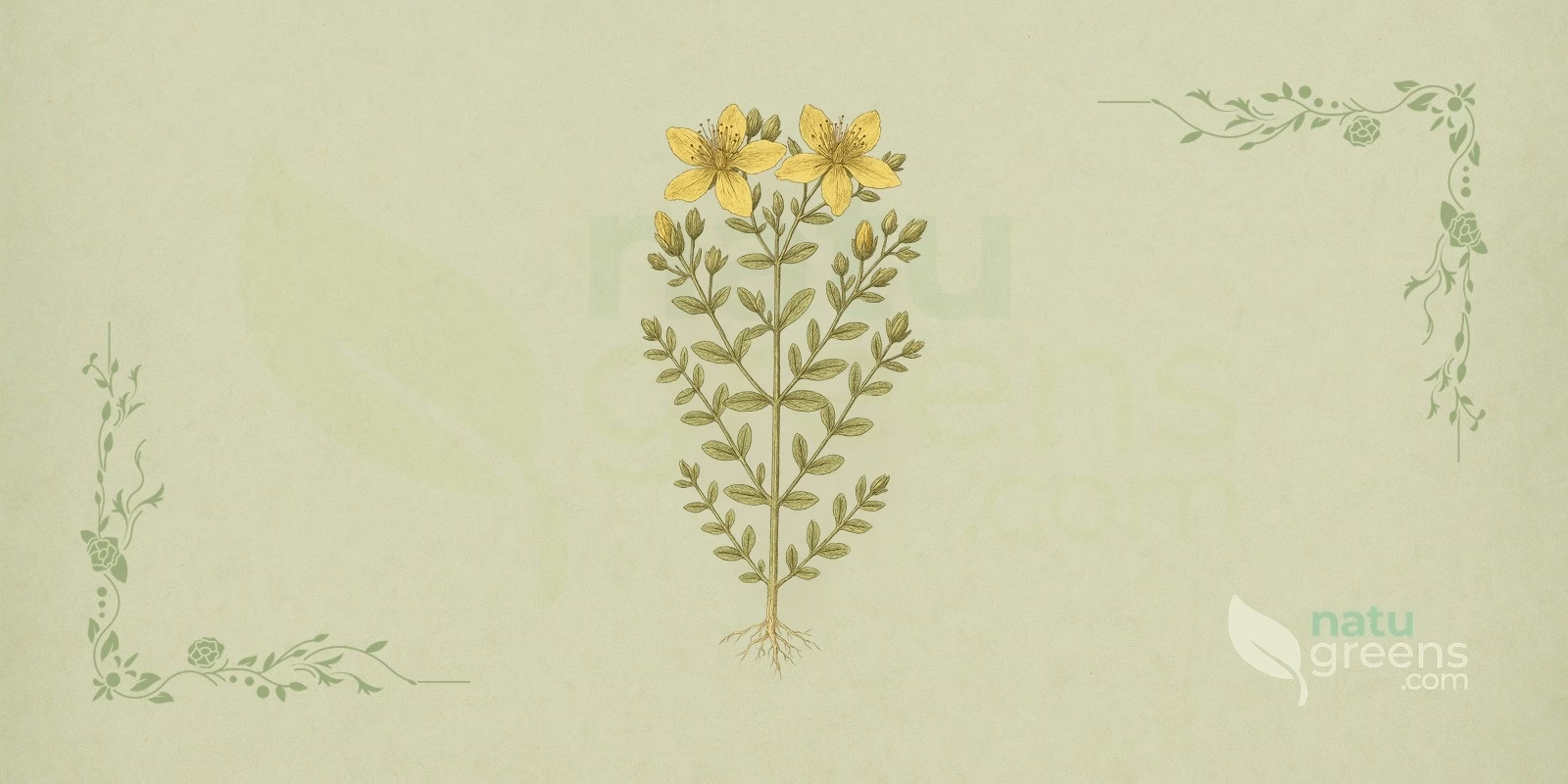
Hypericum perforatum L. / St. John’s Wort is a perennial herbaceous plant of the Hypericaceae family, described by Carl Linnaeus in 1753. Native to Europe, western Asia, and North Africa, this species has been widely introduced into temperate regions around the world because of its notable medicinal properties. St. John’s wort has been used in traditional medicine for centuries, with records dating back to ancient Greece. Its yellow flowers, marked by tiny translucent glands that look like perforations, are harvested during bloom for the preparation of various herbal products.
In European herbal tradition, St. John’s wort holds a prominent place, especially as a remedy for nervous system conditions. Its best-known applications include traditional support for mild to moderate depressive states, anxiety, and insomnia. The plant is recognized for its complex phytochemical makeup, rich in compounds such as hypericin and hyperforin, which are the main contributors to its properties. Modern scientific research has validated many of its traditional uses, cementing its position as one of the most studied and widely used medicinal plants in the world.
Popular and International Names of St. John’s Wort
- English: St. John’s wort, common St. John’s wort, perforate St. John’s wort, Klamath weed.
- Spanish: hipérico, hierba de San Juan, corazoncillo.
- Portuguese: bel-furada, erva-cruz, erva-de-são-joão, hipérico, milfurada, pericão, pipnicão, pirão.
- French: millepertuis perforé, herbe de la Saint-Jean.
- Italian: iperico, erba di San Giovanni.
- German: Echtes Johanniskraut, Tüpfel-Johanniskraut.
Botanical Synonyms of Hypericum perforatum
Hypericum vulgare Lam., Hypericum officinale Gaterau, and Hypericum officinarum Crantz are among the botanical synonyms historically associated with this species. These names, however, are considered illegitimate or invalid under current botanical nomenclature rules. The accepted name, universally recognized in the scientific community, is Hypericum perforatum L., which prevails in all reference pharmacological and botanical publications.
Botanical Family: Hypericaceae
The Hypericaceae family, previously classified as a subfamily (Hypericoideae) within the Clusiaceae, comprises around 9 genera and more than 700 species. These plants are distributed across nearly the entire world, with the greatest diversity in temperate regions. They are frequently characterized by oil- and resin-secreting glands, visible as translucent or dark dots or lines on the leaves and flowers. The genus Hypericum is the most representative and economically important in the family, owing to the medicinal use of several of its species.
Parts of St. John’s Wort Used
- Aerial parts
- Flowering tops (flowers and buds)
- Flowers
- Leaves
Ethnobotanical and Traditional Uses
- Anxiety and nervousness
- Healing wounds, ulcers, and burns
- Insomnia and sleep disorders
- Mild to moderate depression
- Neuralgic pain
- Treatment of mental illness (historically)
Therapeutic Properties of St. John’s Wort
- Analgesic (traditional use to relieve pain)
- Antibacterial (activity studied against bacteria)
- Antidepressant (activity studied against depression)
- Anti-inflammatory (effect studied for reducing inflammation)
- Antioxidant (activity studied against free radicals)
- Antiviral (activity studied against viruses)
- Anxiolytic (effect studied for reducing anxiety)
- Cognitive enhancer (effect studied on brain function)
- Neuroprotective (protective effect studied on the nervous system)
- Photosensitizing (effect studied on light sensitivity)
- Wound-healing (effect studied on wound healing)
Detailed Phytochemical Profile of St. John’s Wort
- Essential oils (alpha-pinene, caryophyllene, limonene, myrcene)
- Flavonoids (apigenin, kaempferol, luteolin, quercetin)
- Hyperforin (a prenylated phloroglucinol)
- Hypericin (a naphthodianthrone)
- Tannins (proanthocyanidins)
- Xanthones
Preparation and Administration Forms of St. John’s Wort
- Capsules
- Extracts (dry, fluid)
- Infusions (teas)
- Oils (macerated)
- Tablets
- Tinctures
Synergy with Other Medicinal Plants
Anxiety and Insomnia
The combination of St. John’s wort with valerian (Valeriana officinalis) and passionflower (Passiflora incarnata) is often used to enhance sedative and anxiolytic effects. This synergy is particularly useful for traditional support of sleep disorders and states of nervous agitation. St. John’s wort acts on neurotransmitters, while valerian and passionflower promote relaxation, creating a broad calming effect.
Cognitive Function
Preliminary studies suggest a possible synergy between St. John’s wort and sage (Salvia officinalis) in improving memory and cognitive function. Combining these two extracts may offer neuroprotective support and enhance cholinergic activity in the brain, although more research is needed to confirm these effects in humans.
Recipes and Usage Protocols of St. John’s Wort
Infusion for Anxiety and Mild Depression
Ingredients: 1 to 2 teaspoons (2-4 g) of dried St. John’s wort flowers and leaves, 200 ml of boiling water.
Preparation: Place the herb in a cup and add the freshly boiled water. Cover and let steep for 10 to 15 minutes. Strain and drink 1 to 3 times a day. This tea is traditionally used to ease symptoms of anxiety, nervousness, and mild depression.
St. John’s Wort Oil for Topical Use
Ingredients: Fresh St. John’s wort flowers and buds, extra virgin olive oil or another quality vegetable oil.
Preparation: Fill a glass jar with the fresh flowers, without packing them too tightly. Cover completely with the oil, making sure no part of the plant is exposed to air. Close the jar and let it macerate in the sun or a warm spot for 3 to 6 weeks. The oil will take on a deep red color. Strain and store in a dark glass bottle. Apply topically to wounds, burns, bruises, and muscle pain.
Tincture for Emotional Support
Ingredients: Fresh St. John’s wort flowers and leaves, 40-50% grain alcohol (or vodka).
Preparation: Finely chop the fresh plant material and fill a glass jar. Add alcohol until it completely covers the herb. Seal well and let macerate in a dark place for 4 to 6 weeks, shaking the jar daily. Strain and store the tincture in a dark dropper bottle. The usual dose varies, but generally falls between 1 and 4 ml, 2 to 3 times a day, diluted in water, and it is advisable to adjust the amount with guidance from a health care professional given the plant’s potential for drug interactions.
The preparations above follow traditional records and do not replace professional guidance. Before any internal use, check the contraindications and interactions described in this article.
Associated Therapies
Aromatherapy
In aromatherapy, St. John’s wort infused oil is valued for its anti-inflammatory and wound-healing properties. It is often used in massage to relieve neuralgic pain, such as sciatica, muscle aches, and bruises. Its topical application helps soothe irritated skin and promote tissue regeneration in cases of minor burns and wounds.
Clinical Herbal Medicine
St. John’s wort is one of the most studied plants in modern clinical herbal medicine, especially as traditional support for mild to moderate depression. Extracts are standardized to contain a specific concentration of hypericin and/or hyperforin, aiming for greater consistency of effect and safety. It is used, under professional guidance, in capsules or tablets to support mood disorders, anxiety, and symptoms associated with menopause.
Homeopathy
In homeopathy, the remedy Hypericum perforatum is one of the primary treatments for injuries to nerve-rich areas, such as the fingers, toes, and spine. It is indicated for sharp, shooting, radiating pain resulting from puncture wounds, crush injuries, tooth extractions, or surgery. The remedy is prepared from the fresh flowering plant through successive dilutions and dynamizations.
Contraindications and Side Effects of St. John’s Wort
Drug Interactions
St. John’s wort is known to induce cytochrome P450 enzymes (especially CYP3A4) and P-glycoprotein, which speeds up the metabolism of many drugs, reducing their effectiveness. It interacts with a wide range of medications, including antidepressants (SSRIs), anticoagulants (warfarin), oral contraceptives, immunosuppressants (cyclosporine), antiretrovirals, statins, and some chemotherapy drugs. Medical consultation is mandatory before starting its use.
Photosensitivity
Consuming St. John’s wort can increase skin sensitivity to sunlight, an effect known as photosensitivity. Fair-skinned individuals, or those taking high doses, should avoid prolonged sun exposure and use sunscreen to prevent burns and skin reactions. This effect is more pronounced with internal use than with topical application of the oil.
Other Precautions
Use of St. John’s wort is contraindicated during pregnancy and breastfeeding due to a lack of safety studies. People with severe depression, bipolar disorder, or schizophrenia should not use the plant without rigorous medical supervision. Its use should be discontinued at least two weeks before any surgery to avoid interactions with anesthetics.
Historical Notes and Interesting Facts
The genus name, Hypericum, comes from the Greek hyper (above) and eikon (image), referring to the ancient practice of hanging the plant over religious images to ward off evil spirits. The specific epithet, perforatum, alludes to the translucent oil glands on the leaves, which look like tiny holes when held up to the light. In the Middle Ages, the plant was believed to protect against witchcraft and demons, and it was harvested at the summer solstice and hung on doors and windows.
Frequently Asked Questions about St. John’s Wort
Is St. John’s Wort Effective for Depression?
Several clinical studies indicate that St. John’s wort can be effective as traditional support for mild to moderate depression, with efficacy comparable to some conventional antidepressants in part of the research, but generally with fewer reported side effects. Even so, it is not recommended for severe depression, which requires specialized medical care.
How Long Does It Take to Work?
The effects of St. John’s wort are not immediate. Generally, 2 to 4 weeks of continuous use are needed for benefits in mood and anxiety to become noticeable. Consistency in treatment is essential to achieving the desired results.
Can I Take St. John’s Wort with Other Medications?
No. St. John’s wort has a high potential for interaction with many medications, which can reduce their effectiveness or increase the risk of adverse effects. It is absolutely essential to consult a doctor or pharmacist before combining it with any other treatment.
Does St. John’s Wort Oil Stain the Skin?
St. John’s wort oil has an intense red color due to hypericin, but it does not permanently stain the skin. It can, however, stain fabric. The main concern with topical use is photosensitivity, so sun exposure should be avoided after application.
Notice: this content is for informational purposes and does not replace professional medical advice. Consult a physician or herbal practitioner before using medicinal plants, especially during pregnancy, breastfeeding, or alongside medication.
References and Scientific Studies
- DOI2011 Klemow, K. M., et al. (2011). Medical Attributes of St. John’s Wort (Hypericum perforatum). In Herbal Medicine: Biomolecular and Clinical Aspects (2nd ed.). CRC Press/Taylor & Francis. ↗
- DOI2003 Butterweck, V. (2003). Mechanism of action of St John’s wort in depression: what is known? CNS Drugs, 17(8), 539-562. ↗
- DOI2017 Galeotti, N. (2017). Hypericum perforatum (St John’s wort) beyond depression: A therapeutic perspective for pain conditions. Journal of Ethnopharmacology, 200, 136-146. ↗
- DOI2016 Oliveira, A. I., et al. (2016). Neuroprotective Activity of Hypericum perforatum and Its Major Components. Frontiers in Plant Science, 7, 1004. ↗