



Quick summary
Orthosiphon aristatus (Blume) Miq. / Java Tea, popularly known as cat's whiskers or orthosiphon, is a perennial herbaceous plant of the Lamiaceae family, also called Labiatae. Described by Carl Ludwig Blume and later reclassified by Friedrich Anton Wilhelm Miquel, the species is native to tropical Asia, ranging from…
Main caution: Warning: Orthosiphon aristatus (Blume) Miq., also cited in the literature as Orthosiphon stamineus Benth., has a real mild diuretic effect and documented interactions that must be taken seriously.
Orthosiphon aristatus (Blume) Miq. / Java Tea, popularly known as cat's whiskers or orthosiphon, is a perennial herbaceous plant of the Lamiaceae family, also called Labiatae. Described by Carl Ludwig Blume and later reclassified by Friedrich Anton Wilhelm Miquel, the species is native to tropical Asia, ranging from Southeast Asia and the Indian subcontinent to parts of tropical Australia. It has a long history in the traditional medicine of several Asian cultures, above all in Indonesia and Malaysia, where it is called kumis kucing and misai kucing respectively, both meaning "cat's whiskers".
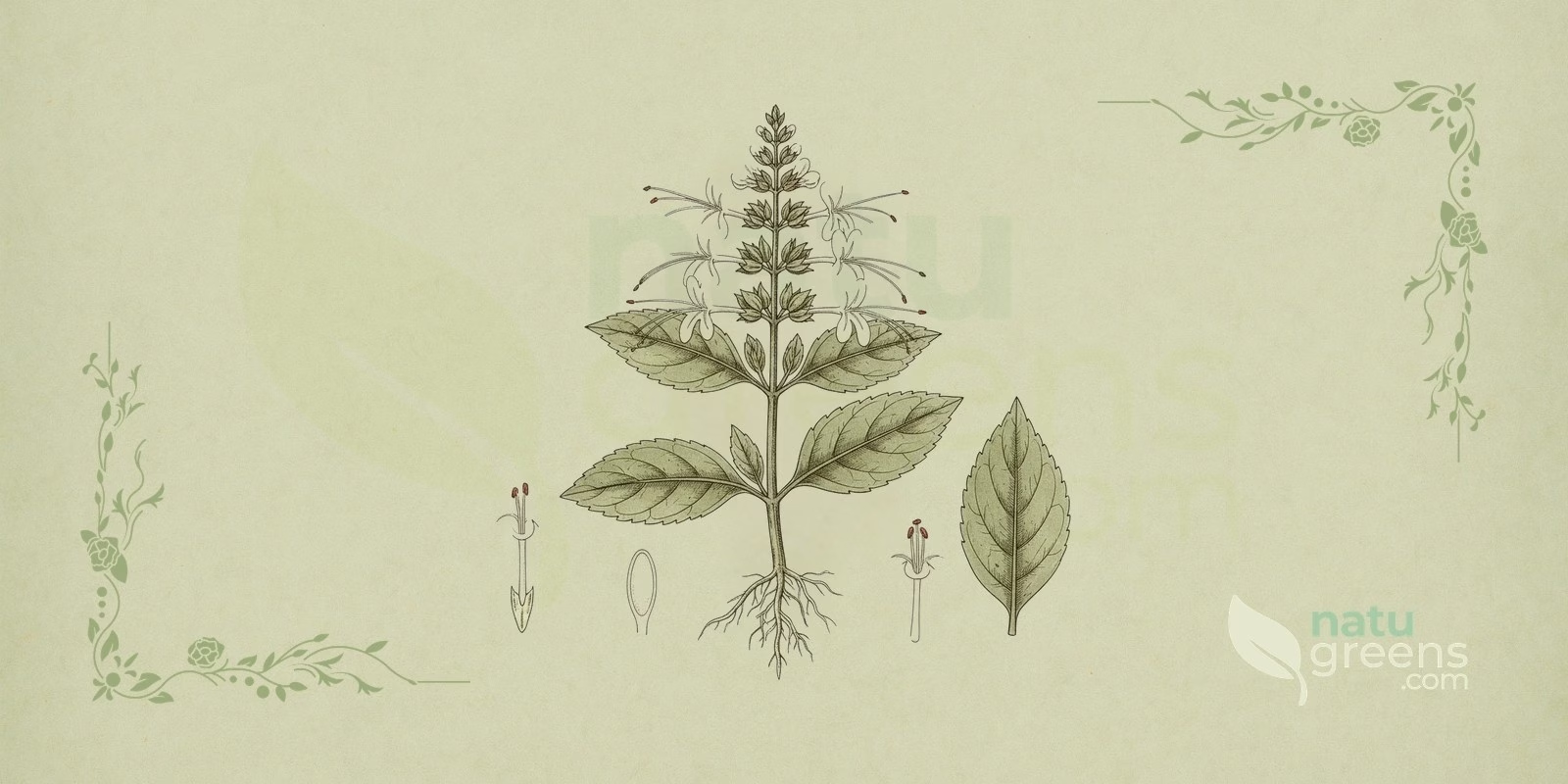
The leaves and stem tips form the basis of teas and extracts, and java tea has historically been used for kidney and urinary complaints as well as for metabolic problems such as diabetes and high blood pressure. The plant is rich in flavonoids and phenolic acids, compounds that laboratory and animal studies have linked to diuretic, antioxidant and anti-inflammatory actions. In Europe it is recognized as a traditional remedy for increasing urine output in mild urinary complaints, which is not the same as efficacy proven in clinical trials, and it is precisely this mild diuretic effect that calls for caution with certain medicines.
Popular and International Names of Java Tea
- English: cat's whiskers, java tea.
- French: moustaches de chat, orthosiphon, thé de java.
- German: Indischer Nierentee, Katzenbart.
- Italian: baffi di gatto, ortosifon, tè di giava.
- Portuguese: bariflora, bigode-de-gato, chá-de-java, chá-misil, ortosifão.
- Spanish: bigotes de gato, ortosifón, té de java.
Botanical Synonyms of Java Tea
Orthosiphon aristatus has gathered a number of botanical synonyms that reflect its complex taxonomic history and the different names given to it over time. The best known is Orthosiphon stamineus Benth., a name widely used in scientific and commercial literature, together with the basionym Ocimum aristatum Blume.
- Clerodendranthus spicatus (Thunb.) C.Y.Wu
- Clerodendranthus stamineus (Benth.) Kudô
- Clerodendrum spicatum Thunb.
- Ocimum aristatum Blume
- Orthosiphon blaetter
- Orthosiphon spicatus
- Orthosiphon spiralis (Lour.) Merr.
- Orthosiphon stamineus Benth.
- Orthosiphon tagawae Murata
- Orthosiphon velteri Doan
This range of names shows how the plant was studied in different periods and regions, and it explains why many scientific papers appear under O. stamineus and others under O. aristatus, even though they deal with the same species.
Botanical Family: Lamiaceae
The Lamiaceae family, also known as Labiatae, is one of the largest and most important families of flowering plants, with about 236 genera and more than 7,000 species distributed worldwide. Its members usually have square stems, opposite leaves and two-lipped flowers, often grouped in whorled inflorescences, and they stand out for their essential oils and aromatic compounds, which give many species medicinal, culinary and ornamental uses, as with mint, rosemary, thyme and sage.
Orthosiphon aristatus shares these features and is recognized for its wealth of biologically active secondary metabolites, including flavonoids, terpenoids and phenolic acids. Ongoing research on the Lamiaceae keeps revealing new compounds and mechanisms of action, which keeps the family in a prominent position in herbal medicine and of interest to the pharmaceutical industry.
Parts of Java Tea Used
- Leaves
- Stem tips
Ethnobotanical and Traditional Uses of Java Tea
- Abdominal pain (folk use)
- Bladder, urethra and kidney inflammation (traditional record; requires medical evaluation)
- Diabetes (traditional record; does not replace medical treatment)
- Fever (recorded in traditional Vietnamese medicine)
- Gallstones (traditional record, no clinical evidence)
- Gout (traditional record)
- Hepatitis (recorded in traditional Vietnamese medicine)
- High blood pressure (traditional record; does not replace medical treatment)
- Increased urine output in mild urinary complaints (traditional use recognized in Europe)
- Influenza (recorded in traditional Vietnamese medicine)
- Jaundice (recorded in traditional Vietnamese medicine)
- Kidney and bladder tonic (traditional record)
- Kidney stones (traditional record, no evidence that it dissolves stones)
- Mild edema (traditional record; contraindicated in cardiac or renal edema)
- Rheumatism (folk use)
Therapeutic Properties of Java Tea
- Antianorexic (traditional record of appetite stimulation)
- Antibacterial (activity observed in laboratory studies)
- Antidiabetic (preliminary animal studies and a review of experimental studies)
- Antigenotoxic (protection of genetic material observed in laboratory assays)
- Antihypertensive (preliminary animal studies)
- Anti-inflammatory (preliminary laboratory and animal studies)
- Antimicrobial (activity observed in laboratory studies)
- Antioxidant (ability to neutralize free radicals in laboratory assays)
- Antiplasmodial (activity against the malaria parasite observed in vitro)
- Cardioactive (preliminary studies in experimental models)
- Diuretic (mild diuretic effect; traditional use to increase urine output)
- Hepatoprotective (preliminary studies in animals and cells)
- Hypoglycemic (preliminary animal studies)
- Hypouricemic (effect on uric acid observed in animal studies, without clinical proof)
- Neuroprotective (preliminary laboratory studies)
- Vasodilator (effect observed in experimental models)
Detailed Phytochemical Profile of Java Tea
- Alpha-amyrin
- Alpha-pinene
- Beta-amyrin
- Beta-caryophyllene
- Betulin
- Bornyl acetate
- Camphor
- Carvone
- Citronellol
- Cymene
- 2,3-Dicaffeoyltartaric acid
- Essential oils
- Eugenol
- Eupatorin
- Flavonoids (flavonol glycosides, lipophilic flavonoids, methoxyflavonoids)
- Limonene
- Linalool
- Menthone
- Rosmarinic acid
- Saponins
- Sinensetin
- Terpenoids (diterpenes, monoterpenes, triterpenes)
- Ursolic acid
Rosmarinic acid, sinensetin and eupatorin are the markers most often used to assess extract quality, and storage studies show that the content of rosmarinic acid and other caffeic acid derivatives can decline over time, which underlines the importance of the origin and proper storage of the dried herb.
Preparation and Administration Forms of Java Tea
- Capsules
- Decoction
- Standardized extracts
- Tablets
- Tea (infusion)
- Tinctures
Synergy with Other Medicinal Plants
Traditional Combinations for the Urinary Tract
In traditional herbal medicine, java tea is paired with horsetail (Equisetum arvense) and bearberry (Arctostaphylos uva-ursi) in blends traditionally used to increase urine output in mild urinary complaints. Horsetail is known for its silica content, and bearberry contains arbutin, a compound studied for its antimicrobial activity in the urinary tract, but bearberry should only be taken for a few days and with professional guidance. Combining diuretic plants also adds up their diuretic effect, and signs such as fever, pain when urinating or blood in the urine call for medical evaluation, never prolonged self-medication.
Traditional Pairings Related to Blood Pressure
In traditional records, java tea appears alongside hibiscus (Hibiscus sabdariffa) and garlic (Allium sativum), plants studied for possible effects on blood pressure and cardiovascular health. The traditional reasoning would be to add the mild diuretic effect of java tea to the vascular interest of the other two plants, but for that very reason the combination may lower blood pressure too much in people already taking antihypertensives or diuretics, and it should not be used without medical supervision.
Traditional Pairings in a Metabolic Context
There are also records of combined use with cinnamon (Cinnamomum verum) and fenugreek (Trigonella foenum-graecum), plants that, like java tea itself, have been investigated in preliminary studies on blood sugar and lipids. Because the effect of all three on blood sugar can add to that of glucose-lowering drugs, people with diabetes should talk to their doctor before any use, and the combination is never a substitute for prescribed care.
Recipes and Usage Protocols of Java Tea
Traditional Java Tea Infusion
This is the most traditional way of using the plant, employed to increase urine output in mild urinary complaints.
Ingredients: 1 tablespoon of dried java tea leaves and 250 ml of boiling water.
Preparation: place the leaves in a cup and add the boiling water. Cover and let steep for 10 to 15 minutes, then strain and drink warm, between meals, for short periods. How often and for how long to use it should be agreed with a health professional, especially by people taking lithium, diuretics, antihypertensives or glucose-lowering drugs, and anyone with edema due to heart or kidney failure should not use the infusion.
Traditional Java Tea Tincture
The tincture is a traditional way of preserving the compounds in the leaves; it is more concentrated than the tea, so its dose should not be set on your own.
Ingredients: 50 g of dried java tea leaves and 500 ml of 70% grain alcohol.
Preparation: place the leaves in a dark glass jar and cover them with the alcohol. Seal tightly and leave to macerate for 2 to 3 weeks in a cool, dark place, shaking daily, then strain and store in a dropper bottle. The amount to use should be indicated by a health professional, and the tincture is not suitable for pregnant or breastfeeding women, children or people who avoid alcohol.
Traditional Fresh Leaf Poultice
The poultice is a traditional external use on sore areas, recorded in Asian folk medicine.
Ingredients: fresh java tea leaves and warm water.
Preparation: crush the fresh leaves into a paste, adding a little warm water if needed. Apply to intact skin over the area of muscle or joint pain, cover with a clean cloth and leave for 20 to 30 minutes. Tradition credits this use with local relief, but the poultice should be removed if redness or itching appears.
The preparations above follow traditional records and do not replace professional guidance. Before any internal use, check the contraindications and interactions described in this article.
Associated Therapies of Java Tea
Western Herbal Medicine
In Western herbal medicine, java tea is valued mainly for its mild diuretic effect, and the European traditional monograph describes it as a plant of traditional use to increase urine output in mild urinary complaints, without this representing proven efficacy. Herbalists often include it in blends aimed at the urinary tract, and standardized extracts exist to ensure consistent levels of flavonoids and phenolic acids. Accounts of its use for kidney stones, gout or recurrent urinary infections belong to tradition and do not justify replacing tests, antibiotics or medical follow-up.
Traditional Chinese Medicine (TCM)
Although java tea is not a classical TCM herb, its diuretic properties attract the interest of practitioners of Eastern medicine. In practice, its use in Southeast Asia follows mainly the local traditions of Indonesia, Malaysia and Vietnam, where the plant goes into teas for the kidneys and bladder and, in Vietnam, also into remedies for fever, influenza, hepatitis and jaundice, always as a traditional record.
Contraindications and Side Effects of Java Tea
Important Drug Interactions
Warning: Orthosiphon aristatus (Blume) Miq., also cited in the literature as Orthosiphon stamineus Benth., has a real mild diuretic effect and documented interactions that must be taken seriously.
- Lithium: java tea may reduce the renal clearance of lithium, with a risk of toxicity from accumulation. Never use the plant together with lithium without medical supervision.
- Diuretics: its diuretic effect adds to that of diuretic medicines.
- Antihypertensives: there is a risk of low blood pressure when the plant is combined with blood pressure medication.
- Glucose-lowering drugs: there is a risk of additive hypoglycemia in people taking diabetes medication.
Contraindications
- Edema due to heart or kidney failure: java tea is contraindicated in these situations, in which the swelling requires medical treatment.
- Urinary warning signs: fever, pain when urinating or blood in the urine call for medical evaluation, never prolonged self-medication with the plant. Java tea does not dissolve kidney stones, does not cure urinary infections and does not replace treatment for high uric acid; its traditional use is to increase urine output.
- Pregnancy, breastfeeding and children: there are not enough safety data, so use should be avoided at these stages.
- Allergy to plants of the Lamiaceae family: anyone with a known sensitivity should avoid the plant.
Plant Identity
The name cat's whiskers comes from the long, thin stamens of the flower, which resemble whiskers, and it must not be confused with cat's claw (Uncaria tomentosa), a completely different Amazonian plant with distinct properties. When buying, always check the scientific name on the label.
Side Effects
- Allergic reactions: although rare, itching or skin rashes mean use should be stopped.
- Gastrointestinal discomfort: sensitive people may experience nausea or stomach discomfort.
- Increased urinary frequency: this is the expected effect of the plant and calls for adequate hydration.
Historical Notes and Interesting Facts about Java Tea
Why Cat's Whiskers
The nickname the plant carries in several languages comes from the flower itself, whose long, thin, protruding stamens look like a cat's whiskers. In Indonesia the name kumis kucing means exactly that, as does misai kucing in Malaysia, and the same image appears in the English cat's whiskers, the French moustaches de chat, the Italian baffi di gatto and the German Katzenbart.
A Tea Named after an Island
The name java tea recalls the Indonesian island where the plant has been used for generations, and the German Indischer Nierentee, roughly "Indian kidney tea", shows how the fame of its urinary use travelled from Asia to Europe. Its taxonomic history is eventful too: described by Blume as Ocimum aristatum, the species was later moved by Miquel to the genus Orthosiphon and accumulated more than ten synonyms, among them the popular Orthosiphon stamineus.
Frequently Asked Questions about Java Tea
What Is Java Tea Used For?
Java tea is traditionally used to increase urine output in mild urinary complaints, a use recognized as traditional in Europe. Laboratory and animal studies are investigating antioxidant and anti-inflammatory effects and effects on blood sugar, but these data are still preliminary and do not prove any clinical benefit.
Does Java Tea Interact with Medicines?
Yes. The plant may reduce the elimination of lithium by the kidneys, with a risk of toxicity, and it adds its effect to that of diuretics, antihypertensives and glucose-lowering drugs, which can cause low blood pressure or hypoglycemia. Anyone taking any of these medicines should not drink the tea without medical supervision.
Does Java Tea Dissolve Kidney Stones?
There is no evidence that the plant dissolves kidney stones; the traditional record refers to increased urine output. Severe pain, fever, pain when urinating or blood in the urine require immediate medical evaluation.
Who Should Not Take Java Tea?
The plant is contraindicated for people with edema due to heart or kidney failure and should be avoided during pregnancy, breastfeeding and in children, owing to a lack of safety data. It also requires medical supervision for anyone taking lithium, diuretics, blood pressure medication or diabetes medication.
Are Cat's Whiskers and Cat's Claw the Same Plant?
No. Cat's whiskers is Orthosiphon aristatus, an Asian member of the Lamiaceae whose name comes from the long stamens of its flower, whereas cat's claw is Uncaria tomentosa, a completely different Amazonian plant with distinct properties.
What Is the Difference between Orthosiphon aristatus and Orthosiphon stamineus?
None in the botanical sense: they are names for the same species. Orthosiphon aristatus (Blume) Miq. is the accepted name, and Orthosiphon stamineus Benth. is a synonym widely used in scientific articles and on commercial labels.
Notice: this content is for informational purposes and does not replace professional medical advice. Consult a physician or herbal practitioner before using medicinal plants, especially during pregnancy, breastfeeding, or alongside medication.
How to cite this article
NATUGREENS. Java Tea (Orthosiphon aristatus): Properties and Benefits. Natugreens, 19 Nov. 2026. Disponível em: https://natugreens.com/orthosiphon-aristatus-java-tea/. Accessed: Nov. 20, 2026.
Natugreens. (2026). Java Tea (Orthosiphon aristatus): Properties and Benefits. Natugreens. https://natugreens.com/orthosiphon-aristatus-java-tea/
References and Scientific Studies
- PMC2022 Wang Q, et al. A Systematic Review of Orthosiphon stamineus Benth. in the Treatment of Diabetes and Its Complications. Molecules. 2022.
- PMC2018 Chua LS, et al. Phytochemical profile of Orthosiphon aristatus extracts after storage: Rosmarinic acid and other caffeic acid derivatives. Phytomedicine. 2018.
- PMC2023 Alshehade SA, et al. Orthosiphon aristatus (Blume) Miq Alleviates Non-Alcoholic Fatty Liver Disease via Antioxidant Activities in C57BL/6 Obese Mice and Palmitic-Oleic Acid-Induced Steatosis in HepG2 Cells. Pharmaceuticals (Basel). 2023.
- PMC2022 Al-Dulaimi DW, et al. Anticlastogenic, antimutagenic, and cytoprotective properties of Orthosiphon stamineus ethanolic leaves extract. Drug Chem Toxicol. 2022.
- PMC2023 Zhu C, et al. Study on the mechanism of Orthosiphon aristatus (Blume) Miq. in the treatment of hyperuricemia by microbiome combined with metabonomics. J Ethnopharmacol. 2023.
You May Also Like
Take your time and tell us everything you think, details included. Every response is read by someone on our editorial team and goes into the article's revision. An honest critique helps us more than a polite compliment.
Take your time and tell us everything you think, details included. Every response is read by someone on our editorial team and goes into the article's revision. An honest critique helps us more than a polite compliment.