



Quick summary
Cordyceps militaris (L.) Fr. is a fungus of the Cordycipitaceae family that, in the wild, parasitizes moth larvae and pupae buried in the soil or in leaf litter. Once it has taken over the host's body, the fungus forms small, orange, club-shaped fruiting bodies that push up above the surface. Unlike Tibetan cordyceps…
Main caution: Reported adverse effects include gastrointestinal discomfort, nausea, diarrhea and dry mouth. Allergic reactions are possible.
Cordyceps militaris (L.) Fr. is a fungus of the Cordycipitaceae family that, in the wild, parasitizes moth larvae and pupae buried in the soil or in leaf litter. Once it has taken over the host's body, the fungus forms small, orange, club-shaped fruiting bodies that push up above the surface. Unlike Tibetan cordyceps, which is rare and expensive, C. militaris can be cultivated on grain substrates, and that is why it forms the basis of most supplements sold as cordyceps today. The effects attributed to it on energy, immunity and physical performance are still under study, with small trials and mixed results.
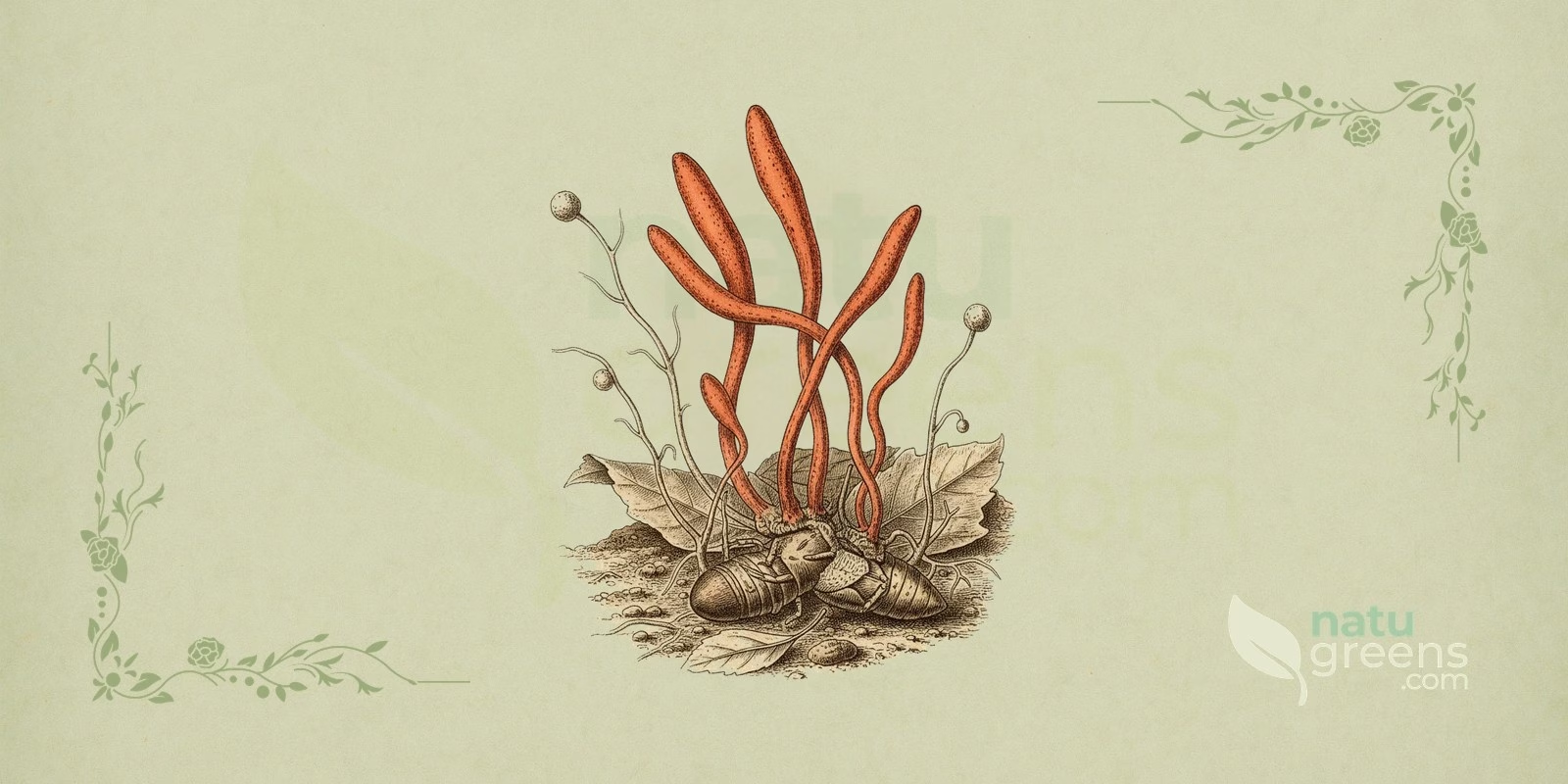
Popular and International Names of Cordyceps militaris
- English: militaris cordyceps, scarlet caterpillarclub.
- French: cordyceps militaire.
- German: Puppen-Kernkeule.
- Portuguese: cordyceps militaris.
- Spanish: cordyceps militaris.
Not to Be Confused with Tibetan Cordyceps
Names such as cordyceps and caterpillar fungus are applied both to Cordyceps militaris and to Tibetan cordyceps, which has its own article on this site under the name Cordyceps sinensis. Part of the current literature treats that other species as Ophiocordyceps sinensis, in the family Ophiocordycipitaceae. It grows in the high-altitude grasslands of the Himalayas and the Tibetan Plateau, and it is rare, expensive and under heavy collection pressure. These are different fungi, and study results obtained with one cannot be transferred to the other.
The confusion goes further. Many older clinical studies on "cordyceps" used the Tibetan fungus or a fermented mycelium known as Cs-4, which comes from yet another fungus, Paecilomyces hepiali. Whenever you read about the benefits of cordyceps, it is worth checking which material was actually studied.
Scientific Synonyms of Cordyceps militaris
Linnaeus described the fungus in 1753 as Clavaria militaris, and it was later moved to the genus Cordyceps. The mycological literature records these synonyms:
- Clavaria militaris L.
- Sphaeria militaris (L.) Ehrh.
- Torrubia militaris (L.) Tul. & C.Tul.
Family: Cordycipitaceae
The Cordycipitaceae family belongs to the order Hypocreales and brings together fungi that parasitize insects and other arthropods, known as entomopathogenic fungi. Several of them produce metabolites of research interest, such as nucleosides of the cordycepin type. Some close relatives of C. militaris are used for the biological control of agricultural pests.
Cordyceps militaris is the type species of the genus, meaning the reference from which the genus was defined. In the wild it occurs in temperate forests of the Northern Hemisphere, across Europe, Asia and North America.
Parts of Cordyceps militaris Used
The most prized part is the fruiting body, the orange club, which today is almost always obtained by cultivation on rice or other grain substrates. Supplements can also be made from mycelium, the vegetative part of the fungus, which is often grown on grain that ends up ground together with it. This difference matters for quality, since mycelium-on-grain products can contain a lot of starch and only small amounts of the compounds of interest.
Traditional Uses of Cordyceps militaris
In Chinese tradition, C. militaris was used as a more affordable substitute for Tibetan cordyceps, with similar indications: tiredness, weakness after illness, coughs and complaints linked to the kidneys and to sexual vitality, according to the concepts specific to Traditional Chinese Medicine. In contemporary Chinese cooking, the dried fruiting bodies go into soups and broths, especially in southern China.
These uses are traditional and do not amount to proven indications.
Therapeutic Properties of Cordyceps militaris
The activities below have been observed in the laboratory, in animals or in small, heterogeneous clinical trials. None of them has been proven for use in people:
- Anti-inflammatory (reduction of inflammatory markers in experimental models, under study)
- Antioxidant (activity of extracts in laboratory assays)
- Antiproliferative effect in vitro (cordycepin in cultured cells and in animals, under study)
- Effect on blood glucose (observed in animals, under study)
- Effect on immunity (modulation of immune cells in the laboratory and in animals, under study)
- Energy and libido (traditional use, without clinical confirmation)
- Physical performance (small trials with mixed results, under study)
It is not accurate to say that cordyceps boosts immunity, improves VO2 max or fights cancer. The available studies do not support these claims.
Detailed Chemical Profile of Cordyceps militaris
C. militaris draws research attention for its cordycepin content, which is generally higher than that of Tibetan cordyceps:
- Adenosine (a nucleoside found in many mushrooms)
- Carotenoids (responsible for the orange color of the fruiting body)
- Cordycepin (3'-deoxyadenosine, the most studied compound in the fungus)
- Ergosterol (the sterol typical of fungi)
- Mannitol (a sugar alcohol abundant in mushrooms)
- Polysaccharides (such as beta-glucans, of interest in immunological studies)
Levels vary widely depending on the strain, the substrate and the cultivation method, which makes products hard to compare.
Preparation and Administration Forms of Cordyceps militaris
The fungus is sold as dried fruiting bodies, powder, capsules and extracts. Quality varies a great deal between manufacturers: there are fruiting-body products, mycelium-on-grain products and cases of adulteration. Choose brands that state the species, the part used and the content of active compounds, and that provide laboratory analysis.
The dose depends on the product and should follow the advice of a health professional and the manufacturer's instructions. Anyone taking long-term medication should talk to their doctor before starting.
Synergy with Other Medicinal Species
Traditional Tonic Combinations
Commercial and traditional formulas combine cordyceps with ginseng (Panax ginseng) and rhodiola (Rhodiola rosea), with the idea of adding tonics together against fatigue. No studies have shown that these blends offer any advantage, and ginseng has interactions of its own, including with anticoagulants.
Combinations with Other Mushrooms and Roots
Cordyceps appears alongside reishi (Ganoderma lucidum) and astragalus (Astragalus membranaceus) in products marketed for immunity. Combining products that act on the immune system is not advisable for transplant recipients, people with autoimmune disease or patients undergoing chemotherapy.
Respiratory Combinations
In Chinese tradition, there are formulas with licorice (Glycyrrhiza glabra) and thyme (Thymus vulgaris). Prolonged use of licorice can raise blood pressure and lower potassium, and it should not be used without professional guidance.
Recipes and Usage Protocols of Cordyceps militaris
Cordyceps Broth
In southern Chinese cooking, the dried fruiting bodies are added to chicken or vegetable broths and simmered slowly. This is a culinary use, in small amounts, that gives the broth a golden color and a mild flavor.
Fruiting Body Tea
The tea is made by steeping dried fruiting bodies in hot water, covered, for a few minutes. The amount should follow the supplier's or a professional's guidance, and the tea should not be used to replace the treatment of any disease.
Supplements
Capsules and powders should be taken as directed on the label and with professional supervision, especially by people with a chronic disease or who take medication.
The preparations above follow traditional records and do not replace professional guidance. Before any internal use, check the contraindications and interactions described in this article.
Associated Therapies and Complementary Approaches for Cordyceps militaris
Traditional Chinese Medicine
In Traditional Chinese Medicine, cordyceps is regarded as a tonic for the lungs and kidneys, within the internal logic of that system. C. militaris entered this use as a substitute for Tibetan cordyceps, which is becoming increasingly scarce.
Sports Supplementation
In sport, cordyceps is sold for endurance and recovery. Trials with C. militaris are few and small, some of them using mushroom blends, and the results are not consistent. Athletes should also keep in mind that supplements can be contaminated with banned substances, and that only products with batch certification offer any real assurance.
Contraindications and Side Effects of Cordyceps militaris
- Allergy to fungi or mushrooms: contraindicated.
- Anticoagulants and antiplatelet drugs: cordycepin has antiplatelet activity in the laboratory. People taking warfarin, aspirin, clopidogrel or similar drugs should avoid use without their doctor's approval.
- Antidiabetic drugs: the effects on blood glucose may add up. Do not adjust your medication on your own.
- Immunosuppressants, autoimmune disease, transplantation and chemotherapy: use only with the approval of the treating physician.
- Pregnancy, breastfeeding and children: not recommended, owing to a lack of data.
- Surgery: stop use before surgical procedures and inform the medical team.
Reported adverse effects include gastrointestinal discomfort, nausea, diarrhea and dry mouth. Allergic reactions are possible.
Interesting Facts about Cordyceps militaris
Insect-parasitizing fungi became famous as "zombie fungi" thanks to documentaries and pop culture. The best-known case of manipulated behavior, however, involves ants infected by Ophiocordyceps species, not C. militaris, which develops in pupae that are already motionless in the soil.
Commercial cultivation of C. militaris on grain has expanded in China over recent decades and turned a little-known wild fungus into one of the best-selling mushroom supplements in the world. This has eased some of the demand for Tibetan cordyceps, whose harvest sustains the economy of Himalayan communities and worries conservationists.
Frequently Asked Questions about Cordyceps militaris Tea
Is Cordyceps militaris Tea Safe for Daily Use?
The safety of prolonged daily use is not well established. Short trials have not shown serious problems in healthy adults, but anyone who takes medication, has a chronic disease or is about to have surgery should consult their doctor first.
What Is the Difference between Cordyceps militaris and Cordyceps sinensis?
They are different fungi. Tibetan cordyceps, called Cordyceps sinensis or Ophiocordyceps sinensis, is wild, rare and expensive. C. militaris is cultivated on grain, more affordable and usually richer in cordycepin. Studies on one do not automatically apply to the other.
Does Cordyceps militaris Improve Athletic Performance?
This has not been proven. There are small trials, some with mushroom blends, that show mixed results. It cannot be claimed that it improves VO2 max or endurance.
Does Cordyceps militaris Boost Immunity or Treat Cancer?
No. Effects on immune and tumor cells have been seen in the laboratory and in animals, without clinical confirmation. People undergoing cancer treatment should only use it with their oncologist's approval.
Does Cordyceps militaris Have Side Effects?
It can cause gastrointestinal discomfort, nausea, diarrhea and dry mouth. An allergy to fungi is a contraindication, and there are interactions with anticoagulants, antidiabetic drugs and immunosuppressants.
How Can I Tell Whether a Cordyceps Supplement Is Good Quality?
Check whether the label states the species, whether the product is made from fruiting bodies or from mycelium on grain, and what its compound content is. Choose manufacturers that provide laboratory test reports, because adulteration exists on the market.
Is Cordyceps militaris a Mushroom?
Yes. It is a fungus, related to other mushrooms, and it belongs to the kingdom Fungi, not to the plant kingdom.
Notice: this content is for informational purposes and does not replace professional medical advice. Consult a physician or herbal practitioner before using medicinal plants, especially during pregnancy, breastfeeding, or alongside medication.
How to cite this article
NATUGREENS. Cordyceps militaris: Medicinal Mushroom, Studies and Precautions. Natugreens, 20 Nov. 2026. Disponível em: https://natugreens.com/cordyceps-militaris-mushroom/. Accessed: Nov. 20, 2026.
Natugreens. (2026). Cordyceps militaris: Medicinal Mushroom, Studies and Precautions. Natugreens. https://natugreens.com/cordyceps-militaris-mushroom/
References and Scientific Studies
- DOI2010 Das, S. K., Masuda, M., Sakurai, A. and Sakakibara, M. (2010). Medicinal uses of the mushroom Cordyceps militaris: current state and prospects. Fitoterapia, 81(8), 961-968. Review of the compounds and activities described, with a predominance of preclinical data. ↗
- DOI2012 Shrestha, B. et al. (2012). The medicinal fungus Cordyceps militaris: research and development. Mycological Progress, 11, 599-614. Review of the biology, cultivation and research of the species. ↗
- DOI2021 Jędrejko, K. J., Lazur, J. and Muszyńska, B. (2021). Cordyceps militaris: an overview of its chemical constituents in relation to biological activity. Foods, 10(11), 2634. Discusses the chemical composition and the variation between fruiting bodies and mycelium. ↗
- DOI2017 Hirsch, K. R. et al. (2017). Cordyceps militaris improves tolerance to high-intensity exercise after acute and chronic supplementation. Journal of Dietary Supplements, 14(1), 42-53. Small trial with a mushroom blend based on C. militaris, showing modest and inconsistent effects on exercise parameters. ↗
You May Also Like
Take your time and tell us everything you think, details included. Every response is read by someone on our editorial team and goes into the article's revision. An honest critique helps us more than a polite compliment.
Take your time and tell us everything you think, details included. Every response is read by someone on our editorial team and goes into the article's revision. An honest critique helps us more than a polite compliment.