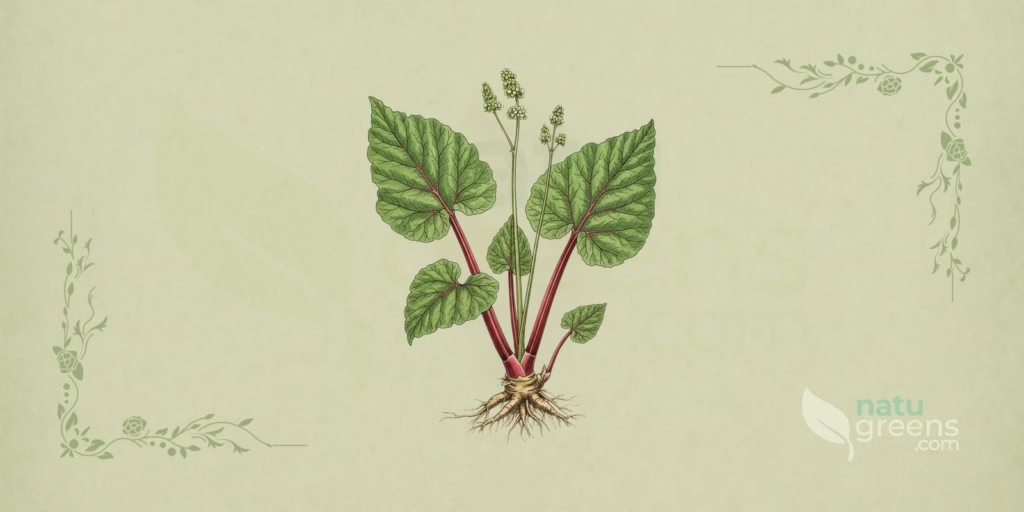
Rhubarb, Rheum rhabarbarum L., is a large perennial herb of the family Polygonaceae, the same botanical grouping that brings together sorrel, Japanese knotweed and buckwheat. The plant builds a dense basal rosette from a woody perennial crown, and what catches the eye in any bed where it has settled are the leaves: heart-shaped blades half a metre across, carried on fleshy, thick petioles washed in green, pink or red according to the cultivar.
The species is native to a belt running from southern Siberia into northern and central China, a region of hard winters and short summers that shaped a plant dependent on cold to complete its cycle. Carl Linnaeus described it formally in 1753, in the first volume of Species Plantarum, and the name has since travelled through two and a half centuries of nomenclatural confusion with neighbouring species of the genus, a tangle that settled only with recent taxonomic revisions.
What makes Rheum rhabarbarum remarkable is not merely its size. It is the contrast held inside the plant itself: the same leaf structure produces a petiole that became an ingredient of pies and preserves across northern Europe, and a blade that concentrates soluble oxalates at levels that make it dangerous. Few garden species display so sharp a division between usable and toxic parts, and that duality sits at the centre of rhubarb’s botanical identity.
Taxonomy
The systematic position of the species is well resolved and is recognised without disagreement by the reference taxonomic databases. The accepted name is Rheum rhabarbarum L., published in Species Plantarum 1: 372, in 1753, recorded in IPNI under the identifier 301818-2.
- Kingdom: Plantae
- Division: Magnoliophyta (angiosperms)
- Class: Magnoliopsida (eudicots)
- Order: Caryophyllales
- Family: Polygonaceae Juss.
- Subfamily: Polygonoideae
- Tribe: Rheeae
- Genus: Rheum L.
- Species: Rheum rhabarbarum L., 1753
Synonyms
Plants of the World Online, maintained by the Royal Botanic Gardens, Kew, treats the following names as synonyms of Rheum rhabarbarum:
- Rhabarbarum verum Garsault (name published in a rejected work)
- Rheum franzenbachii Münter
- Rheum undulatum L.
- Rheum undulatum var. longifolium C.Y.Cheng & T.C.Kao
- Rheum × cultorum Thorsrud & Reisaeter
The case of Rheum undulatum deserves a note. Linnaeus published that name in 1762, in the second edition of Species Plantarum, treating as a distinct species material now recognised as belonging to the same taxon. Much of the horticultural literature of the nineteenth century and the early twentieth still works with that separation, which explains why old seed catalogues carry both names side by side as though they were different plants.
Etymology
The generic name Rheum derives from the Greek rhēon, a term that designated the plant drug imported from the East and which etymological tradition links to the ancient name of the Volga, Rha, one of the routes along which the material reached the Mediterranean. The epithet rhabarbarum comes from the medieval Latin rha barbarum, literally “rha of the barbarians”, an expression that recorded the European perception of the plant as a product of foreign and distant lands. English “rhubarb” is the direct phonetic settling of that same Latin root.
Morphological Description
Rheum rhabarbarum is a robust perennial herb of basal rosette habit, fully deciduous in winter. The foliage reaches 60 to 120 centimetres in height, and the plant approaches 2 metres once it sends up the flowering stalk. Growth starts from a persistent woody crown that spreads sideways year after year and underpins the longevity of the clump.
Leaves
The basal leaves are the most conspicuous structure of the species. The blade measures 20 to 50 centimetres long by 15 to 40 centimetres wide, heart-shaped to orbicular in outline, with a wavy to crisped margin that is never deeply lobed. The upper surface is dark green and the lower one paler, with palmate and strongly raised main venation. The petiole is fleshy and succulent, 20 to 60 centimetres long by 2 to 4 centimetres across, roughly semicylindrical in cross section and coloured from green to deep red depending on the cultivar. At the base of each petiole sits a membranous ocrea, a structure characteristic of the Polygonaceae, formed by the fusion of the stipules around the node.
The leaf blades contain soluble oxalates in high concentration, on the order of 0.5 to 1.0 percent of fresh weight, along with anthraquinone derivatives. Ingestion of the leaves causes poisoning in people and in domestic animals, and this toxicity is a permanent feature of the plant rather than an occasional hazard.
Flowers
The inflorescence is an erect, branched terminal panicle 30 to 60 centimetres long, produced from the second or third year of the clump’s life. The individual flowers are small, 3 to 5 millimetres, hermaphrodite, with six whitish to greenish-cream tepals, nine stamens and a superior three-angled ovary. Opening runs from late spring into early summer in the northern hemisphere, typically from May to June.
Fruits and Seeds
The fruit is a three-angled achene enclosed by three broad membranous wings, 7 to 10 millimetres long, light brown to reddish when ripe. Each fruit holds a single seed. The wings give the achene a considerable drag surface relative to its mass, which sustains dispersal by wind.
Root and Stem
The underground system combines a shallow woody crown, technically a thickened rhizome, with fleshy taproots and branched roots that descend 40 to 60 centimetres into the soil profile. In mature plants the crown reaches 10 to 25 centimetres across and concentrates multiple growth buds that resprout each spring. This architecture is what allows a clump to stay productive for one or two decades in the same spot, something uncommon among vegetable crops.
Distribution and Habitat
The natural range of the species stretches from southern Siberia into northern and central China, taking in the steppes and mountain slopes of the Asian interior. The original habitat brings together deep, well-drained soils on hillsides and along watercourses, in settings of short summers and long, severe winters.
Beyond its native range, rhubarb followed the expansion of European and North American horticulture and today appears across almost the whole temperate zone of the northern hemisphere. In the Americas there are records of spontaneous occurrence in Alaska, the Yukon, the Canadian provinces and a long list of northern United States. In Europe the species is listed as naturalised in Great Britain, Ireland and Norway, with establishment of uncertain degree in Denmark, Finland and Sweden.
Naturalisation is of the persistent rather than the invasive kind. Spontaneous populations usually correspond to clumps left behind in abandoned gardens, or to crown fragments carried along with moved soil, and no aggressive behaviour towards native vegetation has been documented in any of the regions where the plant has escaped cultivation.
As for environmental requirements, the species occupies ground from sea level to about 2,000 metres in temperate latitudes, calls for annual rainfall between 600 and 1,200 millimetres well spread through the year, and thrives in deep, fertile, well-drained soils rich in organic matter, with a pH between 6.0 and 7.0. Waterlogged or strongly acid soils compromise the crown. The decisive limiting factor is thermal: the plant needs a winter period with temperatures below 5 degrees Celsius for six to eight weeks in order to vernalise, and it withstands extreme cold, down to around minus 30 degrees.
In Brazil, cultivation only holds up in high regions with a pronounced winter, such as the Serra Gaúcha, the Serra Catarinense and the area around Campos do Jordão. There is no significant commercial production in the country, and the plants found there come mostly from home gardens, inherited from lines brought over by European immigrants.
Cultivation
Standard propagation is vegetative, by division of mature crowns three to four years old, carried out in autumn or early spring, with each division carrying two or three viable buds. Propagation from seed is possible, but yields genetically variable offspring, which restricts it to breeding programmes and to the few cultivars selected for that route, such as ‘Glaskin’s Perpetual’. Usual spacing falls between 90 and 120 centimetres in every direction, a reflection of the volume a mature clump takes up.
This is a crop demanding in nutrients and organic matter, which explains the regular incorporation of compost or well-rotted manure into the beds and the nitrogen top dressing applied when growth resumes in spring. The plant asks for full sun; marked shading reduces the vigour of the petioles. One routine practice in cultivation is cutting the flowering stalks as soon as they appear, since flowering diverts resources away from vegetative production.
Among the phytosanitary problems, crown rot caused by species of Phytophthora is the most serious and is directly tied to waterlogging. Leaf spot from Ascochyta rhei produces circular reddish-brown lesions on the blades. On the animal side, the weevil Lixus concavus bores into petioles and crown, slugs and snails attack the tender spring growth, and aphids colonise the undersides of the leaves and the flowering stalks. Turnip mosaic virus also infects the species, causing mosaic patterning and leaf deformation.
Harvest begins only in the second year after planting, so as not to exhaust the crown while it is still forming, and is done by pulling and twisting the petiole at the base, never by cutting, a procedure that avoids leaving stubs open to rot. The British practice of forcing, developed in Yorkshire, covers the clumps in winter with opaque pots and produces, in the dark, early etiolated petioles that are tender and deep pink.
Cultivars
Cultivated diversity is wide, with selections guided by colour, vigour, fibre content and season of production. Among the most widespread are ‘Canada Red’, red-stalked inside and out; ‘Crimson Cherry’, of compact habit; ‘Glaskin’s Perpetual’, seed-propagated and productive in its first year; ‘Timperley Early’, an early British cultivar with pink petioles; ‘Valentine’, of deep pigmentation and low fibre; and ‘Victoria’, a classic nineteenth-century British selection that remains among the most widely planted.
Phenology
The annual cycle begins with the resprouting of the crown buds in early spring, as soon as soil temperatures rise, and the foliage reaches full development within a few weeks. Flowering occurs from May to June in the northern hemisphere, restricted to clumps at least two or three years old, and fruiting follows from June to August, with ripening and release of the achenes at the end of summer.
Pollination is mixed. The flowers are small, whitish and produce accessible nectar, drawing flies, small bees and wasps, and small beetles, while the open architecture of the panicle combined with abundant production of light pollen also favours transport by wind. Fruit dispersal is anemochorous, secured by the three membranous wings of the achene, with secondary movement by gravity and by running water on sloping ground. In horticultural practice this stage rarely completes itself, because the flowering stalks are usually removed before fruiting.
At the end of the growing season the above-ground parts dry off completely and the plant enters dormancy, surviving winter through the crown and root system alone.
Related Species and Confusions
The genus Rheum gathers several dozen Asian species, and telling them apart is the main source of identification error. The most useful separating points in the field are the outline of the leaf blade, the colour of the flowers and the anatomy of the root in cross section.
- Rheum × hybridum Murray designates the garden hybrid complex involving R. rhabarbarum and related species. Many commercial cultivars belong to that group rather than to the pure species, which makes assigning a scientific name to garden material a less straightforward task than it appears.
- Rheum officinale Baill. has large, entire leaves, but with a less wavy margin, and a root that shows yellow stellate striations in cross section, absent in R. rhabarbarum.
- Rheum palmatum L. separates easily by its deeply palmately lobed leaves, with five to seven lobes, by its reddish flowers and by young foliage of a purplish-red tone.
- Rheum rhaponticum L. is the most persistent confusion. The two species are morphologically close, and the separation rests above all on geographical origin, the Balkans in the case of R. rhaponticum and the Asian interior in that of R. rhabarbarum, and on the chemical composition of the root, which in R. rhaponticum accumulates the stilbene rhaponticin. Much of the horticultural literature of the eighteenth and nineteenth centuries applied the name R. rhaponticum to garden rhubarb, and the mistake still circulates in commercial catalogues.
- Rheum tanguticum Maxim. ex Balf., from the Tibetan Plateau, comes close to R. palmatum in leaf outline and is not confused with garden rhubarb.
Outside the genus, the relevant look-alike in a vegetable garden is burdock, Arctium lappa, whose large heart-shaped basal leaves can mislead at a distance. Looking at the ocrea at the base of the petiole settles the doubt at once, since that structure is absent in the Asteraceae.
Phytochemistry
The chemical profile of Rheum rhabarbarum stands clearly apart from that of the Asian species historically exploited for their roots, and the distribution of compounds among the plant’s organs is markedly uneven.
Organic acids predominate in the petioles, with malic acid as the major component and the direct reason for the pronounced acidity of the tissue. Ascorbic acid content lies between 8 and 12 milligrams per 100 grams of fresh matter, and potassium appears at around 288 milligrams per 100 grams. The dietary fibre fraction sits close to 1.8 percent, split between pectins and cellulose. In red-stalked cultivars, the pigmentation follows from the accumulation of anthocyanins, chiefly cyanidin-3-glucoside and cyanidin-3-rutinoside, concentrated in the outer layers of the tissue. Soluble oxalates are present in the petioles as well, at 0.2 to 0.5 percent, consistently lower than the figure recorded in the blades.
The leaf blades concentrate 0.5 to 1.0 percent soluble oxalates and accumulate anthraquinone derivatives, among them emodin and chrysophanol, though at levels well below those of the root species of the genus. It is this combination that makes the leaves the toxic portion of the plant.
The root of R. rhabarbarum contains anthraquinones and tannins, but in a profile and concentration distinct from those of R. officinale and R. palmatum, and it lacks the anatomical stellate striations that mark those two species in cross section.
Rhubarb in History and Ethnobotany
The cultural trajectory of rhubarb splits into two chapters that rarely meet. The first belongs to the Asian root species, above all Rheum officinale and Rheum palmatum, whose dried roots circulated along the Silk Road and reached European apothecaries from late Antiquity onward as a high-value commodity. Trade records from the sixteenth and seventeenth centuries describe the Asian material among the costliest items in a European apothecary’s inventory, and the search for the geographical origin of the drug set Russian and British botanical expeditions in motion throughout the eighteenth century.
The second chapter, far more recent, is that of Rheum rhabarbarum and concerns the petioles. The species reached western Europe as a botanical collection plant in the eighteenth century, and the use of the petioles as food took hold only from the end of that century, spreading rapidly in England. Horticultural records from the early nineteenth century document the development of the forcing technique in Yorkshire around 1817, and the so-called rhubarb triangle, bounded by Bradford, Leeds and Wakefield, established itself as the largest producing centre in the world by the end of the nineteenth century, helped by the arrival of the railway and the quick supply route to London.
In inner Asia, the region where the species originates, ethnographic records indicate that local populations gathered petioles from wild plants as a seasonal sour food, a practice documented in travellers’ accounts and in nineteenth-century compilations of economic flora. In Scandinavia and North America, rhubarb entered immigrant family gardens through the nineteenth century and won a fixed place in the spring kitchen, tied to pies, compotes and preserves, a category in which it remains.
One twentieth-century episode deserves separate mention. During the First World War, official British guidance went so far as to suggest eating rhubarb leaves as a vegetable in a context of food shortage, a mistaken recommendation that led to documented cases of poisoning and was later withdrawn. The episode is frequently cited in the literature on toxic garden plants.
Conservation
Rheum rhabarbarum has no formal assessment on the IUCN Red List, which places it in the condition of a not evaluated species. Neither does it appear in any CITES appendix. The absence of an assessment reflects the combination of an extensive native range in the Asian interior and a massive cultivated presence throughout the northern hemisphere, a picture that removes any immediate concern for the persistence of the species.
The conservation question that matters for rhubarb is of another kind and concerns cultivated genetic diversity. Since commercial propagation is almost entirely vegetative, by crown division, the cultivars in circulation are clones on a narrow genetic base, a situation that raises collective vulnerability to new pathogens. Germplasm banks kept by institutions such as the Vavilov Institute in Russia and the genetic resources system of the United States Department of Agriculture conserve Rheum accessions precisely to offset that narrowness.
Other species of the genus face far more serious pressure. Rheum tanguticum, intensively exploited for its roots on the Tibetan Plateau, ranks among the species of Rheum whose conservation status gives cause for concern, a contrast that helps put the comfortable position of garden rhubarb in perspective.
Interesting Facts
- Forcing in Yorkshire is carried out in dark sheds, and the harvest happens by candlelight so as not to interrupt the etiolation. Forced rhubarb from the region received Protected Designation of Origin status from the European Union in 2010.
- In complete darkness, the growth of forced petioles is fast enough for audible cracking to be heard in the sheds, produced by the bursting of the buds and the stretching of the tissues.
- In 1947, a United States court classified rhubarb as a fruit for import tariff purposes, despite the marketed part being a leaf petiole and therefore a vegetative organ.
- The European search for the geographical origin of Asian medicinal rhubarb was one of the drivers of botanical exploration in central Asia during the eighteenth century, and trade in the root became a state monopoly in imperial Russia.
- The ocrea, the membranous sheath wrapping the node at the base of the petiole, is the most reliable diagnostic marker of the family Polygonaceae and makes it possible to recognise the kinship between rhubarb and plants as different in appearance as buckwheat.
Notice: this content is for informational purposes and does not replace professional medical advice. Consult a physician or herbal practitioner before using medicinal plants, especially during pregnancy, breastfeeding, or alongside medication.
References and Scientific Studies
View All 9 Cited References
- Euro+Med PlantBase. Rheum rhabarbarum L. Botanic Garden and Botanical Museum Berlin. Available at: ↗
- 2003 Flora of China Editorial Committee. Rheum L. In: Flora of China, vol. 5. Science Press & Missouri Botanical Garden Press. 2003.
- 1992 Foust, C. M. Rhubarb: The Wondrous Drug. Princeton University Press. 1992.
- International Plant Names Index (IPNI). Rheum rhabarbarum L., Sp. Pl. 1: 372 (1753). Royal Botanic Gardens, Kew; Harvard University Herbaria; Australian National Herbarium. Available at: ↗
- 2025 IUCN. The IUCN Red List of Threatened Species. Version 2025. Available at: ↗
- 2006 Kalisz, S.; Szkaradek, K.; Bober, I. Composition of minerals in rhubarb stalks. Polish Journal of Food and Nutrition Sciences, 56(2): 177-180. 2006.
- Linnaeus, C. Species Plantarum, vol. 1. Stockholm. 1753. Available at: ↗
- POWO. Plants of the World Online: Rheum rhabarbarum L. Royal Botanic Gardens, Kew. Available at: ↗
- World Flora Online. Rheum rhabarbarum L. (wfo-0000404478). Available at: ↗