



Quick summary
Celastrus paniculatus Willd., commonly known as the intellect tree or, in traditional Indian terms, jyotishmati and malkangni, is a woody liana in the Celastraceae family. Native to the Indian subcontinent, southern China, and Southeast Asia, the species was described by the German botanist Carl Ludwig Willdenow in…
Main caution: Celastrus paniculatus should be used with caution, and much of that caution comes precisely from the shortage of solid human studies. Nearly all of the research on cognitive effects, including memory, attention, and…
Celastrus paniculatus Willd., commonly known as the intellect tree or, in traditional Indian terms, jyotishmati and malkangni, is a woody liana in the Celastraceae family. Native to the Indian subcontinent, southern China, and Southeast Asia, the species was described by the German botanist Carl Ludwig Willdenow in 1798 and can reach up to ten meters in length when it finds support to climb. In Ayurveda, its seeds and the oil extracted from them hold a prominent place among traditional brain tonics, used for centuries in the hope of supporting memory and mental clarity.
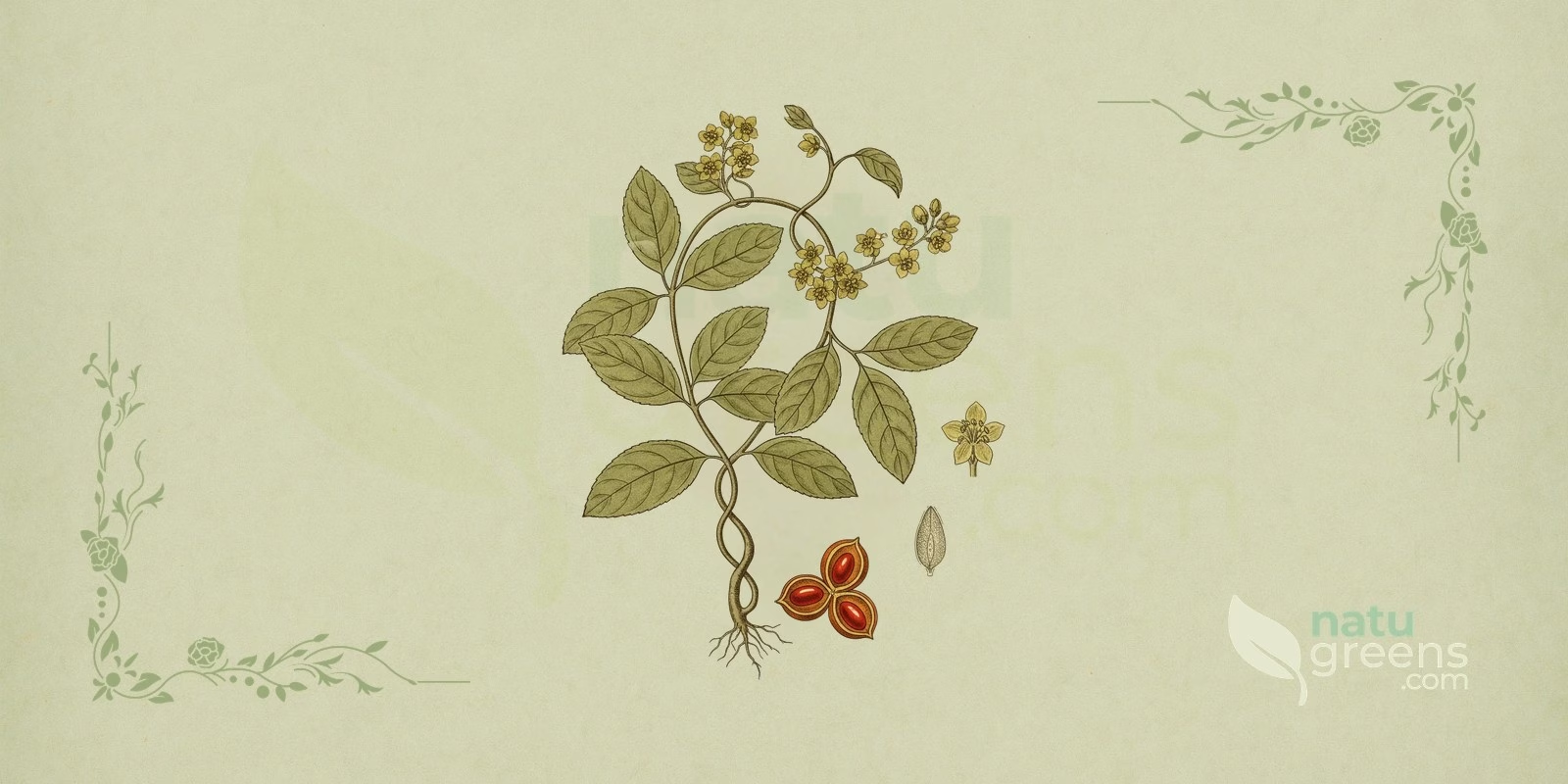
Scientific research on Celastrus paniculatus is still at an early stage. Most of the available data comes from preclinical studies carried out in animal models or laboratory assays, not from clinical trials in humans. For this reason, this article presents the plant's traditional uses and what science has investigated so far, without ever presenting these preliminary findings as proven results or as substitutes for medical treatment.
Popular and International Names of the Intellect Tree
- Portuguese: celastro paniculado, mal-cangni.
- Sanskrit/Ayurveda: jyotishmati (traditional term, also spelled jyotishmathi).
- Hindi: malkangni.
- English: black oil plant, climbing staff tree, intellect tree, staff vine.
- German: Baumwürger.
- Spanish: celastro paniculado, árbol del intelecto.
- French: célastre paniculé, arbre de l'intellect.
- Italian: celastro paniculato, albero dell'intelletto.
Not to Be Confused with Celastrus orbiculatus
The genus Celastrus includes several species, and some of them share English common names with the intellect tree. The most important case is Celastrus orbiculatus, a climbing plant native to East Asia also known as oriental bittersweet, which has become a significant invasive species in parts of North America. It is a distinct species from Celastrus paniculatus, without the same history of use in Ayurveda, and the two names should never be treated as equivalent when searching for, or buying, seeds and oils.
Botanical Synonyms of the Intellect Tree
Celastrus paniculatus Willd. is the accepted, stable botanical name, used consistently in current scientific literature. The subspecies Celastrus paniculatus subsp. aggregatus is recognized by some authors, but it does not change the species' identity or the traditional uses attributed to it. Before modern nomenclature was stabilized, older spellings and combinations can be found in regional texts, though these are no longer in current use.
Botanical Family: Celastraceae
The Celastraceae family includes trees, shrubs, and lianas distributed mainly across the planet's tropical and subtropical regions. Among the group's most notable chemical traits is the presence of alkaloids, triterpenes, and sesquiterpenes, many of them associated with biological activities studied in the laboratory. Celastrus paniculatus stands out within the family precisely for this rich phytochemical profile, concentrated above all in the seeds.
Celastraceae species have simple leaves, small flowers, and capsular fruits that, when they open, expose seeds covered by a striking aril, usually red or orange. This trait, also present in Celastrus paniculatus, helps with both botanical identification and seed dispersal by birds, which feed on the aril.
Parts of the Intellect Tree Used
In Ayurvedic tradition, the seeds are the most valued part of the intellect tree, since they concentrate the oil used in its best-known preparations. Leaves, fruits, and roots also appear in records of folk use, though far less frequently and with much less documentation than the seeds.
- Seeds
- Oil extracted from the seeds
- Leaves
- Fruits
- Roots
Ethnobotanical and Traditional Uses of the Intellect Tree
In Ayurvedic medicine, Celastrus paniculatus is classified as a medhya plant, a category reserved for herbs traditionally associated with strengthening intelligence and memory. The most frequently cited traditional use involves the seed oil, consumed or applied in the hope of supporting concentration, mood, and mental clarity, especially in the context of studying and aging. Ethnobotanical records also describe the use of the oil, often combined with warm milk, in folk practices related to joint pain and mobility, as well as the occasional use of the plant in children with learning difficulties, always within the Ayurvedic system and under the guidance of traditional practitioners.
These uses are traditional and do not replace conventional diagnosis or treatment. None of the indications listed here should be read as medical advice.
Medicinal Properties of the Intellect Tree
The properties listed below come mostly from preclinical trials, carried out in animal models or laboratory tests with extracts and seed oil. None of them currently has solid confirmation from clinical studies in humans, so all of them should be read as findings still under study or as traditional use, never as a guarantee of effect.
- Nootropic (in preclinical studies, associated with better cognitive performance in animal models)
- Neuroprotective (investigated for its protective action on neurons in models of stress and injury)
- Antioxidant (free radical fighting activity observed in laboratory assays)
- Traditional anxiolytic (traditional calming use, with preliminary signals in animal studies)
- Mood balance (traditional Ayurvedic use associated with emotional well-being, still without clinical validation)
Detailed Phytochemical Profile of the Intellect Tree
The seed oil of Celastrus paniculatus concentrates a diverse combination of compounds, studied mainly for its potential action on the central nervous system. Among the constituents most frequently cited in the phytochemical literature are:
- Celapanin (sesquiterpene alkaloid typical of the genus Celastrus)
- Malkanguanin (alkaloid associated, in laboratory studies, with effects on the central nervous system)
- Paniculatin (sesquiterpene compound isolated from the seeds)
- Sesquiterpenoids (chemical class associated with neurological activity studied in animal models)
- Beta-sitosterol (phytosterol common in plants, associated in studies with antioxidant activity)
- Flavonoids (antioxidant compounds widely distributed in the plant kingdom)
- Phenolic compounds (contribute to the antioxidant activity of the oil and the seeds)
Preparation and Administration Forms of the Intellect Tree
In Ayurvedic tradition, Celastrus paniculatus is usually prepared in just a few ways, almost all centered on the oil extracted from the seeds. A decoction of the seeds also appears in folk records, mostly linked to joint discomfort. In the supplement market, bottled seed oil can be found for topical use or, less often, for oral use, always in small amounts measured in drops.
- Seed oil for topical use
- Seed oil in small oral doses, traditionally mixed with warm milk
- Seed decoction
- Ointment prepared with seed oil
Synergy with Other Medicinal Plants
Traditional Combination for Mood and Memory
In the literature on traditional use, and in some studies with animal models, Celastrus paniculatus appears combined with Tribulus terrestris, a pairing recorded in preliminary research on anxiety, mood, and memory. The idea behind this combination is that the compounds of the two plants would act on distinct, complementary neurochemical pathways, but this synergy remains restricted to animal models, without confirmation in people.
Traditional Combination for Joint Health
In Indian folk use, intellect tree oil is also combined with other plants and carrier oils in topical preparations aimed at joint discomfort, usually alongside ingredients such as ginger or mustard oil. This combination is part of home-based local application practices and, so far, has no studies confirming a benefit greater than using each plant on its own.
Recipes and Usage Protocols for the Intellect Tree
Seed Oil with Warm Milk
Ingredients: 5 to 10 drops of Celastrus paniculatus seed oil; 200 ml of warm milk.
Preparation: mix the drops of oil well into the warm milk and drink before bed. In Ayurveda, this preparation is traditionally associated with supporting sleep and mental clarity, though there is no clinical proof of this effect in humans.
Seed Decoction for Joint Discomfort
Ingredients: one tablespoon of Celastrus paniculatus seeds; 500 ml of water.
Preparation: boil the seeds in the water for fifteen to twenty minutes, until the volume is reduced by half, then strain and drink while still warm. This protocol appears in traditional Ayurvedic records linked to a feeling of relief from joint discomfort, with no clinical study confirming the effect.
Topical Ointment with Seed Oil
Ingredients: Celastrus paniculatus seed oil; a neutral ointment base, such as beeswax with coconut oil.
Preparation: mix the seed oil into the neutral base until you get a smooth ointment, then apply it to the uncomfortable area with a gentle massage. These uses follow traditional records and do not replace professional guidance, so any persistent joint pain, or any redness, swelling, or local warmth, deserves medical evaluation before any prolonged self-treatment.
The preparations above follow traditional records and do not replace professional guidance. Before any internal use, check the contraindications and interactions described in this article.
Therapies Associated with the Intellect Tree
Clinical Phytotherapy
From the standpoint of contemporary clinical phytotherapy, Celastrus paniculatus is still considered a plant under investigation, rather than an herbal medicine with an established indication. Researchers have particular interest in the seed oil as a candidate complement to strategies aimed at cognitive function and neuronal protection, but moving from preclinical findings to clinical recommendations depends on human studies that, so far, barely exist.
Ayurveda
In Ayurveda, Celastrus paniculatus, known as jyotishmati, belongs to the medhya category, a term used for herbs traditionally linked to strengthening memory and intelligence. Tradition also describes the plant as a stimulant of the so-called digestive fire, jatharagni, connecting digestive health to mental clarity. Ayurvedic practitioners often include the seed oil in formulations aimed at balancing the vata and kapha doshas, always within its own diagnostic system, which does not correspond to evidence-based medicine.
Contraindications and Side Effects of the Intellect Tree
Celastrus paniculatus should be used with caution, and much of that caution comes precisely from the shortage of solid human studies. Nearly all of the research on cognitive effects, including memory, attention, and functions associated with conditions such as dementia or attention deficit, comes from preclinical models, carried out in animals or in the laboratory. There is, at this time, no proof that Celastrus paniculatus treats, prevents, or reverses dementia, attention deficit hyperactivity disorder, or any other cognitive diagnosis in humans. What exists is longstanding traditional use and preliminary findings still under study, two categories quite different from a validated clinical indication.
People with known sensitivity to plants in the Celastraceae family should avoid Celastrus paniculatus in any form. Pregnancy is a context of clear contraindication: there is a traditional record of using Celastrus paniculatus as an emmenagogue, that is, as a plant used to bring on menstruation, and also as an abortifacient in folk medicine systems. This history of use is, by itself, enough to contraindicate the plant during pregnancy, regardless of any other claimed benefit, and it also calls for caution during breastfeeding. Seed oil taken by mouth can cause gastrointestinal discomfort, with reports of nausea and stomach irritation when the dose is excessive or the use is inappropriate; starting with small amounts and watching the body's response is a reasonable precaution for anyone who decides to try the oil under guidance. In young children, use should always be supervised by a health professional, given the lack of safety studies for this age group. According to Ayurvedic tradition itself, people with a predominantly Pitta constitution are said to be more prone to headache and digestive discomfort with the use of Celastrus paniculatus, which reinforces the need to start with conservative doses.
Drug Interactions
There are no consistent clinical studies on how Celastrus paniculatus interacts with commonly used medications, which calls for extra caution. Because some of the plant's compounds have been studied for a possible action on the central nervous system, there is a theoretical concern that Celastrus paniculatus could add to the effect of sedatives, anxiolytics, hypnotics, and other central nervous system depressants, including alcoholic beverages, increasing drowsiness or slowing reflexes. For this same theoretical reason, special caution is recommended for anyone already using sedative or anticonvulsant medication or medication for sleep disorders, and stopping use before surgical procedures involving anesthesia is advised, until specific safety data exist. Anyone under ongoing medical treatment, especially for neurological or psychiatric conditions, should talk to their treating professional before combining Celastrus paniculatus with any medication.
Curiosities and Historical Facts
The Elixir of Life in Indian Tradition
In Ayurveda, Celastrus paniculatus carries poetic nicknames such as elixir of life and tree of life, a reference to the traditional belief that the plant would help preserve vitality and clarity over the years. This kind of reputation, common to many medhya plants, helps explain why the seeds appear so often in formulations aimed at healthy aging within the Ayurvedic system, even without the backing of modern clinical studies.
A Name Linked to Light
The Sanskrit term jyotishmati comes from a root associated with light and brightness, an idea that tradition links to the plant's supposed ability to illuminate the mind and sharpen reasoning. The English name intellect tree follows the same symbolic line, naming the species after the effect that folk culture attributed to it, long before any laboratory investigated its compounds.
Frequently Asked Questions about the Intellect Tree
Does the Intellect Tree Really Help Memory?
The idea that Celastrus paniculatus helps memory comes mainly from traditional Ayurvedic use and from preclinical studies in animals, which observed effects on cognitive performance in certain models. So far there is no robust clinical study in humans confirming this effect, so the accurate answer is that the plant is under study for this purpose, not that its effect on memory has been proven.
What Is the Difference between the Oil and Seed Tea?
The large majority of available studies on Celastrus paniculatus use the oil extracted from the seeds, not a tea or infusion. Seed tea appears in sparser traditional mentions, and its chemical makeup tends to differ from that of the oil, since not all of the seeds' fat-soluble compounds transfer into hot water the same way. For this reason, results associated with the oil should not be automatically extended to the tea.
Is the Intellect Tree Safe during Pregnancy?
No. Celastrus paniculatus has a traditional record of use as an emmenagogue and as an abortifacient, which is reason enough to contraindicate its use during pregnancy. Pregnant women should avoid any preparation based on this plant and seek guidance from a health professional for any need related to memory, mood, or pain during pregnancy.
Who Should Avoid Intellect Tree Seed Oil?
Besides pregnant women, the following should avoid it, or use it only under professional guidance: people with known sensitivity to plants in the Celastraceae family, young children, people already using sedative, anxiolytic, hypnotic, or anticonvulsant medication, and anyone about to undergo surgery with anesthesia. Anyone who experiences gastrointestinal discomfort after using the oil should reduce the dose or stop using it and seek professional guidance if the discomfort persists.
Notice: this content is for informational purposes and does not replace professional medical advice. Consult a physician or herbal practitioner before using medicinal plants, especially during pregnancy, breastfeeding, or alongside medication.
How to cite this article
NATUGREENS. Intellect Tree (Celastrus paniculatus): Memory and Cautions. Natugreens, 21 Nov. 2026. Disponível em: https://natugreens.com/celastrus-paniculatus-intellect-tree/. Accessed: Nov. 21, 2026.
Natugreens. (2026). Intellect Tree (Celastrus paniculatus): Memory and Cautions. Natugreens. https://natugreens.com/celastrus-paniculatus-intellect-tree/
References and Scientific Studies
Peer-Reviewed Scientific Studies (5)
- PMC2016 Bhagya, V., Christofer, T., & Shankaranarayana Rao, B. S. (2016). Neuroprotective effect of Celastrus paniculatus on chronic stress-induced cognitive impairment. Indian Journal of Pharmacology, 48(6), 687-693. PMC
- PMC2014 Debnath, M., Biswas, M., Shukla, V. J., & Nishteswar, K. (2014). Phytochemical and analytical evaluation of Jyotishmati (Celastrus paniculatus Willd.) leaf extracts. AYU, 35(1), 54-57. PMC
- PMC2022 Nagpal, K., Garg, M., Arora, D., Dubey, A., & Grewal, A. S. (2022). An extensive review on phytochemistry and pharmacological activities of Indian medicinal plant Celastrus paniculatus Willd. Phytotherapy Research, 36, 1930-1951. PubMed
- PMC2023 Ralta, A., Prakash, A., Kumar, M. P., Kumar, R., Sarma, P., Bhatia, A., Medhi, B., & Chakrabarti, A. (2023). Neuroprotective effect of Celastrus paniculatus seed extract on epilepsy and epilepsy-associated cognitive deficits. Basic and Clinical Neuroscience, 14(1), 155-166. PMC
- DOI2019 Shen, Y., Chen, B. L., Zhang, Q. X., Zheng, Y. Z., & Fu, Q. (2019). Traditional uses, secondary metabolites, and pharmacology of Celastrus species: a review. Journal of Ethnopharmacology, 241, 111934. DOI
Supplementary Readings (2)
- Willdenow, C. L. (1798). Species Plantarum. G. C. Nauk.
- 2015 Younus, M. (2015). Ethno botanical study and traditional uses of Celastrus paniculatus. International Journal of Innovative Science, Engineering & Technology, 2(11), 139-143. IJISET
You May Also Like
Take your time and tell us everything you think, details included. Every response is read by someone on our editorial team and goes into the article's revision. An honest critique helps us more than a polite compliment.
Take your time and tell us everything you think, details included. Every response is read by someone on our editorial team and goes into the article's revision. An honest critique helps us more than a polite compliment.