Enterolobium contortisiliquum (Vell.) Morong / Earpod Tree, popularly known as earpod tree, pacara earpod tree, or timbaúva, is a tree native to and typical of the Brazilian flora, belonging to the Fabaceae family. Described by José Mariano da Conceição Vellozo and reclassified by Thomas Morong, this species is widely distributed in South America. Recognized for its broad crown and its curved, pod-shaped fruits that resemble an ear, the plant has a rich history of traditional use. From the use of its wood to its medicinal applications, the earpod tree has been valued in many cultures.
Modern scientific research has described the phytochemical profile of the earpod tree and some in vitro activities, but it focuses above all on the poisoning the plant causes in ruminants. No medicinal use in humans has been validated so far. Compounds such as triterpene saponins, flavonoids, and phenolic acids account for the biological properties described in the laboratory. That is precisely why it is crucial to understand its contraindications, especially the toxicity linked to saponins. This article explores the many facets of the earpod tree, from its botany to its applications and precautions.
Popular and International Names of Earpod Tree
- English: earpod tree, pacara earpod tree, monkey earpod tree, elephant earpod tree.
- Spanish: timbó, timbó colorado, pacará, oreja de negro.
- Portuguese: tamboril, orelha-de-negro, timbaúva, orelha-de-macaco, faveira-de-bolota, faveira-de-chorão, faveira-de-orelha, faveiro, pacará, pau-de-sabão, saboneteira, tambori, tamboril-do-campo, tamboril-verdadeiro, timbaúba, timboúva.
- French: arbre à oreilles.
- Italian: albero dell’orecchio.
- German: Ohrhülsenbaum.
Botanical Synonyms of Earpod Tree
Acacia melalobiata Rojas Acosta, Acacia saponaria Heyne ex Benth., Calliandra pacara Griseb., Enterolobium glaucescens Mart., Enterolobium timbouva Mart., Feuilleea pacara (Griseb.) Kuntze, Mimosa contortisiliqua Vell.
Botanical Family: Fabaceae
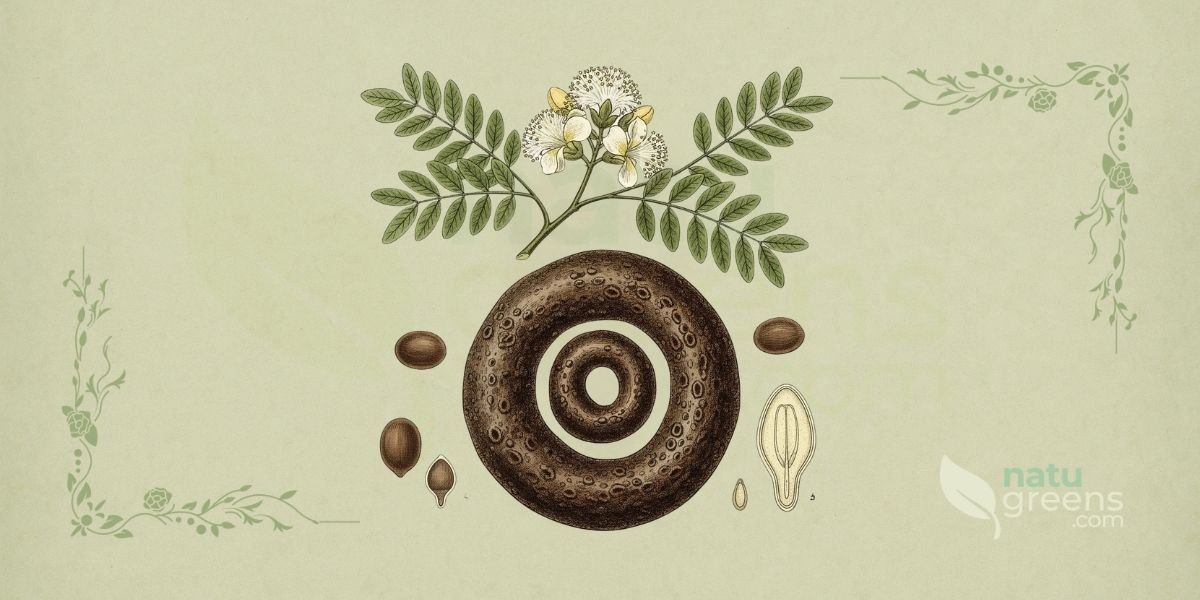
Botanical illustration of Enterolobium contortisiliquum (Vell.) Morong (earpod tree, timbaúva), a tree native to the Brazilian flora of the Fabaceae family, described by Vellozo and reclassified by Morong, showing the complete plant with bipinnate leaves, flowers in globose heads, and curved pod-shaped fruits resembling an ear, in 19th-century botanical encyclopedia style on a herbarium paper background.
The Fabaceae family, also known as Leguminosae, is one of the largest and most diverse families of flowering plants, with about 765 genera and more than 19,500 species. It is characterized by the presence of pod-shaped fruits (legumes) and by the ability of many of its species to fix atmospheric nitrogen through a symbiosis with soil bacteria. This family includes plants of great economic, food, and medicinal importance, such as beans, peas, lentils, peanuts, and various forest trees.
The earpod tree, as a member of the Fabaceae, shares these distinctive characteristics. Its ability to enrich the soil with nitrogen makes it valuable in agroforestry systems and reforestation programs. The phytochemical diversity of the family is vast, with many species producing alkaloids, flavonoids, saponins, and tannins, which confer a wide range of biological and medicinal properties.
Parts of Earpod Tree Used
- Fruit rind (pericarp)
- Roots
- Seeds
Ethnobotanical and Traditional Uses of Earpod Tree
- Antiparasitic (worms)
- Canoes and light boats (trunk)
- Charcoal production
- Civil construction
- Gonorrhea (historical record; requires medical antibiotic treatment)
- Honey production
- Pulp production
- Soap (saponins)
- Urban forestry and landscaping
Therapeutic Properties of Earpod Tree
The activities listed below come from laboratory assays on plant extracts. None of them amounts to a treatment validated in people.
- Anthelmintic (fights intestinal worms); traditional use, without established clinical efficacy
- Antibacterial (fights bacteria); traditional use, without established clinical efficacy
- Anticancer (inhibits tumour cells in laboratory studies)
- Anti-inflammatory (reduces inflammation)
- Cytotoxic (toxic to cells, including cancer cells)
- Insecticidal (kills insects)
- Larvicidal (kills larvae)
- Ovicidal (kills eggs)
Detailed Phytochemical Profile of Earpod Tree
- 9,12-Octadecadienoic acid
- Alpha-amyrin
- Amino acids (leucine, isoleucine, glutamic acid, aspartic acid)
- Beta-amyrin
- Catechin
- Flavonoids
- Gallic acid
- Glucose
- Hexadecanoic acid
- Isovitexin
- p-Coumaric acid
- Polysaccharides
- Protocatechuic acid
- Pyrogallol
- Quercetin
- Quercetin-7-O-rutinoside
- Rhamnose
- Sterols
- Syringic acid
- Triterpene saponins (bisdesmosidic and monodesmosidic, of acacic acid)
- Xylose
Preparation and Administration Forms of Earpod Tree
- Decoction (fruit rind, roots)
- Extracts (pericarp, seeds)
Synergy with Other Medicinal Plants
We publish no combinations of earpod tree with other plants for internal use. The systematic review of poisonings links the saponins of this species to severe liver damage, and adding the plant to other actives by mouth only widens a risk that has no established safe dose to begin with. Readers looking for antiparasitic or antioxidant support will find far better documented backing in species already studied in people, such as garlic (Allium sativum) or green tea (Camellia sinensis), each within its own indications and limits. For the earpod tree, what the literature supports today is phytochemical interest, not a place in any usage protocol.
Recipes and Usage Protocols of Earpod Tree
Fruit Rind Decoction for Topical Use
Ingredients: 20 g of dried earpod tree fruit rind (pericarp), 500 ml of water.
Preparation: Boil the fruit rind in water for 15 to 20 minutes. Strain and let cool. What tradition records here are compresses on intact skin. The saponins are irritant, so test a small area first, never apply the decoction to open wounds, and seek medical assessment for any lesion with pus, local warmth, or fever.
Internal Use of the Seeds: Why We Publish No Preparation
Ethnobotanical literature records the internal use of the seeds as an anthelmintic, but the systematic review of poisonings shows that the saponins of the earpod tree cause severe liver damage. We publish no preparation and no dose for internal use of this plant.
Associated Therapies
Phytotherapy
In traditional phytotherapy, the earpod tree is associated with anthelmintic, anti-inflammatory, and antimicrobial properties attributed to its saponins. There are no standardized earpod tree extracts and no clinical studies in humans. Modern literature on the species centres on the poisoning it causes, and internal use has no scientific backing. What exists today is research interest in the phytochemical profile, not a therapeutic indication.
Contraindications and Side Effects of Earpod Tree
Common Side Effects
In high doses, the saponins present in the earpod tree can cause gastrointestinal irritation, nausea, vomiting, and diarrhea. Allergic reactions, although rare, can occur in sensitive individuals, manifesting as skin rashes or itching. It is essential to watch for any adverse reaction and discontinue use immediately if undesirable symptoms occur. Consulting a healthcare professional is recommended before starting any treatment with the earpod tree.
Drug Interactions
Due to the presence of saponins, the earpod tree can interact with medications that affect intestinal absorption or liver function. It can potentiate the effect of diuretics or laxatives, and interfere with the absorption of other drugs. Patients using anticoagulants, anti-inflammatories, or medications for chronic diseases should be cautious and seek medical advice before using the earpod tree, in order to avoid adverse interactions.
General Contraindications
The earpod tree is contraindicated for pregnant and breastfeeding women, due to the lack of studies proving its safety in these groups. Individuals with pre-existing liver or kidney disease should avoid its use, as some of its compounds can overload these organs. The ingestion of large quantities of the plant, especially the pods, is known to cause toxicity in ruminants, leading to photosensitization, abortions, and severe digestive problems. Toxicity in humans is less documented than in ruminants, which does not make it less likely: given the liver damage already described, the guidance is to avoid internal consumption of the plant, not merely to moderate it.
Historical Notes and Interesting Facts about the Earpod Tree
The Brazilian name orelha-de-negro refers to the flat, spirally coiled pod, which looks like an ear, while timbaúva comes from Tupi and links the tree to the timbós, plants traditionally used as fish poison because of their saponins. That same resemblance to an ear explains both the Brazilian name orelha-de-macaco and the English earpod tree. The tree is a symbol of the Brazilian flora, present in several regions and with a history of use intertwined with local communities. Beyond its ornamental value, the earpod tree is appreciated for its light wood and for the broad shade of its crown, being frequently used in landscaping and urban forestry projects. Its presence contributes to biodiversity and to Brazilian popular culture.
Frequently Asked Questions about Earpod Tree
Is Earpod Tree Tea Safe for Human Consumption?
No. No internal preparation of earpod tree has established safety, which is why this article publishes neither a recipe nor a dose for ingestion. The systematic review of poisonings links the saponins of this species to severe liver damage, and no clinical study in people supports drinking the tea. The use tradition records, and the only one described here, is external: compresses on intact skin. With a plant that carries a documented toxicity record, the decision belongs to a healthcare professional following the case.
What Are the Main Benefits of the Earpod Tree?
What exists are activities observed in the laboratory, not benefits confirmed in people. Assays on pericarp and seed extracts describe anthelmintic, antibacterial, anti-inflammatory, and cytotoxic action, attributed mainly to triterpene saponins and flavonoids. Tradition records its use against intestinal parasites, but modern literature on the species deals chiefly with the poisoning it causes in ruminants. No safe human dosage has been established, and none of these findings has been validated as a treatment.
Can the Earpod Tree Be Used During Pregnancy?
No, the earpod tree is contraindicated for pregnant and breastfeeding women. The lack of studies proving its safety during pregnancy and breastfeeding makes its use inadvisable. Some compounds present in the plant may have effects that are not safe for fetal development or for the baby. It is essential that pregnant or breastfeeding women avoid consuming the earpod tree and always seek medical advice before using any medicinal plant.
How Does the Earpod Tree Interact with Other Medications?
Due to the presence of saponins, the earpod tree can interact with medications that affect intestinal absorption or liver function. It can potentiate the effects of diuretics and laxatives and interfere with the absorption of other drugs. The seeds show hemagglutinating activity in laboratory assays, with no known effect on blood coagulation in humans. Patients taking medications for chronic diseases should consult a healthcare professional before using the earpod tree to avoid adverse interactions and ensure the safety of the treatment.
Notice: this content is for informational purposes and does not replace professional medical advice. Consult a physician or herbal practitioner before using medicinal plants, especially during pregnancy, breastfeeding, or alongside medication.
References and Scientific Studies
Peer-Reviewed Scientific Studies (2)
- PEER2021 Bezerra, J. J. L., Pinheiro, A. A. V., & Lucena, R. B. (2021). Phytochemistry and poisoning in ruminants by Enterolobium contortisiliquum (Vell.) Morong (Fabaceae): A systematic review. Toxicon, 201, 46-53.
- PMC2023 Barros, F. B., Azevedo, F. R., Cândido, E. L., Alencar, C. H., Júnior, F. N. P., & Rodrigues, A. R. S. (2023). Phytochemical prospection, hemagglutinating and insecticidal activity of saline extracts from the seeds of Tamboril (Enterolobium contortisiliquum) Vell. Morong (Fabaceae) on Aedes aegypti (Diptera: Culicidae). Brazilian Journal of Biology, 83.
Supplementary Readings (2)
- 2002 Lorenzi, H. (2002). Árvores Brasileiras: Manual de Identificação e Cultivo de Plantas Arbóreas Nativas do Brasil. Vol. 1. Instituto Plantarum, Nova Odessa, SP.
- 2018 Matloub, A. A., Mohammed, R. S., El Souda, S. S., El-Hallouty, S. M., Gomaa, E. Z., & Hassan, A. A. (2018). Phytochemical and Biological Studies on Enterolobium contortisiliquum (Vell.) Morong Pericarps. Journal of Materials and Environmental Sciences, 9(10), 2768-2778.