Trimezia martinicensis (Jacq.) Herb. / Walking Iris is a perennial plant of the Iridaceae family. Known as the yellow walking iris, it is native to the Antilles and to the tropical Americas, from Mexico south to South America, and today it grows naturalized across much of the tropics, valued as much for its beauty as for its medicinal uses.
Its leaves are sword-shaped, like those of the iris, and the vibrant yellow flowers appear atop tall stalks. The most remarkable trait, however, is its vegetative propagation: small plantlets grow on the flower stalks themselves and take root as soon as they touch the soil, which earned the plant its popular name of “walking iris”. Ancient cultures already used it medicinally, and modern science is still investigating those applications.
Popular and International Names of Walking Iris
- English: yellow walking iris, walking iris, forenoon yellow flag, Martinique trimezia.
- Spanish: lirio caminante amarillo, iris caminante, bandera amarilla de la mañana.
- Portuguese: íris-amarela-caminhante, íris-caminhante, bandeira-amarela-da-manhã.
- French: iris jaune marchant, trimezia de la Martinique.
- Italian: iris giallo camminante, trimezia della Martinica.
- German: Gelbe Wander-Iris, Martinique-Trimezia.
Botanical Synonyms of Walking Iris
The taxonomy of Trimezia martinicensis is complex and reflects the diversity of the Iridaceae family itself. Below are the most relevant botanical synonyms:
- Cipura martinicensis (Jacq.) Kunth
- Cipura semiaperta Heynh.
- Ferraria lurida Salisb.
- Iris martinicensis Jacq.
- Lansbergia caracasana de Vriese
- Lansbergia martinicensis (Jacq.) Baker
- Marica martinicensis (Jacq.) Ker Gawl.
- Marica semiaperta G.Lodd.
- Poarchon fluminensis Allemão
- Remaclea funebris C.Morren
- Sisyrinchium fluminense Vell.
- Sisyrinchium galaxioides Gomes
- Trimezia bahiensis Ravenna
- Trimezia caracasana (de Vriese) Benth. & Hook.f. ex B.D.Jacks.
- Trimezia connata Ravenna
- Trimezia galaxioides (Gomes) Ravenna
- Trimezia lurida Salisb.
- Trimezia meridensis Herb.
- Trimezia semiaperta (G.Lodd.) Ravenna
- Tritonia riparia Cordem.
- Vieusseuxia martinicensis (Jacq.) DC.
- Xiphion martinicensis (Jacq.) Chaz.
Botanical Family: Iridaceae

Seen up close, the flower shows the pattern that sets it apart: three broad, plain outer tepals against smaller inner ones, recurved and painted in reddish brown.
Trimezia martinicensis belongs to the Iridaceae family, a diverse group of monocotyledonous plants that includes irises, crocuses, and gladioli. The family is known for its showy flowers and for storing reserves in rhizomes, corms, or bulbs. Although the Iridaceae are cosmopolitan, they are concentrated in the southern hemisphere, above all in South Africa and South America.
Cultivated above all for their ornamental value, many of these species also carry medicinal and economic importance. Flowers in the family bring together three sepals and three petals, often fused at the base, along with three stamens. Trimezia martinicensis displays all of these characteristics, and its sword-shaped leaves and yellow flowers are typical of the group.
Parts of Walking Iris Used
- Bulbs
- Leaves
- Roots
Ethnobotanical and Traditional Uses of Walking Iris
- Amenorrhea (abnormal cessation of menstruation)
- Diarrhea (an ethnobotanical record in adults; use in children is not advised, since the plant is purgative and can worsen dehydration)
- Laxative
- Oliguria (decreased urine production)
- Relief of chills
- Stomach problems
- Vermifuge
Therapeutic Properties of Walking Iris
- Antibacterial (fights bacteria); traditional use, without established clinical efficacy
- Antifungal (fights fungi)
- Anti-inflammatory (reduces inflammation)
- Astringent (contracts tissues and blood vessels, an effect attributed above all to the leaf infusion)
- Laxative (promotes bowel movements)
- Purgative (causes intense bowel evacuation, an effect attributed to the decoction of root and bulb at higher doses)
Detailed Phytochemical Profile of Walking Iris
Phytochemical research on Trimezia martinicensis is still limited. Bioactive compounds such as flavonoids, glycosides, saponins, tannins, and triterpenoids have been identified in other species of the genus, and studies on those related species suggest antimicrobial, anti-inflammatory, and antioxidant activities, which may explain part of the recorded ethnobotanical uses. Identifying the specific compounds of this species remains to be done and could open new applications.
Preparation and Administration Forms of Walking Iris
- Decoction (of the root or bulb)
- Infusion (of the leaves)
Synergy with Other Medicinal Plants
Digestive Problems
Trimezia martinicensis has laxative properties and is usually paired with carminative plants such as peppermint (Mentha piperita) or fennel (Foeniculum vulgare). The combination relieves digestive discomfort and flatulence, supports elimination, and balances the effects of each plant, which helps minimize cramps.
Infections and Inflammations
The anti-inflammatory and antibacterial properties described for the genus are what motivate external use alongside calendula (Calendula officinalis) or chamomile (Matricaria chamomilla), a locally recorded practice for wounds and insect bites that has not yet been assessed in studies.
Recipes and Usage Protocols of Walking Iris
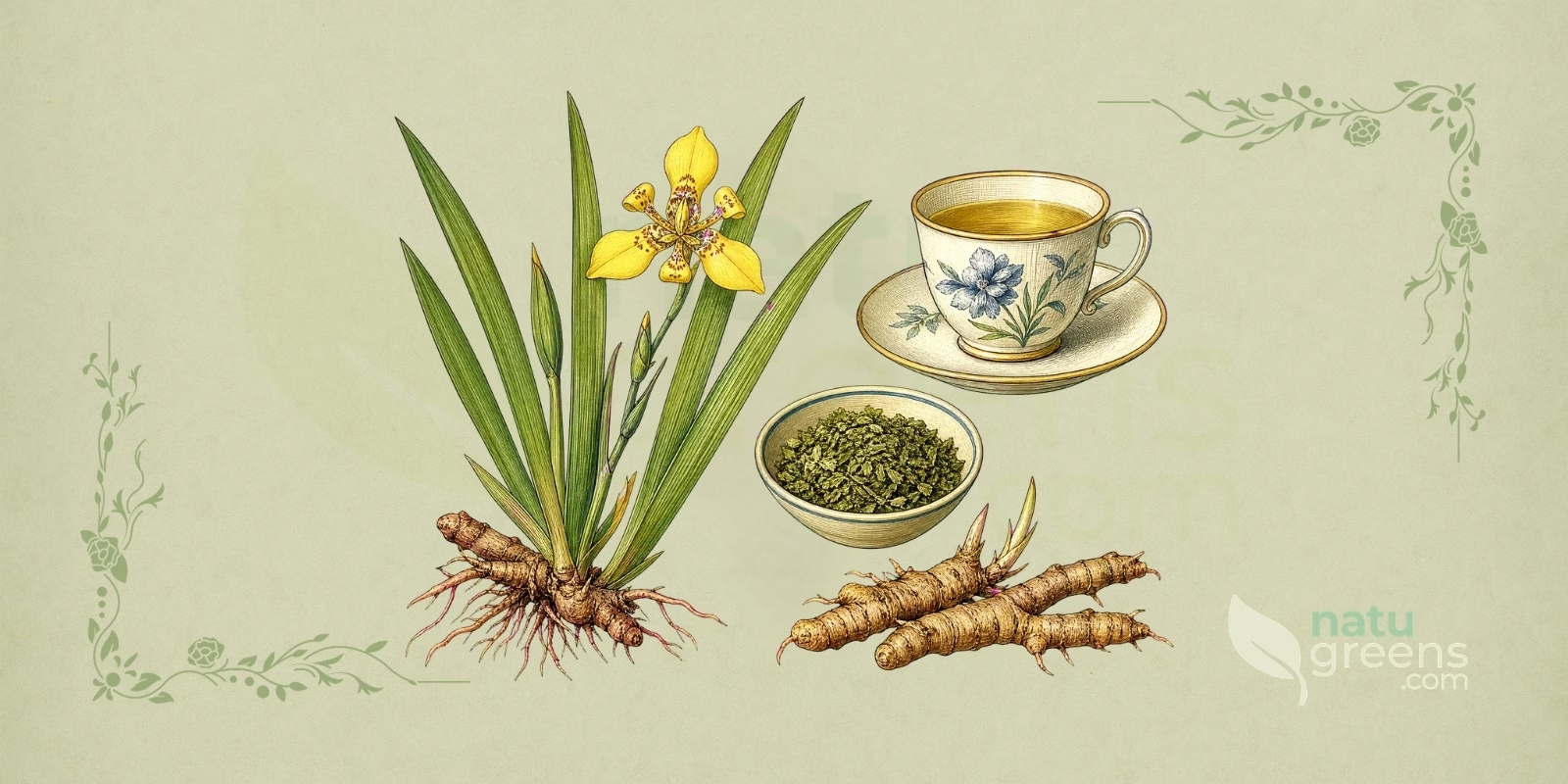
Dried leaves for the infusion, bulbs and roots for the decoction: each preparation starts from a different organ of the plant, and that choice is what sets the strength of the effect.
Decoction for Chills and as a Laxative
Ingredients: 10 to 15 grams of dried root or bulb, 500 ml of water.
Preparation: Boil the root or bulb in the water for 10 to 15 minutes, then strain and drink one cup, at most twice a day and for no more than a few days. The preparation is traditionally used for chills and as a laxative, and its purgative effects call for close attention to the dosage. Consult a healthcare professional before use.
Infusion for Stomach Problems and as a Vermifuge
Ingredients: 1 teaspoon of dried leaves, 250 ml of boiling water.
Preparation: Add the boiling water to the leaves and let steep for 5 to 10 minutes, then strain and drink warm. Tradition employs it for stomach problems and as a vermifuge. Consult a healthcare professional before use.
Associated Therapies
Phytotherapy
In phytotherapy, Trimezia martinicensis is used for gastrointestinal disorders, above all as a laxative or purgative, and always under the supervision of a phytotherapist, who adjusts dosages and combinations. The plant is also valued for its astringent and anti-inflammatory properties.
Traditional Medicine
Across Latin America and the Caribbean the plant gathers a range of uses: in Trinidad it is employed for oliguria and amenorrhea, and in Guatemala for diarrhea and stomach problems. These applications reflect an old body of empirical knowledge.
Contraindications and Side Effects of Walking Iris
The laxative properties call for caution: avoid the plant during pregnancy and breastfeeding, in children, and in cases of inflammatory bowel disease. Excessive use can cause dehydration and cramps. Consult a healthcare professional before use.
Historical Notes and Interesting Facts
Trimezia martinicensis is often confused with the genus Neomarica, since both go by the name “walking iris”. Its way of propagating is what draws the most attention: new plantlets are born on the flower stalks and take root when they touch the soil, which helped make it a popular ornamental. Native to the Americas, it is today naturalized in many parts of the world.
Frequently Asked Questions about Walking Iris
Is the Walking Iris Safe for Consumption?
Its medicinal use requires caution, because the laxative effects are potent. The plant is not recommended without professional supervision, and should be avoided by pregnant women, breastfeeding mothers, and children.
What Are the Main Ornamental Uses of the Plant?
It is widely used in tropical landscaping, where the yellow flowers and the foliage carry the visual appeal. It suits flowerbed borders and rock gardens well, and can also be grown in pots.
How Did the Plant Get the Name “Walking Iris”?
The name comes from its peculiar propagation: plantlets are born on the flower stalks, the stalks bend until they touch the ground, and there the plantlets take root. That is how the plant “walks” across the bed.
Notice: this content is for informational purposes and does not replace professional medical advice. Consult a physician or herbal practitioner before using medicinal plants, especially during pregnancy, breastfeeding, or alongside medication.
References and Scientific Studies
Peer-Reviewed Scientific Studies (1)
- DOI Standley, Paul C., and Julian A. Steyermark. Flora of Guatemala. Fieldiana: Botany, 1946-. ↗.
Supplementary Readings (3)
- Teixeira da Fonseca, Eurico. Indicador de madeiras e plantas uteis do Brasil. Officinas graphicas Villas-Boas & Co., 1922. ↗.
- 1959 Uphof, J. C. Th. Dictionary of Economic Plants. H. R. Engelmann (J. Cramer), 1959. ↗.
- Royal Botanic Gardens, Kew. “Trimezia martinicensis (Jacq.) Herb.” Plants of the World Online. ↗.