Quick summary
Lonicera japonica Thunb. / Japanese Honeysuckle, commonly known as Japanese honeysuckle, Jin Yin Hua (Chinese) or Ren Dong, is a climbing plant of the Caprifoliaceae family, native to East Asia, that has held a prominent place in Traditional Chinese Medicine (TCM) for centuries. Its fragrant white flowers, which turn…
Main caution: There are no safety data on the use of Lonicera japonica during pregnancy and breastfeeding, so pregnant and breastfeeding women should avoid the plant, and it should not be given to children without professional…
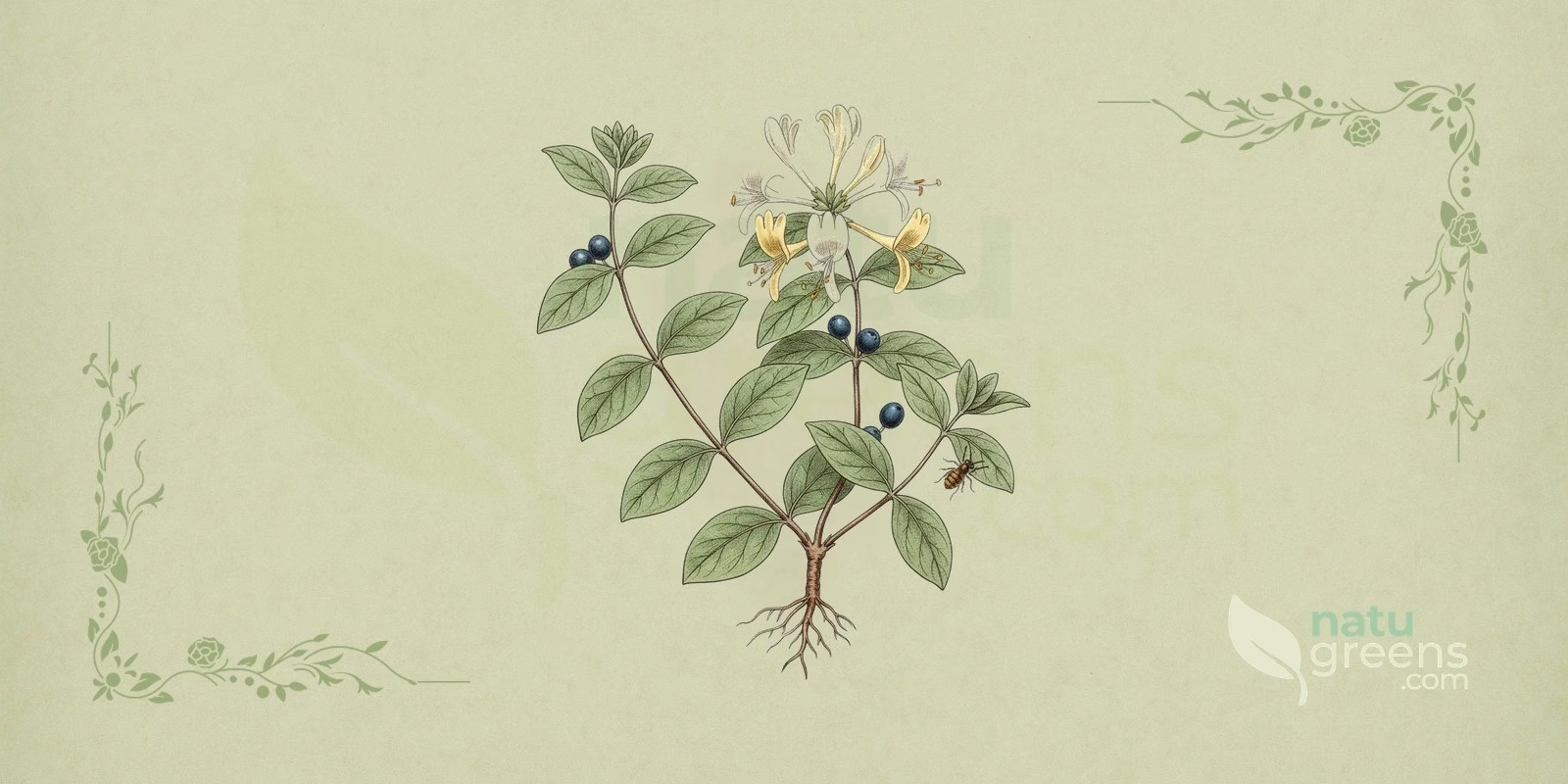
Lonicera japonica Thunb. / Japanese Honeysuckle, commonly known as Japanese honeysuckle, Jin Yin Hua (Chinese) or Ren Dong, is a climbing plant of the Caprifoliaceae family, native to East Asia, that has held a prominent place in Traditional Chinese Medicine (TCM) for centuries. Its fragrant white flowers, which turn yellowish with age, are harvested while still in bud to make infusions, extracts and other herbal products, and it is precisely this flower bud that the Chinese Pharmacopoeia lists as the official herbal drug, called "Jin Yin Hua".
In TCM, Japanese honeysuckle ranks among the most important remedies of the tradition, used to "clear heat" and "expel superficial pathogens", concepts that the classical texts associate with fevers, epidemic febrile diseases, sores, carbuncles and various infections. Laboratory and animal studies are now investigating a wide range of bioactive compounds in the plant with anti-inflammatory, antibacterial and antioxidant activity, although these findings have not yet been confirmed by robust clinical trials. Beyond its value in traditional medicine, Lonicera japonica is grown as an ornamental and appears in cooking and in the cosmetics industry, but it is also recognized as an invasive species in Brazil, the United States and other countries, which calls for caution before planting it.
Popular and International Names of Japanese Honeysuckle
- English: Honeysuckle, Japanese honeysuckle.
- Chinese: Jin Yin Hua (金银花), Ren Dong (忍冬).
- French: Chèvrefeuille du Japon.
- German: Japanisches Geißblatt.
- Italian: Caprifoglio giapponese.
- Portuguese: Madressilva-de-inverno, Madressilva-do-japão, Madressilva-japonesa.
- Spanish: Madreselva, Madreselva japonesa.
Botanical Synonyms of Lonicera japonica
The accepted scientific name is Lonicera japonica Thunb., and the botanical synonyms recorded for the species include the following:
- Lonicera chinensis Watson
- Lonicera flexuosa Thunb.
- Lonicera japonica var. chinensis (Watson) Baker
- Lonicera japonica var. flexuosa (Thunb.) Hemsl.
- Lonicera repens G.Don
Botanical Family: Caprifoliaceae
The Caprifoliaceae, known as the honeysuckle family, comprise about 860 species in 42 genera, distributed mainly across the temperate regions of the Northern Hemisphere, and consist largely of woody plants such as shrubs and climbers, with the occasional herb. Many species are valued for their ornamental flowers and for fruits that attract wildlife, and Lonicera japonica shares the morphological traits typical of the group, such as tubular, bisexual flowers and berry-like fruits.
The Caprifoliaceae produce a range of bioactive compounds, including iridoids, saponins, flavonoids and phenolic acids, which help explain the medicinal interest in several of their species. This chemical diversity has been the subject of ongoing pharmacological research, since different members of the family are used in the traditional medicine of many cultures, albeit with quite distinct uses and safety profiles.
Parts of Japanese Honeysuckle Used
- Essential oil (obtained from the flowers)
- Flowers (above all the flower buds, which make up the official drug "Jin Yin Hua", and also the open flowers)
- Leaves
- Stems and branches (traditionally used in TCM under the name Ren Dong)
The fruits of Lonicera japonica itself, small black berries, are not edible and play no part in traditional use, which focuses on the flower bud and the stem.
Ethnobotanical and Traditional Uses
The uses below reflect records from traditional medicine, chiefly Chinese, and are not equivalent to clinically proven indications:
- Beverages and traditional food preparations
- Cosmetics for skin care and oral hygiene
- Detoxification, in the sense of the TCM concept of "clearing heat and resolving toxicity"
- Fevers and colds (traditional record)
- Gastrointestinal complaints (traditional record)
- Skin infections and inflammation (traditional record)
- Sore throat and cough (traditional record)
- Sores, ulcers and carbuncles (traditional topical use)
Therapeutic Properties of Japanese Honeysuckle
The properties listed below have been described mainly in laboratory studies, in animal models and in compound TCM formulas, so none of them should be read as a proven effect in humans:
- Antibacterial (activity against Gram-negative and Gram-positive bacteria observed in vitro, without clinical confirmation)
- Anti-inflammatory (reduction of inflammatory markers in laboratory and animal studies)
- Antioxidant (free radical scavenging in in vitro assays)
- Antiproliferative (activity observed in laboratory studies, without clinical confirmation)
- Antiviral (activity observed only in vitro and in animal models, without clinical confirmation)
- Hepatoprotective (liver protection described in animal models)
- Hypoglycemic (lower blood glucose observed in preliminary animal studies)
- Hypolipidemic (lower blood lipids in preliminary animal studies)
- Immunomodulatory (stimulation of the immune response described in animal studies)
Detailed Phytochemical Profile of Japanese Honeysuckle
Lonicera japonica contains a wide variety of bioactive compounds, and the main groups described in the literature are the following:
- Essential Oils: dihydrocarveol, ethyl palmitate, hexadecanoic acid, linalool, octadecadienoic acid.
- Flavonoids: corymbosin, hyperoside, luteolin-7-O-α-d-glucoside, luteolin-7-O-β-d-galactoside, quercetin-3-O-β-d-glucoside, 5-hydroxy-3′,4′,7-trimethoxyflavone.
- Iridoids: ketologanin, kingiside, loganin, secologanin, secologanoside, secoxyloganin, sweroside, 7α-morroniside, 7β-morroniside.
- Organic Acids: caffeic acid, chlorogenic acid (considered one of the main active constituents and used as a quality marker for the drug), hexadecanoic acid, isochlorogenic acid, myristic acid.
- Saponins: mainly of the oleanane and hederagenin types.
- Others: lonijaposides, nucleosides, polysaccharides, shuangkangsu and 15 trace elements (Fe, Mn, Cu, Zn, Ti, Sr, Mo, Ba, Ni, Cr, Pb, V, Co, Li, Ca).
The composition varies between flowers, stems and leaves, which explains why Chinese tradition distinguishes the use of each part and why the Chinese Pharmacopoeia adopts the flower bud as the reference drug.
Preparation and Administration Forms of Japanese Honeysuckle
- Capsules and tablets
- Decoction
- Essential oil (for external use or aromatherapy only)
- Extracts (fluid, dry)
- Infusion (tea)
- Syrups
- Tinctures
- Topical preparations (compresses, creams, ointments)
Synergy with Other Medicinal Plants
Respiratory Infections and Fevers
In TCM, Lonicera japonica is traditionally combined with Forsythia suspensa (Fructus Forsythiae), a pairing that forms the basis of the classical formula Yin Qiao San, recorded in Chinese tradition for colds, flu and feverish conditions. Forsythia is described in that tradition as having the same action of "clearing heat" and "resolving toxicity", which is why the two plants appear side by side in many formulas, although the efficacy of the combination in humans still depends on more consistent clinical studies.
Inflammation and Pain
In Western herbalism, Lonicera japonica is sometimes paired with plants such as Harpagophytum procumbens (devil's claw) or Salix alba (white willow), traditionally used for joint and muscle pain. The rationale for this pairing is theoretical: white willow contains salicin, while Japanese honeysuckle contributes iridoids and flavonoids that have shown anti-inflammatory activity in the laboratory, but no published studies have evaluated this specific combination in people.
Immune Support
Lonicera japonica is also paired with Astragalus membranaceus (astragalus), a plant that TCM traditionally uses as a tonic and whose immunomodulatory properties are under study. One record of this combination comes from aquaculture, where adding both plants to the feed of Nile tilapia was associated with a stronger non-specific immune response and greater resistance to infection in the fish, a result that cannot be transferred directly to humans.
Recipes and Usage Protocols of Japanese Honeysuckle
Traditional Infusion for Colds and Sore Throats
This infusion is traditionally used in TCM for colds, sore throat and fever, and should be prepared with dried flower buds of verified origin identified as "Jin Yin Hua".
Ingredients: 1 to 2 teaspoons of dried Lonicera japonica flowers, 200 ml of boiling water, honey (optional, never for children under 1 year old).
Preparation: Add the flowers to the boiling water, cover and leave to steep for 10 to 15 minutes. Strain and sweeten with honey if desired. How often and for how long to drink it should be decided with guidance: consult a health professional.
Traditional Topical Compress for the Skin
The flower and leaf compress is traditionally applied in TCM to superficial sores and skin irritation, always on intact skin around small lesions with no signs of serious infection.
Ingredients: 2 tablespoons of dried Lonicera japonica flowers and leaves, 500 ml of water.
Preparation: Boil the flowers and leaves in the water for 15 minutes, strain and let the decoction cool. Soak a clean cloth in the liquid and apply it to the area for 15 to 20 minutes. Stop using it if redness, itching or any other sign of allergy appears.
Traditional Syrup for Cough and Congestion
This syrup reproduces a preparation traditionally used for cough and respiratory congestion, in which a concentrated decoction of the flowers is preserved in honey.
Ingredients: 50 g of dried Lonicera japonica flowers, 500 ml of water, 250 g of honey.
Preparation: Make a concentrated decoction by boiling the flowers in the water for 20 minutes. Strain, add the honey and warm gently until it dissolves completely. Store in a sterilized glass jar in the refrigerator. Do not give it to children under 1 year old because of the honey, and agree on the amount and duration of use with a health professional.
The preparations above follow traditional records and do not replace professional guidance. Before any internal use, check the contraindications and interactions described in this article.
Associated Therapies
Traditional Chinese Herbal Medicine (TCM)
In TCM, Lonicera japonica is one of the pillars of formulas aimed at conditions classified as "heat" and "toxins", and it appears frequently in complex preparations recorded for febrile syndromes, infections and inflammation. The action of "clearing heat and resolving toxicity" is the central concept guiding this use, which ranges from acute infections to skin diseases, and the tradition values the plant for its ability, according to its own principles, to act on several body systems and balance energy.
Western Herbalism
In Western herbalism, Lonicera japonica is known for the anti-inflammatory, antibacterial and antiviral activities described in laboratory studies, and it appears in standardized extracts or tinctures used to support the immune system and in upper respiratory tract complaints. Modern research has focused on identifying and isolating active compounds such as chlorogenic acid, but translating these results into clinical practice still depends on trials in humans.
Veterinary Applications
Lonicera japonica has been studied as a feed additive in aquaculture and livestock farming, including in fish such as Nile tilapia, with the aim of supporting gut health and disease resistance. The immunostimulant and antibacterial effects observed in these studies have led researchers to investigate the plant as a possible alternative to conventional antibiotics in animal production, a line of research that is still in development.
Contraindications and Side Effects of Japanese Honeysuckle
General Contraindications
There are no safety data on the use of Lonicera japonica during pregnancy and breastfeeding, so pregnant and breastfeeding women should avoid the plant, and it should not be given to children without professional guidance either. An allergic reaction is possible, and anyone with a known allergy to plants of the Caprifoliaceae family should avoid all preparations. Chinese tradition contraindicates the plant in cases of diarrhea due to "spleen and stomach cold", a TCM-specific classification that should be understood as a traditional record.
Interactions and Precautions
Because animal studies describe hypoglycemic and hypolipidemic effects, people taking glucose-lowering medication for diabetes or cholesterol medication should consult a doctor before using the plant, and the same applies to anyone with pre-existing medical conditions or taking other medicines. The evidence for the antimicrobial and anti-inflammatory action of Japanese honeysuckle comes from in vitro studies, animal models and compound TCM formulas, so the plant should not be regarded as a natural antibiotic or as an antiviral, and it must never replace medical treatment of an infection.
Distinction from Other Species
European honeysuckles, such as Lonicera periclymenum, Lonicera caprifolium and Lonicera xylosteum, have toxic fruits and different traditional uses, and they are not interchangeable with Lonicera japonica. The fruits of Japanese honeysuckle itself, black berries, are not edible either, since only the flower (bud) and the stem are used traditionally. Since 2005 the Chinese Pharmacopoeia has separated "Jin Yin Hua" (Lonicera japonica) from "Shan Yin Hua" (Lonicera macranthoides, Lonicera hypoglauca and others), which has a different chemical composition, and because the trade sometimes confuses the two, it is worth checking the botanical identity of the product.
Side Effects
The side effects reported for Lonicera japonica are rare and generally mild, and may include gastrointestinal discomfort. Acute and subacute toxicity studies in rats indicated low toxicity even at high oral doses, but the authors themselves point to the need for chronic toxicity studies to confirm long-term safety.
Invasive Plant
Japanese honeysuckle is a recognized invasive plant in Brazil, the United States and other countries, capable of spreading over and smothering native vegetation when it escapes cultivation. For this reason, planting it in open ground or in an unmanaged garden is not recommended, and anyone who already has the plant should keep it from escaping into neighboring properties and natural areas.
Historical Notes and Interesting Facts
The Chinese name Jin Yin Hua literally means "gold and silver flower", a reference to the flowers that open white and turn yellowish with age, so that the same stem displays both colors at once. The name Ren Dong, used mainly for the stems, means "the one that endures winter", alluding to the foliage the plant keeps through much of the cold season.
The formula Yin Qiao San, which brings together Japanese honeysuckle and forsythia, is one of the best-known classical combinations in Chinese herbal medicine and is still found in TCM manuals. In 2005, the Chinese Pharmacopoeia began officially distinguishing "Jin Yin Hua", obtained from Lonicera japonica, from "Shan Yin Hua", obtained from other species of the genus, a separation prompted by the differences in chemical composition between the two drugs.
Taken from Asia to other continents as an ornamental plant prized for the scent of its flowers, Japanese honeysuckle eventually escaped from gardens and now appears on the invasive species lists of several countries, including Brazil. More recently, the plant has also been studied as an additive in animal feed, a field in which researchers are looking for alternatives to the routine use of antibiotics in livestock farming.
Frequently Asked Questions about Japanese Honeysuckle
What Is Japanese Honeysuckle?
Japanese honeysuckle (Lonicera japonica Thunb.) is a climber of the Caprifoliaceae family, native to East Asia, with tubular flowers that open white and turn yellowish. In Traditional Chinese Medicine, the flower bud is the official herbal drug known as "Jin Yin Hua", listed in the Chinese Pharmacopoeia.
Which Part of Japanese Honeysuckle Is Used?
Traditional use focuses on the flower bud and the stem, and the leaves also appear in some preparations. The fruits, small black berries, are not edible and play no part in the traditional use of the plant.
Is Japanese Honeysuckle the Same as European Honeysuckles?
No. European honeysuckles, such as Lonicera periclymenum, Lonicera caprifolium and Lonicera xylosteum, have toxic fruits and different traditional uses, and they are not interchangeable with Lonicera japonica. Nor should "Jin Yin Hua" be confused with "Shan Yin Hua", which is obtained from other Lonicera species and has a different chemical composition.
Does Japanese Honeysuckle Have Proven Antibiotic Action?
No. The evidence for antimicrobial and anti-inflammatory action comes from in vitro studies, animal models and compound TCM formulas, without confirmation in clinical trials with the plant on its own. For this reason it should not be regarded as a natural antibiotic or as an antiviral, and it never replaces medical treatment of an infection.
Can Pregnant and Breastfeeding Women Use Japanese Honeysuckle?
There are no safety data on the use of the plant during pregnancy and breastfeeding, so it should be avoided at these stages. People allergic to plants of the Caprifoliaceae family, children and those taking medication for diabetes also need professional guidance before using any preparation.
Can I Grow Japanese Honeysuckle in My Garden?
Japanese honeysuckle is a recognized invasive plant in Brazil, the United States and other countries, and it can spread over native vegetation. For this reason, planting it in open ground or in an unmanaged garden is not recommended, and anyone who already has the plant should keep it from escaping into natural areas.
Notice: this content is for informational purposes and does not replace professional medical advice. Consult a physician or herbal practitioner before using medicinal plants, especially during pregnancy, breastfeeding, or alongside medication.
How to cite this article
NATUGREENS. Japanese Honeysuckle (Lonicera japonica): Properties and Benefits. Natugreens, 8 Nov. 2026. Disponível em: https://natugreens.com/lonicera-japonica-japanese-honeysuckle/. Accessed: Nov. 8, 2026.
Natugreens. (2026). Japanese Honeysuckle (Lonicera japonica): Properties and Benefits. Natugreens. https://natugreens.com/lonicera-japonica-japanese-honeysuckle/
References and Scientific Studies
- PMC2011 Shang X, et al. Lonicera japonica Thunb.: ethnopharmacology, phytochemistry and pharmacology of an important traditional Chinese medicine. J Ethnopharmacol. 2011.
- PMC2016 Zhao YY, et al. Research progress on pharmacological effects and their differences among the flowers, stems and leaves of Lonicera japonica. Zhongguo Zhong Yao Za Zhi. 2016.
- PMC2021 Tang X, et al. Potential Application of Lonicera japonica Extracts in Animal Production: From the Perspective of Intestinal Health. Front Microbiol. 2021.
- PMC2023 Yang X, et al. Extraction, Purification, Structural Characteristics, Health Benefits, and Application of the Polysaccharides from Lonicera japonica Thunb.: A Review. Molecules. 2023.