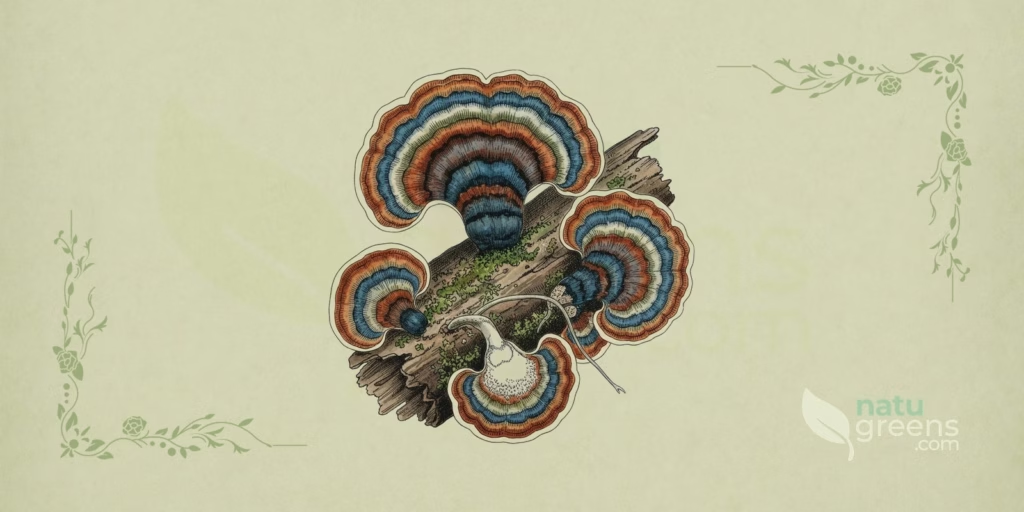
Trametes versicolor (L.) Lloyd / Turkey Tail, popularly known as turkey tail, is a common polypore mushroom of the Polyporaceae family. This species was described by Carl Linnaeus as Boletus versicolor in 1753 and later transferred to the genus Trametes by Curtis Gates Lloyd. It is found in many regions of the world. Trametes versicolor is recognized for its remarkable therapeutic properties. Its fan-shaped structures, with concentric bands of varied colors, are harvested for the preparation of extracts and other herbal products.
In traditional medicine, especially in China, the turkey tail mushroom has a documented history in the Chinese materia medica reaching back to the sixteenth century, when it was recorded in the Bencao Gangmu. Its applications range from immune support to adjuvant treatment in oncology. Modern scientific research has validated many of the traditional uses of Trametes versicolor, consolidating its position as one of the most studied and most widely used medicinal mushrooms in the world.
Popular and International Names of Turkey Tail
- English: turkey tail, cloud mushroom, Japanese ladies fan.
- Spanish: yesquero de colores, yesquero multicolor.
- Portuguese: cogumelo-cauda-de-peru, cauda-de-peru.
- French: tramète versicolore, tramète à couleur changeante.
- Italian: coda di tacchino.
- German: Schmetterlingstramete, Bunte Tramete.
- Japanese (Kampo): kawaratake.
- Chinese (TCM): yun zhi.
Taxonomic Synonyms of Turkey Tail
The name Trametes versicolor (L.) Lloyd is the accepted and most common name in the scientific literature. However, this species has a wide range of synonyms, reflecting its complex taxonomic history and different classifications over time. Among the most frequently encountered synonyms are Coriolus versicolor (L.) Quél. and Polyporus versicolor (L.) Fr. These denominations are widely used in older publications and in some regions.
Other synonyms include Agaricus versicolor (L.) Lam., Bjerkandera versicolor (L.) P.Karst., Boletus versicolor L., and Polystictus versicolor (L.) Fr. The diversity of names underscores the ubiquity of and scientific interest in this mushroom. Its current classification as Trametes versicolor is the most recognized globally.
Classification and Family: Polyporaceae
The Polyporaceae family belongs to the order Polyporales, within the class Agaricomycetes and the phylum Basidiomycota. This family is characterized by mushrooms that produce spores in pores on the underside of the cap. Many members of the Polyporaceae are wood decomposers, playing a crucial role in forest ecosystems by contributing to nutrient cycling and soil health.
Trametes versicolor is a prominent example of this family, sharing typical morphological features such as its leathery texture and fan shape. The Polyporaceae family is known for producing bioactive compounds, including polysaccharides and triterpenes, which confer medicinal properties on many of its species. Pharmacological research has focused on the chemical diversity of this family, contributing to the development of phytomedicines and dietary supplements.
Parts of Turkey Tail Used
- Fruiting body (mushroom)
Ethnobotanical and Traditional Uses of Turkey Tail
- Elimination of dampness and wind in TCM
- Immune system regulation
- Invigoration of the spleen in TCM
- Longevity support
- Promotion of general well-being
- Relief of coughs and breathing difficulty
- Treatment of infectious diseases
Therapeutic Properties of Turkey Tail
- Anticancer (under study for inhibition of carcinogenesis and under study for antimetastatic effects)
- Antidiabetic (under study for its effect on blood sugar control)
- Antifibrotic (prevents excessive fibrous tissue formation)
- Anti-inflammatory (reduces inflammatory processes)
- Antimicrobial (fights pathogenic microorganisms); traditional use, without established clinical efficacy
- Antioxidant (fights free radicals)
- Immunomodulatory (modulates and strengthens the immune system); traditional use, without established clinical efficacy
- Wound healing (promotes wound healing)
Detailed Chemical Profile of Turkey Tail
- Alkaloids
- Anthraquinones
- Beta-glucans
- Flavonoids
- Phenolic compounds
- Polysaccharides (PSK, PSP)
- Proteins
- Saponins
- Tannins
- Triterpenoids
Note: classes such as alkaloids, anthraquinones, flavonoids, saponins, and tannins are typical of vascular plants, and their presence in polypores is poorly documented; the constituents consistently described in this species are the beta-glucans and the polysaccharide-protein complexes PSK and PSP.
Preparation and Administration Forms of Turkey Tail
- Extracts (powder, capsules)
- Teas (infusions)
- Tinctures (liquid extractions)
Synergy with Other Plants and Mushrooms
Immune Support and General Well-Being
Combining Trametes versicolor with Hericium erinaceus (lion’s mane), Ophiocordyceps sinensis or Cordyceps militaris (cordyceps), and Ganoderma lucidum (reishi) is common in commercial formulations, although the combined effect has not yet been measured in clinical studies. The support for neuronal health attributed to some medicinal mushrooms is described for Hericium erinaceus, not for Trametes versicolor. Studies are investigating Trametes versicolor as an adjuvant to chemotherapy drugs, including paclitaxel; because these are narrow-therapeutic-window medications, any combination can only exist by decision of and under monitoring by the oncologist. This application is particularly relevant in Traditional Chinese Medicine (TCM). The combination can improve treatment efficacy and potentially mitigate some adverse effects. However, its use must always be supervised by a qualified health professional, as interaction with conventional treatments requires caution.
Recipes and Usage Protocols of Turkey Tail
Turkey Tail Tea
To prepare a tea, use 1 to 4 grams of dried mushroom per cup of hot water. Steep for 10 to 15 minutes. Strain and drink. It can be taken 1 to 3 times a day for immune support and general well-being. For a more pleasant flavor, add honey or lemon. This tea is a traditional way to enjoy the mushroom’s benefits.
Turkey Tail Tincture
Tinctures are concentrated liquid extractions of the mushroom, usually administered in drops. Always follow the manufacturer’s instructions for correct dosing. They can be taken sublingually or diluted in water. Tinctures offer a practical, effective way to consume the active compounds of Trametes versicolor, with fast, efficient absorption.
Associated Therapies
Herbal Medicine
Trametes versicolor is a valuable component of modern herbal medicine, used in various forms such as standardized extracts and supplements. Its immunomodulatory activity is the most studied of its effects, and its adjuvant use in oncology remains under clinical investigation, always as a complement and never as a substitute for the treatment prescribed by a doctor. Herbal medicine is based on the use of medicinal plants and fungi, and the turkey tail mushroom is a classic example of an organism with broad therapeutic application, widely studied and applied.
Traditional Chinese Medicine (TCM)
In TCM, Trametes versicolor, known as yun zhi, has documented use reaching back to the sixteenth century, when it was recorded in the Bencao Gangmu. It is valued for invigorating the spleen, eliminating dampness and wind, and relieving coughs. TCM integrates the mushroom into complex formulations to balance the body and promote health. Its use in TCM reflects deep knowledge of its properties, passed down through generations of practitioners within a holistic approach to treatment.
Integrative Oncology
Trametes versicolor is widely investigated in integrative oncology, used as an adjuvant in cancer treatments. Its polysaccharides, such as PSK and PSP, are studied for their ability to modulate the immune response. They can improve the quality of life of patients undergoing chemotherapy and radiotherapy. Integrative oncology combines conventional therapies with complementary approaches, aiming to optimize results and reduce side effects. The turkey tail mushroom is a promising example in this field.
Contraindications and Side Effects of Turkey Tail
Trametes versicolor is generally well tolerated by most people. However, like any bioactive substance, it can present some contraindications and side effects. Being aware of these possibilities is important, and consulting a health professional is always recommended before starting any supplementation.
Possible Side Effects
In rare cases, mild gastrointestinal discomfort can occur, including diarrhea, dark stools, or nausea. These symptoms are usually transient and disappear when use is stopped. Nail changes have also been reported, but are uncommon. If any of these effects persist, seek medical advice.
Drug Interactions
Trametes versicolor can interact with certain medications. It may reduce the effectiveness of immunosuppressant medications, since it stimulates the immune response, so transplant recipients and people with autoimmune disease should not use it without their treating physician’s authorization. Patients undergoing chemotherapy or taking anticoagulants should tell their doctor before starting any supplementation, since data on interactions with these medications remain scarce. Interaction with conventional treatments must be carefully evaluated. Medical supervision is essential.
Historical Notes and Interesting Facts about Turkey Tail
Origin of the Name
The scientific name versicolor means “of several colors”, befitting the mushroom’s vibrant, multicolored appearance. Its concentric bands display a range of tones, resembling the tail of a turkey. This distinctive feature makes it easy to identify in the wild, and the popular name turkey tail is a direct reference to this visual resemblance.
Global Presence and Habitat
Trametes versicolor is one of the most common and most widely distributed mushrooms in the world. It grows on dead wood, mainly of deciduous trees, and can be found in forests on every continent except Antarctica. Its ubiquity and its ability to decompose wood make it a vital element in ecosystems, and its presence is an indicator of healthy forests. It is a robust, adaptable mushroom.
Ancient Use in Eastern Medicine
Known as yun zhi in China and kawaratake in Japan, the turkey tail mushroom has a long history of medicinal use. In China, it has been recorded in the materia medica since the Bencao Gangmu of 1578. In Japan, it was incorporated into cancer treatment programs decades ago. Its importance in Eastern medicine is immense; it is a symbol of health and longevity where tradition and science converge.
Frequently Asked Questions about Turkey Tail
Is Turkey Tail Edible?
Yes, Trametes versicolor is edible, but it is generally not eaten for its texture. Its consistency is quite tough and leathery, making it unpalatable. It is more common to use it as teas, extracts, or tinctures, in which its medicinal compounds are extracted and concentrated. The focus is on its therapeutic benefits, not its culinary value. It is a functional mushroom.
Where Does Turkey Tail Grow?
Trametes versicolor is a saprophytic mushroom. It grows on dead wood, mainly on trunks and branches of deciduous trees, and is common in forests and woodlands. It prefers humid, shady environments. Its ability to decompose wood contributes to ecosystem health. It is a very adaptable, resilient mushroom, found at various altitudes and in various climates.
How Do I Identify Turkey Tail?
Identifying Trametes versicolor rests on distinctive features. It has a fan or semicircular shape, with concentric bands of varied colors that can include shades of brown, gray, blue, and green. The underside of the mushroom is porous, without gills. Its texture is leathery and flexible. Foraging still calls for care with the lookalikes: Stereum ostrea has a smooth underside, and Trichaptum biforme shows purplish, irregular pores. Only a white, finely porous surface confirms the species.
Notice: this content is for informational purposes and does not replace professional medical advice. Consult a physician or herbal practitioner before using medicinal plants, especially during pregnancy, breastfeeding, or alongside medication.
References and Scientific Studies
Peer-Reviewed Scientific Studies (6)
- PMC2020 Habtemariam, S. (2020). Trametes versicolor (Synn. Coriolus versicolor) Polysaccharides in Cancer Therapy: Targets and Efficacy. Biomedicines.
- DOI2024 Ajibola, O. O., et al. (2024). Turkey tail mushroom (Trametes versicolor): an edible macrofungi with immense medicinal properties. Current Opinion in Food Science.
- PMC2019 Benson, K. F., et al. (2019). The mycelium of the Trametes versicolor (Turkey tail) mushroom and its fermented substrate each show potent and complementary immune activating properties in vitro. BMC Complementary and Alternative Medicine.
- DOI2025 Lodi, R. S., et al. (2025). Current research on the medical importance of Trametes species. Fungal Biology Reviews.
- DOI2024 Camilleri, E., et al. (2024). A comprehensive review on the health benefits, phytochemicals, and enzymatic constituents for potential therapeutic and industrial applications of Turkey tail mushrooms. Discover Applied Sciences.
- PMC2020 Lam, C. S., et al. (2020). Herb-drug interactions between the medicinal mushrooms Lingzhi and Yunzhi and cytotoxic anticancer drugs: a systematic review. Chinese Medicine.
Supplementary Readings (1)
- Global Biodiversity Information Facility (GBIF). Trametes versicolor (L.) Lloyd. GBIF Backbone Taxonomy.