The cape jasmine (Gardenia jasminoides J.Ellis) is an evergreen shrub of the family Rubiaceae, the same lineage that gave us coffee, cinchona and ipecac, and probably the best known case of a plant that conquered the West through its scent long before botany made any sense of it. The white, waxy flowers stand singly at the branch tips and give off a heavy perfume that builds through the late afternoon and can fill an entire garden on its own. It was that smell, and not the leaf or the fruit, that secured the species a permanent place in temperate gardening across almost every continent.
Its native range lies on the opposite side of the world from the common name it carries in English and in Portuguese. According to Plants of the World Online, published by the Royal Botanic Gardens, Kew, the original distribution runs from the Eastern Himalaya through central and southern China, reaches Indochina and ends in southern Japan, always within the subtropical belt. The name cape jasmine preserves the memory of the trade route that carried the first plants to Europe, with a stop at the Cape of Good Hope, rather than any African origin.
Morphologically, the real interest of the species lies less in the showy flower than in the fruit. While the corolla lasts only a few days before collapsing into a yellowish cream, the ribbed berry ripens slowly, takes on a deep orange tone and stays attached to the shrub for months, the persistent calyx still crowning its tip. That fruit underpins the long economic history of the plant in East Asia, where the pigments it accumulates have supplied dye houses and kitchens for centuries.
The cape-jasmine reached Western gardens through its scent long before botany had made sense of the species.
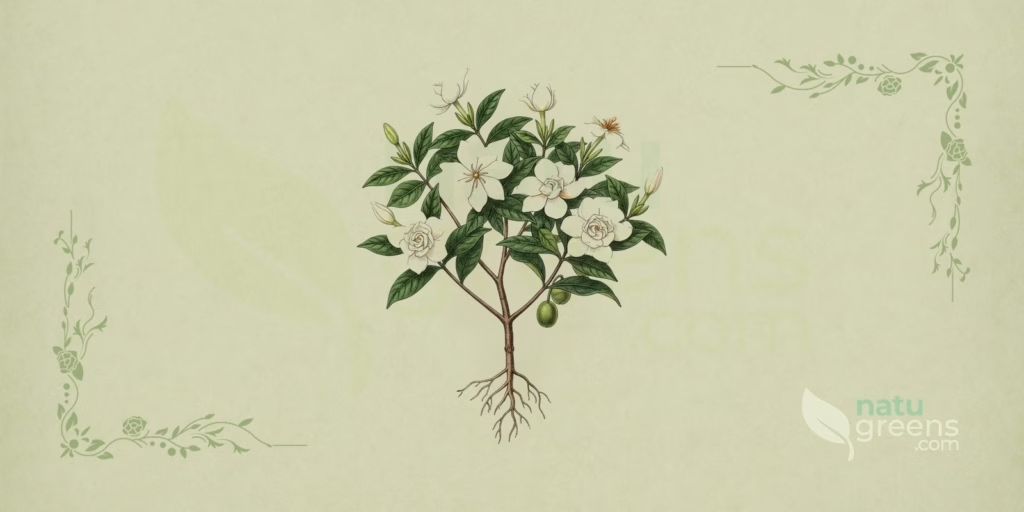
Cape-jasmine flowers open white and waxy at the branch tips, and their perfume builds through the late afternoon.
Taxonomy
The accepted name is Gardenia jasminoides J.Ellis, published in the Philosophical Transactions of the Royal Society of London, volume 51, part 2, page 935, in 1761. The record appears in the International Plant Names Index under identifier 751073-1, and Plants of the World Online confirms the binomial as accepted, with no fewer than fifty-six associated synonyms, the legacy of two and a half centuries of parallel descriptions produced by European, Japanese and Taiwanese authors working on cultivated material.
The full classification, following the taxonomic backbone adopted by Kew, runs as follows:
- Kingdom: Plantae
- Phylum: Streptophyta
- Class: Equisetopsida
- Subclass: Magnoliidae
- Order: Gentianales
- Family: Rubiaceae
- Tribe: Gardenieae
- Genus: Gardenia J.Ellis, 1761
- Species: Gardenia jasminoides J.Ellis, 1761
The genus Gardenia brings together more than a hundred accepted species spread across the tropical and subtropical regions of Africa, Asia, Australasia and the Pacific islands. The tribe Gardenieae, to which it belongs, has traditionally been placed in the subfamily Ixoroideae, although the internal boundaries of the Rubiaceae have been under revision by molecular phylogenetic work since the 2000s.
Homotypic Synonyms
Founded on the same nomenclatural type as the name of Ellis, all published as superfluous and therefore illegitimate names:
- Gardenia augusta Merr., Interpr. Herb. Amboin.: 485 (1917), nom. illeg. superfl.
- Gardenia florida L., Sp. Pl., ed. 2: 305 (1762), nom. illeg. superfl.
- Genipa florida Baill., Hist. Pl. 7: 307, 379 (1880), nom. illeg. superfl.
Principal Heterotypic Synonyms
Of the fifty-three recognised heterotypic synonyms, those with the widest circulation in horticultural and floristic literature are:
- Gardenia grandiflora Lour., Fl. Cochinch.: 147 (1790)
- Gardenia maruba Siebold ex Blume, Bijdr. Fl. Ned. Ind.: 1015 (1826)
- Gardenia pictorum Hassk., Flora 28: 234 (1845)
- Gardenia radicans Thunb., Gardenia: 11 (1780)
- Jasminum capense Mill., Gard. Dict., ed. 8: no. 7 (1768)
- Mussaenda chinensis Lour., Fl. Cochinch.: 152 (1790)
- Varneria augusta L., Amoen. Acad. 4: 136, 138 (1759), genus not validly published
It is worth noting that Gardenia augusta circulated for decades as though it were the correct name of the species, above all in the Australian and North American literature of the second half of the twentieth century, and it still turns up on nursery labels and in trade catalogues. It is a superfluous name with no priority over that of Ellis, and its use today is considered incorrect.
Etymology of the Binomial
The generic name honours Alexander Garden (1730-1791), a Scottish physician and naturalist settled in Charleston, South Carolina, and a diligent correspondent of Linnaeus and of John Ellis. It was, however, a second choice. Ellis had meant to name the genus Warneria, after Richard Warner, the English horticulturist in whose garden the studied specimen flowered, but Warner declined the honour. Linnaeus, for his part, had already used the spelling Varneria in 1759 without valid generic publication, and he vetoed the alternative name Augusta that Ellis proposed. The epithet jasminoides means jasmine-like, a direct reference to the scent and to the look of the corolla, even though the two plants belong to distinct families and are not closely related.
Morphological Description
An evergreen shrub of variable stature, between 0.3 and 3 metres tall depending on the form and on growing conditions, densely branched from the base and forming a rounded, compact crown. Young shoots are cylindrical and puberulent, turning glabrous and greyish as they become woody. The creeping forms, corresponding to the old Gardenia radicans Thunb., barely exceed half a metre and spread sideways, whereas vigorous specimens of the typical form comfortably grow taller than a person.
Leaves
- Arrangement: opposite or gathered in whorls of three
- Blade: 3 to 25 centimetres long by 1.5 to 8 centimetres wide
- Domatia: tufts of hairs frequent in the vein axils on the lower surface
- Margin: entire
- Petiole: short, up to 0.5 centimetre, rarely 1 centimetre
- Secondary veins: 8 to 15 pairs, prominent on the lower surface
- Shape: oblong-lanceolate, obovate, oblanceolate or elliptic, with an acute to acuminate apex and a cuneate base
- Stipules: calyptrate, fused into a cylindrical sheath 4 to 13 millimetres long and split for about three quarters of its length, a diagnostic character of the Rubiaceae
- Texture and colour: chartaceous to subcoriaceous, dark green and glossy above, paler and dull beneath
Flowers
The flowers are borne singly at the branch tips, rarely in the upper axils, and open in sequence over several weeks. Each one lasts two to four days, and the shift from pure white to yellowish cream marks the end of anthesis with almost clockwork precision.
- Calyx: tubular and ribbed, with 5 to 8 linear lobes reaching 40 millimetres and persisting on the fruit
- Corolla: white when it opens, salverform, the cylindrical tube 30 to 50 millimetres long by 4 to 6 millimetres across, with a hairy throat
- Corolla lobes: usually 6, varying from 5 to 8 in wild forms, obovate, 15 to 40 millimetres by 6 to 28 millimetres, and very numerous in the double garden forms
- Ovary: inferior, unilocular, with parietal placentation
- Scent: intense and sweet, peaking in the late afternoon and at night
- Stamens: inserted at the throat of the tube, with subsessile linear anthers
Fruits and Seeds
- Colour: yellow to yellowish orange when ripe, darkening as it dries out
- Persistent calyx: linear lobes that stay erect at the tip of the mature fruit
- Pulp: orange and strongly staining, marking fingers and fabric with ease
- Ribs: 5 to 9 prominent longitudinal ridges, sometimes winged
- Seeds: numerous, flattened and angular, embedded in the pulp
- Type and size: an ovoid, subglobose or ellipsoid berry, 1.5 to 7 centimetres long by 1.2 to 2 centimetres wide
Root and Stem
The root system is fibrous and shallow, with most of the absorbing roots concentrated in the top twenty centimetres of soil, an arrangement that explains why the species is equally sensitive to waterlogging and to a substrate that dries out quickly. The stem is woody, with smooth brown bark, and it resprouts readily from the base after pruning, which accounts for the longevity of cultivated specimens. The prostrate forms root at nodes in contact with the ground, a habit that gave rise to the epithet radicans.
Distribution and Habitat
The native distribution recognised by Plants of the World Online covers Cambodia, the Eastern Himalaya, Hainan, Japan, Laos, north-central China, south-central China, south-east China, Taiwan, Thailand and Vietnam. This is therefore a species with a broad Asian span, its centre of genetic diversity lying in southern China, where wild populations occupy the belt south of the Yangtze and show considerable morphological variation in leaf and fruit size.
Beyond that range, Kew records established introductions in Bangladesh, the Caroline Islands, the Comoros, Korea, the Mariana Islands, the Marshall Islands, the Society Islands and the Tubuai Islands. The pattern is telling: the species establishes itself above all in humid tropical and subtropical archipelagos, where ornamental cultivation came before escape. There is no record of aggressive invasive behaviour in any of these territories, and local spread tends to stay close to inhabited areas. In Brazil, where it ranks among the most widely planted ornamentals in gardens and along pavements, no naturalisation has been recorded.
Its original habitat consists of humid forested slopes, forest margins, bamboo thickets, stream banks and open ground on permanently moist soil, at elevations ranging from near sea level to about 1,500 metres. The preferred climate is humid subtropical, with hot summers, mild winters and well distributed rainfall of between 1,000 and 2,000 millimetres a year. The most rigid soil requirement of the species is acidity: it thrives on acid, organically rich, free-draining soils and responds badly to calcareous substrates or to a pH above 7.
Cultivation of Cape-Jasmine
Commercial propagation is carried out almost entirely from semi-ripe cuttings, ten to fifteen centimetres long, taken in late spring and summer and kept under mist with bottom heat. Rooting takes six to eight weeks and becomes more uniform with a rooting agent. Air layering works well for multiplying large mature specimens without waiting for young plants to grow on, and sowing, although possible, is slow and uneven, with irregular germination spread over thirty to sixty days, which is why it remains confined to breeding programmes. In regions with alkaline soil, grafting onto Gardenia thunbergia is a long established nursery practice, adopted precisely to get around the intolerance of the original rootstock to high pH.
The growing requirements are well understood and none too flexible. The plant asks for full sun in mild climates and shade during the hottest afternoon hours in tropical ones, an acid substrate between pH 5.0 and 6.5, steady moisture without waterlogging, and shelter from drying winds. Cool nights favour bud formation, which explains the more generous flowering seen in southern and south-eastern Brazil compared with regions where nights stay warm. Bud drop before opening is the commonest complaint among gardeners and usually follows a sharp swing in temperature, irregular watering, or a change of position while the flower buds are forming.
Its health record centres on a handful of recurring problems:
- Iron chlorosis: interveinal yellowing of the young leaves on alkaline soil, the most frequent physiological disorder of the species
- Mealybugs and scale insects: they colonise the underside of the leaves and the branch axils, and their sugary excretion opens the way for fungi
- Root rot: caused by soil fungi of the genus Phytophthora in compacted or waterlogged substrates
- Sooty mould: a superficial black coating associated with scale insects, aphids and whiteflies
- Spider mites: common in dry, sheltered settings, causing bronzing and premature leaf fall
- Whitefly: infests the underside of the leaves under protected cultivation and in close plantings
Among the most widespread garden forms are ‘August Beauty’, with a long flowering season and medium stature, ‘Chuck Hayes’, selected for cold hardiness, ‘Kleim’s Hardy’, compact and single flowered, ‘Mystery’, with large double flowers, ‘Radicans’, dwarf and creeping, and ‘Veitchii’, the commonest in pot production. Where the fruit is harvested for pigment extraction, picking takes place in late autumn and winter, with the fruits fully orange and still firm on the branch.
Phenology
In its native range the species flowers from March to July, peaking between April and June, and fruiting runs from May through to February of the following year, which means that flowers and fruits from successive crops share the same shrub for much of the year. In the southern hemisphere the calendar shifts to spring and summer, with flowering concentrated between October and March and the fruit ripening through autumn and winter.
Floral biology points to night pollination. The white corolla with its long narrow tube, the late afternoon anthesis and the release of a scent that intensifies as darkness falls make up the classic profile of flowers adapted to long-tongued moths, hawkmoths above all, although bees and other daytime insects do visit newly opened flowers in search of pollen. Natural dispersal is attributed to fruit-eating birds, which fits a fleshy, brightly coloured fruit that persists on the branch through the winter, even if field records are scarce for a plant that has long been multiplied above all by the hands of horticulturists. The double garden forms, with stamens converted into petals, are largely sterile and rarely set fruit.
Related Species and Confusions
Within the genus, three species regularly turn up alongside the cape jasmine in collections and nurseries. Gardenia thunbergia Thunb., from South Africa, is told apart at a glance by its tree-like stature, which can reach five metres, by its much longer and narrower floral tube and by its hard woody fruit, which stays on the plant for years. Gardenia taitensis DC., the tiare of the South Pacific and the emblematic flower of Tahiti, has larger and more membranous leaves and a corolla of broad flat lobes, always single. Gardenia volkensii K.Schum., from the African savannahs, has a branched, twisted habit and fruits with a rigid rind, and nobody who has seen the two side by side would mistake it for the Asian species.
Outside the genus, confusions are more frequent and carry more weight:
- Camellia japonica L. (Theaceae): the white double-flowered cultivars look like a gardenia from a distance, but the camellia has no perceptible scent, its leaves have a serrate margin and its ovary is superior
- Jasminum sambac (L.) Aiton (Oleaceae): flowers equally white and fragrant, but arranged in cymes rather than borne singly, with thin rather than leathery leaves and a climbing or scrambling habit
- Tabernaemontana divaricata (L.) R.Br. ex Roem. & Schult. (Apocynaceae): the double-flowered variety is the most deceptive lookalike in Brazilian gardens, where it goes by the names jasmim-café and jasmim-leiteiro
The decisive distinction from Tabernaemontana is simple and immediate: any broken branch or leaf bleeds a white, milky latex, entirely absent in the Rubiaceae. That latex, characteristic of the Apocynaceae, contains alkaloids and irritates the skin and mucous membranes, which is why telling the two apart is more than a point of identification trivia. The petals of Tabernaemontana are also slightly twisted, with a pinwheel look, whereas those of the gardenia overlap in a regular spiral.
Phytochemistry
The chemical profile of Gardenia jasminoides is dominated by two groups of compounds concentrated in the fruit: the iridoid glycosides and the water-soluble carotenoids. Among the iridoids, geniposide is the major component, accompanied by gardenoside, geniposidic acid and shanzhiside, along with genipin, the aglycone released by hydrolysis of geniposide. Among the carotenoids, crocin and its aglycone crocetin account for the deep yellow-orange of the pulp, and they are exactly the same pigments that colour true saffron, obtained from the stigmas of Crocus sativus, a plant from an entirely different family.
These compounds are unevenly distributed through the plant. The iridoids and carotenoids accumulate above all in the pericarp and pulp of the ripe fruit, with far lower levels in leaves and shoots. The leaves concentrate triterpenes, ursolic acid among them, together with flavonoids and chlorogenic acids. The flowers, for their part, contribute nothing to the pigment picture and make up a chapter of their own: the floral essential oil brings together benzyl acetate, benzyl alcohol, cis-jasmone, linalool and alpha-terpineol, the combination behind the olfactory signature that perfumery has been trying to reproduce since the nineteenth century, direct extraction on an industrial scale having never proved viable.
Genipin has one striking and well documented chemical property: on contact with primary amino acids and proteins it reacts to form stable blue pigments. It is that reaction, and not any pre-existing pigment, that lies behind the colourant known as gardenia blue, used in the Asian food industry. From the same fruit, then, come a direct yellow and a blue obtained by reaction, which makes the species a remarkably versatile industrial source of natural colourants.
As for animal safety, the record is plain and belongs in the present tense: the species appears on the lists of plants toxic to dogs, cats and horses maintained by the ASPCA Animal Poison Control Center, which identifies geniposide and gardenoside as the responsible principles, with mild vomiting, diarrhoea and hives described after ingestion.
History and Ethnobotany
The documentary trail of the species begins in East Asia long before any European record. The dried fruits appear under the name zhi zi (栀子) in Chinese materia medica compilations from at least the first century, with a mention in the Shennong Bencao Jing, and they remained catalogued in the imperial pharmacopoeias throughout the two millennia that followed. In parallel, and with equally old documentation, the fruit was employed as a source of yellow dye by Chinese dyers, who used it to colour silk and cotton fabrics.
In Japan, where the plant is called kuchinashi, the same fruit entered the kitchen and has stayed there. The pulp colours traditional preparations such as kuri kinton, the chestnut sweet of the new year, and takuan, pickled daikon, as well as rice and noodles. That culinary use survived industrialisation and today sustains commercial plantings in China and Japan devoted to extracting pigment for the food and cosmetics industries.
The species reached Europe around the first half of the eighteenth century, along the routes of the Dutch and English trading companies that operated between Asia and the Atlantic with a stop at the Cape of Good Hope. It was from a specimen grown in England that John Ellis dissected the flower, realised the plant was unrelated to the true jasmines and proposed, in 1761, the genus that now bears the name of Alexander Garden. Over the following decades the gardenia became a status symbol in European glasshouse horticulture, and in the nineteenth century it crossed the Atlantic to settle in the gardens of the American South, where it was grown on a large scale on the estates of South Carolina, Georgia and Louisiana.
In the twentieth century the flower gained a second cultural life as personal adornment. It served as the standard buttonhole of men’s formal dress until the 1950s and became indelibly associated with the singer Billie Holiday, who wore it pinned in her hair on stage, to the point where the gardenia turned into part of her public visual identity.
Conservation
The species has no published global assessment on the IUCN Red List, and a search of the database returns no entry for the binomial, a situation that formally places it as Not Evaluated (NE). Nor does it appear in any CITES appendix, so there is no international restriction on trade in plants, seeds or fruits.
The absence of an assessment is not in itself a sign of concern. The species has a wide native distribution, occurs in several Asian countries and is grown on an industrial scale in China, Japan and Korea for pigment production, besides being one of the most widely propagated ornamentals in the world in commercial nurseries. That combination makes its persistence practically independent of the fate of the wild populations, which face the usual pressures of habitat conversion in southern China. Ex situ conservation is robust and passive: botanic garden collections, germplasm banks held by Asian agricultural institutions and the sheer scale of ornamental cultivation do the job between them.
The contrast with other species in the genus, however, is stark. Several island Gardenia have naturally tiny ranges and a critical situation, most notably Gardenia brighamii H.Mann, endemic to Hawaii and reduced to a few dozen wild individuals, dependent on reinforcement planting and on protection from introduced herbivores. The comfortable margin enjoyed by the cape jasmine, then, does not extend to the genus it represents in the popular imagination.
Interesting Facts
- The Japanese name kuchinashi means, literally, without a mouth, an allusion to a fruit that ripens without splitting open, unlike dehiscent capsules that release their seeds through slits.
- The synonym Jasminum capense Mill., of 1768, and the English common name cape jasmine record the trade route rather than the origin: the first plants reached Europe on ships that called at the Cape of Good Hope, and for a long time the species was believed to be African.
- The crocin in gardenia fruit is the same pigment found in saffron stigmas, which makes the fruit a far cheaper industrial source of the same colouring molecule, albeit without the characteristic aroma of the spice.
- The gardenia perfume sold in the shops is almost always a synthetic reconstruction. The flower does not yield essential oil in economically viable quantities, and the industry works with accords built from benzyl acetate, linalool and other molecules identified in analysis of the natural scent.
- Ellis came close to naming the genus Warneria, after the owner of the plant he studied. The refusal of that honour gave the world the name that stuck, taken from a Scottish naturalist who lived on the other side of the Atlantic and probably never saw the species alive.
Notice: this content is for informational purposes and does not replace professional medical advice. Consult a physician or herbal practitioner before using medicinal plants, especially during pregnancy, breastfeeding, or alongside medication.
References and Scientific Studies
View All 9 Cited References
- ASPCA Animal Poison Control Center. Toxic and Non-Toxic Plant List: Gardenia jasminoides. American Society for the Prevention of Cruelty to Animals. Available at ↗
- Ellis, J. An account of the plants Halesia and Gardenia. Philosophical Transactions of the Royal Society of London, 51(2): 929-935, 1761.
- 1993 Iwatsuki, K., Yamazaki, T., Boufford, D. E. & Ohba, H. (eds.). Flora of Japan IIIa: 1-482. Kodansha, Tokyo, 1993.
- POWO. Gardenia jasminoides J.Ellis. Plants of the World Online, Royal Botanic Gardens, Kew. Available at ↗
- The International Plant Names Index. Gardenia jasminoides J.Ellis, record 751073-1. Available at ↗
- 2026 The IUCN Red List of Threatened Species. Search for the name Gardenia jasminoides, with no global assessment published as of August 2026. Available at https://www.iucnredlist.org/search?query=Gardenia jasminoides
- Thunberg, C. P. Gardenia: 1-19. Dissertation presented at Uppsala University, 1780.
- 2011 Wu, Z., Raven, P. H. & Hong, D. (eds.). Flora of China, vol. 19: Rubiaceae, 1-884. Science Press, Beijing, and Missouri Botanical Garden Press, St. Louis, 2011.
- 2017 Xiao, W., Li, S., Wang, S. & Ho, C. T. Chemistry of Gardenia jasminoides Ellis. Journal of Food and Drug Analysis, 25(1): 43-61, 2017.