Ocimum tenuiflorum is a perennial aromatic herb of the Lamiaceae, the same lineage as rosemary, mint and sage, and in the household landscapes of South Asia it holds a position that almost no other cultivated plant has ever reached. It grows as a roadside weed and as a temple courtyard plant at the same time, and this double standing as ruderal herb and ritual species has followed it since the earliest European botanical records from India. Its most widespread common name, tulsi, comes from the Sanskrit tulasi and travelled along with the plant into practically every part of the tropics.
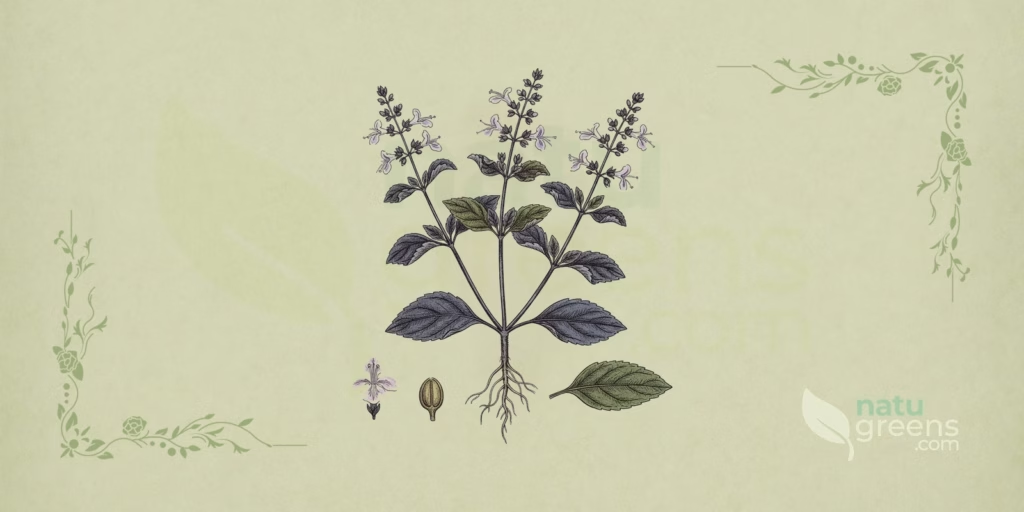
Morphologically it is a small labiate with a square stem and softly hairy leaves, and its most immediate trait is the scent. Crushing a leaf releases an olfactory profile dominated by eugenol, the same compound that gives clove its character, over a peppery base that sets the species apart from culinary basil at the very first rub between the fingers. That chemical signature is the most practical field criterion for separating it from its close relatives, and it is also the reason the species matters to the essential oil industry.
This profile brings together the formal botanical information on the species: accepted nomenclature and synonymy, detailed morphological description, natural and naturalised range, cultivation requirements, phenology, documented chemical composition, historical record and conservation status.
Taxonomy
The accepted name is Ocimum tenuiflorum L., published by Carl Linnaeus in the second volume of Species Plantarum, page 597, in 1753. The full hierarchy runs as follows, from kingdom to species.
- Kingdom: Plantae
- Division: Magnoliophyta (angiosperms)
- Class: Magnoliopsida (eudicots)
- Order: Lamiales
- Family: Lamiaceae
- Subfamily: Nepetoideae
- Tribe: Ocimeae
- Genus: Ocimum L., 1753
- Species: Ocimum tenuiflorum L., 1753
The synonymy of the species is long, the outcome of independent descriptions drawn up in distant regions by authors who had no way of comparing material. The names below are treated today as heterotypic synonyms of the accepted name, in alphabetical order.
- Moschosma tenuiflorum (L.) Heynh.
- Ocimum caryophyllinum F.Muell.
- Ocimum flexuosum Blanco
- Ocimum hirsutum Benth.
- Ocimum inodorum Burm.f.
- Ocimum monachorum L.
- Ocimum sanctum L.
- Ocimum tomentosum Lam.
- Ocimum villosum Roxb.
The oddest entry on that list is Linnaeus himself, who described the same plant twice. In 1767 he published Ocimum sanctum without realising that the taxon had already been named fourteen years earlier. Under the principle of priority of the International Code of Nomenclature the older name prevails, yet English-language literature and the Ayurvedic bibliography enshrined the epithet sanctum, and it still turns up on commercial labels and in outdated databases.
As for etymology, the generic name Ocimum is a Latinisation of the Greek okimon, a word that in Antiquity covered basil-like aromatic herbs without the precision of a modern specific name. The epithet tenuiflorum combines tenuis, Latin for slender or thin, with flos, floris, meaning flower. The reference is to the small size of the corollas, which rarely exceed four millimetres.
Morphological Description
An aromatic perennial herb or subshrub with a semi-woody base, generally between 30 and 100 centimetres tall, branching freely from the lower third upwards. Grown in a pot it tends to stay at the bottom of that range; in deep soil and warm weather it reaches full size within a single season. The whole plant gives off a strong scent when touched, and the downy indumentum lends the young parts a greyish cast.
Leaves
The leaves are opposite and decussate, with a petiole 1 to 3 centimetres long. The blade is ovate to elliptic, measuring 2.5 to 5 centimetres long by 1 to 3 centimetres wide, with an acute to obtuse apex, a cuneate base and a serrate margin that becomes almost entire on the upper leaves. Both surfaces are pubescent and carry punctate oil glands visible against the light, corresponding to the peltate glandular trichomes in which the essential oil accumulates. Colour varies with the cultivated line, from uniform light green to a deep purple that extends to the stems and bracts as well.
Flowers
The flowers are gathered into verticillasters of roughly six units, spaced along terminal racemes 5 to 15 centimetres long. The calyx is campanulate and two-lipped, about 2 millimetres at anthesis and lengthening to 4 or 4.5 millimetres in fruit, when the suborbicular, apiculate upper lip curves back over the developing nutlets. The corolla is 3 to 4 millimetres long, purple to lilac-pink and occasionally whitish, with a tube shorter than the calyx and a limb divided into two lips. The four stamens are didynamous and exserted, declined over the lower lip, and the style is gynobasic with a bifid stigma, an arrangement typical of the subfamily Nepetoideae.
Fruits and Seeds
The fruit is a schizocarp that breaks up into four nutlets sheltered by the persistent calyx. Each nutlet measures about 1.3 by 0.9 millimetres, is ovoid-elliptic in outline and faintly reticulate on the surface, ranging in colour from light brown to nearly black at maturity. The pericarp produces mucilage as soon as it meets water, a phenomenon known as myxocarpy, and the seed becomes wrapped in a translucent gelatinous layer within seconds of immersion.
Root and Stem
The root system is a taproot when the plant comes from seed, with lateral roots concentrated in the upper twenty centimetres of soil; specimens raised from cuttings develop a fibrous, shallower system, a detail that matters for drought tolerance. The stem is distinctly square in cross section, grooved on the faces and covered with simple trichomes, turning semi-woody and greyish at the base in plants more than a year old.
Distribution and Habitat
The native range recognised by Plants of the World Online covers tropical and subtropical Asia through to the western Pacific, a broad territory taking in the Andaman and Nicobar Islands, Bangladesh, Borneo, Cambodia, India, Java, Laos, Maluku, Myanmar, Nepal, New Guinea, Pakistan, the Philippines, Queensland, the Solomon Islands, South China, Sri Lanka, Sulawesi, Sumatra, Taiwan, Thailand and Vietnam. Such an extent raises an open question about how much of the present distribution reflects natural dispersal and how much results from millennia of human transport tied to household cultivation.
Beyond its native range the species has escaped from cultivation and naturalised across much of the tropics, with established populations in the Caribbean, Central and South America, East Africa, Polynesia and the southern United States. Compendia of introduced species record agricultural and environmental weed behaviour in Cuba, Guam, parts of Malaysia and Puerto Rico, where it colonises roadsides, abandoned ground and field margins. In Brazil it occurs as a cultivated plant and occasionally as a garden escape near vegetable plots and backyards, with no formal invasion risk assessment published so far.
Ecologically it favours open, disturbed ground with fertile, well-drained soil and a pH between 6.0 and 7.5, and it occurs from sea level up to around 1,800 metres. The favourable thermal range lies between 20 °C and 35 °C, and the plant suffers leaf damage below 10 °C. Frost kills the aerial parts, which confines perennial cultivation to tropical and subtropical regions and turns the species into a summer annual in temperate climates.
Cultivation
The commonest method of propagation is by seed, sown on the surface or merely pressed against moist substrate, since germination is favoured by light. At temperatures between 20 °C and 25 °C the seedlings emerge in seven to fourteen days, with no need for stratification or any pre-treatment. The vegetative alternative is a herbaceous cutting of eight to ten centimetres taken from branches that have not yet flowered, which roots in two to three weeks and reproduces the colour and aromatic profile of the mother plant faithfully.
Field requirements are modest and come down to full sun, drainage and regular watering. Six hours of direct sun a day sustain compact, well-branched plants; under shade the stem grows leggy and the density of glandular trichomes falls. Waterlogged soils encourage root rot, and excess nitrogen produces lush foliage with a diluted aroma. Removing the inflorescences from time to time keeps the plant in a vegetative phase for longer and delays the ageing of the branches.
Among the phytosanitary problems, the most frequent in dense plantings are fusarium wilt caused by Fusarium oxysporum f. sp. basilici, which brings on vascular wilting and darkening of the stem, and downy mildew from Peronospora belbahrii, recognisable by yellowish blotches bounded by the veins and by greyish sporulation on the underside. Mites, whiteflies and aphids colonise new shoots and inflorescences, and damping-off in the seedbed follows from overwatering combined with poor ventilation. Rotating the plot and allowing generous spacing settle most of these cases without chemical intervention.
Commercial harvesting is done by cutting branches at the onset of flowering, the moment when essential oil yield in the leaves peaks. Tropical plantings allow three or more cuts a year from the same clump, with vigorous regrowth whenever the cut leaves a few basal nodes intact.
Phenology
In the humid tropics the species flowers almost year round, with a clear peak during and just after the rainy season. The cycle is quick: under warm conditions, seed-grown plants begin flowering six to eight weeks after emergence, which explains how readily the plant establishes itself on freshly disturbed ground. Where the dry season is pronounced, flowering concentrates in the months of greatest water availability and the aerial parts may dry back partially during the unfavourable period.
Pollination is predominantly entomophilous, with frequent visits from bees of the genera Apis and Xylocopa, drawn by the nectar that gathers at the base of the corolla tube. Floral architecture nonetheless favours self-pollination as well, because the declined stamens sit close to the stigma within the same flower, and high rates of selfing have been documented in the species. This combination of insect visitation and autogamy sustains seed production even in isolated populations or in urban pots without abundant pollinators.
Dispersal is essentially barochorous, the nutlets dropping at the foot of the plant when the dry calyx opens. The mucilage released by the pericarp makes the seeds stick to damp soil, to animal feet and to vehicle tyres, which widens the effective reach of dispersal considerably in human-altered environments and helps explain the distribution of the species along roads.
Related Ocimum Species and Confusions
The genus Ocimum holds dozens of tropical species of similar appearance, and identification from a photograph of a single leaf is far from reliable. Scent, the size of the fruiting calyx and the adult habit reliably separate the species most common in the nursery trade.
- Ocimum americanum L.: smaller and more delicate in habit, with a marked citrus scent and narrow leaves, often sold as lemon basil.
- Ocimum basilicum L.: larger, broader leaves that are glabrous and glossy, an aniseed scent with no clove note, generally white flowers and a visibly larger fruiting calyx.
- Ocimum campechianum Mill.: a Neotropical species with membranous leaves and a milder scent, common as a ruderal in Brazilian urban areas.
- Ocimum gratissimum L.: a subshrub reaching 2 metres or more, with leaves 5 to 12 centimetres long, frankly woody stems and a long, branched inflorescence.
- Ocimum kilimandscharicum Gürke: an unmistakable camphor scent and greyish leaves owing to the dense indumentum.
One naming muddle deserves particular attention because it circulates in retail. The label vana tulsi, handled in catalogues as though it were a variety of Ocimum tenuiflorum, in practice corresponds to Ocimum gratissimum, a distinct species of far greater stature. Any buyer expecting a pot herb and receiving a two-metre shrub has fallen victim to that slip.
Outside the genus, the likeliest look-alike in Brazil is Mesosphaerum suaveolens, known there as hortelã-brava, an aromatic ruderal labiate whose juvenile stage shows a square stem and ovate, serrate leaves of similar appearance. The distinction is made at flowering, because hortelã-brava bears bluish flowers in axillary cymes and a fruiting calyx with long, rigid teeth, quite unlike the short, recurved calyx of tulsi. The scent differs too: hortelã-brava smells resinous and harsh, with no clove note.
Phytochemistry
Essential oil content in the leaves and inflorescences generally lies between 0.2% and 1.5% of fresh weight, concentrated in the peltate glandular trichomes of the epidermis. In most populations studied the major component is eugenol, a phenylpropanoid that can exceed 60% of the volatile fraction and accounts for the clove note. It is accompanied by beta-caryophyllene, beta-elemene, germacrene D and methyl eugenol, with linalool and other monoterpenes in smaller proportions. The literature describes distinct chemotypes within the species, some dominated by eugenol and others by methyl eugenol, with variation tied both to geographic origin and to the cultivated line.
One of those components warrants a plain safety note. Methyl eugenol was classified by the International Agency for Research on Cancer in Group 2A, probably carcinogenic to humans, in the assessment published as volume 134 of the monographs, and European flavouring legislation prohibits adding it to food. The classification concerns the isolated substance and the level of exposure, not a verdict on the plant.
The non-volatile fraction is dominated by phenolic and triterpenic compounds. Documented among them are rosmarinic acid, a phenolic ester common in the Nepetoideae, the triterpenic acids oleanolic and ursolic, and a set of flavones that includes apigenin, cirsimaritin, luteolin, orientin and vicenin. Young leaves and bracts tend to concentrate more phenolics than mature leaves, and the proportion shifts over the cycle, with maximum values close to the onset of flowering. The seeds store fixed oil in which polyunsaturated fatty acids predominate, together with an outer layer of mucilaginous polysaccharides responsible for the myxocarpy described above.
History and Ethnobotany
The relationship between the species and the societies of South Asia is an ancient one, recorded in both textual and material sources. The classical treatises of the Indian medical tradition, among them the Charaka Samhita and the Sushruta Samhita, listed the plant among the botanical species of interest, and later compilations of Sanskrit materia medica repeated those entries across the centuries. None of this amounts to guidance for use: it is historical documentation of the place the plant occupied within a specific body of knowledge.
On the religious side, the Vaishnava tradition identifies the plant with the goddess Vrinda, associated with Lakshmi, and household cultivation took on a codified ritual form. Hindu families kept, and in many places still keep, a specimen planted in a raised masonry structure in the central courtyard of the house, the tulsi vrindavan, tended with ritual watering and a lamp lit at nightfall. The Tulsi Vivah ceremony, a symbolic marriage of the plant to an image of Vishnu celebrated at the close of the rainy season, marks the opening of the wedding season in the traditional calendar. Rosaries of beads turned from the lignified stem circulated among devotees and were described by European travellers from the seventeenth century onwards.
It was by that route that the plant entered Western botanical literature. The great colonial floras of the Malabar Coast, foremost among them the Hortus Malabaricus of Hendrik van Rheede, documented basils grown in yards and temples under their local names, and that material provided the basis for the descriptions Linnaeus compiled in the following century. In the cooking of Southeast Asia the species holds a role of its own to this day, being the ingredient that gives its name to the Thai dish pad kra pao, in which the leaves are tossed into high heat at the last moment of preparation.
Conservation
No global assessment has been published for Ocimum tenuiflorum on the IUCN Red List, so the formal standing of the species is that of a not evaluated taxon. Neither does the species appear in any of the CITES appendices, and there is no international restriction on trade in plant material or seed.
The absence of an assessment does not indicate neglect but rather an obvious case of low priority. The natural range is vast, the plant is abundant in disturbed environments, and domestic cultivation in millions of homes and temples works as an ex situ conservation network of a scale hard to match. The risk of extinction for the species as a whole is remote.
The real concerns lie elsewhere. Commercial standardisation around a few lines selected for essential oil production tends to narrow the genetic base of cultivated material, and wild populations on the Indian subcontinent face collection pressure and habitat conversion without any systematic monitoring programme. Phylogeographic studies using chloroplast DNA have pointed to significant genetic structure among Indian populations, which strengthens the case for conserving regional variation instead of treating the species as a homogeneous block.
As for household safety, no toxic principle is documented for the species. The ASPCA database of toxic and non-toxic plants does not list the genus Ocimum among the plants dangerous to dogs and cats, and it classifies common basil as a non-toxic species.
Interesting Facts
- Linnaeus described the same plant twice, in 1753 and in 1767, and the later name he coined, Ocimum sanctum, dominated the bibliography for two centuries despite being technically invalid under the principle of priority.
- The seeds become wrapped in translucent jelly within seconds of contact with water, and that mucilage glues the nutlets to soil, to animal hair and to tyres, turning roads into dispersal corridors.
- Old stems, once lignified, were turned into rosary beads, a rare case of a herbaceous plant yielding a durable craft material.
- The plant has a wedding of its own in the Hindu calendar: Tulsi Vivah celebrates the symbolic union of the courtyard specimen with an image of Vishnu and formally opens the wedding season.
- In the Brazilian nursery trade the names alfavaca-santa, manjericão-sagrado and tulsi all circulate for this one species, while alfavaca-santa is also applied to other Ocimum, which makes buying by common name a poor bet.
Notice: this content is for informational purposes and does not replace professional medical advice. Consult a physician or herbal practitioner before using medicinal plants, especially during pregnancy, breastfeeding, or alongside medication.
References and Scientific Studies
View All 9 Cited References
Peer-Reviewed Scientific Studies (1)
- DOI2014 Bast, F.; Rani, P.; Meena, D. Chloroplast DNA phylogeography of holy basil (Ocimum tenuiflorum) in Indian subcontinent. The Scientific World Journal, 2014. ↗
Supplementary Readings (8)
- CABI. Ocimum tenuiflorum (holy basil). CABI Compendium. Wallingford: CAB International.
- 2024 IARC. Aspartame, methyleugenol, and isoeugenol. IARC Monographs on the Identification of Carcinogenic Hazards to Humans, vol. 134. Lyon: International Agency for Research on Cancer, 2024.
- IPNI. Ocimum tenuiflorum L. International Plant Names Index. Royal Botanic Gardens Kew, Harvard University Herbaria and Australian National Botanic Gardens. ↗
- IUCN. The IUCN Red List of Threatened Species. Consulted with no published assessment for the species. ↗
- Linnaeus, C. Species Plantarum, vol. 2, p. 597. Stockholm: Laurentius Salvius, 1753.
- 1992 Paton, A. A synopsis of Ocimum L. (Labiatae) in Africa. Kew Bulletin, 47(3), 403-435. 1992.
- POWO. Ocimum tenuiflorum L. Plants of the World Online. Royal Botanic Gardens Kew. ↗
- 1994 Wu, Z. Y.; Raven, P. H. (eds.). Flora of China, vol. 17: Verbenaceae through Solanaceae. Beijing and Saint Louis: Science Press and Missouri Botanical Garden Press, 1994.