Chrysanthemum × morifolium is the plant that nearly everyone simply calls the chrysanthemum, a perennial herb of the Asteraceae family that does not grow wild anywhere and in all likelihood never did. What is cultivated under that name is a hybrid complex assembled by human selection in eastern China over more than two millennia, through the repeated crossing of several species within the genus itself. Plants of the World Online, maintained by the Royal Botanic Gardens Kew, records the hybrid formula as C. argyrophyllum × C. dichrum × C. indicum × C. nankingense × C. zawadskii, and places the origin of the group in southeastern China.
That condition of ancient hybrid explains almost everything that makes the plant remarkable. The chrysanthemum accounts for more than twenty thousand cultivars registered in ornamental horticulture, a range of floral forms running from a simple daisy-like head to spheres ten centimetres across and the filamentous inflorescences known as spiders, and an unstable hexaploid genome that keeps throwing up somatic variation even within a single clonal line. At the same time it is one of the most heavily traded pot and cut flowers on the planet, with substantial production chains in China, Colombia, Japan, Kenya and the Netherlands, as well as Brazil, where the region around Holambra, in the state of São Paulo, concentrates a large share of the national crop.
This profile brings together the classification confirmed by IPNI and Plants of the World Online, the nomenclatural history that saw the genus broken up and then reassembled by decision of a botanical congress, the morphology as set out in floristic treatments, the phenological behaviour governed by photoperiod, the documented agronomic management, the descriptive chemistry of the flower heads, and the historical and cultural record of the species in Asia and the West.
Taxonomy
The accepted name in Plants of the World Online is Chrysanthemum × morifolium (Ramat.) Hemsl., under IPNI identifier 77111328-1. The epithet morifolium goes back to Thomas Albin Joseph d’Audibert de Ramatuelle, who published it in the Journal d’Histoire Naturelle, volume 2, page 240, in 1792, while the current combination is credited to William Botting Hemsley, who treated the garden chrysanthemum and its allies in the Annals of Botany in 1889. Authorship is rendered differently from one database to another: a good part of the literature cites the name simply as Chrysanthemum morifolium Ramat., and IPNI itself keeps separate records for the competing combinations. The multiplication sign adopted by Kew flags the hybrid nature of the taxon, and the binomial is routinely written without it in agronomic and horticultural publications.
- Kingdom: Plantae
- Division: Tracheophyta
- Class: Magnoliopsida
- Order: Asterales
- Family: Asteraceae Bercht. & J. Presl
- Subfamily: Asteroideae
- Tribe: Anthemideae
- Subtribe: Artemisiinae
- Genus: Chrysanthemum L.
- Species: Chrysanthemum × morifolium (Ramat.) Hemsl., Ann. Bot. 3 (1889)
Synonyms
The synonymy is bulky, the product of two centuries of parallel cultivar descriptions and of two generic transfers pulling in opposite directions. Among the names treated as synonyms by Plants of the World Online are:
- Anthemis grandiflora Ramat.
- Chrysanthemum × hortorum W. Mill.
- Chrysanthemum × sinense Sabine
- Dendranthema × grandiflorum (Ramat.) Kitam.
- Dendranthema × morifolium
- Matricaria × morifolia
The Reclassification into Dendranthema and the Return to Chrysanthemum
Few cultivated plants have had so eventful a nomenclatural history. During the 1960s, revisions of the tribe Anthemideae concluded that the genus Chrysanthemum, as circumscribed at the time, brought together heterogeneous lineages, and most of the Asian species were transferred to Dendranthema. The practical consequence was that the florist’s chrysanthemum, one of the most widely traded ornamental plants in the world, came to be designated Dendranthema × grandiflorum in catalogues, phytosanitary regulations and agronomic literature from the 1970s through the 1990s.
The pushback came from the trade itself. In 1995 Piers Trehane submitted to the journal Taxon a proposal to conserve the name Chrysanthemum with a conserved type, replacing the type species with Chrysanthemum indicum L. The measure was approved and ratified at the International Botanical Congress held in St. Louis in 1999, returning the garden and florist chrysanthemums to their original genus and shifting to other genera the European species that had previously carried the name. Today the use of Chrysanthemum is overwhelmingly dominant, even though Dendranthema still turns up in older literature and in some East Asian publications.
Etymology
The generic name combines the Greek terms chrysos, gold, and anthemon, flower, a reference to the yellow flower heads of the species Linnaeus was familiar with. The epithet morifolium comes from Latin and means with leaves resembling those of the mulberry, genus Morus, a comparison resting on the lobed outline and the texture of the foliage. English took the common name straight from the Latin genus, and the clipped form mum has become standard in North American horticulture, alongside garden mum, hardy mum and florist’s chrysanthemum.
Morphological Description
This is an erect to semi-erect perennial herb that forms compact clumps and reaches thirty to ninety centimetres in most cultivars, although exhibition varieties can exceed a metre and a half when grown with support. Where winters are severe the aerial parts die back and the plant resprouts from the base the following spring; in mild climates, as across much of Brazil, the behaviour is semi-persistent and the clump holds its foliage all year. Morphological variation between cultivars is so wide that any description has to be read as a range rather than a fixed standard.
Leaves
The leaves are alternate and petiolate, with a petiole of one to three centimetres and a blade three to ten centimetres long by two to five wide, ovate in outline and pinnately lobed with three to five deep lobes and an irregularly serrate margin. The upper surface is green to greyish green, while the paler lower surface carries an indumentum of fine hairs that gives it a faintly felted feel. Crushed leaves release a distinctive camphoraceous smell, a consequence of the essential oil stored in glandular trichomes, and that scent is one of the most useful field clues for recognising the genus within the Anthemideae.
Flowers
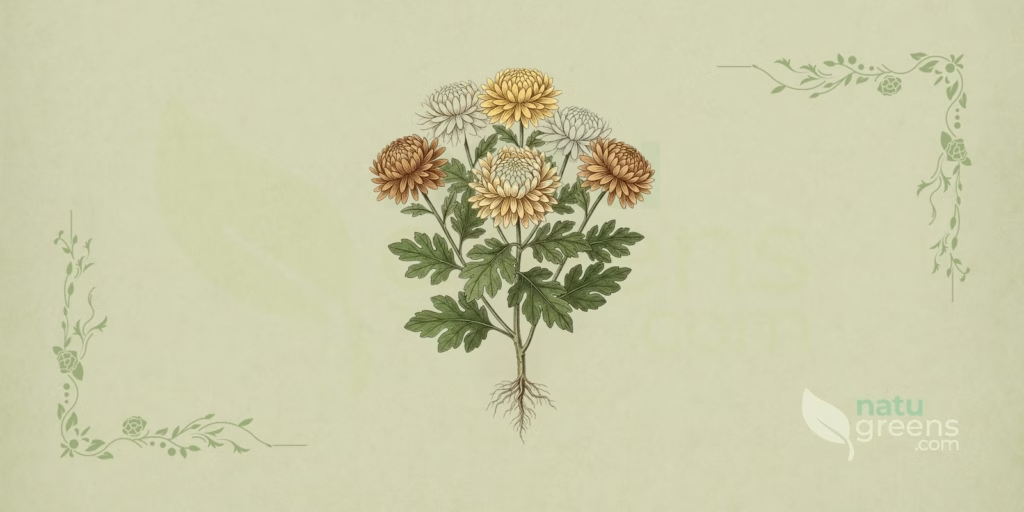
What the trade calls a chrysanthemum flower is, in strict botanical terms, a capitulum, the compound inflorescence typical of the Asteraceae, made up of dozens to hundreds of individual florets gathered on a convex receptacle and protected by an involucre of bracts arranged in series. The margin is occupied by ray florets, which take on the visual role of petals, and the centre by tubular disc florets. Diameters run from two to thirty centimetres depending on the cultivar, and the palette covers white, yellow, bronze, orange, pink, red, purple and greenish tones, along with bicoloured combinations.
Centuries of horticultural selection worked precisely on that architecture, multiplying the ray florets at the expense of the disc florets and producing the classes recognised by horticultural societies, among them anemone, decorative, incurved, pompon, reflexed, single and spider. In many double cultivars the disc florets all but disappear, which sharply reduces the output of pollen and seed.
Fruits and Seeds
The fruit is a cypsela, the achene characteristic of the Asteraceae, one to two millimetres long, dark brown, and without a conspicuous pappus in most cultivars. Production of viable seed is low and erratic, owing both to the partial sterility associated with hexaploidy and to the suppression of disc florets in double cultivars. In practice, sexual propagation is confined to breeding programmes, since the progeny of any cultivar segregates into forms and colours that do not reproduce the mother plant.
Root and Stem
The stem is erect, branched in its upper portion, green to purplish green, covered in fine whitish hairs and slightly woody at the base in mature plants. The root system is fibrous and shallow, concentrated in the first ten to thirty centimetres of soil, which leaves the plant vulnerable to both brief drought and waterlogging. Short rhizomes and stolons arise from the base and give rise to new shoots each cycle, the mechanism that sustains the perennial clump and underpins propagation by division.
Distribution and Habitat
Being a hybrid of cultivated origin, the chrysanthemum has no natural range in the usual sense. Plants of the World Online records southeastern China as the region where the hybrid complex arose, and the parent species are spread across continental and insular East Asia, from the eastern Himalaya and northern Indochina to Korea, Japan, Mongolia and southern Siberia. Every occurrence of the plant outside that belt is the result of deliberate introduction.
Global dispersal happened in two waves. The first, within Asia, carried the chrysanthemum from China to Japan and Korea between the eighth and tenth centuries. The second set out from the port of Marseille in 1789, when Chinese specimens reached France and, within a few decades, England and the rest of Europe, feeding the intense hybridisation work of the nineteenth century. Today the plant is grown in practically every temperate, subtropical and tropical highland region of the world.
As for environmental requirements, it thrives in well-drained, fertile soils rich in organic matter with a pH between 6.0 and 7.0, from sea level up to around two thousand metres. The ideal thermal range for vegetative growth lies between 17 and 23 degrees Celsius; temperatures above 30 degrees compromise the quality of the flower heads, and hardy garden cultivars tolerate moderate frost with the aerial parts dying back. Records of naturalisation are rare and localised, generally tied to garden escapes on roadsides and disturbed ground, and the species does not feature on any significant list of invasive plants.
Cultivation
Commercial production rests almost entirely on vegetative propagation, which preserves the identity of the cultivar. The dominant method is tip cutting, using cuttings of five to ten centimetres taken from stock plants held in vegetative condition and rooted in a light substrate under mist in fourteen to twenty-one days, often with the help of rooting hormones. Clump division, carried out at the end of winter, serves gardens and small plantings. Micropropagation through meristem culture fills a specific and strategic role, which is to produce starting material free of viruses and viroids for renewing stock plant banks.
Crop management combines successive pinching to induce branching, balanced fertilisation with attention to phosphorus at the transition into the reproductive phase, regular irrigation preferably by drip, and, in long-stemmed cultivars, support with horizontal netting. Field spacings usually fall between thirty and fifty centimetres within the row and fifty to eighty centimetres between rows. Under protected cultivation, photoperiod control is the centrepiece of the system: blackout screens shorten the day to induce flowering out of season, while night-break lighting extends the vegetative phase, which allows the market to be supplied year round.
Among the most frequent pests are the fall armyworm and other noctuids of the genera Helicoverpa and Spodoptera, whitefly, the leafminer fly of the genus Liriomyza, the chrysanthemum aphid Macrosiphoniella sanborni, which is specific to the crop, and the thrips Frankliniella occidentalis, also important as a virus vector. On the disease side the notable ones are white rust caused by Puccinia horiana, a quarantine organism regulated by EPPO and by several national plant health services, the brown rust of Puccinia chrysanthemi, Septoria leaf spot, Verticillium wilt and chrysanthemum mosaic virus. Harvest for cut flowers takes place when the head reaches the opening stage defined for each cultivar, while heads destined for drying are picked by hand, one at a time.
Phenology
The chrysanthemum is the textbook short-day plant, and that single trait organises its whole calendar. Floral induction depends on long nights and sets in once the photoperiod falls below roughly thirteen and a half hours, a threshold that varies with the cultivar. Under natural conditions in the northern hemisphere this places flowering in autumn, between September and November, an association that earned the plant the nickname of autumn flower in several languages. In the southern hemisphere the natural peak shifts to the period between March and May.
From the planting of the cutting to the opening of the first heads, ninety to a hundred and twenty days pass on average. Pollination is entomophilous, carried out by bees, flies and butterflies drawn to the disc florets, but the ecological weight of those visits is much reduced in double cultivars, where selection has suppressed the disc. Fruiting, when it happens, follows some weeks after anthesis, and dispersal of the cypselae is anemochorous over short distances. In practical terms, the perpetuation of the cultivated chrysanthemum depends on neither seeds nor dispersers: it is clonal and mediated by human hands.
Related Species and Confusions
The genus Chrysanthemum holds some forty accepted species, concentrated in East Asia and organised into two large lineages, the C. indicum complex and the C. zawadskii complex. The species that matter most for understanding the cultivated chrysanthemum are precisely its parents and contributors: C. argyrophyllum, C. dichrum, C. indicum, C. lavandulifolium, C. nankingense, C. vestitum and C. zawadskii. Telling the hybrid apart from those species in the field is difficult and at times unworkable without cytogenetic analysis, since the variation induced by selection outstrips the natural variation among the wild taxa. The most usable clue is the size of the flower head, far larger and fuller in cultivated material, together with an origin in planted ground rather than in a spontaneous population.
Outside the genus, the commonest confusion is historical and stems precisely from the nomenclatural changes. Several plants once called Chrysanthemum now belong to different genera: Argyranthemum frutescens, the marguerite daisy, formerly C. frutescens; Glebionis coronaria, formerly C. coronarium, whose leaves are eaten as a vegetable in East Asia; Leucanthemum vulgare, the oxeye daisy, formerly C. leucanthemum; Tanacetum parthenium, formerly C. parthenium; and Tanacetum vulgare, common tansy, formerly C. vulgare. Anyone working with dried material or with literature predating the 2000s needs to check the date and the source of a name before assuming the identity of the plant, because the same binomial can point to very different species depending on the period.
There is no classic dangerous lookalike for the chrysanthemum in the sense of confusion with a violently poisonous plant, but it is worth recording that the genus Tanacetum, closely placed within the Anthemideae and similar in its camphoraceous scent, includes species with a considerably more aggressive sesquiterpene lactone profile, and that several similar-looking Anthemideae are contact sensitisers.
Phytochemistry
The flower heads are the most thoroughly studied organ of the plant chemically, and they concentrate three main classes of metabolites. The dominant flavonoids are flavones and their glycosides, notably acacetin, apigenin, diosmetin and luteolin, accompanied by derivatives such as linarin and luteolin-7-O-glucoside. The phenolic acids appear above all as caffeoylquinic esters, among them chlorogenic acid and 3,5-dicaffeoylquinic and 4,5-dicaffeoylquinic acids, used as analytical markers for quality control of dried batches. Leaves tend to register higher relative levels of phenolic acids than the heads, whereas flavonoids and essential oil concentrate in the inflorescences.
The essential oil is dominated by monoterpenes, with borneol, camphor, chrysanthenone, eucalyptol and alpha-pinene among the recurring constituents, rounded out by sesquiterpenes such as beta-caryophyllene. Recent surveys of the genus catalogue more than one hundred and eighty monoterpenoids and more than two hundred sesquiterpenoids, including lactones of the eudesmanolide, germacranolide and guaianolide types, of which handelin is a frequently cited example. To that picture are added carotenoids responsible for part of the yellow colouring, notably lutein and zeaxanthin, along with structural and storage polysaccharides. Composition varies sharply between cultivars, between growing regions and according to the post-harvest drying method, which limits any generalisation drawn from isolated analyses.
History and Ethnobotany
Cultivation of the chrysanthemum in China is documented from the Zhou dynasty onwards, and classical texts already mentioned it as a garden plant and as a raw material recorded in early compendia. The Shennong Bencao Jing, compiled between the first and second centuries of our era, listed the dried flower heads under the name Ju Hua among the materials catalogued by the Chinese pharmacopoeia of the day. By the Song dynasty the plant had become the subject of monographic treatises, exhibitions and cultivar classifications, an activity that anticipated European ornamental horticulture by centuries.
In Japan, where it arrived around the eighth century, the chrysanthemum was absorbed into court culture with unmatched intensity. The Chōyō no Sekku festival, held on the ninth day of the ninth month, was part of the aristocratic calendar from the Heian period, and from the Kamakura period the stylised sixteen-petalled chrysanthemum came to identify the imperial house, a use that survives in the imperial seal and in the phrase Chrysanthemum Throne, employed as a metonym for the Japanese monarchy itself. The kiku exhibitions consolidated extremely elaborate training techniques, such as ozukuri, in which hundreds of heads are obtained from a single plant trained into a dome, and kengai, which trains the plant into a cascade.
The Western trajectory begins in 1789, with the introduction of Chinese specimens into France by the merchant Pierre-Louis Blancard, and gathers scale in the nineteenth century through the work of British and French horticultural societies, which registered and named cultivars by the thousand. Over that same period, across much of Catholic Europe and later in Latin America, the chrysanthemum established itself as the flower associated with All Saints’ Day and All Souls’ Day, a role that accounts for demand peaks in early November in the northern hemisphere and for a substantial part of the commercial calendar of Brazilian floriculture.
From a safety standpoint, the plant contains sesquiterpene lactones, and the ASPCA Animal Poison Control Center classifies the genus as toxic to dogs, cats and horses, listing sesquiterpene lactones and pyrethrin-type compounds among the toxic principles, with signs that include excessive salivation, vomiting, diarrhoea, incoordination and dermatitis. In people, repeated contact with leaves and stems causes allergic contact dermatitis in sensitised individuals, a condition described in the occupational literature among flower growers and greenhouse workers.
Conservation
Chrysanthemum × morifolium has no assessment on the IUCN Red List, a situation to be expected for a taxon of hybrid origin that exists only in cultivation, and it therefore stands as not evaluated. Nor does the species appear in the CITES appendices, and there is no international restriction on its trade.
The conservation question shifts instead to two other points. The first concerns the wild populations of the parent species, especially within the C. indicum and C. zawadskii complexes, which face habitat loss and fragmentation across East Asia and constitute the genetic reservoir on which any future breeding depends. The second is ex situ conservation of cultivated diversity itself, held in germplasm banks and living collections, since clonal cultivars are easily lost once they leave commercial circulation and no seed bank can recover them. Added to that is the environmental cost of intensive greenhouse production, with heavy use of energy, fertilisers and crop protection products, a recurring theme in sustainability debates within the flower industry.
Interesting Facts
- The hexaploidy of the cultivated chrysanthemum, with 2n equal to 54 chromosomes and frequent aneuploidy, is one reason somatic mutations appear so readily in the clumps. A good share of commercial cultivars arose precisely from mutant shoots spotted and propagated by attentive growers.
- In the air quality study conducted by NASA in 1989, in sealed chambers, the potted chrysanthemum ranked among the best performers at removing volatile organic compounds. Later research showed the effect is small in real, ventilated interiors, and the original result survives as a historical curiosity.
- The stylised sixteen-petalled chrysanthemum has identified the Japanese imperial house since the Kamakura period and appears on the Japanese passport, on the imperial seal and in the phrase Chrysanthemum Throne.
- The same genus that stands for longevity and nobility in East Asia is a funeral flower across much of Europe and Latin America, a cultural contrast that regularly produces misunderstandings with gifts and floral arrangements.
- A single plant trained by the Japanese ozukuri technique can display more than a thousand open heads at once, all supported by one original stem trained over the better part of a year.
Notice: this content is for informational purposes and does not replace professional medical advice. Consult a physician or herbal practitioner before using medicinal plants, especially during pregnancy, breastfeeding, or alongside medication.
References and Scientific Studies
View All 10 Cited References
Peer-Reviewed Scientific Studies (4)
- DOI2022 Hao, D. C., Song, Y., Xiao, P., Zhong, Y., Wu, P., Xu, L. The genus Chrysanthemum: phylogeny, biodiversity, phytometabolites, and chemodiversity. Frontiers in Plant Science, 13: 973197. 2022. ↗
- DOI Hemsley, W. B. The garden chrysanthemum and its allies. Annals of Botany, 3(4): 487-500. 1889. ↗
- DOI2012 Liu, P. L., Wan, Q., Guo, Y. P., Yang, J., Rao, G. Y. Phylogeny of the genus Chrysanthemum L.: evidence from single-copy nuclear gene and chloroplast DNA sequences. PLOS ONE, 7(11): e48970. 2012. ↗
- DOI1995 Trehane, P. Proposal to conserve the name Chrysanthemum L. with a conserved type (Compositae). Taxon, 44(3): 439-441. 1995. ↗
Supplementary Readings (6)
- 2007 Anderson, N. O. Chrysanthemum. In: Flower Breeding and Genetics: Issues, Challenges and Opportunities for the 21st Century. Springer, Dordrecht. 2007.
- ASPCA Animal Poison Control Center. Chrysanthemum. American Society for the Prevention of Cruelty to Animals. ↗
- EPPO Global Database. Puccinia horiana. European and Mediterranean Plant Protection Organization. ↗
- International Plant Names Index. Chrysanthemum × morifolium (Ramat.) Hemsl., record 77111328-1. The Royal Botanic Gardens Kew, The Harvard University Herbaria and Australian National Herbarium. ↗
- Plants of the World Online. Chrysanthemum × morifolium (Ramat.) Hemsl. Royal Botanic Gardens Kew. ↗
- Ramatuelle, T. A. J. d’A. de. Journal d’Histoire Naturelle, vol. 2, p. 240. Paris. 1792.