



Quick summary
Calluna vulgaris (L.) Hull / Heather, commonly known as heather, common heather, ling or Scotch heather, is the only species in the genus Calluna, in the family Ericaceae. It is a perennial dwarf shrub native to Europe and Western Asia that forms the characteristic moorlands of Scotland, Ireland and northern Portugal…
Main caution: Warning: heather contains arbutin, which is converted into hydroquinone in the body. For this reason, traditional use should always be short term, never continuous or prolonged, and the plant should be avoided during…
Calluna vulgaris (L.) Hull / Heather, commonly known as heather, common heather, ling or Scotch heather, is the only species in the genus Calluna, in the family Ericaceae. It is a perennial dwarf shrub native to Europe and Western Asia that forms the characteristic moorlands of Scotland, Ireland and northern Portugal, and people have carried it to other continents. Heather has been part of European traditional medicine for centuries, above all for kidney and urinary tract complaints, and its small flowers, ranging from pink to purple, are gathered for infusions and other preparations.
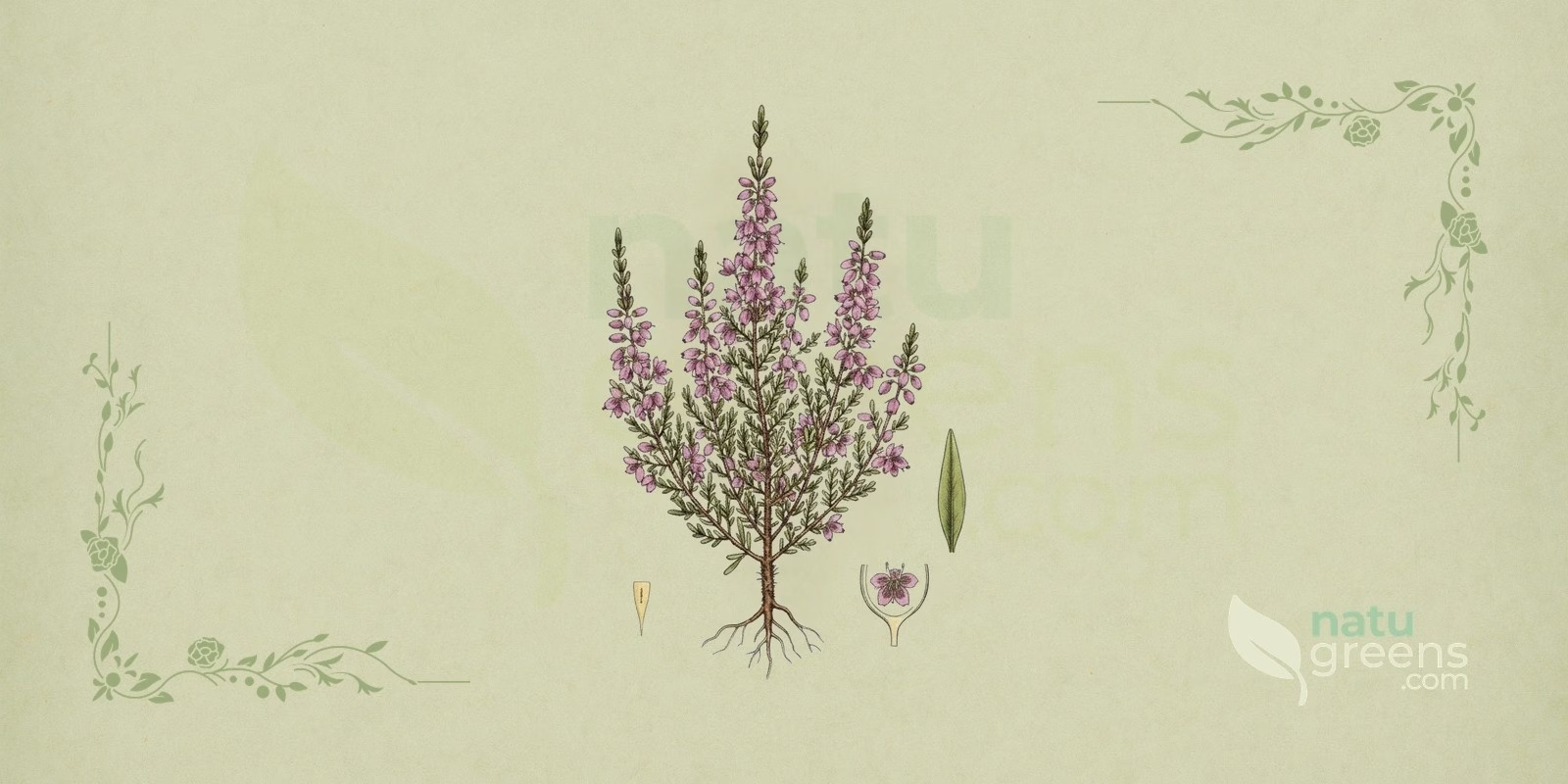
In herbal tradition, heather is described as a diuretic and urinary antiseptic, and it also appears in the relief of rheumatic pain, arthritis and skin problems. These uses are traditional and do not amount to proven efficacy, and research on its antioxidant and antimicrobial activities, linked to the plant's phenolic compounds and flavonoids, is still preliminary and largely carried out in vitro. The plant contains arbutin, a substance the body converts into hydroquinone, which is why its traditional use should always be short term.
Popular and International Names of Heather
- English: common heather, heather, ling, Scotch heather.
- French: béruée, brande, bruyère commune, bucane, callune, fausse bruyère, grosse bruyère.
- German: Besenheide, Heidekraut.
- Italian: brugo, erica.
- Portuguese: leiva, mongariça, quebra-panelas, queiró, queiró-das-ilhas, rapa, torga-ordinária, urze, urze-comum, urze-roxa.
- Spanish: argaña, aulaga, azuleja, bercol, berecilla, bereza, brezo, urce.
Botanical Synonyms of Heather
- Calluna vulgaris (L.) Salisb.
- Erica vulgaris L.
The basionym Erica vulgaris L. shows that Linnaeus placed the plant in the genus Erica, from which it was later separated into its own genus, Calluna. This history explains a confusion that persists to this day: Calluna vulgaris belongs to a monotypic genus with a single species, while Erica includes many species, the "true" heaths in the botanical sense, and in everyday English the word heather is used for both genera without distinction. In practice, Calluna is recognized by its tiny, scale-like leaves overlapping along the branches and by a colored calyx larger than the corolla, whereas Erica species have needle-like leaves arranged in whorls and a corolla showier than the calyx.
Botanical Family: Ericaceae
The Ericaceae family is a diverse group of shrubs and small trees that thrive in poor, acidic soils, often thanks to their association with mycorrhizal fungi in the roots. It includes species of great ornamental value, such as azaleas and rhododendrons, and others of food and medicinal interest, such as blueberries and bearberry, which share with heather the presence of phenolic compounds and, in several cases, arbutin.
Heather reflects the traits of the family well: it favors moors, peat bogs and acidic slopes, withstands strong winds, cold and periodic fires, and covers vast areas of Europe and Asia Minor. This ability to adapt to harsh conditions has made it a keystone plant of Atlantic landscapes and an important source of nectar for bees in late summer.
Parts of Heather Used
- Flowering aerial parts
- Flowering tops
- Flowers
Ethnobotanical and Traditional Uses of Heather
- Arthritis (traditional use)
- Bronchitis and cough (traditional use)
- Chilblains (traditional external use)
- Diabetes (traditional record; does not replace medical treatment)
- Diuretic (traditional use)
- Eczema (traditional external use)
- Gout and high uric acid (traditional record)
- High blood pressure (traditional record; does not replace medical treatment)
- Menstrual cramps and discomfort (folk use)
- Mild sedative (folk use)
- Mouth and throat infections (traditional use as a gargle)
- Nervous exhaustion (folk use)
- Rheumatic pain (traditional use)
- Urinary infections (traditional use as a urinary antiseptic; require medical evaluation)
- Vulvar infections (traditional record; require medical evaluation)
Therapeutic Properties of Heather
- Anti-inflammatory (traditional use; activity observed in preliminary animal studies)
- Antimicrobial (preliminary in vitro studies)
- Antioxidant (preliminary in vitro studies)
- Astringent (traditional use, linked to its tannin content)
- Cholagogue (traditional record of stimulating bile secretion)
- Depurative (traditional record)
- Diaphoretic (traditional record)
- Diuretic (traditional use, without proven efficacy)
- Expectorant (traditional use)
- Mild sedative (folk use)
- Urinary antiseptic (traditional use, attributed to arbutin)
- Vasoconstrictor (traditional record)
Detailed Phytochemical Profile of Heather
- Arbutin (converted into hydroquinone in the body)
- Callunene (megastigmane)
- Chlorogenic acid
- Flavonoids (including kaempferol-3-O-galactoside)
- Phenolic compounds
- Tannins
Phytochemical studies show that the composition varies with the plant part and the harvest season, and that aqueous and hydroalcoholic extracts of the flowering herb are rich above all in phenolic compounds and flavonoids. One of these flavonoids, kaempferol-3-O-galactoside, was isolated from the aerial parts and tested in animal models of inflammation and pain, a result that remains preliminary.
Preparation and Administration Forms of Heather
- Baths
- Infusions
- Topical ointments
Synergy with Other Medicinal Plants
Traditional Blends for the Urinary Tract
In traditional European herbalism, heather is blended with bearberry (Arctostaphylos uva-ursi) or buchu (Agathosma betulina) in teas traditionally taken for mild urinary complaints. Because bearberry also contains arbutin, the combination adds to hydroquinone exposure, so it should be used only for a very short time, avoided during pregnancy, breastfeeding and by anyone with kidney disease, and it never replaces a medical assessment of a urinary infection.
Traditional Combinations for Rheumatic Pain
In traditional blends for joint pain, heather appears alongside white willow (Salix alba) and devil's claw (Harpagophytum procumbens), plants studied for anti-inflammatory activity. The combination rests on tradition rather than clinical proof, and white willow, because it contains salicylates, calls for caution in people allergic to aspirin or taking anticoagulants.
Recipes and Usage Protocols of Heather
Traditional Heather Infusion
An infusion of the flowers is the most traditional way to use heather, taken for mild urinary complaints and always for only a few days.
Ingredients: a small amount of dried heather flowers and 250 ml of boiling water.
Preparation: place the flowers in a cup and pour the boiling water over them. Cover, steep for 10 minutes, strain and drink warm. Because of the arbutin, use should be short term, never continuous, and the frequency should be agreed with a health professional; fever, pain when urinating or blood in the urine require medical evaluation.
Traditional Heather Bath
A bath with a heather decoction is a traditional external use associated with relaxation and with comfort for sore muscles.
Ingredients: 50 g of flowering aerial parts of heather and 2 liters of water.
Preparation: boil the heather in the water for 15 minutes, strain and add the liquid to the bathwater, soaking for 20 to 30 minutes. Tradition credits this bath with a feeling of relaxation and relief from muscular and rheumatic aches, and it should be stopped if any skin irritation appears.
The preparations above follow traditional records and do not replace professional guidance. Before any internal use, check the contraindications and interactions described in this article.
Therapies Associated with Heather
Herbal Medicine
In European herbal medicine, heather is traditionally used in blends for the urinary tract and for rheumatic complaints, based on the diuretic, antiseptic and anti-inflammatory properties that tradition attributes to it. In vitro studies have tested extracts of the plant against bacteria common in urinary infections, but these results are preliminary and do not support its use against infections or for preventing kidney stones. Because it contains arbutin, heather is included in short traditional protocols, never in continuous use.
Homeopathy
Homeopathy uses preparations of Calluna vulgaris made from the fresh plant, according to its principles of dilution and potentization, and describes them for urinary and rheumatic symptoms such as frequent urination, joint pain and a feeling of heaviness in the limbs. These uses belong to the homeopathic tradition and lack scientific proof, and persistent urinary or joint symptoms should be assessed by a doctor.
Contraindications and Side Effects of Heather
Arbutin and Short-Term Use
Warning: heather contains arbutin, which is converted into hydroquinone in the body. For this reason, traditional use should always be short term, never continuous or prolonged, and the plant should be avoided during pregnancy, breastfeeding and by anyone with kidney disease, since hydroquinone is eliminated through the kidneys.
Contraindications
- Children: safety in children has not been studied, and use should be avoided.
- Ericaceae allergy: people with a known hypersensitivity to plants of this family should avoid heather, which can cause skin irritation or respiratory symptoms.
- Heart failure: because of its traditional diuretic effect, which can alter electrolyte balance, medical guidance is necessary.
- Kidney disease: contraindicated, because hydroquinone is eliminated through the kidneys.
- Pregnancy and breastfeeding: use should be avoided.
Drug Interactions
- Anticoagulants: a possible influence on anticoagulants, with an increased risk of bleeding, has been reported, which calls for medical guidance.
- Diuretics: heather may add to the effect of diuretic drugs and promote electrolyte imbalance.
Side Effects
Heather is generally well tolerated in short-term traditional use, but sensitive people may have allergic reactions, and excessive or prolonged use can cause electrolyte imbalance through its diuretic effect, as well as increasing exposure to hydroquinone. Anyone taking medication on a continuous basis should consult a health professional first.
Historical Notes and Interesting Facts about Heather
A Plant of a Thousand Uses
Long before it was studied in the laboratory, heather had many household uses: it dyed wool yellow, tanned leather and was bound into brooms, the British besoms. In the Middle Ages it also went into gruit, the herb mixture used to flavor beer before hops became widespread, which gave rise to traditional heather ale.
Scottish Luck and Jelly-Like Honey
In Scotland, finding white heather is considered a sign of good luck, a tradition that became popular in Queen Victoria's time. Heather honey, for its part, is a highly prized product famous for its thixotropic texture, which keeps it jelly-like in the jar until it is stirred, when it briefly becomes more fluid.
Heather or Erica?
In English, heather refers both to Calluna vulgaris and to several species of the genus Erica, but botanically they are different genera of the same family, and Calluna has a single species. Fittingly, the scientific name of the genus comes from the Greek kallyno, meaning to sweep or to beautify, a nod to the brooms made from its branches.
Frequently Asked Questions about Heather
Is Heather Used for Urinary Infections?
Heather is traditionally used as a diuretic and urinary antiseptic, and in vitro studies have tested its extracts against urinary bacteria. These data are preliminary and do not prove efficacy, and fever, pain when urinating or blood in the urine require medical evaluation.
Why Should Heather Be Used Only for a Short Time?
Because the plant contains arbutin, which is converted into hydroquinone in the body. That is why traditional use should be short term, never continuous, and avoided by pregnant or breastfeeding women and by people with kidney disease.
Who Should Not Use Heather?
Pregnant and breastfeeding women, children, people with kidney disease and anyone allergic to plants of the Ericaceae family. People with heart failure or who take diuretics or anticoagulants should consult a health professional first.
How Is Heather Traditionally Prepared?
The most common form is an infusion of the dried flowers, steeped for about 10 minutes in boiling water and used for only a few days. Baths and ointments are traditional external uses.
Does Heather Have Side Effects?
In short-term traditional use it is usually well tolerated, but it can cause allergies in sensitive people. Prolonged use can lead to electrolyte imbalance and increase exposure to hydroquinone.
Are Heather and Erica the Same Plant?
No. Common heather (Calluna vulgaris) is the only species in its genus, while Erica includes many species, although both are popularly called heather in English. Both belong to the Ericaceae family.
Notice: this content is for informational purposes and does not replace professional medical advice. Consult a physician or herbal practitioner before using medicinal plants, especially during pregnancy, breastfeeding, or alongside medication.
How to cite this article
NATUGREENS. Heather (Calluna vulgaris): Properties and Benefits. Natugreens, 19 Nov. 2026. Disponível em: https://natugreens.com/calluna-vulgaris-heather/. Accessed: Nov. 20, 2026.
Natugreens. (2026). Heather (Calluna vulgaris): Properties and Benefits. Natugreens. https://natugreens.com/calluna-vulgaris-heather/
References and Scientific Studies
- PMC2022 Cucu AA, et al. Calluna vulgaris as a Valuable Source of Bioactive Compounds: Exploring Its Phytochemical Profile, Biological Activities and Apitherapeutic Potential. Plants (Basel). 2022.
- PMC2022 Kaunaite V, et al. Phytochemical Diversity and Antioxidant Potential of Wild Heather (Calluna vulgaris L.) Aboveground Parts. Plants (Basel). 2022.
- PMC2014 Vučić DM, et al. In vitro activity of heather [Calluna vulgaris (L.) Hull] extracts on selected urinary tract pathogens. Bosn J Basic Med Sci. 2014.
- PMC2007 Orhan I, et al. Bioassay-guided isolation of kaempferol-3-O-beta-D-galactoside with anti-inflammatory and antinociceptive activity from the aerial part of Calluna vulgaris L.. J Ethnopharmacol. 2007.
- PMC2020 Starchenko G, et al. Phytochemical Profile and Pharmacological Activities of Water and Hydroethanolic Dry Extracts of Calluna vulgaris (L.) Hull. Herb. Plants (Basel). 2020.
You May Also Like
Take your time and tell us everything you think, details included. Every response is read by someone on our editorial team and goes into the article's revision. An honest critique helps us more than a polite compliment.
Take your time and tell us everything you think, details included. Every response is read by someone on our editorial team and goes into the article's revision. An honest critique helps us more than a polite compliment.