Tribulus terrestris is a prostrate herb in the Zygophyllaceae, the same lineage that gathers desert genera such as Zygophyllum and Larrea, and it is far better known for what it leaves on the ground than for its foliage. The woody fruits are armed with rigid spines that end up pointing skyward whenever a mericarp settles on its side, and that single detail earned the species an international reputation as the plant that punctures bicycle tyres and injures the feet of livestock. The English names puncture vine, goathead and caltrop all describe precisely that trait.
The species is native to the Old World, with its centre of distribution in the Mediterranean Basin and a natural range that reaches across Africa, the Middle East, Central Asia, the Indian subcontinent and China. From the nineteenth century onward it travelled with grain, fodder, wool and farm machinery, and it settled into virtually every hot, dry region of the planet, to the point of appearing on official noxious weed lists in the United States, Australia and South Africa. Few herbaceous plants manage that combination of efficient passive dispersal, extreme drought tolerance and a long lived seed bank.
The paradox of the plant is that while some countries spend public money to reduce its populations, others grow it on a commercial scale as raw material for the botanical extract industry, chiefly in Bulgaria, India and China. This profile brings together the classification confirmed by IPNI and Plants of the World Online, the morphology as set out in primary floristic treatments, the documented distribution, the agronomic behaviour, the phenology, the chemical composition in descriptive terms, the historical record and the conservation status of the species.
The puncture vine is a prostrate herb of the Zygophyllaceae, the same lineage that gathers desert genera such as Larrea and Zygophyllum.
Taxonomy
The binomial Tribulus terrestris was published by Carl von Linné in Species Plantarum, volume 1, page 387, in 1753, and it remains the accepted name in Plants of the World Online, maintained by the Royal Botanic Gardens, Kew, under IPNI identifier 873489-1. A later homonym exists, Tribulus terrestris Muhl., published in the Catalogus Plantarum Americae Septentrionalis in 1813, which carries no nomenclatural standing because it postdates the Linnaean name and survives in IPNI only as a historical record.
- Kingdom: Plantae
- Division: Tracheophyta
- Class: Magnoliopsida
- Order: Zygophyllales
- Family: Zygophyllaceae R.Br.
- Subfamily: Tribuloideae
- Genus: Tribulus L., 1753
- Species: Tribulus terrestris L., 1753
The synonymy of the species is moderate and reflects above all older attempts to treat hairy populations, or those with larger fruits, as independent taxa. Names now regarded as synonyms include Tribulus lanuginosus L., Tribulus orientalis A.Kern., Tribulus terrestris var. lanuginosus (L.) Chiov. and Tribulus terrestris var. orientalis (A.Kern.) Beck. Part of the regional literature still recognises infraspecific varieties, among them T. terrestris var. bicornutus (Fisch. & C.A.Mey.) Hadidi, described in the Flora Iranica, and T. terrestris var. rajasthanensis, from the Thar Desert, whose acceptance varies with the treatment followed.
The etymology of the binomial is literal. The generic epithet comes from Latin tribulus, itself derived from Greek tribolos, the name of a spiked military device scattered on the ground to stop cavalry and infantry, which the Romans nicknamed after the resemblance to the fruits of this very plant. The specific epithet terrestris means of the earth, a reference to the creeping habit, with the stems running flat against the soil instead of rising.
Morphological Description
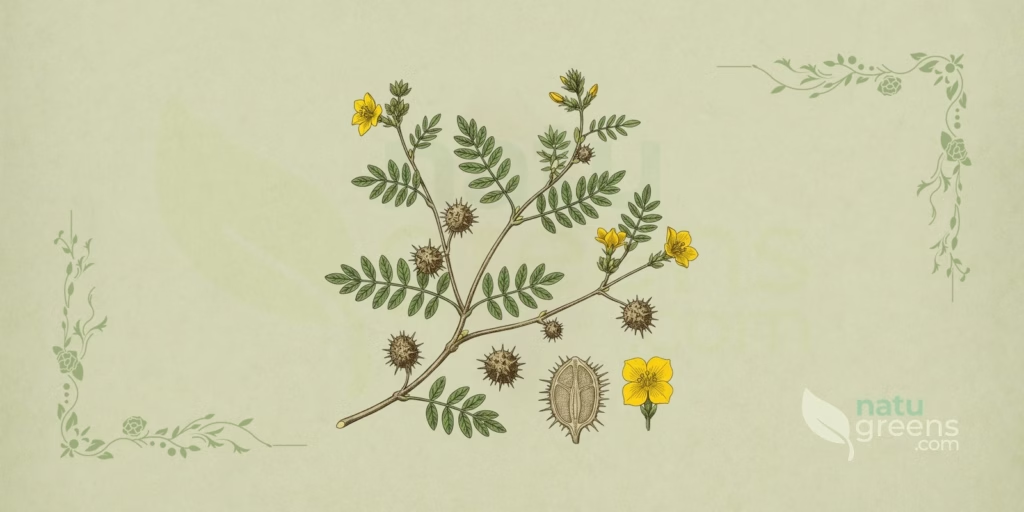
This is an annual herb where winters are cold, and a longer lived plant, sometimes a short lived perennial, where frost does not occur. It branches from the base and forms radial mats that spread over the ground, twenty centimetres to more than a metre across under favourable conditions, yet rarely more than ten centimetres tall. The whole of the aerial part is covered in silky whitish hairs, densest on young shoots, which gives the foliage its characteristic greyish green cast and helps limit water loss.
Leaves
The leaves are opposite and paripinnate, with three to seven pairs of leaflets and no terminal leaflet, and they measure two to six centimetres long. At each node one member of the pair is usually noticeably smaller than the other, an asymmetry common throughout the genus. The leaflets are oblong to elliptic, four to eleven millimetres long by two to four millimetres wide, with an entire margin, an acute or mucronate apex and both surfaces clothed in sericeous hairs. The stipules are persistent, lanceolate and small, a detail that helps separate the species from superficially similar creeping plants.
Flowers
The flowers are borne singly in the leaf axils on short pedicels, and they are actinomorphic and pentamerous. The five sepals are lanceolate and persistent, while the five petals are obovate, yellow, four to ten millimetres long, and fall within a few hours of anthesis. The androecium has ten stamens in two whorls, with a nectary disc at the base, and the ovary is superior, sessile, hirsute and divided into five locules, topped by a short lobed stigma. The flowers open in the morning and close again before midday in hot weather, so anyone who looks at the plant in the afternoon will miss the flowering altogether.
Fruits and Seeds
The fruit is the diagnostic structure of the genus and the reason behind every one of its common names. It is a woody schizocarp, depressed globose, seven to fifteen millimetres across excluding the spines, which splits at maturity into five wedge shaped mericarps. Each mericarp carries a pair of diverging dorsal spines three to seven millimetres long, reaching twelve millimetres in some populations, usually accompanied by a smaller ventral pair, along with tubercles and short bristles on the surface. Within each mericarp there are one to four seeds separated by transverse septa, so a single fruit can hold as many as twenty seeds. Because the mericarps almost always come to rest with one spine turned upward, the structure works as a miniature caltrop and clings readily to hair, hooves, shoe soles and tyres.
Root and Stem
The root system is a taproot, with a slender main axis that reaches more than a metre down in loose sandy soils, backed by shallow lateral roots that exploit brief rainfall. That double architecture explains how the plant survives long dry spells. The stems are cylindrical to slightly angular, green when young and often reddish where exposed to sun, herbaceous and only somewhat woody at the base, and they measure from ten centimetres to about a metre long.
Distribution and Habitat
The native range covers the Mediterranean region in the broad sense, taking in southern Europe, North Africa, the Middle East, Central Asia, the Indian subcontinent, China and much of tropical and southern Africa. From that base, puncture vine has naturalised across the Americas, in Australia, in New Zealand and on oceanic islands such as those of the Hawaiian archipelago, always along agricultural trade routes. In Brazil the plant is not native and is recorded as an introduced and naturalised species, concentrated in disturbed ground in the semi-arid Northeast and in the South of the country.
Typical habitat combines sandy or stony soils that are dry, well drained and poor in organic matter, with a neutral to alkaline pH and tolerance of moderate salinity. Roadsides, bare earth yards, degraded pasture, stabilised dunes, waste ground and the edges of irrigated fields are where the species thrives, almost always in full sun and where the original vegetation has been stripped away. It occurs from sea level to around 2,500 metres at low latitudes, and the clearest limiting factor is frost, which kills plants in active growth.
Its status as an invader is documented in several countries. In the United States the species is regulated as a noxious weed across a number of western and southwestern states; in South Australia it is a declared plant, with restrictions on movement and sale and a control obligation placed on rural landholders; and in South Africa and Argentina its presence in pasture is treated as a livestock problem. The CABI invasive species compendium maintains a dedicated datasheet on the species, with a region by region introduction history.
Puncture Vine Cultivation
Propagation is by seed alone, since the plant produces no adventitious roots along its trailing stems and does not lend itself to cuttings. Germination is irregular because of the physical dormancy imposed by the woody endocarp, and batches stored for more than one season respond better when the mericarps are given light mechanical scarification. Sowing is shallow, under one to two centimetres of soil, and emergence takes anywhere from one to three weeks with soil temperatures between 25 and 30 degrees Celsius.
Field requirements are modest and nearly all of them come down to light and drainage. Full sun is essential, shading cuts fruit set dramatically, and waterlogged or compacted soils encourage root rot. Irrigation is only justified during severe drought while plants are establishing, and heavy nitrogen feeding pushes foliage without a matching gain in fruit. Commercial growing takes place mainly in semi-arid parts of Bulgaria, India and China, at close spacing so that the crop forms continuous ground cover.
Among the natural enemies, the ones most often cited are the weevils Microlarinus lareynii, whose larvae develop inside the fruits and destroy seed, and Microlarinus lypriformis, which mines the stems and root crown. Both were introduced deliberately in biological control programmes and, in commercial plantings, become pests in their own right. Aphids and mites turn up in dry spells, and fungal leaf spots appear wherever conditions are wetter than the species prefers. Harvest is done by lifting whole plants once most of the fruits have darkened, followed by drying until the material turns brittle. It is worth remembering that in jurisdictions where the plant is declared noxious, growing it may be prohibited by law, and checking local legislation comes before any planting.
Phenology
In temperate regions flowering runs from spring into early autumn, while in warm climates with rainfall spread through the year the plant flowers and fruits almost continuously. Anthesis is a morning event and each flower lasts only a few hours, which concentrates the activity of floral visitors into the first part of the day. Small bees, flies and other generalist insects visit the flowers for the nectar produced by the basal disc, but the species is largely autogamous, and contact between anthers and stigma inside the bud secures fruit set even where pollinators are entirely absent. That reproductive independence is one of the reasons the plant can colonise areas it reaches as a handful of isolated individuals.
Fruits ripen roughly four to six weeks after pollination and turn from green to dark brown before breaking apart into mericarps. Dispersal is mainly epizoochorous and anthropochorous, with mericarps caught in hair, wool, hooves, footwear, tyres and farm implements, though flash floods also carry fruits considerable distances across arid ground. Seeds within a single fruit show staggered dormancy and germinate in successive waves over several years, which builds persistent seed banks in the soil and turns any eradication programme into a medium term commitment.
Related Species and Confusions
The genus Tribulus holds a number of species that varies with the treatment adopted, somewhere between twelve and twenty five, nearly all of them confined to arid and semi-arid regions of the Old World. The commonest field confusion is with Tribulus cistoides L., a pantropical perennial common on coastal strips and oceanic islands, told apart by its much larger flowers, two to four centimetres across, its more robust habit and its proportionally larger mericarps. Other species in the genus are separated by fruit characters, among them Tribulus alatus Delile, from North Africa, whose mericarps bear winged expansions instead of rigid spines, and Tribulus zeyheri Sond., a South African species with large flowers.
In the Americas the most important confusion is with species of Kallstroemia, which occupy the same kind of habitat and repeat the pattern of opposite paripinnate leaves and solitary yellow flowers. The decisive character lies in the fruit. In Kallstroemia the schizocarp splits into around ten nutlets that are merely tuberculate, without rigid spines, and it retains an elongated central beak after the parts have fallen. In Tribulus the units are five, woody, triangular in section and always armed with paired spines. Since dried ground material traded in bulk preserves none of these characters, telling the species apart in processed raw material depends on laboratory analysis and documentary traceability rather than visual inspection.
Phytochemistry
The chemical profile of the species is dominated by steroidal saponins, present in both major structural types. Among the furostanol compounds protodioscin is the most frequently reported, alongside pseudoprotodioscin and prototribestin, while the spirostanol group includes tribulosin, dioscin and the terrestrosins. Hydrolysis of these molecules releases steroidal aglycones such as diosgenin, gitogenin, hecogenin and ruscogenin, compounds of interest to fine chemistry because they serve as feedstock in industrial synthesis.
The distribution of these constituents within the plant is not uniform. Aerial parts and fruits concentrate saponins at higher levels than the roots, and comparative surveys record marked variation between geographic provenances, with southeastern European populations showing profiles that differ from those of southern and eastern Asia. Factors such as phenological stage at harvest, altitude and water regime also shift the measured levels.
Beyond the saponins, the species accumulates beta-carboline alkaloids, chiefly harman and norharman, most concentrated in seeds and roots. The flavonoid group includes kaempferol, quercetin, rutin and astragalin, along with a range of glycosidic derivatives. Rounding out the composition are phenolic acids such as caffeic and chlorogenic acid, phytosterols, tannins in low proportion and a fixed oil present in the seeds.
History and Ethnobotany
The written record of the plant is an old one and follows the civilisations of the Mediterranean. Dioscorides described a creeping herb with spiny fruits under the Greek name tribolos in De Materia Medica in the first century, and Roman authors repeated the description while linking the plant to the military device of the same name. In the traditional Chinese pharmacopoeia the dried fruit appears under the name bai ji li in early compilations such as the Shennong Bencao Jing, and in the Indian tradition the name gokshura occurs in classical compendia attributed to Charaka and Sushruta. These records belong to the cultural history of the species and do not describe present day practice.
The modern trajectory of the plant is economic before it is botanical. Through the second half of the twentieth century, research groups in Eastern Europe began characterising standardised extracts of the species, and Bulgaria established itself as the reference commercial origin on the international market for plant raw materials. From the 1990s onward, India and China expanded production, and puncture vine came to circulate globally as a processed botanical commodity, a situation that continues.
On the safety side, there is a documented issue that is not confined to the past. The steroidal saponins of the plant are implicated in cases of hepatogenous photosensitisation in sheep and goats that graze large quantities of the species, a disease known in South Africa as geeldikkop and also described as ovine tribulosis, with outbreaks recorded in Australia, the United States and Argentina. Affected animals show jaundice, skin lesions on unpigmented areas and liver changes with obstruction of the bile ducts. The woody fruits, for their part, cause mechanical injury: they lodge between the pads of dogs and in the hooves of grazing animals and can lead to secondary infection. For dogs and cats there is no consolidated toxicological assessment of ingestion, and the documented harm in those animals is mechanical.
Conservation
The species appears on the IUCN Red List in the Least Concern category, the expected outcome for a plant with an enormous range, abundant populations and no dependence on specialised habitat. It is listed in none of the CITES appendices and is subject to no trade restriction on conservation grounds.
The management challenge associated with Tribulus terrestris is the reverse of the classic conservation problem. Instead of protection, what exists are containment programmes, the best known of which began in 1961, when the weevils Microlarinus lareynii and Microlarinus lypriformis were brought from Italy and released in California. Over the following years releases extended to other western states and to Hawaii, with a measurable reduction in flower and fruit production, particularly in unirrigated areas. Where the species is native, it plays an ecological role as pioneer cover on degraded soils and as a nectar source for generalist insects in arid environments.
Interesting Facts
- The scientific name came from the weapon, not the other way around. The Roman tribulus was a four pointed object arranged so that one spike always faced upward, exactly the way the mericarp of the plant rests on the ground.
- The English name puncture vine was born of the bicycle age. The spines go straight through ordinary inner tubes, and cycling clubs in arid parts of the United States still hold annual pulling parties.
- Anyone who looks at the plant after lunch is unlikely to see an open flower, because anthesis is early and brief, which is why a great many people identify the species by its fruits alone.
- Seeds from the same fruit do not germinate together. Staggered dormancy spreads emergence over several years, and that is why ground that looks clean grows plants again after a rainy season.
- The same species is a legally regulated noxious weed on one continent and an export crop on another, with seed sold lawfully in one country and its transport banned in the next.
Notice: this content is for informational purposes and does not replace professional medical advice. Consult a physician or herbal practitioner before using medicinal plants, especially during pregnancy, breastfeeding, or alongside medication.
References and Scientific Studies
View All 11 Cited References
Peer-Reviewed Scientific Studies (1)
- PMC1991 Kellerman, T. S., Erasmus, G. L., Coetzer, J. A. W., Brown, J. M. M., Maartens, B. P. Photosensitivity in South Africa. VI. The experimental induction of geeldikkop in sheep with crude steroidal saponins from Tribulus terrestris. Onderstepoort Journal of Veterinary Research, 58(1), 47-53. 1991. ↗
Institutional Sources (2)
- GOV University of California Statewide IPM Program. Puncturevine, Tribulus terrestris. ↗
- GOV New Mexico State University Cooperative Extension Service. History and Use of Puncturevine Weevils for Biological Control, guide H-187. ↗
Supplementary Readings (8)
- Plants of the World Online. Tribulus terrestris L. Royal Botanic Gardens, Kew. ↗
- International Plant Names Index. Tribulus terrestris L., Sp. Pl. 1: 387 (1753), record 873489-1. ↗
- Linnaeus, C. Species Plantarum, vol. 1, p. 387. Stockholm. 1753. ↗
- World Flora Online. Tribulus terrestris L., with the morphological treatment from the Flora of North America. ↗
- Ribeiro, R. S. Zygophyllaceae R.Br. In: Monografias da Flora e Funga do Brasil. Rio de Janeiro Botanical Garden. ↗
- IUCN Red List of Threatened Species. Tribulus terrestris, assessment 203497. ↗
- CABI Compendium. Tribulus terrestris (puncture vine), datasheet 54447. CAB International. ↗
- California Invasive Plant Council. Tribulus terrestris Plant Assessment Form. ↗