Zea mays holds a singular place among cultivated plants, because no other grass has been reshaped so deeply by human selection that it lost the ability to reproduce on its own. It is a large monoecious annual herb belonging to the family Poaceae and native to Mesoamerica, and its bract-wrapped ear depends entirely on someone to shell it and sow the grain if the species is to carry on existing.
The family Poaceae brings together some 780 genera and more than eleven thousand species, among them rice, sugarcane and wheat. Within that enormous diversity, maize stands apart for a reproductive architecture without parallel: the male flowers occupy the top of the stalk, gathered into an open panicle that farmers call the tassel, while the female flowers sit in lateral ears sheltered under layers of husk. The long silky stigmas that emerge from the tip of the ear round out a set of characters that makes identification immediate, even for someone who has never opened a botanical key.
The profile that follows deals with the plant itself. It gathers the taxonomic position confirmed in the international databases, the morphology that separates maize from similar grasses, its phenological behaviour in the field, the chemical composition described in the literature, and the long history of domestication that turned a Mexican grass with tiny ears into the highest-volume agricultural crop on the planet.
Maize is the English name of Zea mays, a large monoecious annual grass of the Poaceae native to Mesoamerica.
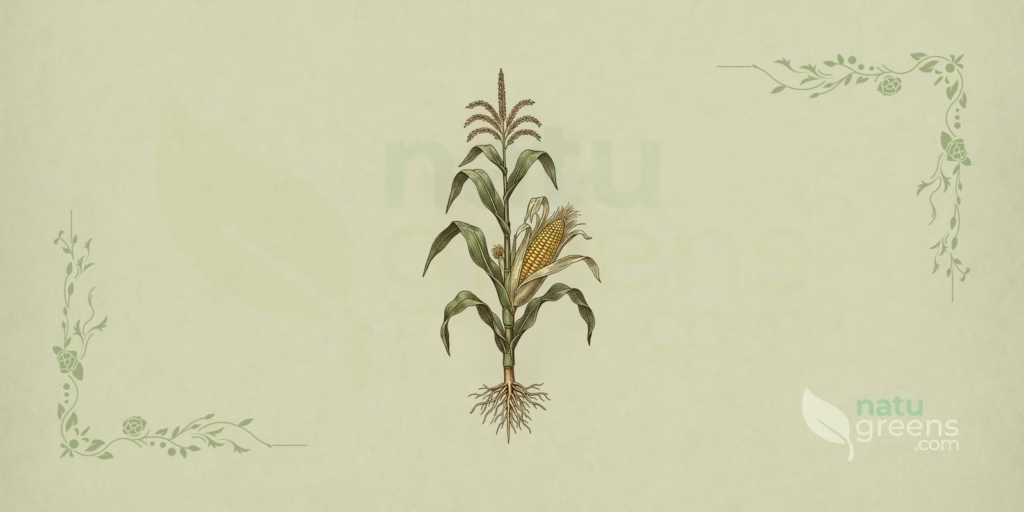
Human selection reshaped maize so deeply that its bract-wrapped ear no longer sheds grain on its own.
Taxonomy
The accepted name is Zea mays L., published by Carl von Linné in Species Plantarum (volume 2, page 971) in 1753. A search of the International Plant Names Index confirms the binomial, the authorship and the original publication reference, and Plants of the World Online keeps the same name as accepted, with no recombination proposal under way. The full hierarchical classification is summarised below.
- Kingdom: Plantae
- Division: Magnoliophyta (angiosperms)
- Class: Liliopsida (monocotyledons)
- Order: Poales
- Family: Poaceae Barnhart
- Subfamily: Panicoideae
- Tribe: Andropogoneae
- Genus: Zea L., 1753
- Species: Zea mays L., 1753
Accepted Synonyms
The synonymy of the species is short, which is what one would expect of a plant described early and always recognised under the same name. Plants of the World Online lists five homotypic and heterotypic synonyms.
- Mays americana Baumg.
- Mays zea Gaertn.
- Mayzea cerealis Raf.
- Thalysia mays (L.) Kuntze
- Zea segetalis Salisb.
Accepted Subspecies
Three subspecies are currently recognised, and only one of them corresponds to field maize. The other two are teosintes, wild Mexican grasses with hardened spikelets that were long treated as plants of another genus.
- Zea mays subsp. huehuetenangensis (Iltis & Doebley) Doebley, from north-western Guatemala
- Zea mays subsp. mays, cultivated maize
- Zea mays subsp. parviglumis Iltis & Doebley, from the Balsas River valley in Mexico
One active disagreement over circumscription is worth recording: the teosinte of the central Mexican highlands appears throughout much of the agronomic literature as Zea mays subsp. mexicana, but Plants of the World Online raises it to a species of its own, Zea mexicana (Schrad.) Kuntze. Anyone consulting sources from different periods will come across both usages, and neither is wrong within the system that adopts it.
Etymology
The generic name Zea comes from the Greek zeia, a term that designated a cereal grown in Mediterranean antiquity, probably a hulled wheat. Linné reused the word for the American plant, a common gesture in eighteenth-century botany, which reached for classical vocabulary to name species that Greek authors had never laid eyes on. The epithet mays has an entirely different origin: it derives from mahiz, the name the Taíno peoples of the Caribbean gave the plant, which passed into Castilian as maíz and from there into the other European languages.
Endosperm Groups
Within the cultivated subspecies, variation in the endosperm supports a horticultural nomenclature that runs parallel to formal taxonomy. The groups are practical categories rather than accepted taxa, and they remain in current use in breeding and in the seed trade.
- Dent: characteristic depression at the crown of the kernel, dominant in commercial production
- Flint: vitreous, hard endosperm, prevalent in Brazil and Argentina
- Flour: soft, mealy endosperm, traditional in Andean varieties
- Pod: each kernel enclosed in glumes of its own, a primitive form with no commercial cultivation
- Popcorn: small vitreous kernel whose internal moisture drives expansion under heat
- Sweet: mutations that block the conversion of sugar into starch, eaten while still green
- Waxy: starch made up almost entirely of amylopectin, the basis of industrial starches
Morphological Description
Maize is an erect annual herb reaching 1.5 to 4 metres in height, with long-cycle tropical varieties passing 5 metres. The robust habit rests on a cylindrical, solid stalk filled with pith parenchyma, which runs counter to the usual image of the hollow culm associated with grasses in general. The plant is monoecious and bears unisexual flowers separated into distinct inflorescences, a condition that sets it apart from the overwhelming majority of grasses.
Leaves
The leaves are alternate and distichous, that is, arranged in two opposite planes along the stalk, which gives the young plant a flattened silhouette when seen from above. Each leaf measures 50 to 120 centimetres long by 5 to 12 centimetres wide, with a lanceolate blade, a long tapering tip and an entire to slightly wavy margin. Venation is parallel, with a prominent whitish midrib that serves as a field character. The sheath wraps the stalk completely, with overlapping margins, and the ligule is membranous and short, 2 to 5 millimetres. A mature plant carries 12 to 22 leaves, a number that varies with the cultivar and the length of the cycle.
Flowers
The spatial separation of the sexes is the most striking trait of the species. The tassel is a terminal panicle with 10 to 25 lateral branches, made up of spikelets bearing two staminate flowers with three anthers each, and a single plant may release tens of millions of pollen grains over the period of anthesis. The ear, in turn, is an axillary inflorescence set in the middle third of the stalk, wrapped in leafy bracts and carrying somewhere between 200 and 1,000 pistillate flowers arranged in invariably even rows, generally 8 to 24. The stigmas form the filaments 10 to 30 centimetres long popularly known as silk, and each one belongs to an individual flower, so that the failure of a single filament to catch pollen results in a kernel that never forms.
Fruits and Seeds
The fruit is a caryopsis, the type characteristic of Poaceae in which the pericarp fuses with the seed coat and the whole behaves as a single indehiscent unit. The kernels measure 5 to 15 millimetres and sit in even rows on the cob, the woody central axis that supports the ear. Colour covers a remarkable range, from white and yellow to orange, red, purple, blue and almost black, depending on the pigmentation of the pericarp and the aleurone layer. Thousand-kernel weight usually falls between 250 and 400 grams in the dent and flint types, and an average commercial ear delivers 400 to 600 kernels.
Root and Stem
The root system is fibrous and organised into three successive functional sets. The seminal roots come first, of embryonic origin, and sustain the seedling until around the sixth leaf stage, when they lose importance. The nodal roots emerge from the underground nodes from the third leaf stage onwards, spread laterally for up to 1 metre and descend around 1.5 metres, accounting for almost the whole of the adult system. Finally the adventitious support roots, known as brace roots, emerge from the exposed lower nodes and anchor the plant in the soil, no trivial job in a plant that has to hold several metres of biomass upright under wind and rain. The stalk shows well-marked nodes and internodes that lengthen unevenly, shorter at the base and progressively longer towards the tassel.
Maize Distribution and Habitat
The origin of the species is confined to the basin of the Balsas River, in what is now the Mexican state of Guerrero, a seasonally dry region where the ancestral teosinte still occurs in natural populations. The cultivated subspecies, however, has no native range in the usual sense of the term, because it is a cultigen: it exists only where it has been planted. From Mesoamerica the plant spread across the whole of the Americas before the arrival of the Europeans, and after 1493 it reached Europe, Africa and Asia within a few decades.
Maize is grown today from sea level up to around 3,800 metres in the Andes, with varieties adapted to each band. The species demands full sun, responds well to temperatures between 25 and 30 degrees Celsius during vegetative growth and needs at least 10 degrees in the soil to germinate. It tolerates no frost at any stage of the cycle. Preferred soils are deep, fertile and well drained, with good water retention and a pH between 5.5 and 7.0, and its nitrogen demand ranks among the highest of all annual crops. Rainfall required over the cycle, which lasts 90 to 150 days, comes to around 500 to 800 millimetres, concentrated above all in the critical window running from two weeks before to two weeks after flowering.
One point tends to go unnoticed in descriptions of distribution: maize hardly naturalises at all. Volunteer plants turn up at field margins and on waste ground, but the populations do not sustain themselves over generations, because the husk-enclosed ear keeps the kernels from loosening and dispersing. Where maize occurs outside cultivation there is almost always a sown field nearby, and its presence is transient.
Cultivation
Propagation is exclusively by seed, with no vegetative route of practical use. Sowing is done at 3 to 5 centimetres deep, at densities running from 55,000 to 80,000 plants per hectare for grain production and 60,000 to 70,000 for silage, and row spacing usually falls between 0.45 and 0.90 metre. Germination takes 5 to 10 days in soil at 25 degrees Celsius.
The crop is demanding in nutrients to an almost aggressive degree. Nitrogen is the single most decisive factor and field recommendations range from 150 to 250 kilograms per hectare, split between the sowing fertilisation and two topdressings, one between the fourth and sixth leaf stages and another between the eighth and tenth. Phosphorus and potassium round out the programme in far smaller amounts. In regions with a water deficit irrigation becomes indispensable, and in central Brazil the centre pivot is the dominant system. Rotation with soya shaped the entire farming calendar of the Cerrado, where second-crop maize takes over the ground as soon as the legume is harvested.
Among the pests, fall armyworm (Spodoptera frugiperda) carries the greatest economic weight in the Americas, attacking the whorl and later the ear. The corn leafhopper (Dalbulus maidis) has come to the fore recently in Brazil for transmitting the mollicutes that cause corn stunt, and the corn earworm (Helicoverpa zea) damages the kernels at the tip. Among the fungal diseases, grey leaf spot (Cercospora zeae-maydis), southern rust (Puccinia polysora) and northern leaf blight (Exserohilum turcicum) stand out, all of them foliar and all capable of compromising grain filling when they advance before maturity.
Grain harvest takes place when moisture falls into the 18 to 23 per cent range, a moment that coincides with the formation of the black layer at the base of the kernel, the visible sign that physiological maturity is complete and that the plant has stopped translocating photoassimilates to the seed.
Phenology
Flowering occurs between 50 and 100 days after sowing, with wide variation according to the cycle of the cultivar and the thermal accumulation of the region. The species shows pronounced protandry, that is, the tassel releases pollen before the stigmas of the same plant are receptive, and that gap of a few days pushes the reproductive system towards cross-fertilisation. Pollination is anemophilous and the pollen, abundant though it is, is heavy and travels short distances, which makes each field a reasonably closed breeding population.
After fertilisation, grain filling takes 45 to 65 days and passes through the successive milk, dough and dent stages up to physiological maturity. Natural dispersal, by contrast, simply does not exist. The husk that protects the ear from birds and insects also imprisons the kernels on the cob, and without human intervention the whole ear rots where it falls. This reciprocal dependence between plant and farmer is the outcome of millennia of selection and the most radical biological trait of the species.
Related Species and Confusions
Besides maize, the genus Zea holds a set of wild Mesoamerican grasses known collectively as teosintes. The main ones are Zea diploperennis Iltis, Doebley & R.Guzmán, a diploid perennial teosinte from Jalisco described only in 1979, Zea luxurians (Durieu & Asch.) R.M.Bird, an annual from Guatemala and Honduras, Zea nicaraguensis Iltis & B.F.Benz, restricted to the Nicaraguan coastal plain and tolerant of flooding, and Zea perennis (Hitchc.) Reeves & Mangelsd., a tetraploid perennial teosinte also from Jalisco. All of them are told apart from maize with ease by the female inflorescence, which in the teosintes is a fragile spike of a few hardened spikelets, without an enclosing husk and without a fleshy cob.
In the field, the real confusion arises at the juvenile stage, when maize has yet to form a tassel or an ear and other large grasses resemble it. Three cases deserve attention.
- Johnson grass (Sorghum halepense): a rhizomatous perennial with leaves similar to those of young maize. The leaves and regrowth of this species contain cyanogenic glycosides, and ingestion by cattle and horses, above all in regrowth after drought or frost, causes cyanide poisoning. Reliable separation comes from the thick rhizomes, absent in maize.
- Sorghum (Sorghum bicolor): similar in stature, but it ends in a compact terminal panicle rather than an open tassel, forms no axillary ear and usually shows a whitish waxy bloom over leaves and stalk.
- Sugarcane (Saccharum officinarum): perennial, with culms filled by sucrose-rich tissue, narrower leaves and none of the broad white midrib of maize. It never produces a lateral ear.
The absolute diagnostic character remains the combination of a terminal male tassel with an axillary female ear bearing long stigmas. No other grass brings the two structures together.
Phytochemistry
Composition varies a good deal according to the organ analysed. The mature kernel is dominated by starch, which accounts for 60 to 72 per cent of dry weight and divides between amylose and amylopectin in a ratio of roughly one to three in conventional types, a relationship that shifts almost entirely to amylopectin in waxy maize. The protein fraction runs between 6 and 12 per cent and has zein as its predominant storage protein, notoriously poor in the amino acids lysine and tryptophan. The oil, concentrated in the germ, represents 3 to 5 per cent and is rich in linoleic acid.
The pigments follow the colour of the kernel. Carotenoids such as lutein and zeaxanthin accumulate in the endosperm of yellow and orange maize, while anthocyanins of the cyanidin-3-glucoside and pelargonidin type are deposited in the pericarp and the aleurone of purple, red and blue varieties. In the cell walls of the pericarp, ferulic acid occurs bound to arabinoxylans at a concentration high for a cereal.
The stigmas accumulate a distinct profile, with flavonoids such as apigenin, luteolin and maysin, alongside polysaccharide mucilages, potassium at high concentration, saponins at low levels and tannins in the range of 1 to 3 per cent of the dry material. Seedlings, for their part, synthesise benzoxazinoids, among them DIMBOA, compounds associated in the chemical ecology literature with the plant’s defence against herbivorous insects and whose concentration falls as the tissue ages.
Two compositional facts carry direct practical consequences and deserve explicit mention. The first is that the niacin of the kernel occurs largely in a bound form, niacytin, which cooking in water does not release. The second is that grain stored at high moisture or under poor ventilation is colonised by fungi of the genera Aspergillus and Fusarium, which produce mycotoxins such as aflatoxins and fumonisins. These toxins withstand the heat of ordinary processing and the contamination is not detectable by taste or smell, which is why moisture control in storage is a matter of health legislation in practically every producing country.
History and Ethnobotany
The oldest evidence of domesticated maize comes from archaeological sites in the Balsas River valley and has been dated to around 8,700 years before present, from starch grains and phytoliths recovered on grinding tools. The wild ancestor is the teosinte Zea mays subsp. parviglumis, a plant whose ears carry five to twelve kernels sheathed in hard glumes. The morphological distance between that grass and the modern ear is enormous, but work in population genetics has shown that the transformation involved mutations in a small handful of regulatory genes, chief among them teosinte branched1, which suppressed lateral branching and concentrated the energy of the plant in a few large ears, and teosinte glume architecture1, which reduced the hardened glume and left the kernel exposed.
Among the Mesoamerican peoples, maize was not merely food. The Popol Vuh, the sacred book of the Quiché Maya set down in the sixteenth century, tells that definitive humanity was moulded from maize dough after earlier attempts with clay and wood had failed, and depictions of the maize deity appear in Classic Maya iconography over the course of centuries. The Aztecs organised ritual calendar and farming cycle around the same plant.
In technical terms, the most consequential Mesoamerican contribution was nixtamalisation, a process in which the kernels were cooked and left to steep in an alkaline solution obtained from lime or hearth ashes before grinding. The alkaline treatment loosened the pericarp, altered the texture of the dough and released the niacin that had been unavailable until then. The peoples who adopted the technique sustained maize-centred diets for millennia without the epidemics that would strike Europe centuries later ever being recorded among them.
That history had a darker counterpoint in Europe. Maize reached the continent after the voyage of Columbus in 1493 and spread rapidly through the Mediterranean, Africa and Asia in the sixteenth and seventeenth centuries, but the alkaline processing did not travel with the seed. Populations in northern Italy, southern France, the Balkans and later the southern United States came to depend on maize prepared with nothing but grinding and boiling in water, and between the eighteenth and twentieth centuries they faced devastating epidemics of pellagra, a deficiency disease whose nutritional cause was established only in the 1930s through the work of Joseph Goldberger and those who followed him. The episode is now a classic case of how a food culture can be transplanted incompletely.
Carl von Linné formally described the species in 1753, working with material grown in European gardens, almost three centuries after the plant had crossed the Atlantic and more than eight millennia after its domestication in Guerrero.
Conservation
Cultivated maize has no individual assessment on the IUCN Red List, a normal situation for cultigens that exist only under agricultural management and whose persistence does not depend on natural populations. The species likewise appears in no CITES appendix. Conservation concern therefore falls on two quite distinct fronts.
The first is the situation of the wild relatives. Zea diploperennis is listed as endangered on the Red List and survives across a few square kilometres in the Sierra de Manantlán, in Mexico, where the area was turned into a biosphere reserve precisely because of that occurrence. Zea nicaraguensis is in an even more precarious position, with a population estimated at a few thousand individuals concentrated in a minimal strip of the Nicaraguan coastal plain, exposed to wetland drainage and urban expansion. The remaining teosinte populations suffer from habitat fragmentation, grazing and the advance of the agricultural frontier.
The second front is genetic erosion within the cultivated species itself. The replacement of local varieties by uniform commercial hybrids has narrowed the genetic base available to breeding on a global scale. The response came by way of ex situ conservation, with the germplasm bank of CIMMYT, in Mexico, holding the largest collection of maize and teosinte accessions in the world, and by way of on-farm conservation, supported in Brazil by Embrapa programmes and by networks of farmers who keep landrace seed in the South and the Northeast.
Interesting Facts
- The number of kernel rows on an ear is always even, the result of a developmental pattern in which each female spikelet produces two adjacent flowers. Ears with odd row numbers virtually never occur.
- Each strand of silk corresponds to a single flower and has to catch at least one pollen grain for a kernel to form. The irregular gaps that show up on poorly pollinated ears are an exact record of which stigmas went without pollen.
- Maize photosynthesises by the C4 pathway, a mechanism that concentrates carbon dioxide and reduces photorespiration. This explains the productivity of the crop under high temperature and intense light, conditions in which C3 cereals such as wheat lose efficiency.
- Barbara McClintock discovered mobile genetic elements, the so-called transposons, by studying the irregular inheritance of kernel colour in maize, work that earned her the Nobel Prize in Physiology or Medicine in 1983, more than three decades after the original publications.
- Teosinte was regarded as a separate genus for so long that its union with Zea still divides authors, and the hypothesis that maize descended from it was rejected by much of the scientific community until the molecular analyses of the 1990s confirmed it.
Notice: this content is for informational purposes and does not replace professional medical advice. Consult a physician or herbal practitioner before using medicinal plants, especially during pregnancy, breastfeeding, or alongside medication.
References and Scientific Studies
Peer-Reviewed Scientific Studies (2)
- DOI2004 Doebley, J. F. The genetics of maize evolution. Annual Review of Genetics, 38, 37-59. 2004. ↗
- DOI2009 Piperno, D. R., Ranere, A. J., Holst, I., Iriarte, J., Dickau, R. Starch grain and phytolith evidence for early ninth millennium B.P. maize from the Central Balsas River Valley, Mexico. Proceedings of the National Academy of Sciences, 106(13), 5019-5024. 2009. ↗
Supplementary Readings (5)
- CIMMYT. Maize Germplasm Bank. Centro Internacional de Mejoramiento de Maíz y Trigo, El Batán, Mexico. ↗
- International Plant Names Index (IPNI). Zea mays L. Royal Botanic Gardens, Kew; Harvard University Herbaria; Australian National Botanic Gardens. ↗
- IUCN. The IUCN Red List of Threatened Species. International Union for Conservation of Nature. ↗
- Linnaeus, C. Species Plantarum, vol. 2, p. 971. Stockholm. 1753. ↗
- POWO. Plants of the World Online. Zea mays L. Royal Botanic Gardens, Kew. ↗