Ferula linkii is the largest wild umbellifer in the Canary Islands and one of the most conspicuous endemics of the archipelago. From February to June its flowering stems climb to three metres over lava slopes and rocky escarpments, carrying yellow umbels that can be picked out from a distance. Known locally as cañaheja or julan, it belongs to the Apiaceae, the same family as the carrot, fennel and parsley, and to the genus Ferula, which gathers the giant fennels of the Old World.
Size is not the only thing that makes the species remarkable. It is a textbook case of island colonisation followed by diversification: the Canaries hold a small group of endemic ferulas divided among the islands, and Ferula linkii is by far the most abundant and the most widely distributed of them. Its phytochemistry departs from the Mediterranean pattern of the genus as well, with an unusual set of carotane sesquiterpenes described from Canarian material.
This profile brings together the formal taxonomy, the diagnostic morphology, the island ecology, cultivation, the species it can be confused with, the documented phytochemistry and the historical record of the plant. It describes the species from a botanical standpoint and does not recommend any use.
Taxonomy
The species was described by Philip Barker Webb in 1843, in the third volume of the Histoire Naturelle des Îles Canaries, the work Webb co-signed with Sabin Berthelot and which remains the founding landmark of Canarian botany. The protologue appears in the Phytographia Canariensis section, page 160, with the statement of provenance reduced to two words: Ins. Canar.
- Kingdom: Plantae
- Division: Tracheophyta (angiosperms)
- Class: Magnoliopsida (eudicots)
- Order: Apiales
- Family: Apiaceae (Umbelliferae)
- Subfamily: Apioideae
- Genus: Ferula Tourn. ex L.
- Species: Ferula linkii Webb, 1843
The placement of the genus within Apioideae has varied a great deal between authors, and the tribal classifications published through the twentieth century never converged. The hierarchy above therefore stops at the subfamily, which is the stable rank.
A Contested Circumscription
The name has two current readings, and both are worth knowing. Plants of the World Online, from Kew, treats the plant as an island subspecies of the Mediterranean giant fennel, under the name Ferula communis subsp. linkii (Webb) Reduron & Dobignard. The Canarian floras and regional inventories, including the official list of wild species of the archipelago, keep Ferula linkii Webb as a full and valid species. The International Plant Names Index records Webb’s name with authorship, publication and year confirmed, and carries no nomenclatural notes. This profile follows the treatment at species rank, the one in current use in the Canaries, and flags the alternative for readers who consult global databases.
Synonyms and Historical Names
The Canarian inventory links two pre-Webb names to the plant: Ferula aurea Link, published in 1825 in the physical description of the Canaries compiled by Leopold von Buch, and Peucedanum aureum, from 1819. Neither displaced Webb’s binomial in current use.
One error that circulates in online compilations deserves a warning: Ferula latipinna A.Santos, from 1983, is not a synonym of this species. It is a distinct Canarian ferula, restricted to La Gomera and La Palma.
Etymology
The generic name comes from the Latin ferula, a rod or staff, in reference to the dry, straight and surprisingly light stems of these plants, which served exactly that purpose in antiquity. The epithet honours Johann Heinrich Friedrich Link (1767-1851), the German botanist who travelled the Iberian Peninsula and worked on the Macaronesian flora.
Morphological Description
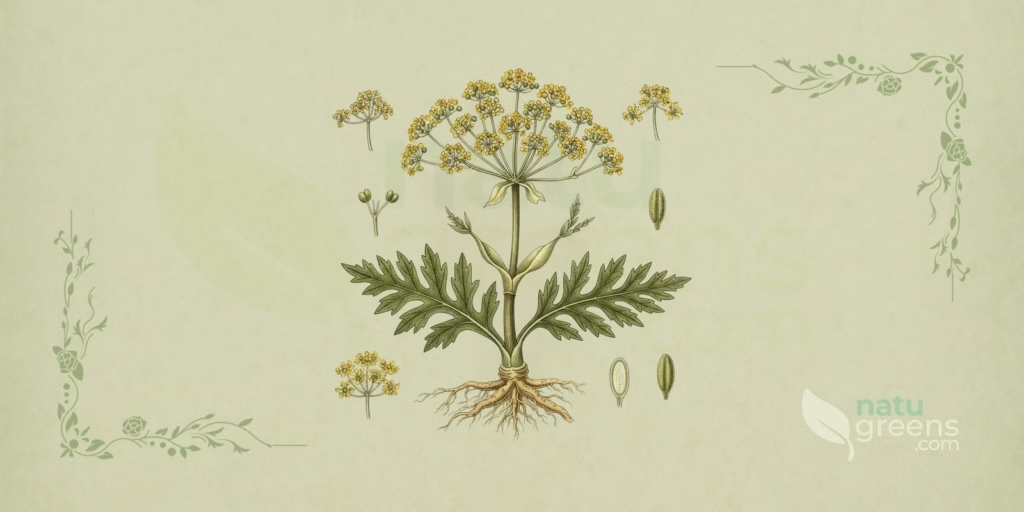
A robust herb with a perennial base and a seasonal aerial part, supported by a deep underground system that resprouts every year. The flowering stems reach 1.5 to 3 metres in height and give the plant the candelabrum silhouette that makes it unmistakable in the Canarian landscape in late winter. Sources disagree on how long individual plants live and how often they flower, which is unsurprising in a species that occupies such a wide altitudinal range.
Leaves
The basal leaves exceed 75 centimetres in length and are the most striking feature of the rosette. They are divided three to four times into very fine, almost thread-like segments, which gives the whole a feathery, glossy green appearance that yellows with age. The lower petioles are thick and cylindrical. On the upper leaves the petiole is reduced to a membranous sheath, yellowish to reddish, that partly clasps the stem, a useful detail for identification in the field. When crushed, the leaf tissue releases a resinous smell rather than an aniseed one.
Flowers
The inflorescence is a large compound umbel with more than twenty rays, accompanied by smaller lateral umbels arranged around the main one. The flowers are small and yellow, with much reduced calyx teeth and acuminate petals whose tips fold inwards, following the pattern of the subfamily. Flowering runs from February to June and may fall outside that window in populations at extreme altitude.
Fruits and Seeds
The fruit is a schizocarp of about 1.5 centimetres, oblong to elliptic, flattened on the dorsal plane and with the margins expanded into wings, a feature typical of the genus. Yellowish green at first, it darkens to reddish brown as it ripens. The pericarp is crossed by vittae, the secretory canals that run through the fruits of the Apiaceae and provide a reliable diagnostic character in cross section.
Root and Stem
The root is long, thick and firmly anchored, an obvious adaptation to stony soils and dry summers. The stem is erect, cylindrical and marked by fine longitudinal grooves, hollow between the nodes and remarkably light once dry, the property that gave the genus both its name and its historical uses.
Distribution and Habitat
The species is endemic to the Canarian archipelago and occurs naturally nowhere else in the world. It is recorded from El Hierro, Fuerteventura, Gran Canaria, La Gomera, La Palma and Tenerife, and is absent only from Lanzarote, where the niche is taken by Ferula lancerotensis Parl. Tenerife and Gran Canaria hold the densest populations.
It occupies sunny rocky pockets, escarpments, scree slopes and open volcanic ground, across an altitudinal range that runs from around 200 metres to above 2,000 metres in the Las Cañadas area on Teide. That amplitude is rare, and it explains why the plant crosses several vegetation belts, from the thermo-Canarian to the supra-Canarian, tolerating everything from maritime influence to the night-time cold of the high mountain. The soils are volcanic, stony, free draining and often poor. As a strict endemic, it has no recorded naturalisation outside the Canaries and shows no sign of invasive behaviour.
Cultivation
Propagation in practice is by seed, sown in autumn right after harvest, since germination capacity falls off in storage. Germination is slow and uneven, and a short spell of moist chilling tends to even it out. Dividing clumps rarely pays off, because the deep taproot makes transplanting established specimens a low-success operation, so sowing directly in the final position is the safer route.
In cultivation the species asks for full sun and sharply drained soil, even stony and poor ground, and it tolerates prolonged drought and strong wind well, as one would expect of a plant from island escarpments. Severe frost and waterlogging are the two real limits. The recorded health problems are those common to fleshy-rooted Apiaceae: root rot in badly drained substrate and aphid colonies on the umbels during flowering. Seed is collected when the mericarps turn reddish brown and before the wings loosen, because dispersal is quick.
Phenology
The cycle is markedly seasonal. The leaf rosette develops in winter, drawing on the moisture of the rains, and the flowering stem emerges from February onwards, peaking between March and May. The open umbels and exposed nectar typical of the Apiaceae attract generalist pollinators: bees, beetles, flies and wasps move across the flowers without any evident morphological specialisation.
Fruiting runs from spring into early summer. The lateral wings of the mericarps act as a drag surface, and dispersal is essentially anemochorous, helped by the trade winds and by the elevated position of the umbels, which work as a launch platform. Once fruiting is over the aerial part dries and stands for months, a pale skeleton still visible in the landscape until the following winter.
Related Ferula Species and Confusions
The Canaries hold a small set of endemic ferulas that can only be told apart with attention to the island of origin and to leaf detail. Ferula arnoldiana S.Scholz & Reyes-Bet., described in 2013, comes from Fuerteventura. Ferula lancerotensis Parl., from 1856, occupies Lanzarote and parts of Fuerteventura. Ferula latipinna A.Santos, from 1983, has broader leaf segments and lives only on La Gomera and La Palma. Outside the archipelago the close relative is Ferula communis L., the Mediterranean giant fennel, comparable in size but with broader leaf segments and a continental distribution.
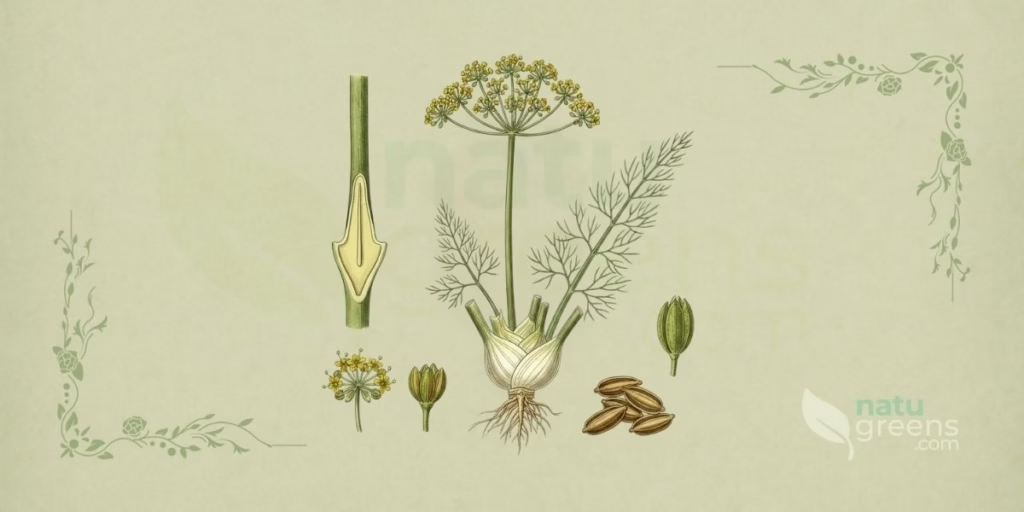
Two confusions call for particular care. Fennel, Foeniculum vulgare, also shows yellow umbels and finely divided leaves, but gives itself away by its intense aniseed scent and by small fruits without broad wings. More serious is the confusion with hemlock, Conium maculatum, which shares the tall habit and the very finely divided leaves but has white flowers rather than yellow, characteristic purple blotches on the stem and an unpleasant smell when crushed. None of these plants should be gathered on the strength of a similar silhouette.
Phytochemistry
The species has been reasonably well studied from a chemical standpoint, and the result came as a surprise because it does not follow the Mediterranean profile of the genus. Several sesquiterpene esters with a carotane skeleton have been isolated from the aerial parts, among them carotdiol esters, along with a sesquiterpene described from this material and named linkiol after the plant itself. Sesquiterpene coumarin ethers were also obtained, including colladin, colladonin, nevskin and umbelliprenin.
To these compounds are added the essential oils of the terpene fraction present in the leaves and stem, and the resin accumulated in the secretory canals that run through stem, petioles and pericarp. The internal distribution follows the pattern of the genus: the sesquiterpenes and coumarin derivatives concentrate mainly in the root system, while the volatile fraction predominates in the aerial part. It is worth recording that the genus Ferula includes chemotypes rich in prenylated coumarins such as ferprenin and ferulenol, and that the published literature on the phytochemistry of Ferula linkii describes the carotane profile above, with no report of those compounds.
On safety, one point stays in the present tense because it is a fact rather than history: Ferula species with a chemotype rich in prenylated coumarins cause ferulosis, a haemorrhagic syndrome that affects cattle, goats, horses and sheep grazing on them. Cañaheja is not a vegetable, it is no part of the human diet, and its resemblance in foliage to fennel is only superficial.
History and Ethnobotany
The plant entered the scientific literature through the front door. Webb and Berthelot described it from the collections behind the Histoire Naturelle des Îles Canaries, published in instalments between the 1830s and the 1850s, a work that established the reputation of the archipelago as one of the great laboratories of plant endemism in the Atlantic. Before them, Leopold von Buch and Heinrich Link had already recorded a golden ferula on the islands, and Alexander von Humboldt had passed through Tenerife in 1799, leaving descriptions of the high-altitude vegetation that spurred later generations of collectors.
On the popular side, the Canarian ethnographic record preserved several names for the same plant: cañaheja, cañalé, cañaleja, chajuira, hinojo gigante and julan, varying from island to island. Ethnobotanical surveys documented that on La Gomera a decoction of the jinojo was turned to for cleaning and cosmetic purposes, and the plant appears in inventories of use collected on Tenerife. Outside the Canaries, the dry stems of the Mediterranean ferulas were widely employed in antiquity as rods, handles and light supports, a use that gave the genus its name.
Conservation
There is no dedicated assessment of the species on the IUCN Red List, so its global status remains not evaluated. Nor does it appear in the CITES appendices or in any specific category of regional protection, which is consistent with the picture in the field: this is the most abundant and most widely distributed ferula in the archipelago, present on six islands and across an exceptionally broad altitudinal range.
That does not make it immune. The pressures affecting Canarian flora in general bear on it too: grazing by feral goats, which damage rosettes and young stems above all at lower elevations; fires, increasingly frequent on the dry slopes; and urban and tourist expansion, which reduces the habitat available in the coastal and mid-altitude belt. Like any island endemic, the species has a small global area of occupancy in absolute terms, which argues for monitoring even in the absence of immediate risk.
Interesting Facts
- The dry stem of a ferula is so light and so tough that Greek mythology chose one of them, the narthex, as the hiding place in which Prometheus is said to have carried the fire stolen from the gods. The narthex of the Greeks was the Mediterranean ferulas, close relatives of the cañaheja.
- The sesquiterpene linkiol takes its name from having been isolated for the first time from this species, a case in which the Canarian plant christened the molecule.
- The distribution of the Canarian ferulas reads like a map of the islands: Lanzarote has its own, Fuerteventura has two, La Gomera and La Palma share another, and the cañaheja occupies almost all the rest of the archipelago.
- Few Canarian plants span such a wide altitudinal range. The same species that grows at 200 metres near the sea turns up above 2,000 metres in Las Cañadas del Teide, exposed to night frost and intense radiation.
- Despite the nickname hinojo gigante, giant fennel, the plant shares neither a use nor even a scent with fennel: crushed cañaheja smells resinous, not of aniseed.
Notice: this content is for informational purposes and does not replace professional medical advice. Consult a physician or herbal practitioner before using medicinal plants, especially during pregnancy, breastfeeding, or alongside medication.
References and Scientific Studies
View All 9 Cited References
- 2001 Bramwell, D.; Bramwell, Z. I. Wild Flowers of the Canary Islands. Editorial Rueda, Madrid. 2001.
- Gobierno de Canarias. Banco de Datos de Biodiversidad de Canarias (BIOTA), record for Ferula linkii Webb. Available at biodiversidadcanarias.es.
- 1990 González, A. G.; et al. Eight carotane sesquiterpenes from Ferula linkii. Phytochemistry. 1990.
- 1993 González, A. G.; et al. Sesquiterpene esters and sesquiterpene coumarin ethers from Ferula linkii. Phytochemistry. 1993.
- International Plant Names Index (IPNI). Ferula linkii Webb, Hist. Nat. Iles Canaries (Phytogr.) 3(2, 2): 160. 1843. Royal Botanic Gardens, Kew; Harvard University Herbaria; Australian National Herbarium. Available at ipni.org.
- Plants of the World Online (POWO). Ferula communis subsp. linkii (Webb) Reduron & Dobignard. Royal Botanic Gardens, Kew. Available at powo.science.kew.org.
- 2007 Sacchetti, G.; et al. Analytical discrimination of poisonous and nonpoisonous chemotypes of giant fennel (Ferula communis L.). Journal of Agricultural and Food Chemistry. 2007.
- 2013 Scholz, S.; Reyes-Betancort, J. A. Una nueva especie del género Ferula (Apiaceae) de Fuerteventura, islas Canarias. Vieraea, 41: 177-188. 2013.
- Webb, P. B.; Berthelot, S. Histoire Naturelle des Îles Canaries. Tome III, partie 2: Phytographia Canariensis. Paris. 1836-1850.