Quick summary
Knotgrass (Polygonum aviculare L.), also known as common knotgrass or prostrate knotweed, is an annual herbaceous plant of the Polygonaceae family, described by Linnaeus in 1753. Native to Eurasia, it has spread to every continent as a spontaneous plant of paths, pavements and trampled ground, where it can be…
Main caution: The genus Polygonum is not uniform, and this species must not be confused with Persicaria hydropiper (water pepper), from a closely related genus and with different properties, nor above all with Polygonum multiflorum…
Knotgrass (Polygonum aviculare L.), also known as common knotgrass or prostrate knotweed, is an annual herbaceous plant of the Polygonaceae family, described by Linnaeus in 1753. Native to Eurasia, it has spread to every continent as a spontaneous plant of paths, pavements and trampled ground, where it can be recognized by its creeping stems full of nodes and its small flowers ranging from white to pink. The herb has been used for centuries in European traditional medicine, which describes it as astringent and diuretic, and the European Medicines Agency (EMA) monograph recognizes the traditional use of the aerial parts for colds, for mild irritation of the mouth and throat and for increasing urine volume, always as traditional use and not as proven efficacy.
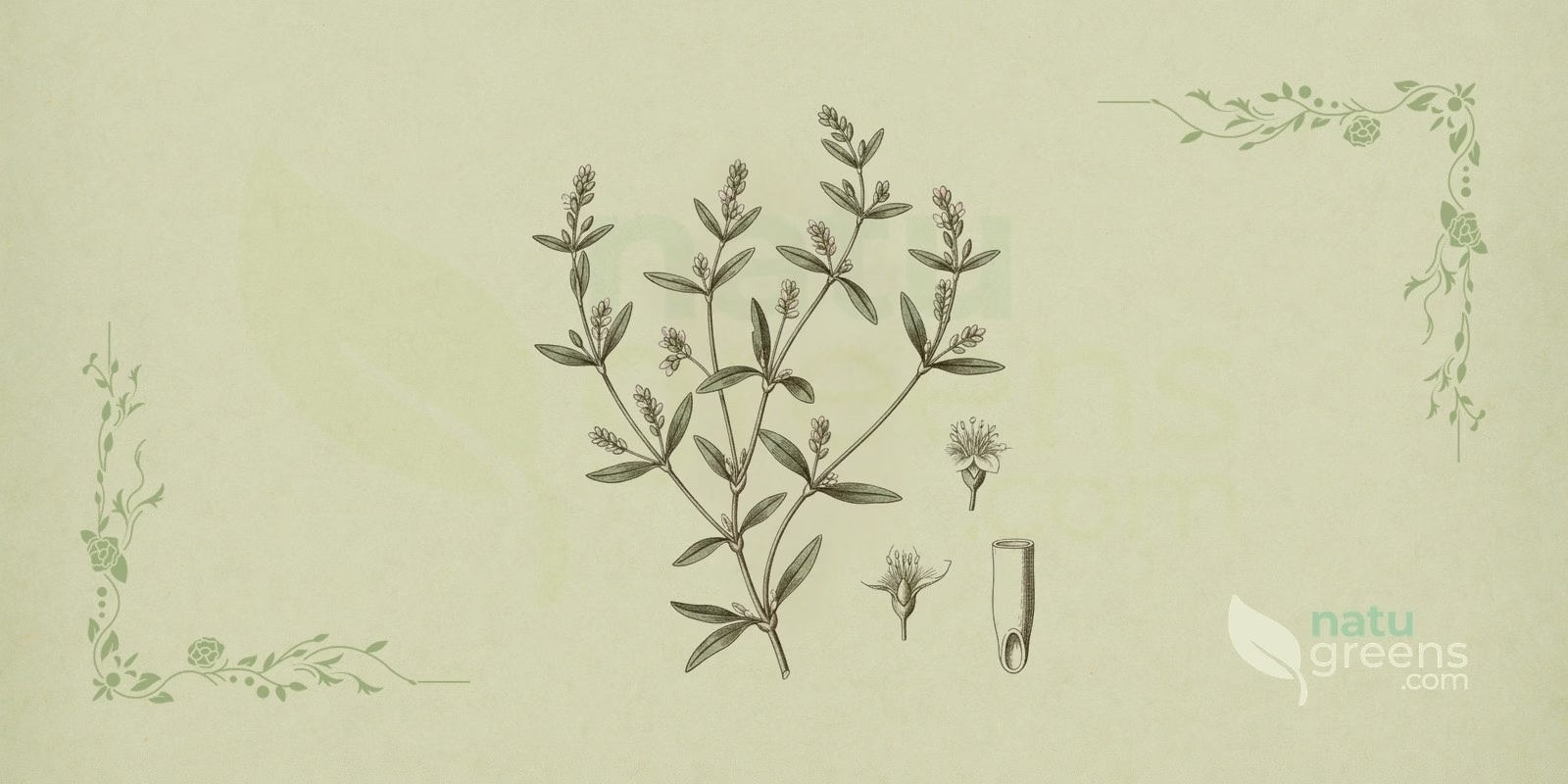
In the European herbal tradition, knotgrass was also applied to small wounds and used for urinary complaints, and its composition, rich in flavonoids and tannins, explains its astringent action and the research interest in its anti-inflammatory and antimicrobial activities, so far observed in the laboratory and in animals. Because the genus Polygonum and its close relatives include plants with very different profiles, some of them toxic, correct identification of the species is the first precaution for anyone who intends to use it.
Popular and International Names of Knotgrass
- English: birdweed, common knotgrass, knotgrass, knotweed, lowgrass, pigweed, prostrate knotweed.
- French: achée, aviculaire, centinode, herbe à cochon, herbe de Saint Innocent, hermole, lis glané, renouée des oiseaux, trainasse.
- German: Blutkraut, Echter Vogelknöterich, Feldknöterich, Gewöhnlicher Vogel-Knöterich, Hansel am Weg, Tausendknotenkraut, Vogelknöterich.
- Italian: attacca fagiuoli, aviculare, centimorbia, centinodia, correggiola, erba correggiola, erba dei cento nodi, erba spaghetta, poligono centinodia, poligono degli uccelli, porcellana selvatica, tiragia.
- Portuguese: centonódia, corriola-bastarda, erva-correndeira, erva-da-ferradeira, erva-da-muda, erva-da-saúde, erva-das-galinhas, erva-dos-passarinhos, língua-de-perdiz, sempre-noiva.
- Spanish: alambrillo, centidonia, cien nudos, cordoncillo, corregüela de los caminos, lengua de pájaro, nudosa, rompepiedras, sanguinaria, treinta nudos.
Botanical Synonyms of Knotgrass
Polygonum aviculare L. has a long list of synonyms and described subspecies, a reflection of its practically worldwide distribution and its great variation in form depending on soil, trampling and moisture. Some authors treat forms such as Polygonum arenastrum and Polygonum aequale as separate species, while others include them in Polygonum aviculare as varieties or subspecies, which is why the names below appear frequently in older floras and studies. Knowing them helps identify the plant precisely in the scientific and herbal literature.
- Avicularia vulgaris Didr.
- Centinodium axillare Montandon
- Polygonum aequale Lindm.
- Polygonum agreste Sumner
- Polygonum aphyllum L.
- Polygonum arenastrum Jord. ex Boreau
- Polygonum aviculare var. arenastrum (Jord. ex Boreau) Rouy
- Polygonum bellardii All.
- Polygonum heterophyllum Lindm.
- Polygonum monspeliense Thiéb. ex Pers.
- Polygonum provinciale C.F.W.Meissn.
- Polygonum rectum L.
- Polygonum rurivagum Jord. ex Boreau
Botanical Family: Polygonaceae
Knotgrass belongs to the Polygonaceae family, which comprises about 50 genera and more than 1,200 species, distributed mainly in the temperate regions of the Northern Hemisphere. The family is characterized by stems with prominent nodes and membranous stipules called ochreae, which wrap the base of the leaves like a small sheath, a detail that is easy to see on knotgrass itself. The Polygonaceae include plants with culinary and medicinal uses, such as rhubarb and buckwheat, and compounds such as flavonoids, tannins and phenolic acids are common in the group. The family also includes species with known risks, which reinforces the need not to treat every plant called knotweed as if they were all the same.
Parts of Knotgrass Used
- Flowering aerial parts (herbal substance of the European monograph)
- Leaves
- Stems
- Young shoots (culinary use)
Ethnobotanical and Traditional Uses of Knotgrass
- Traditional use recognized by the EMA to increase urine volume.
- Traditionally recorded against intestinal worms.
- Traditionally recorded as an antiseptic for wounds.
- Traditionally recorded as an expectorant for cough and bronchitis.
- Traditionally recorded as an internal and external astringent for diarrhea, hemorrhoids, minor bleeding and wounds.
- Traditionally recorded for fatigue.
- Traditionally recorded for gingivitis and sore throat.
- Traditionally recorded for intestinal cramps and gas.
- Traditionally recorded for lung complaints.
- Traditionally recorded for skin problems.
Therapeutic Properties of Knotgrass
- Alpha-glucosidase inhibitor (observed in vitro, no proven effect on human blood sugar)
- Antibacterial (activity of extracts in laboratory studies)
- Antifatigue (preliminary finding in an animal study)
- Antifungal (activity observed in vitro)
- Anti-inflammatory (observed in immune cells and in animals, no clinical trial)
- Antioxidant (attributed to flavonoids in laboratory assays)
- Antiparasitic (traditional record against worms)
- Antiproliferative (activity observed in laboratory studies, no clinical proof)
- Antiviral (isolated laboratory findings)
- Astringent (attributed to tannins, the basis of traditional use in diarrhea and on mucous membranes)
- Diuretic (traditional use recognized by the EMA to increase urine volume)
- Expectorant (traditional use in colds recognized by the EMA)
- Vasoconstrictor (traditional record linked to the astringent action)
- Wound-healing (traditional record of use on small wounds)
Detailed Phytochemical Profile of Knotgrass
The aerial parts of knotgrass are rich in flavonoids, notably avicularin, quercetin and its glycosides, myricitrin, juglanin and astragalin, as well as flavonol glucuronides that showed antioxidant and anti-inflammatory activity in laboratory studies. Tannins account for the traditional astringent action and are also responsible for reducing the absorption of iron and of medicines taken together with the tea. The plant also contains silicic acid, to which tradition attributed a role in connective tissue without clinical proof, the lignan aviculin, saponins, sesquiterpenes, diterpenes such as panicudine and small amounts of alkaloids. Recent studies have also isolated rhamnogalacturonan-type polysaccharides, investigated in animal models of kidney stones, which shows that the chemistry of the species is still being explored.
- Alkaloids
- Astragalin
- Avicularin
- Aviculin (lignan)
- Betmidin
- Diterpenes (panicudine)
- Flavonoids (juglanin, myricitrin, quercetin)
- Saponins
- Sesquiterpenes
- Silicic acid
- Tannins
Preparation and Administration Forms of Knotgrass
- Culinary use (young shoots, tender leaves and stems)
- Decoction
- Gargle and mouthwash (warm infusion)
- Infusion (tea)
- Tincture (alcoholic preparation)
Any preparation of the plant should be taken at least 2 hours apart from iron supplements and other medicines, because of the tannins.
Synergy with Other Medicinal Plants
Respiratory Infusions with Thyme and Licorice
In European folk herbalism, knotgrass appears in blends with thyme (Thymus vulgaris) or licorice (Glycyrrhiza glabra), traditionally used for colds and cough with phlegm. The combination rests on the expectorant history of these herbs and on the traditional use of knotgrass recognized by the EMA, but it has not been evaluated in clinical studies, and licorice has its own restrictions for people with high blood pressure, heart or kidney problems.
Traditional Gargles with Chamomile
For mild irritation of the mouth and throat, knotgrass infusion is traditionally used as a gargle, sometimes mixed with chamomile (Matricaria chamomilla), which has a long tradition on irritated mucous membranes. This pairing is a traditional record for local use, and a severe sore throat with high fever or white patches needs medical evaluation.
Skin Compresses with Calendula
In external applications, knotgrass compresses and washes are traditionally combined with calendula extracts (Calendula officinalis) on minor scrapes and skin irritations. The astringent action attributed to the tannins would add to the topical history of calendula, with no study evaluating the blend, and deep, infected or non-healing wounds require professional care.
Recipes and Usage Protocols of Knotgrass
Traditional Infusion for Colds and Cough
A traditional European preparation, recognized by the EMA monograph for symptoms of the common cold.
Ingredients: 1 to 2 teaspoons of dried knotgrass herb and 200 ml of boiling water.
Preparation: Place the herb in a cup, cover with the boiling water, put a lid on and let steep for 10 to 15 minutes before straining. In traditional use, the infusion is taken up to 3 times a day for a few days, always apart from medicines and iron supplements. If the cough lasts more than a week or comes with fever and shortness of breath, see a doctor.
Gargle for Mild Mouth and Throat Irritation
A local use traditionally applied to minor irritations of the gums, mouth and throat.
Ingredients: 1 tablespoon of dried knotgrass herb and 200 ml of boiling water.
Preparation: Prepare the infusion as described above, let it cool to lukewarm and use it as a mouthwash or gargle a few times a day, without swallowing. See a dentist or doctor if gum bleeding, mouth sores or sore throat persist.
Traditional Infusion for Urine Volume
A preparation traditionally used to increase urine volume and flush the urinary tract in mild urinary complaints, according to the European monograph.
Ingredients: 1 to 2 teaspoons of dried knotgrass herb and 200 ml of boiling water.
Preparation: Prepare the infusion as in the previous recipes and drink it together with a good water intake throughout the day. Do not use if there is swelling due to heart or kidney failure, and seek medical evaluation in case of fever, pain when urinating or blood in the urine, without prolonging self-medication.
Astringent Infusion in the Traditional Record for Mild Diarrhea
A European folk use based on the astringent action of tannins, traditionally applied in short episodes of mild diarrhea in adults.
Ingredients: 1 teaspoon of dried knotgrass herb and 200 ml of boiling water.
Preparation: Prepare as an infusion and drink after meals, staying well hydrated. Diarrhea with blood, fever, signs of dehydration or lasting longer than two days requires medical evaluation, and the infusion should not be used in children.
The preparations above follow traditional records and do not replace professional guidance. Before any internal use, check the contraindications and interactions described in this article.
Therapies Associated with Knotgrass
European Herbal Medicine
In European herbal medicine, knotgrass has an EMA monograph in the traditional use category, the most conservative one, which is based on a long history of use and not on clinical trials. The accepted indications are the relief of cold symptoms and of mild irritation of the mouth and throat, and increasing urine volume in mild urinary complaints, always in adults and for a limited time. Folk uses such as strengthening connective tissue through silicic acid or supporting the joints are not part of the monograph and are unproven.
Traditional Korean Herbal Medicine
In traditional Korean medicine, knotgrass appears in preparations for arthritis and cardiovascular complaints, and this history prompted laboratory studies on its anti-inflammatory and antioxidant effects, such as those carried out in macrophages. This work helps to understand possible mechanisms but does not confirm any benefit in people, and joint or cardiovascular diseases require medical follow-up.
Contraindications and Side Effects of Knotgrass
Plant Identity
The genus Polygonum is not uniform, and this species must not be confused with Persicaria hydropiper (water pepper), from a closely related genus and with different properties, nor above all with Polygonum multiflorum, now called Reynoutria multiflora, a hepatotoxic plant with a real risk of liver damage. No safety or usage data on these species should be attributed to knotgrass, and the scientific name must be checked on the label of teas and extracts.
Contraindications
Knotgrass is not recommended during pregnancy, breastfeeding or for children under 12, due to insufficient safety data. Use to increase urine volume is contraindicated in people with edema due to heart or kidney failure, and fever, pain when urinating or blood in the urine require medical evaluation, never prolonged self-medication with the plant. People with kidney stones, gout or stomach acidity should also use it with caution, as traditional sources report a possible worsening of these conditions.
Side Effects and Interactions
Short-term use is usually well tolerated, but the effects of prolonged use are poorly known, and stomach discomfort may occur because of the tannin content. Tannins reduce the absorption of iron and of medicines taken at the same time, so the recommendation is to space doses at least 2 hours apart. Since the plant increases urine volume, people taking diuretics should consult their doctor, and some point to a theoretical possible interaction with anticoagulants, which justifies caution in that group as well.
Historical Notes and Interesting Facts about Knotgrass
Polygonum aviculare has a long and varied history. Its seeds were a traditional ingredient in the porridges of Germanic peoples of Western Europe, and remains of the plant have been identified in the stomach contents of bodies preserved in bogs, such as the famous Tollund Man, showing that it was part of the diet of ancient communities. Common names in several languages, such as centinode, cien nudos and Tausendknotenkraut, allude to the many nodes on the stem, while the epithet aviculare, linked to small birds, recalls that birds enjoy its seeds. More recently, the plant found a place in popular culture through the Harry Potter novels, in which knotgrass is an ingredient of Polyjuice Potion, used to temporarily take on another person's appearance.
Frequently Asked Questions about Knotgrass
Can Knotgrass Be Taken Every Day?
The European monograph provides for traditional use over short periods, and there is not enough data on prolonged daily consumption. Pregnant and breastfeeding women, children under 12 and people with edema due to heart or kidney failure should not use it, and a health professional should guide the dose and duration.
Can Knotgrass Be Used for Urinary Problems?
The EMA recognizes the traditional use of the plant to increase urine volume in mild urinary complaints, without efficacy proven in clinical studies. Fever, pain when urinating or blood in the urine require medical evaluation, and use is contraindicated in people with swelling due to heart or kidney failure.
Are There Drug Interactions with Knotgrass?
Studies are limited, but tannins reduce the absorption of iron and medicines, so it is advisable to space doses at least 2 hours apart. The effect on urine volume may add to that of diuretics, and there is theoretical caution with anticoagulants, so your doctor or pharmacist should be informed.
Can Children Use Knotgrass?
It is not recommended for children under 12, due to insufficient safety data. In children, cough, diarrhea or urinary complaints should be evaluated by a pediatrician.
What Is the Difference between Knotgrass and Other Polygonum Species?
The genus Polygonum and its relatives include plants with very different chemistry and risks. Knotgrass is not Persicaria hydropiper or Polygonum multiflorum (Reynoutria multiflora), the latter hepatotoxic, and no information on these species applies to it.
Why Should Knotgrass Tea Be Spaced from Other Medicines?
The plant contains tannins, which bind to iron and to some medicines and reduce their absorption. For this reason, an interval of at least 2 hours is recommended between the tea and iron supplements or other medicines.
Notice: this content is for informational purposes and does not replace professional medical advice. Consult a physician or herbal practitioner before using medicinal plants, especially during pregnancy, breastfeeding, or alongside medication.
How to cite this article
NATUGREENS. Knotgrass (Polygonum aviculare): Properties and Benefits. Natugreens, 10 Nov. 2026. Disponível em: https://natugreens.com/polygonum-aviculare-knotgrass/. Accessed: Nov. 10, 2026.
Natugreens. (2026). Knotgrass (Polygonum aviculare): Properties and Benefits. Natugreens. https://natugreens.com/polygonum-aviculare-knotgrass/
References and Scientific Studies
Peer-Reviewed Scientific Studies (4)
- PEER2013 Granica S, et al. Antioxidant and anti-inflammatory flavonol glucuronides from Polygonum aviculare L.. Fitoterapia. 2013.
- PMC2024 Jang CH, et al. Hydroethanolic Extract of Polygonum aviculare L. Mediates the Anti-Inflammatory Activity in RAW 264.7 Murine Macrophages Through Induction of Heme Oxygenase-1 and Inhibition of Inducible Nitric Oxide Synthase. Plants (Basel). 2024.
- PMC2026 Lee YS, et al. Comprehensive Phytopharmacological Profiling of Polygonum aviculare L.: Antioxidant, Anti-Inflammatory, and α-Glucosidase Inhibitory Activities of Bioactive Constituents with Molecular Docking and In Silico Drug-Likeness Analysis. Antioxidants (Basel). 2026.
- PMC2026 Ma Y, et al. Multi-omics analyses reveal a rhamnogalacturonan I (RG-I) from Polygonum aviculare ameliorates nephrolithiasis through regulation of the gut-kidney axis. Carbohydr Polym. 2026.
Supplementary Readings (1)
- 2016 European Medicines Agency (EMA). Knotgrass herb: Polygonum aviculare L., herba. 2016.
Take your time and tell us everything you think, details included. Every response is read by someone on our editorial team and goes into the article's revision. An honest critique helps us more than a polite compliment.
Take your time and tell us everything you think, details included. Every response is read by someone on our editorial team and goes into the article's revision. An honest critique helps us more than a polite compliment.
You May Also Like