



Quick summary
Leontopodium alpinum Cass. / Edelweiss, commonly known as edelweiss, is a perennial herbaceous plant of the Asteraceae family, tribe Gnaphalieae, native to the mountains of Europe, from the Pyrenees and the Alps to the Carpathians and the Balkans, where it grows at high altitudes on rocky and often limestone soils. A…
Main caution: Warning: there are not enough safety data for the internal use or ingestion of edelweiss, and for that reason this use is not recommended, with special emphasis on pregnancy, breastfeeding and children. There is also no…
Leontopodium alpinum Cass. / Edelweiss, commonly known as edelweiss, is a perennial herbaceous plant of the Asteraceae family, tribe Gnaphalieae, native to the mountains of Europe, from the Pyrenees and the Alps to the Carpathians and the Balkans, where it grows at high altitudes on rocky and often limestone soils. A symbol of purity, beauty and the spirit of mountaineering, edelweiss is a national emblem of Switzerland and Austria and has a long history in Alpine folk medicine, today only as a traditional record.
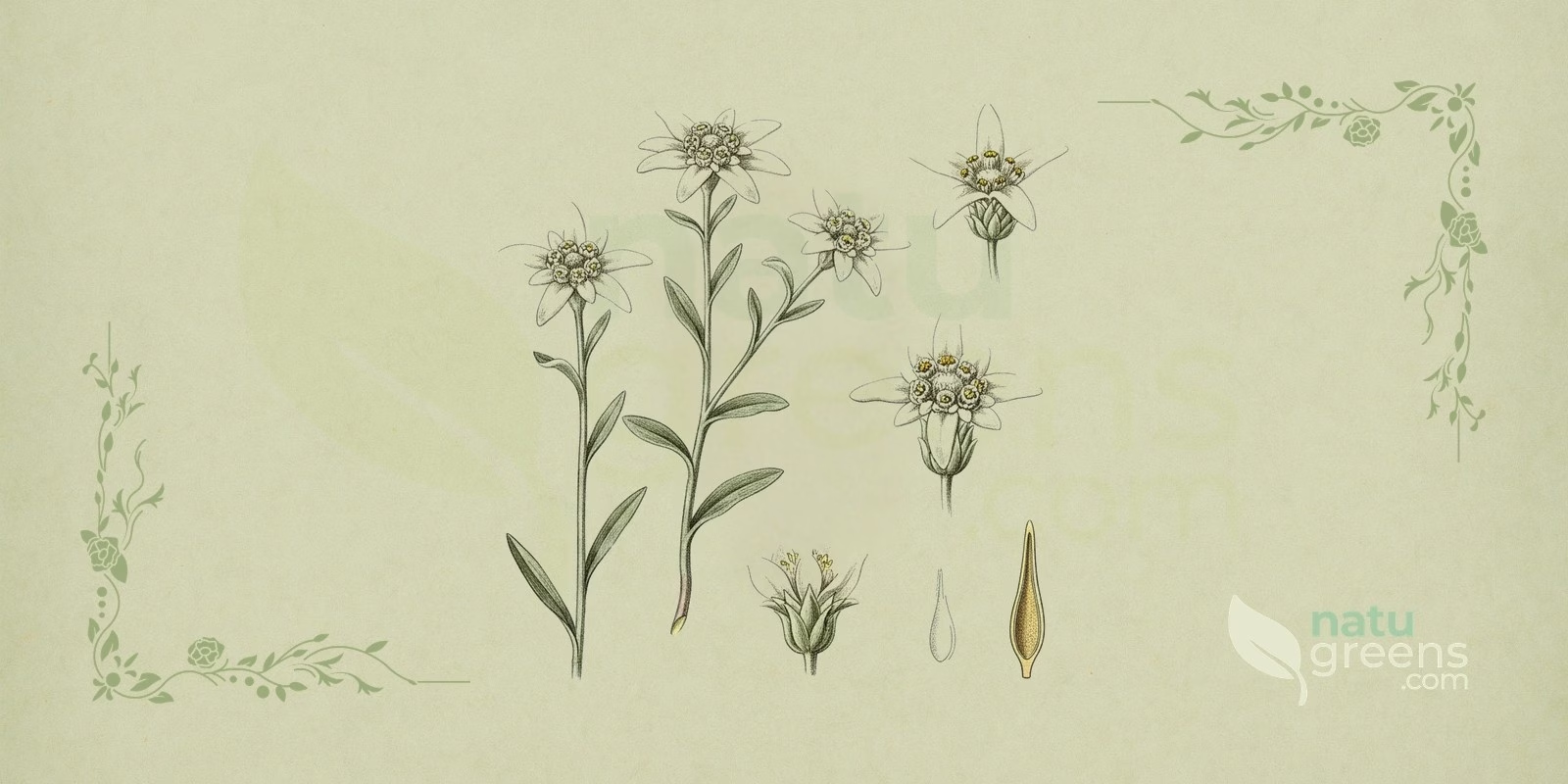
The plant has an unmistakable look: white, felty bracts covered in woolly hairs form a star around the small yellow flower heads, an adaptation that helps shield the plant from the cold, the wind and the intense radiation of the mountains. Its compounds, such as the leontopodic acids, chlorogenic acid and lignans, have shown antioxidant and anti-inflammatory activity only in vitro and in animals. Edelweiss is protected by law in several Alpine countries and regions, so the raw material used by the cosmetics industry today comes mainly from cultivation, above all in Switzerland, and from plant cell culture.
Popular and International Names of Edelweiss
- English: alpine snow flower, edelweiss.
- French: edelweiss, étoile des Alpes, étoile du glacier, immortelle des Alpes.
- German: Alpen-Edelweiß, Edelweiß, Klein Löwenfuss.
- Italian: edelweiss, stella alpina.
- Portuguese: edelvais, edelvaisse, edelweiss, estrela-das-neves, pé-de-leão.
- Spanish: edelweiss, estrella de los Alpes, flor de las nieves.
The name edelweiss is also used commercially for other Asian species of the genus Leontopodium, such as L. japonicum, L. leontopodioides and L. souliei, from the Himalayan group, and studies or traditional Chinese or Tibetan medicine uses involving these plants do not apply to the European Alpine edelweiss.
Botanical Synonyms of Edelweiss
The currently accepted name for edelweiss is Leontopodium nivale subsp. alpinum (Cass.) Greuter, a combination proposed by the botanist Werner Greuter, who treats the Alpine plant as a subspecies of Leontopodium nivale. Even so, Leontopodium alpinum Cass. remains the name used throughout the phytochemical literature, by the cosmetics industry and by the INCI nomenclature on labels, which is why it is kept as the main name in this article.
- Gnaphalium leontopodium (historical name, predating the creation of the genus Leontopodium)
- Leontopodium alpinum Cass.
- Leontopodium nivale subsp. alpinum (Cass.) Greuter (currently accepted name)
Botanical Family: Asteraceae
The Asteraceae family, also called Compositae, is one of the largest and most diverse families of flowering plants in the world, characterized by flower heads in which many small flowers cluster together and look like a single bloom. The family includes species of great economic, ornamental and medicinal importance, such as sunflowers, daisies, artichokes, chamomile, arnica and calendula, as well as ragweed, known for its allergenic pollen.
Edelweiss belongs to the tribe Gnaphalieae, a group of plants that are often woolly or silvery and adapted to dry, cold or exposed environments. Its white star is a remarkable example of the family's morphological diversity: what looks like one large flower is in fact a cluster of yellow flower heads surrounded by modified leaves, the bracts, covered in hairs.
Parts of Edelweiss Used
- Aerial parts (leaves, stems)
- Flowers and bracts
- Plant cells grown in the laboratory (callus culture, cosmetic use)
- Roots (traditional record)
Ethnobotanical and Traditional Uses of Edelweiss
- Abdominal pain (traditional record, hence the folk nickname bellyache flower)
- Diarrhea and dysentery (traditional record)
- Fever (traditional record)
- Heart conditions (traditional record, unproven)
- Inflammation (traditional record)
- Respiratory complaints, such as coughs and bronchial problems (traditional record)
- Traditional veterinary use in Alpine communities
- Wounds (traditional record of external use)
In Alpine folk medicine, edelweiss was prepared as decoctions in milk or wine, sometimes with honey and butter added, for abdominal and respiratory complaints. This use is only a traditional record: there are no safety data for internal use, and for that reason this article gives no indication, dose or method of preparation for ingestion.
Therapeutic Properties of Edelweiss
- Antibacterial (activity observed in vitro with extracts of the Alpine species)
- Antifungal (preliminary in vitro studies)
- Anti-inflammatory (activity shown only in vitro and in animals)
- Antioxidant (activity shown only in vitro and in animals)
- Astringent (traditional record)
- Cytoprotective (studies in cells grown in the laboratory)
- Wound healing (traditional record of external use)
For cosmetic use there are only a few clinical studies, small and partly funded by manufacturers, on skin appearance and hair density, and their results are preliminary and still under study. It is also important not to mix up two different products: the whole-plant extract and the callus culture extract, sold under the INCI name Leontopodium Alpinum Callus Culture Extract, have different compositions, and studies on one do not apply to the other.
Detailed Phytochemical Profile of Edelweiss
- Bisabolanes
- Chlorogenic acid
- Fatty acids
- Isochlorogenic acids
- Leontopodic acids A and B
- Lignans (including leoligin)
- Phenylpropanoids
- Polyacetylenes
- Terpenoids
Leontopodic acids A and B, derived from caffeic acid, are the most characteristic compounds of the plant and the most studied for antioxidant activity. Leoligin, the main lignan in edelweiss, has been investigated in laboratory cells for its role in cholesterol transport, while bisabolanes and polyacetylenes round out a complex chemical profile whose activities have been observed only in vitro and in animals.
Preparation and Administration Forms of Edelweiss
- Cosmetics with callus culture extract
- Cosmetics with extract of the cultivated plant
- Decoctions in milk or wine (historical record only, no current indication)
- Research extracts (concentrated, fluid)
Synergy with Other Medicinal Plants
Research on combinations of edelweiss with other plants is practically nonexistent, and any pairing should be seen as a hypothesis, not a proven effect. In cosmetics, edelweiss extract often appears in formulas alongside calendula (Calendula officinalis) and aloe (Aloe vera), traditional ingredients in products for sensitive skin, and chamomile is also mentioned in blends of this kind for its traditional reputation as a soothing herb.
Keep in mind that calendula and chamomile also belong to the Asteraceae family, so people allergic to this family may react to more than one ingredient in the same formula, which makes a patch test before use even more important in these cases.
Recipes and Usage Protocols of Edelweiss
Why There Are No Recipes for Ingestion
Traditional Alpine preparations, such as teas, decoctions in milk or wine and mixtures with honey and butter, belong to the historical record. Since there are not enough safety data for internal use, nor any oral-use monograph recognized by a regulatory agency, this article offers no recipes for drinking or eating edelweiss.
Patch Test Before Using Cosmetics with Edelweiss
A patch test is a simple precaution recommended before adopting a new cosmetic with edelweiss extract, especially for people allergic to plants of the Asteraceae family.
- Apply a small amount of the product to the inside of the forearm or behind the ear.
- Leave it on and watch the area for 24 to 48 hours, without washing it or covering it with other products.
- If redness, itching, swelling or blisters appear, wash the area and do not use the product.
- Even after a negative test, stop using it if irritation appears in the following days.
Ornamental Growing in a Rock Garden
Anyone who admires edelweiss can grow it as an ornamental plant, from nursery seedlings or seeds, instead of looking for it in the wild, where it is protected.
- Choose a sunny, well-ventilated spot without excess moisture.
- Use a very well-drained substrate with coarse sand and fine gravel, preferably slightly calcareous.
- Water sparingly, letting the substrate dry out between waterings.
- In hot, humid regions growing it is difficult, and pots kept in cool places give better results.
The preparations above follow traditional records and do not replace professional guidance. Before any internal use, check the contraindications and interactions described in this article.
Therapies Associated with Edelweiss
Cosmetics
Edelweiss extract, obtained from the cultivated plant or from callus cultures, is a popular ingredient in creams, serums and daily care products, promoted by brands for antioxidant properties observed in the laboratory. Some of these products also contain sunscreens, but edelweiss itself does not protect against UV radiation and does not replace sunscreen, and the few clinical studies on skin appearance are small and preliminary, with no proof of an anti-aging or skin-regenerating effect.
Homeopathy
Homeopathy uses preparations called Gnaphalium, traditionally described for sciatica-type and neuralgic pain, but some of them come from other species of the same tribe, and they cannot be reliably attributed to edelweiss. In any case, these indications belong to the homeopathic tradition and have no scientific proof.
Contraindications and Side Effects of Edelweiss
Internal Use Not Recommended
Warning: there are not enough safety data for the internal use or ingestion of edelweiss, and for that reason this use is not recommended, with special emphasis on pregnancy, breastfeeding and children. There is also no oral-use monograph recognized by a regulatory agency.
Asteraceae Allergy
People allergic to plants of the Asteraceae family, such as ragweed, arnica and chamomile, may develop contact sensitization to edelweiss. This is a theoretical caution, but it justifies a patch test before using any cosmetic with the extract.
Drug Interactions
There are no documented drug interactions, which reflects the scarcity of clinical research, not a guarantee of safety.
Conservation and Identity
- Legal protection: edelweiss is protected by law in several Alpine countries and regions; do not pick it in the wild. The species is locally protected and rare in part of its range, and the cosmetic raw material comes mainly from cultivation, above all in Switzerland, and from plant cell culture.
- Asian species: plants sold as edelweiss of Asian origin, such as L. japonicum, L. leontopodioides and L. souliei, are different species, and their traditional uses and studies do not apply to Alpine edelweiss.
- Brazilian and New Zealand edelweiss: the so-called Brazilian edelweiss (Sinningia leucotricha, Gesneriaceae) and New Zealand edelweiss (genus Leucogenes) have no real botanical relationship with Alpine edelweiss.
Historical Notes and Interesting Facts about Edelweiss
Symbol of the Mountains
Edelweiss became an icon of the Alpine mountains, associated with purity, beauty and the adventurous spirit of mountaineering, and its image was adopted as an emblem by Alpine clubs, organizations and mountain military units. Its worldwide fame grew through legends and songs, among them the tune that bears its name in the musical The Sound of Music.
The Bellyache Flower
Before it became a romantic symbol, edelweiss was known in Alpine folk medicine as the bellyache flower, because of the milk decoctions used for digestive complaints. Today this use is only a historical record, and scientific interest focuses on the compounds studied in the laboratory and on cosmetics.
Protected and Cultivated
Because it is protected by law in several Alpine countries and regions, edelweiss should not be picked in the wild. The plant used in cosmetics is cultivated, mainly in Switzerland, or produced in cell culture, and anyone who wants to have it nearby can grow it as an ornamental in a rock garden.
Edelweiss That Are Not Edelweiss
The name of the Alpine flower has been borrowed by unrelated plants, such as Sinningia leucotricha, called Brazilian edelweiss for its silvery, velvety leaves, and the species of Leucogenes, known as New Zealand edelweiss.
Frequently Asked Questions about Edelweiss
Is It Safe to Drink Edelweiss Tea?
It is not recommended. Alpine teas and decoctions are a traditional record, and there are not enough safety data for internal use, with special emphasis on pregnancy, breastfeeding and children.
Is Edelweiss Good for the Skin?
The plant's compounds have shown antioxidant and anti-inflammatory activity in vitro and in animals, and the few clinical studies on skin appearance are small and preliminary. Edelweiss does not protect against UV radiation, does not replace sunscreen and has no proven anti-aging effect.
Can People with Allergies Use Cosmetics with Edelweiss?
People allergic to plants of the Asteraceae family, such as ragweed, arnica and chamomile, may develop contact sensitization. In these cases, a patch test before use is especially important.
Where Does Edelweiss Grow Naturally?
In the mountains of Europe, from the Pyrenees and the Alps to the Carpathians and the Balkans, at high altitudes on rocky, often limestone soils. It is protected by law in several Alpine countries and regions and should not be picked in the wild.
Where Does the Edelweiss in Cosmetics Come From?
The raw material comes mainly from cultivation, above all in Switzerland, and from plant cell culture, the so-called calluses. Callus extract and whole-plant extract are different products, and studies on one do not apply to the other.
Is Asian Edelweiss the Same Plant?
No. Species such as L. japonicum, L. leontopodioides and L. souliei are also sold as edelweiss, but they are different, and their uses in Chinese or Tibetan medicine do not apply to the European Alpine edelweiss.
Notice: this content is for informational purposes and does not replace professional medical advice. Consult a physician or herbal practitioner before using medicinal plants, especially during pregnancy, breastfeeding, or alongside medication.
How to cite this article
NATUGREENS. Edelweiss (Leontopodium alpinum): Properties and Benefits. Natugreens, 19 Nov. 2026. Disponível em: https://natugreens.com/edelweiss-leontopodium-alpinum/. Accessed: Nov. 20, 2026.
Natugreens. (2026). Edelweiss (Leontopodium alpinum): Properties and Benefits. Natugreens. https://natugreens.com/edelweiss-leontopodium-alpinum/
References and Scientific Studies
- PMC2003 Dobner MJ, et al. Antibacterial activity of Leontopodium alpinum (Edelweiss). J Ethnopharmacol. 2003.
- PMC2016 Wang L, et al. Leoligin, the Major Lignan from Edelweiss (Leontopodium nivale subsp. alpinum), Promotes Cholesterol Efflux from THP-1 Macrophages. J Nat Prod. 2016.
- PMC2020 Cho WK, et al. Anti-Aging Effects of Leontopodium alpinum (Edelweiss) Callus Culture Extract Through Transcriptome Profiling. Genes (Basel). 2020.
- PMC2022 Campiche R, et al. An extract of Leontopodium alpinum inhibits catagen development ex vivo and increases hair density in vivo. Int J Cosmet Sci. 2022.
You May Also Like
Take your time and tell us everything you think, details included. Every response is read by someone on our editorial team and goes into the article's revision. An honest critique helps us more than a polite compliment.
Take your time and tell us everything you think, details included. Every response is read by someone on our editorial team and goes into the article's revision. An honest critique helps us more than a polite compliment.