



Quick summary
Ononis spinosa L. / Spiny Restharrow, known in Portugal as gatunha, rilha-boi or resta-boi, is a small perennial shrub of the Fabaceae family, native to Europe, North Africa and Western Asia. It grows in dry pastures, along roadsides and on stony ground, where it is easy to recognize by its woody, thorny stems and its…
Main caution: Warning: spiny restharrow is contraindicated when reduced fluid intake has been recommended, as in severe heart or kidney failure, and in swelling (edema) caused by heart or kidney disease. In these cases, increasing…
Ononis spinosa L. / Spiny Restharrow, known in Portugal as gatunha, rilha-boi or resta-boi, is a small perennial shrub of the Fabaceae family, native to Europe, North Africa and Western Asia. It grows in dry pastures, along roadsides and on stony ground, where it is easy to recognize by its woody, thorny stems and its pink, butterfly-shaped flowers, typical of the legume family.
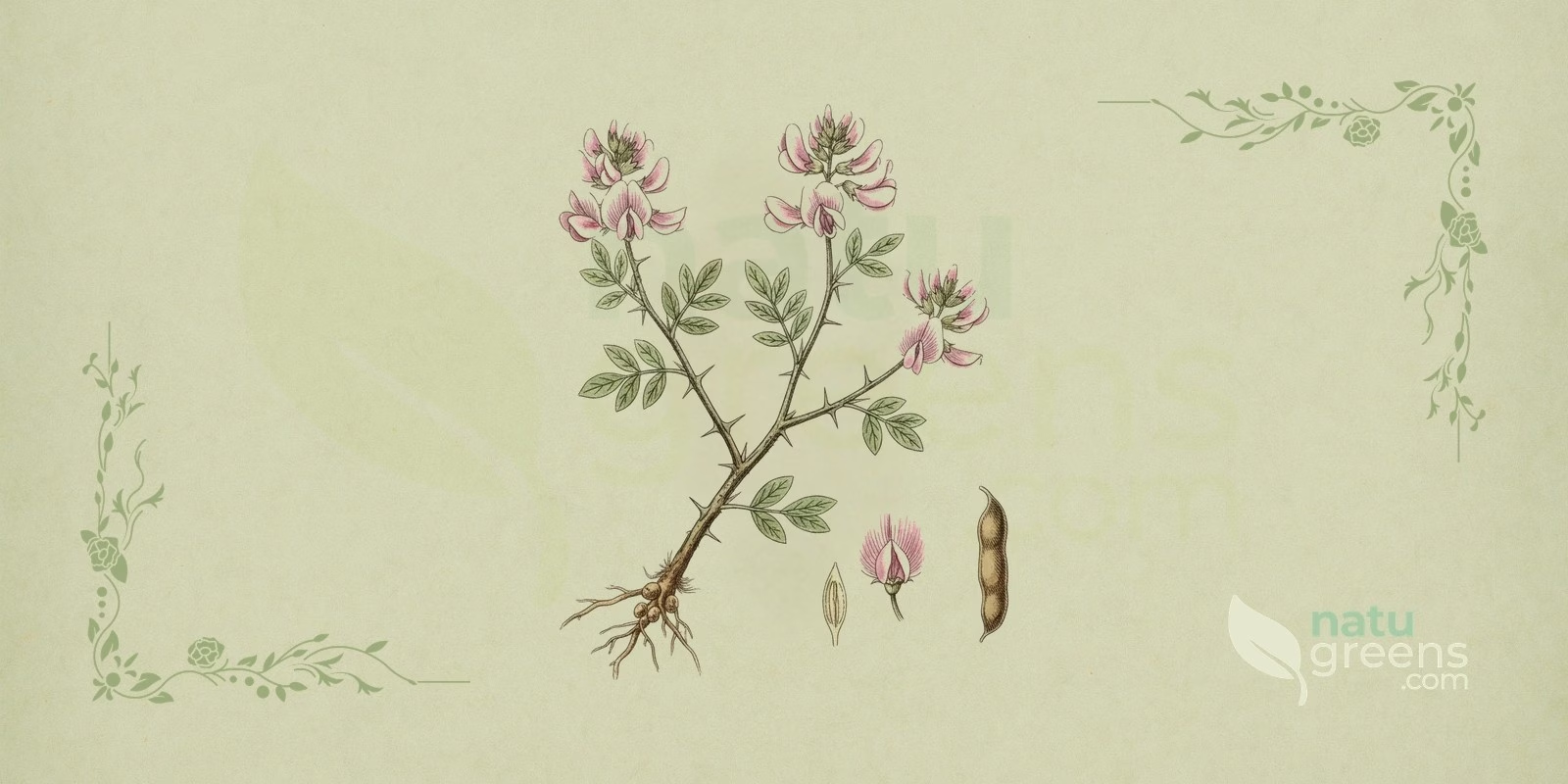
The medicinal part is the root, known in pharmacopoeias as Ononidis radix. In the European Union, it has a recognized traditional use to increase the amount of urine as an adjuvant in mild urinary complaints, a status based on its long history of use rather than on clinical trials. Spiny restharrow is not a treatment for urinary tract infections and does not dissolve kidney stones, and symptoms such as fever, pain when urinating or blood in the urine require medical evaluation.
Popular and International Names of Spiny Restharrow
- Dutch: kattendoorn.
- English: spiny restharrow.
- French: bugrane épineuse.
- German: Dornige Hauhechel.
- Polish: wilżyna ciernista.
- Portuguese: gatunha, resta-boi, rilha-boi, unha-gata (Portugal).
- Spanish: gatuña.
Unha-Gata Is Not Cat's Claw
In Portugal, spiny restharrow is also called unha-gata, a name easily confused with unha-de-gato, the Portuguese name for cat's claw (Uncaria tomentosa), an Amazonian climbing vine of the Rubiaceae family with an entirely different composition, uses and risks. The two plants are not related in any way, and products made from one should never be used in place of the other.
Botanical Synonyms of Spiny Restharrow
The taxonomy of Ononis spinosa has shifted over time, and some forms were once described as separate species. Today several subspecies are recognized within Ononis spinosa L., among them subsp. procurrens, with more creeping and less spiny stems, to which the name Ononis repens belongs, a name often found in older floras.
- Ononis procurrens Wallr. (synonym of subsp. procurrens)
- Ononis repens L. (synonym of subsp. procurrens)
Botanical Family: Fabaceae
The Fabaceae, or Leguminosae, are one of the largest families of flowering plants, with fruits borne in pods and many species able to fix nitrogen from the air through an association with bacteria in their roots. The family includes beans, peas, lentils and clovers.
Legumes are known for their isoflavonoids, and spiny restharrow is no exception: its root contains ononin and formononetin, compounds also found in red clover. The presence of these compounds does not justify any hormonal claims about the plant.
Parts of Spiny Restharrow Used
- Dried root, Ononidis radix (the recognized medicinal part)
- Leaves and flowers (folk use, without official recognition)
Ethnobotanical and Traditional Uses of Spiny Restharrow
- Increasing the amount of urine in mild urinary complaints (traditional use recognized in the European Union)
- Gout and rheumatism (traditional record)
- Skin conditions such as eczema (traditional record)
- Kidney stones (traditional record; does not dissolve stones)
Only the first use has official recognition, and only as a traditional use. A proposal to add inflammation and kidney stones to the European indications was rejected for lack of sufficient data. The other items document folk tradition and do not amount to proven efficacy.
Therapeutic Properties of Spiny Restharrow
- Diuretic (recognized traditional use; increased urine flow observed in laboratory studies)
- Anti-inflammatory (under study; laboratory and animal data)
- Antioxidant (observed in laboratory assays)
- Wound healing (under study; animal models)
There are no clinical studies of spiny restharrow root in patients. The European recognition rests on several decades of traditional use and on laboratory data, and it applies only as an adjuvant to increase urine output in mild urinary complaints, once a doctor has ruled out serious causes.
Detailed Phytochemical Profile of Spiny Restharrow
Spiny restharrow root is rich in isoflavonoids such as ononin and formononetin, along with trifolirhizin, sterols, triterpenes, phenolic acids and a small amount of essential oil. In laboratory studies, isoflavonoids show a structure similar to that of hormones, but there are no data supporting any hormonal effect of spiny restharrow in people, and it should not be used for that purpose.
- Essential oil
- Formononetin
- Ononin
- Phenolic acids
- Sterols
- Trifolirhizin
- Triterpenes
Preparation and Administration Forms of Spiny Restharrow
- Tea made from the dried, chopped root (recognized traditional form)
- Registered root-based products, used as directed on the package leaflet
The recognized use is the root tea, always accompanied by plenty of water throughout the day. Homemade tinctures and extracts have no established safe dose.
Synergy with Other Medicinal Plants
Horsetail and Bearberry
In traditional teas for the urinary tract, spiny restharrow appears alongside horsetail (Equisetum arvense) and bearberry (Arctostaphylos uva-ursi). These blends add up diuretic effects and, in the case of bearberry, exposure to hydroquinone, so they call for short-term use, good hydration and professional guidance. None of them replaces the treatment of a urinary tract infection, which requires a diagnosis and often antibiotics.
White Willow and Devil's Claw
In folk tradition for rheumatic pain, spiny restharrow is mentioned together with white willow (Salix alba) and devil's claw (Harpagophytum procumbens). It is a traditional combination with no studies behind it, and white willow contains salicylates, which call for caution in people taking anticoagulants or allergic to aspirin.
Recipes and Usage Protocols of Spiny Restharrow
Traditional Root Tea
The traditional form is a tea made from the dried, chopped root, prepared with hot water and drunk over the course of the day, together with plenty of water. Since amounts and duration of use vary between products and monographs, follow the leaflet of a registered product or the advice of a health professional rather than homemade doses.
When Not to Use the Tea
Do not use it if you have a fever, pain or burning when urinating, colicky pain, blood in the urine or worsening symptoms, or if your doctor has advised you to restrict fluids. In these cases, seek medical care.
The guidance above follows the recognized traditional use and does not replace medical evaluation. Before use, read the contraindications and interactions described in this article.
The preparations above follow traditional records and do not replace professional advice. Before any internal use, check the contraindications and interactions described in this article.
Associated Therapies of Spiny Restharrow
Traditional European Herbal Medicine
In European herbal medicine, spiny restharrow root is traditionally used to increase urine flow and "flush" the urinary tract in mild complaints, as an adjuvant. The European monograph restricts its use to adults and adolescents aged 12 and over.
European Monograph
The Committee on Herbal Medicinal Products of the European Medicines Agency has published a traditional-use monograph on spiny restharrow root. This recognition reflects a long tradition of use with acceptable safety, not efficacy demonstrated in clinical trials.
Contraindications and Side Effects of Spiny Restharrow
Fluid Restriction and Edema
Warning: spiny restharrow is contraindicated when reduced fluid intake has been recommended, as in severe heart or kidney failure, and in swelling (edema) caused by heart or kidney disease. In these cases, increasing urine output with plants can be dangerous.
Signs That Require a Doctor
Seek medical care if you have a fever, pain or burning when urinating, colicky pain, blood in the urine or worsening symptoms. Spiny restharrow is not a treatment for urinary tract infections and does not dissolve kidney stones.
Hydration
Traditional use requires drinking plenty of water throughout the day.
Age, Pregnancy and Breastfeeding
- Children and adolescents: the European monograph does not recommend use under 12 years of age.
- Pregnancy and breastfeeding: not recommended, due to a lack of safety data.
Interactions
Use caution with diuretics, because the effects may add up, and with lithium, whose blood level may change when urine volume changes. People taking these medicines should talk to their doctor first.
No Hormonal Claims
The isoflavonoids in the root do not make spiny restharrow a hormonal product, and it should not be used for menopause or any purpose of that kind.
Historical Notes and Interesting Facts about Spiny Restharrow
The Plant That Stopped the Plow
The English name restharrow and the Portuguese resta-boi and rilha-boi tell the same story: the plant's tough, tangled roots would catch the plow and hold back the oxen in the fields.
The Legend of Bulat Steel
A Russian legend says that a liquid containing an extract of the plant was used to quench bulat steel, famous for its blades, and that a Russian folk name linked to the word for steel comes from this. The story has no clear historical confirmation.
Ononis
According to an old explanation, the genus name comes from the Greek onos, donkey, because these animals would eat the plant despite its thorns.
Frequently Asked Questions about Spiny Restharrow
Does Spiny Restharrow Help with Weight Loss?
No. Its diuretic effect makes you lose water, not fat, and the plant has no use for weight loss.
Is Spiny Restharrow Used for Urinary Tract Infections?
Not as a treatment. Its recognized use is traditional, to increase urine output as an adjuvant in mild complaints. A urinary tract infection needs a medical diagnosis, and fever, pain when urinating or blood in the urine require medical care.
Does Spiny Restharrow Dissolve Kidney Stones?
There is no evidence that it does, and the request to include kidney stones in the European monograph was rejected for lack of data. Renal colic requires medical evaluation.
Can Spiny Restharrow Be Used in Pregnancy?
It is not recommended during pregnancy or breastfeeding, due to a lack of safety data. It is also not recommended for children under 12.
Can People with Heart Problems Use It?
It should not be used by people with severe heart or kidney failure, fluid restriction or swelling of cardiac or renal origin.
Are Spiny Restharrow and Cat's Claw the Same Plant?
No. The Portuguese name unha-gata, used for spiny restharrow, should not be confused with cat's claw (Uncaria tomentosa), called unha-de-gato in Portuguese, an Amazonian plant from a different family.
Notice: this content is for informational purposes and does not replace professional medical advice. Consult a physician or herbal practitioner before using medicinal plants, especially during pregnancy, breastfeeding, or alongside medication.
How to cite this article
NATUGREENS. Spiny Restharrow (Ononis spinosa): Traditional Uses and Safety. Natugreens, 20 Nov. 2026. Disponível em: https://natugreens.com/ononis-spinosa-spiny-restharrow/. Accessed: Nov. 20, 2026.
Natugreens. (2026). Spiny Restharrow (Ononis spinosa): Traditional Uses and Safety. Natugreens. https://natugreens.com/ononis-spinosa-spiny-restharrow/
References and Scientific Studies
Peer-Reviewed Scientific Studies (2)
- DOI2016 Gampe N, et al. (2016). Characterization and identification of isoflavonoid glycosides in the root of Spiny restharrow (Ononis spinosa L.) by HPLC-QTOF-MS, HPLC-MS/MS and NMR. Journal of Pharmaceutical and Biomedical Analysis, 123, 74-81. Isoflavonoids of the root. ↗
- PMC2026 Nechita VI, et al. Phytochemical Constituents and Biological Activities of Ononis spinosa: A Comprehensive Review. Plants (Basel, Switzerland). 2026.
Supplementary Readings (1)
- 2014 European Medicines Agency, HMPC. (2014). Community herbal monograph on Ononis spinosa L., radix. EMA/HMPC/138317/2013. Traditional-use monograph for increasing urine flow in mild urinary complaints.
You May Also Like



Take your time and tell us everything you think, details included. Every response is read by someone on our editorial team and goes into the article's revision. An honest critique helps us more than a polite compliment.
Take your time and tell us everything you think, details included. Every response is read by someone on our editorial team and goes into the article's revision. An honest critique helps us more than a polite compliment.