Quick summary
Agrimonia eupatoria L., known in English as agrimony or common agrimony, is a perennial herbaceous plant of the Rosaceae family, described by Carl Linnaeus and native to Europe and Southwest Asia, where it grows in damp meadows, pastures and along stream banks. Agrimony has been used for centuries in European…
Main caution: There is a monograph from the European Medicines Agency (EMA) on agrimony, which recognizes as traditional use the plant's application in mild diarrhea, as a gargle for inflammation of the mouth and throat and in…
Agrimonia eupatoria L., known in English as agrimony or common agrimony, is a perennial herbaceous plant of the Rosaceae family, described by Carl Linnaeus and native to Europe and Southwest Asia, where it grows in damp meadows, pastures and along stream banks. Agrimony has been used for centuries in European traditional medicine, which values it above all for its astringent action and its use in mild inflammation, and today it is covered by a monograph from the European Medicines Agency (EMA) that recognizes some of these applications as traditional use, without this implying proven clinical efficacy.
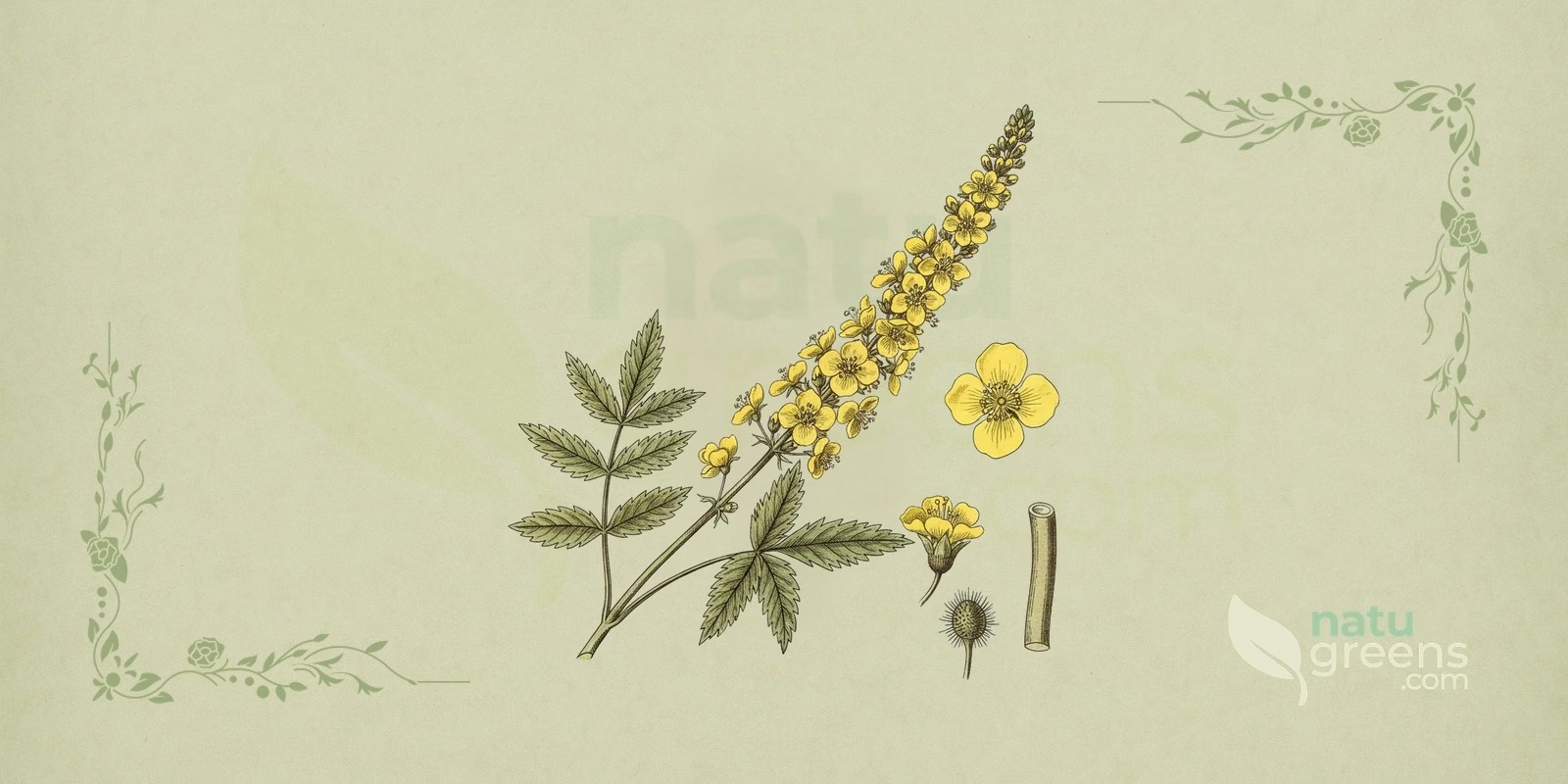
The plant forms erect flowering stems that can reach up to 100 cm in height, with pinnate leaves with serrated margins and, from June to September, spike-like inflorescences of yellow flowers whose faintly spicy scent recalls apricots. The fruits are small achenes covered in hooks that cling easily to animal fur and clothing, which helps disperse the seeds. The phytochemical richness of agrimony, which combines tannins, flavonoids and volatile oils, explains its long history of folk use and the continuing interest of scientific research in the species.
Popular and International Names of Agrimony
- English: agrimony, church steeples, cocklebur, common agrimony, harvest lice, sticklewort.
- French: aigremoine eupatoire, francormier, herbe de Saint-Guillaume, thé des bois.
- German: Gemeiner Odermennig, Heil aller Welt, Königskraut, Odermennig.
- Italian: agrimonia, erba da taglio, erba di San Guglielmo, erba vettonica.
- Portuguese: agrimônia, agrimónia (European Portuguese spelling), amoricos, erva-agrimônia, erva-de-são-guilherme, erva-eupatória, erva-hepática, lagrimosa, namoricos.
- Spanish: agrimonia, agrimoña, eupatoria, hierba de San Guillermo, mermasangre.
Botanical Synonyms of Agrimonia eupatoria
The botanical synonyms of Agrimonia eupatoria L. include Agrimonia canescens Dumort., Agrimonia elata Salisb., Agrimonia vulgaris Gray and Eupatorium dioscoridis Bubani. Although Agrimonia eupatoria L. is the accepted and most widely used name, the existence of several synonyms reflects the taxonomic complexity of the genus and the regional variations in how the species has been classified over the history of botany, which is why it is always worth checking the full binomial when consulting the literature.
This attention to the name matters all the more because the genus includes closely related species that should not be confused with agrimony, such as Agrimonia pilosa, an Asian species used in traditional Far Eastern medicine, and Agrimonia procera, a more strongly scented European species that some pharmacopoeias accept alongside Agrimonia eupatoria as a source of the herbal drug Agrimoniae herba.
Botanical Family: Rosaceae
Agrimonia eupatoria belongs to the Rosaceae family, one of the largest and most diverse families of flowering plants, with approximately 4,828 species distributed across 91 genera. The family is of great economic importance, since it includes many edible fruits such as apples, pears, strawberries, raspberries and cherries, as well as numerous ornamental plants, starting with roses, and it is characterized by flowers that are generally hermaphroditic, with five sepals, five petals and a superior or inferior ovary.
Within the Rosaceae, agrimony shares with other species the presence of tannins and phenolic compounds, which account for its astringent action and for most of the medicinal interest it attracts. The phytochemical and morphological diversity of the family has been the subject of extensive studies, which reveal the adaptability and evolutionary success of this group in very different ecosystems around the world.
Parts of Agrimony Used
- Aerial parts (stem, leaves and flowers)
- Flowers
- Leaves
Ethnobotanical and Traditional Uses
- Astringent for mild diarrhea and digestive complaints (traditional record)
- Folk diuretic for urinary complaints
- Gargle for mild inflammation of the mouth and throat
- Liver and gallbladder tonic in European folk medicine
- Topical application for skin problems such as eczema and acne (traditional record)
- Topical application to superficial wounds and skin ulcers in folk medicine
- Traditional relief of sore throat and cough
Therapeutic Properties of Agrimony
- Analgesic (effect observed in animal models, not clinically proven)
- Antibacterial (activity observed in laboratory studies)
- Anti-inflammatory (effect observed in experimental studies and traditional record)
- Antioxidant (ability to neutralize free radicals measured in the laboratory)
- Antiviral (activity observed in laboratory studies, not clinically proven)
- Astringent (tightens tissues and mucous membranes, an action attributed to tannins)
- Cholagogue (traditional record of stimulating bile secretion)
- Diuretic (traditional record)
- Hepatoprotective (effect investigated in experimental studies, not clinically proven)
- Hypoglycemic (possible effect observed in an animal model, not proven in humans)
- Immunomodulatory (activity observed in laboratory studies)
- Wound-healing (traditional record of topical use on superficial wounds)
Detailed Phytochemical Profile of Agrimony
- Catechins
- Coumarins
- Flavonoids (apigenin, kaempferol, luteolin, quercetin, tiliroside)
- Phenolic acids (caffeic acid, ellagic acid, gallic acid)
- Proanthocyanidins (dimers and trimers)
- Tannins (3% to 21%)
- Triterpene glycosides (euscaphic acid, tormentic acid)
- Volatile oils
Preparation and Administration Forms of Agrimony
- Capsules
- Compresses
- Decoction
- Dry extract
- Fluid extract
- Infusion
- Poultice
- Tincture
Synergy with Other Medicinal Plants
Digestive Comfort
In the European herbal tradition, agrimony appears alongside chamomile (Matricaria chamomilla) and peppermint (Mentha × piperita) in blends traditionally used for mild digestive discomfort, such as passing diarrhea, dyspepsia and flatulence. The rationale behind this pairing is to bring together the astringent tannins of agrimony, the compounds that tradition credits with soothing the mucosa in chamomile and the carminative effect popularly associated with peppermint, although no clinical study has evaluated the blend.
Liver and Bile Function
As liver support of traditional record, agrimony may be paired with milk thistle (Silybum marianum) and dandelion (Taraxacum officinale). In this combination, agrimony contributes as a folk bile tonic, milk thistle through silymarin, which studies are investigating for its action on liver cells, and dandelion through its traditional use as a stimulant of bile flow, a combination that tradition uses to aid the digestion of fats, although there is no clinical evidence for the blend.
Topical Skin Care
In external applications, agrimony is traditionally used together with calendula (Calendula officinalis) and comfrey (Symphytum officinale) in compresses and ointments for superficial skin irritation and inflammation. The astringent action of agrimony adds to the traditional use of calendula on minor injuries and of comfrey on bruises, but comfrey contains pyrrolizidine alkaloids and should be restricted to intact skin, never applied to open wounds, and only for short periods.
Recipes and Usage Protocols of Agrimony
Agrimony Infusion for Mild Diarrhea
This infusion is the form traditionally used for episodes of mild, passing diarrhea, one of the applications that the EMA monograph recognizes as traditional use.
Ingredients: 1 teaspoon (2 to 3 g) of dried agrimony aerial parts and 200 ml of boiling water.
Preparation: place the agrimony in a cup, add the boiling water, cover and let it steep for 10 to 15 minutes before straining and drinking it warm. Tradition suggests 2 to 3 cups a day, between meals, for no more than 1 week without professional guidance, always keeping a 2-hour gap from medicines and iron supplements. If the diarrhea lasts more than 2 days or comes with fever or blood, seek medical evaluation instead of continuing with the tea.
Agrimony Compress for the Skin
The compress is the preparation traditionally used in external applications on small wounds, superficial cuts and areas of inflamed skin.
Ingredients: 2 tablespoons of dried agrimony aerial parts and 500 ml of water.
Preparation: boil the agrimony in the water for 10 minutes to obtain a decoction, let it cool and strain. Soak a clean cloth or gauze in the liquid and apply it to the area for 20 to 30 minutes, 2 to 3 times a day, making use of the astringent action attributed to tannins. Deep wounds, or wounds with discharge, local warmth or that do not close within a few days, should be assessed by a health professional.
Agrimony Tincture for Gargling
Gargling with diluted tincture is the traditional use of agrimony for mild inflammation of the mouth and throat, also recognized as such by the European monograph.
Ingredients: 50 g of dried agrimony aerial parts and 250 ml of 70% alcohol.
Preparation: place the agrimony in a dark glass jar, cover it with the alcohol and leave it to macerate for 2 weeks in a cool, dark place, shaking it every day, before straining and storing the tincture. For gargling, dilute 5 to 10 ml of the tincture in 50 ml of warm water and use it 3 to 4 times a day for throat irritation, mild pharyngitis or gingivitis, without swallowing the liquid. A severe sore throat, one with high fever or one that persists for several days, calls for a consultation with a health professional.
The preparations above follow traditional records and do not replace professional guidance. Before any internal use, check the contraindications and interactions described in this article.
Associated Therapies
Herbal Medicine
In European herbal medicine, agrimony is valued for its astringent action, attributed to its high concentration of tannins, and appears mainly in preparations for mild complaints of the gastrointestinal tract, such as diarrhea and dyspepsia. Folk medicine also uses it as a bile tonic and in topical preparations for superficial wounds and skin inflammation, uses that the EMA monograph classifies as traditional, meaning they rest on long experience of use and not on clinical trials proving efficacy. This versatility explains why the plant is still present in traditional formulations in several European countries.
Homeopathy
In homeopathy, agrimony is prepared under the name Agrimonia eupatoria and indicated, according to the principles of this practice, for conditions involving digestive complaints, such as diarrhea and dyspepsia, and skin irritation. The homeopathic approach is based on the individuality of symptoms and the totality of signs presented by the patient, and dilutions and potencies are chosen according to the practice's own philosophy, which has no scientific evidence of efficacy for these uses.
Bach Flower Remedies
Agrimony is one of the 38 Bach flower remedies, known as Agrimony, and in this system it is indicated for people who hide worries and inner torment behind a cheerful, carefree front. According to Edward Bach's description, those who identify with Agrimony tend to avoid confrontation and seek peace at any cost, often turning to distractions or addictions to escape their own problems, and the remedy is meant to help the person acknowledge their emotions, express what they feel and deal with difficulties more authentically. Bach flower remedies are a complementary practice without scientific evidence and do not replace psychological or medical care.
Contraindications and Side Effects of Agrimony
Traditional Use Recognized by the EMA
There is a monograph from the European Medicines Agency (EMA) on agrimony, which recognizes as traditional use the plant's application in mild diarrhea, as a gargle for inflammation of the mouth and throat and in topical use on inflamed skin. This recognition rests on a tradition of long-standing use and not on efficacy proven by clinical studies, and it should therefore be understood as recognized traditional use, not as a guarantee of results.
General Contraindications
Because it is rich in tannins, agrimony should not be used internally for more than 1 week continuously without professional guidance, since prolonged use or high doses can cause gastrointestinal irritation, nausea or constipation in sensitive people. The EMA does not recommend agrimony for children under 12, nor during pregnancy and breastfeeding, due to a lack of safety data. People with bile duct obstruction or gallstones should avoid the plant, because the cholagogue effect that tradition attributes to it may worsen these conditions, and there are isolated reports of photosensitivity, which calls for caution with intense sun exposure during use.
Diarrhea that lasts more than 2 days, or comes with fever or blood, requires medical evaluation, not tea. The same applies to wounds that do not heal, signs of skin infection and a persistent sore throat, situations in which agrimony is no substitute for proper diagnosis and care.
Drug Interactions
The tannins in agrimony can reduce the absorption of iron and of medicines taken by mouth, so intake of the plant should be separated from intake of iron and medicines by 2 hours. There is a possible hypoglycemic effect observed in an animal model, which calls for caution with antidiabetic drugs and blood glucose monitoring by people who take them. People on anticoagulants should also talk to their doctor before use, as a precaution, and in general it is advisable to consult a doctor or pharmacist before combining agrimony with any long-term medication.
Not to Be Confused with Other Plants
Agrimony should not be confused with Agrimonia pilosa, an Asian species of the same genus, or with Agrimonia procera, an aromatic European species, which have their own composition and history of use. Particular care is needed with the English name hemp agrimony, which refers to Eupatorium cannabinum, a plant from another family that contains hepatotoxic pyrrolizidine alkaloids: Eupatorium cannabinum is a different plant and must not be used as a substitute for agrimony.
Historical Notes and Interesting Facts
Agrimony has a long history of use and symbolism in Europe, and in the Middle Ages it was even regarded as a magical herb, used in protective rituals. A popular belief of the time held that, placed under the pillow, the plant would induce a deep sleep that would only end when it was removed, an idea that reflects the old association of agrimony with calming effects, although there is no scientific evidence for such an effect. The genus name is often linked to the Greek argemone, a term associated in antiquity with plants used for eye ailments, which points to one of the traditional uses attributed to the species.
In folk medicine, the plant was also called herb of Saint William, in honor of a saint who, according to tradition, used it to care for wounds, and the epithet eupatoria evokes Mithridates VI Eupator, king of Pontus remembered for his interest in medicinal plants. The presence of agrimony in ancient texts and European folklore shows the cultural importance the species has kept over the centuries, including in Anglo-Saxon formulations used on wounds.
A practical curiosity is that the hooked fruits explain several English folk names, such as sticklewort and cocklebur, as well as the familiar sight of seeds stuck to the clothes of people walking through meadows at the end of summer. The English name hemp agrimony, despite the resemblance, belongs to Eupatorium cannabinum, a plant with no close kinship to true agrimony.
Frequently Asked Questions about Agrimony
Can Agrimony Tea Be Consumed Every Day?
Because it is rich in tannins, agrimony should not be used internally for more than 1 week continuously without professional guidance. Prolonged use or large amounts can cause gastrointestinal irritation or constipation in sensitive people, and the tea should be kept 2 hours apart from iron and medicines. Anyone with pre-existing conditions or on long-term medication should consult a health professional first.
Can Agrimony Be Used for Skin Problems?
Tradition uses agrimony in compresses and poultices on superficial wounds, ulcers, eczema and acne, because of the astringent action attributed to tannins, and the EMA monograph recognizes topical use on inflamed skin as traditional use. This recognition is not the same as proven efficacy, and persistent or serious skin problems require medical consultation.
What Is the Traditional Role of Agrimony in Digestive Health?
The best-known digestive use of agrimony is the infusion for mild diarrhea, an application the EMA classifies as recognized traditional use. Folk medicine also uses it as a bile tonic and for dyspepsia and flatulence, with no clinical evidence for these effects. Diarrhea that lasts more than 2 days, or comes with fever or blood, requires medical evaluation, not tea.
Who Should Not Use Agrimony?
The EMA does not recommend agrimony for children under 12, nor during pregnancy and breastfeeding, due to a lack of data. People with bile duct obstruction or gallstones should avoid it, and those taking antidiabetic drugs need to be cautious, since there is a possible hypoglycemic effect in an animal model. There are also isolated reports of photosensitivity.
Is Agrimony the Same Plant as Hemp Agrimony?
No. The English name hemp agrimony refers to Eupatorium cannabinum, a plant from another family that contains hepatotoxic pyrrolizidine alkaloids. Eupatorium cannabinum is a different plant and must not be used as a substitute for agrimony, which should also not be confused with Agrimonia pilosa or Agrimonia procera.
How Is Agrimony Related to the Bach Flower Remedies?
Agrimony is the source of Agrimony, one of the 38 Bach flower remedies, indicated in this system for people who hide their worries behind a cheerful appearance. It is a complementary practice without scientific evidence, which does not replace psychological or medical care.
Notice: this content is for informational purposes and does not replace professional medical advice. Consult a physician or herbal practitioner before using medicinal plants, especially during pregnancy, breastfeeding, or alongside medication.
How to cite this article
NATUGREENS. Agrimony (Agrimonia eupatoria): Properties and Benefits. Natugreens, 8 Nov. 2026. Disponível em: https://natugreens.com/agrimonia-eupatoria-agrimony/. Accessed: Nov. 8, 2026.
Natugreens. (2026). Agrimony (Agrimonia eupatoria): Properties and Benefits. Natugreens. https://natugreens.com/agrimonia-eupatoria-agrimony/
References and Scientific Studies
- PMC2015 Granica S, et al. The phytochemical investigation of Agrimonia eupatoria L. and Agrimonia procera Wallr. as valid sources of Agrimoniae herba, the pharmacopoeial plant material. J Pharm Biomed Anal. 2015.
- PMC2016 Lee KH, et al. Anti-nociceptive effect of Agrimonia eupatoria extract on a cisplatin-induced neuropathic model. Afr J Tradit Complement Altern Med. 2016.
- PMC2020 Paluch Z, et al. The therapeutic effects of Agrimonia eupatoria L.. Physiol Res. 2020.
- PMC2017 Santos TN, et al. Antioxidant, anti-inflammatory, and analgesic activities of Agrimonia eupatoria L. infusion. Evid Based Complement Alternat Med. 2017.