Quick summary
Blackthorn (Prunus spinosa L.), also known as sloe, is a thorny shrub in the Rosaceae family described by Carl Linnaeus in 1753. Native to Europe, Western Asia and parts of North Africa, it has become naturalized in other regions of the world. The plant forms dense, spiny branches, opens white flowers before the…
Main caution: Despite its long history of use, Prunus spinosa calls for caution because some of its parts contain potentially toxic compounds, above all cyanogenic glycosides capable of releasing hydrogen cyanide (HCN) in the body.…
Blackthorn (Prunus spinosa L.), also known as sloe, is a thorny shrub in the Rosaceae family described by Carl Linnaeus in 1753. Native to Europe, Western Asia and parts of North Africa, it has become naturalized in other regions of the world. The plant forms dense, spiny branches, opens white flowers before the leaves emerge in spring and bears small, round, dark blue to black fruits known as sloes.
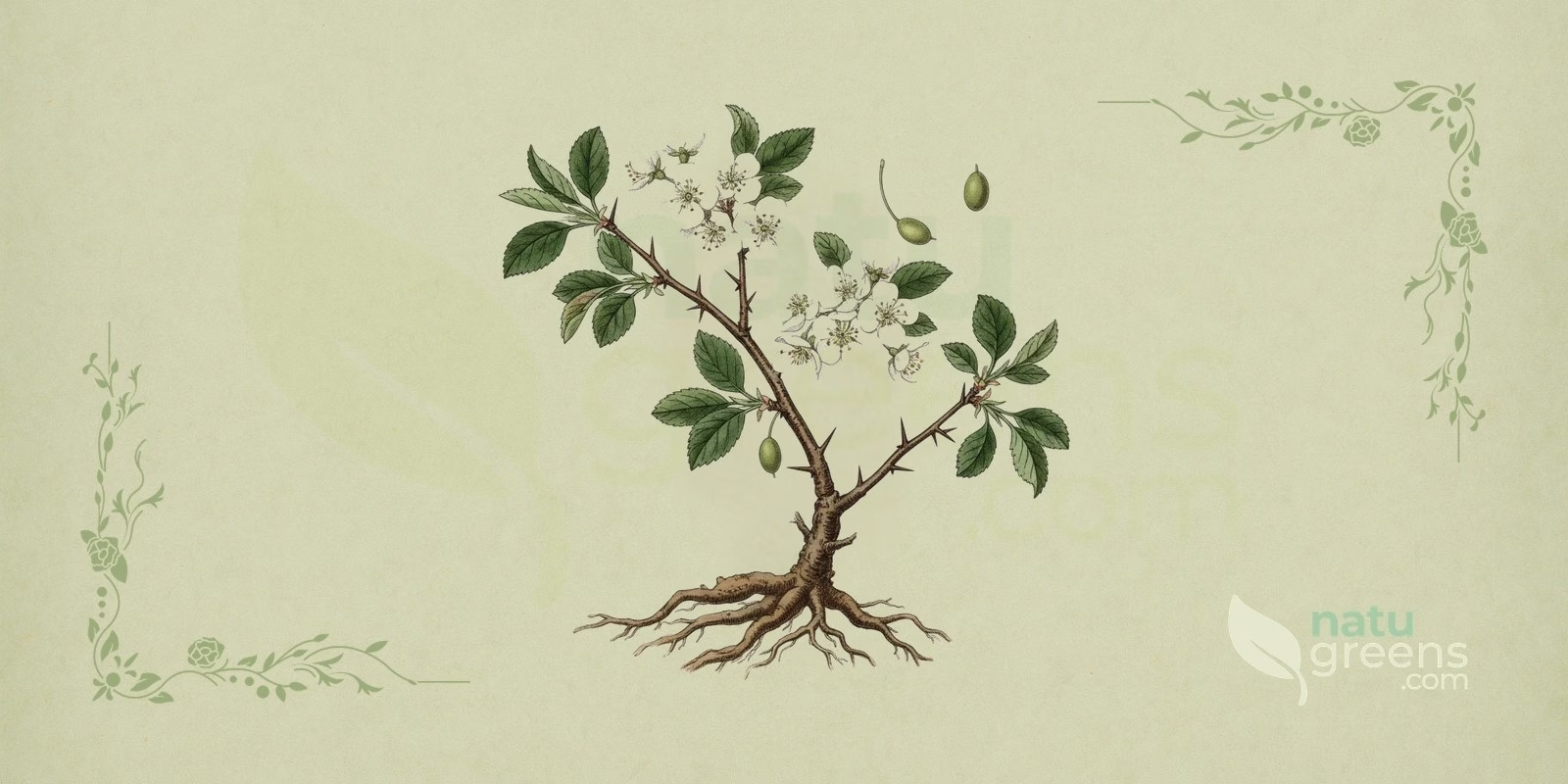
Blackthorn has a long history in European cooking and folk medicine, which values the astringency of its fruits and records the flowers as a mild laxative and diuretic, uses that have never been tested in clinical trials. The ripe fruits go into liqueurs, jams and preserves, while the flowers and leaves appear in traditional home remedies. Recent scientific research has examined the phytochemical makeup of Prunus spinosa, which is rich in anthocyanins, flavonoids and phenolic acids, and describes antioxidant and anti-inflammatory activities observed mainly in laboratory studies. This article brings together the plant's taxonomy, historical uses, research data and safety precautions, with particular attention to the stones, which contain amygdalin.
Popular and International Names of Blackthorn
The Portuguese names below come from current usage in Portugal, since the species is not part of the Brazilian flora. The literal Portuguese rendering of blackthorn as espinheiro-preto is not an established common name, which is why it is not listed here.
- English: blackthorn, sloe; the fruit is also known as a sloe.
- French: épine noire, prunellier.
- German: Schlehdorn, Schwarzdorn.
- Italian: prugnolo, pruno selvatico.
- Portuguese: abrunheiro, abrunheiro-bravo, ameixeira-brava, ameixieira-brava, brunheiro, cagoeiceiro-bravo; the fruit is called abrunho.
- Spanish: ciruelo silvestre, endrino.
Botanical Synonyms of Prunus spinosa
Prunus spinosa has accumulated a long list of botanical synonyms, a reflection of the species' wide distribution and of the morphological variation that led to different classifications over time. The currently accepted name is Prunus spinosa L., as established by Carl Linnaeus and confirmed by World Flora Online, but other names still appear in the specialist literature and are gathered in the list below.
- Druparia spinosa Clairv.
- Prunus acacia Crantz
- Prunus acacia Crantz ex Poir.
- Prunus acacia-germanica Crantz
- Prunus amygdaliformis Pau
- Prunus communis Bab.
- Prunus communis prol. depressa Clavaud
- Prunus communis prol. erythrocalyx Clavaud
- Prunus communis prol. latiflora Clavaud
- Prunus communis prol. oxypyrena Clavaud
- Prunus communis prol. pubescens Clavaud
- Prunus communis prol. subinermis Clavaud
- Prunus communis subsp. spinosa (L.) Syme
- Prunus communis subvar. cinerea Clavaud
- Prunus communis subvar. ellipsoides Clavaud
- Prunus communis subvar. stenopetala (Ducommun) Clavaud
- Prunus communis unranked coronata Clavaud
- Prunus communis unranked depressa Clavaud
- Prunus communis unranked erythrocalyx Clavaud
- Prunus communis unranked foecundissima Clavaud
- Prunus communis unranked latiflora Clavaud
- Prunus communis unranked lucida Clavaud
- Prunus communis unranked oxypyrena Clavaud
- Prunus communis unranked pubescens Clavaud
- Prunus communis unranked rubella Clavaud
- Prunus communis unranked subinermis Clavaud
- Prunus communis var. spinosa (L.) Hook. & Arn.
- Prunus curdica Fenzl ex Fritsch
- Prunus densa Martrin-Donos
- Prunus densiflora Jord. & Fourr.
- Prunus domestica var. spinosa (L.) Kuntze
- Prunus ericiflora A.Sav.
- Prunus erythrocalyx var. rubella Clavaud
- Prunus glomerata A.Sav.
- Prunus insititia var. brachypoda Borbás
- Prunus insititia var. spinosa (L.) Weston
- Prunus kurdica Fenzl ex Fritsch
- Prunus moldavica Kotov
- Prunus ovata (Ser.) A.W.Hill
- Prunus podolica Andrz.
- Prunus polymorpha unranked spinosa (L.) Griess.
- Prunus pubescens unranked acuminata Clavaud
- Prunus spinosa f. acuminata (Clavaud) Domin
- Prunus spinosa f. arborescens (Dierb.) Domin
- Prunus spinosa f. brachypoda (Borbás) Soó
- Prunus spinosa f. cinerea (Clavaud) Domin
- Prunus spinosa f. coaetanea (Wimm. & Grab.) P.D.Sell
- Prunus spinosa f. densiflora P.D.Sell
- Prunus spinosa f. erythrocalyx (Clavaud) Domin
- Prunus spinosa f. genuina (Ducommun) Domin
- Prunus spinosa f. genuina Posp.
- Prunus spinosa f. globosodrupacea Bregadze
- Prunus spinosa f. kefaliana Pacz.
- Prunus spinosa f. major Posp.
- Prunus spinosa f. marginata Wiefel
- Prunus spinosa f. maritima Corill., Figureau & Godeau
- Prunus spinosa f. microcarpa (Wallr.) Buia
- Prunus spinosa f. microsphaera Domin
- Prunus spinosa f. ovalidrupacea Bregadze
- Prunus spinosa f. ovata Rouy & E.G.Camus
- Prunus spinosa f. oxypyrena (Clavaud) Domin
- Prunus spinosa f. parvifolia Novák
- Prunus spinosa f. plano-subgloboso-drupacea Bregadze
- Prunus spinosa f. plena (Weston) C.K.Schneid.
- Prunus spinosa f. prorepens Domin
- Prunus spinosa f. puberula Medw.
- Prunus spinosa f. purpurea (André) C.K.Schneid.
- Prunus spinosa f. rosea Kawecki
- Prunus spinosa f. rubella (Clavaud) Domin
- Prunus spinosa f. rupestris Wiefel
- Prunus spinosa f. semiglabra Domin
- Prunus spinosa f. serotina Wiefel
- Prunus spinosa f. sessiliflora Beck
- Prunus spinosa f. stenopetala (Ducommun) Domin
- Prunus spinosa f. subdasyphylla Nyár.
- Prunus spinosa f. subepruinosa Domin
- Prunus spinosa f. tardeflorens (Bertsch) H.Scholz & I.Scholz
- Prunus spinosa f. varbossania K.Malý
- Prunus spinosa f. variegata Zabel ex C.K.Schneid.
- Prunus spinosa f. vulgaris Wiefel
- Prunus spinosa lus. purpurea (André) Asch. & Graebn.
- Prunus spinosa prol. amelanchierflora (Paill.) Rouy & E.G.Camus
- Prunus spinosa prol. dasyphylla (Schur) Asch. & Graebn.
- Prunus spinosa prol. densa (Martrin-Donos) Rouy & E.G.Camus
- Prunus spinosa prol. depressa (Clavaud) Rouy & E.G.Camus
- Prunus spinosa prol. ericiflora (A.Sav.) Rouy & E.G.Camus
- Prunus spinosa prol. fastigiata (Paill.) Rouy & E.G.Camus
- Prunus spinosa prol. foecundissima (Clavaud) Rouy & E.G.Camus
- Prunus spinosa prol. lamottei (A.Sav.) Rouy & E.G.Camus
- Prunus spinosa prol. latiflora (Clavaud) Rouy & E.G.Camus
- Prunus spinosa prol. lucens (A.Sav.) Rouy & E.G.Camus
- Prunus spinosa prol. lucida (Clavaud) Rouy & E.G.Camus
- Prunus spinosa prol. microstigma (Paill.) Rouy & E.G.Camus
- Prunus spinosa prol. ovata (Ser.) Rouy & E.G.Camus
- Prunus spinosa prol. parviflora (Paill.) Rouy & E.G.Camus
- Prunus spinosa prol. pubescens (Clavaud) Rouy & E.G.Camus
- Prunus spinosa prol. subcylindrica (A.Sav.) Rouy & E.G.Camus
- Prunus spinosa prol. subinermis (Clavaud) Rouy & E.G.Camus
- Prunus spinosa prol. typica Asch. & Graebn.
- Prunus spinosa prol. vulgatus Rouy & E.G.Camus
- Prunus spinosa subf. macrocarpa Petković
- Prunus spinosa subsp. cerasina Hrabětová
- Prunus spinosa subsp. coaetanea (Wimm. & Grab.) R.Knapp
- Prunus spinosa subsp. cyclopetala (Borbás) Jáv.
- Prunus spinosa subsp. dasyphylla (Schur) Domin
- Prunus spinosa subsp. euspinosa Domin
- Prunus spinosa subsp. fechtneri Domin
- Prunus spinosa subsp. insititioides (Ficalho & Cout.) Franco
- Prunus spinosa subsp. megalocarpa Domin
- Prunus spinosa subsp. moravica Domin
- Prunus spinosa subsp. ovoideoglobosa Domin
- Prunus spinosa subsp. rapaicsii Pénzes
- Prunus spinosa subsp. szabadosii Pénzes
- Prunus spinosa subvar. alba Domin
- Prunus spinosa subvar. coronata (Clavaud) Rouy & E.G.Camus
- Prunus spinosa subvar. euvirgata Domin
- Prunus spinosa subvar. genuina (Ducommun) Asch. & Graebn.
- Prunus spinosa subvar. lucens (A.Sav.) Domin
- Prunus spinosa subvar. major (Posp.) Asch. & Graebn.
- Prunus spinosa subvar. moldavica (Kotov) Vitk.
- Prunus spinosa subvar. platypetala Rouy & E.G.Camus
- Prunus spinosa subvar. platyphylla (Gand.) Asch. & Graebn.
- Prunus spinosa subvar. sessiliflora (Beck) Asch. & Graebn.
- Prunus spinosa subvar. stenopetala (Ducommun) Rouy & E.G.Camus
- Prunus spinosa subvar. stepposa (Kotov) Vitk.
- Prunus spinosa subvar. wallrothii Domin
- Prunus spinosa unranked arborescens Dierb.
- Prunus spinosa unranked chlorocarpa K.Koch
- Prunus spinosa unranked florepleno K.Koch
- Prunus spinosa unranked florerubro M.Vilm. & Bois
- Prunus spinosa unranked frutescens Dierb.
- Prunus spinosa unranked genuina Ducommun
- Prunus spinosa var. acropyrena Domin
- Prunus spinosa var. amphitricha Domin
- Prunus spinosa var. amygdaliformis (Pau) Willk.
- Prunus spinosa var. angustifolia Wimm. & Grab.
- Prunus spinosa var. atricha Domin
- Prunus spinosa var. balearica Willk.
- Prunus spinosa var. brachypetala Domin
- Prunus spinosa var. brachypoda (Borbás) Borbás
- Prunus spinosa var. chlorocarpa (K.Koch) Domin
- Prunus spinosa var. cinerea (Clavaud) Rouy & E.G.Camus
- Prunus spinosa var. cinereo-ovata Pénzes
- Prunus spinosa var. clavaudii Domin
- Prunus spinosa var. coaetanea Wimm. & Grab.
- Prunus spinosa var. coronata (Clavaud) Browicz & Ziel.
- Prunus spinosa var. dasyphylla Schur
- Prunus spinosa var. densa (Martrin-Donos) Domin
- Prunus spinosa var. depressa (Clavaud) Domin
- Prunus spinosa var. dostalii Domin
- Prunus spinosa var. dulcescens Domin
- Prunus spinosa var. dulcescens H.L.Werneck
- Prunus spinosa var. ellipsocarpa Domin
- Prunus spinosa var. ellipsoides (Clavaud) Domin
- Prunus spinosa var. ericiflora (A.Sav.) Domin
- Prunus spinosa var. eriophora Hausskn.
- Prunus spinosa var. erythrocalyx (Clavaud) Rouy & E.G.Camus
- Prunus spinosa var. florepleno G.Kirchn.
- Prunus spinosa var. foecundissima (Clavaud) Domin
- Prunus spinosa var. genuina Rouy & E.G.Camus
- Prunus spinosa var. heterochroa Domin
- Prunus spinosa var. hypotricha Domin
- Prunus spinosa var. inermis Godr. ex Hegi
- Prunus spinosa var. inermis Tinant
- Prunus spinosa var. insititioides Ficalho & Cout.
- Prunus spinosa var. kefaliana (Pacz.) Domin
- Prunus spinosa var. lamottei (A.Sav.) Domin
- Prunus spinosa var. latiflora (Clavaud) Domin
- Prunus spinosa var. leucocarpa Bechst. ex Domin
- Prunus spinosa var. lombensis Nyár.
- Prunus spinosa var. longifolia D.Gut.
- Prunus spinosa var. major (Posp.) Domin
- Prunus spinosa var. microcarpa Wallr.
- Prunus spinosa var. nitidula Domin
- Prunus spinosa var. ovaliputaminata Bregadze
- Prunus spinosa var. ovata Ser.
- Prunus spinosa var. oxypirena (Clavaud) Rouy & E.G.Camus
- Prunus spinosa var. oxypyrena (Clavaud) Rouy & E.G.Camus
- Prunus spinosa var. parviflora (Paill.) Domin
- Prunus spinosa var. parvifolia (Novák) Domin
- Prunus spinosa var. plena Weston
- Prunus spinosa var. praecox Wimm. & Grab.
- Prunus spinosa var. pubescens (A.Sav.) Domin
- Prunus spinosa var. pubescens Ficalho & Cout.
- Prunus spinosa var. purpurea André
- Prunus spinosa var. rhamnoides Buchenau
- Prunus spinosa var. rhamnoides Murr
- Prunus spinosa var. rosea (Kawecki) Browicz & Ziel.
- Prunus spinosa var. rubella (Clavaud) Rouy & E.G.Camus
- Prunus spinosa var. rugosa Domin
- Prunus spinosa var. serotina Weihe ex Lej. & Courtois
- Prunus spinosa var. sessiliflora (Beck) Domin
- Prunus spinosa var. simulans H.L.Werneck
- Prunus spinosa var. simulans Murr
- Prunus spinosa var. stenopetala Ducommun
- Prunus spinosa var. sterilis Lavallée
- Prunus spinosa var. subcinera Cout.
- Prunus spinosa var. subcinerea Cout.
- Prunus spinosa var. subcylindrica (A.Sav.) Domin
- Prunus spinosa var. subglobosoputaminata Bregadze
- Prunus spinosa var. subinermis Moris
- Prunus spinosa var. thessala Hausskn.
- Prunus spinosa var. typica C.K.Schneid.
- Prunus spinosa var. variegata (Zabel ex C.K.Schneid.) Domin
- Prunus spinosa var. variegata Zabel
- Prunus spinosa var. virgata (Martrin-Donos) Rouy & E.G.Camus
- Prunus spinosa var. vulgaris Ser.
- Prunus spinosa var. xanthocarpa Domin
- Prunus stenopetala (Ducommun) Manceau
- Prunus stepposa Kotov
- Prunus subvillosa Debeaux
- Prunus vinariensis Hausskn. ex C.K.Schneid.
- Prunus virgata Martrin-Donos
- Prunus vulgatior var. stenopetala Clavaud
These synonyms include historical combinations such as Prunus domestica var. spinosa and Prunus insititia var. spinosa, which classed blackthorn as a variety of cultivated plums. Today it is recognized as a species in its own right and should not be confused with the plum tree (Prunus domestica), the peach tree (Prunus persica), African cherry (Prunus africana) or black cherry (Prunus serotina), plants of the same genus that differ from it in species, part used and research data.
Botanical Family: Rosaceae
Rosaceae is one of the largest and most important families of flowering plants, with about 100 genera and more than 4,800 species distributed worldwide. It stands out for its morphological diversity and for the large number of plants with economic, food and ornamental value, such as roses, apples, pears, strawberries, cherries and plums. Blackthorn shares typical features of the family, such as five-petaled flowers with numerous stamens and drupe-type fruits.
Rosaceae produce a wide range of bioactive compounds, including polyphenols, flavonoids, tannins and organic acids, which are investigated as the basis of the antioxidant, anti-inflammatory and antimicrobial activities described in several species of the family. For this reason, the family attracts ongoing interest in pharmacological research and in the development of herbal medicines, although results vary considerably from one species to another.
Parts of Blackthorn Used
In European tradition, the flowers, recorded in pharmacognosy as Pruni spinosae flos, and the fruits are the parts with the most established use, while the leaves appear only in folk remedies.
- Flowers: used dried in infusions, traditionally recorded as a mild laxative and diuretic.
- Fruits (Sloes): eaten ripe in jams, preserves and liqueurs, and known for their strong astringency when raw.
- Leaves: used in folk medicine in infusions and mouthwashes, with caution because of their cyanogenic glycoside content.
The seeds, enclosed in the fruit stone, are left out of this list and should not be used in any form, because they concentrate amygdalin, a cyanogenic glycoside.
Ethnobotanical and Traditional Uses
Blackthorn brings together practical, culinary and medicinal uses accumulated over centuries in rural Europe. The medicinal uses listed below are records of folk tradition and have not been confirmed by clinical trials, so they serve as historical documentation and not as treatment recommendations.
- Expectorant and hair tonic, a use attributed to ancient Persia
- Firewood for household fuel
- Folk relief of bladder, kidney and stomach complaints
- Homemade preserves and liqueurs made with the fruits
- Livestock-proof hedges formed by the dense, spiny branches
- Mild laxative, traditionally recorded for the flowers and, in folk use, for the leaves
- Mouthwash made from the liquid of boiled leaves
- Recorded folk use for inflammation, thyroid complaints and conditions once called hysteria
- Recorded folk use for menopausal symptoms
- Recorded folk use for skin conditions
- Recorded folk use in blood regulation, without scientific evidence
- Recorded folk use in diabetes and obesity control, without scientific evidence
- Walking sticks and tools made from the wood
Therapeutic Properties of Blackthorn
The properties attributed to Prunus spinosa come from two distinct sources: traditional European use, which has not been tested in clinical trials, and laboratory studies with fruit and flower extracts, whose results have not yet been confirmed in people. The plant's varied phytochemical makeup explains the research interest, but none of the activities described below replaces medical advice or conventional treatment.
- Anticoagulant (activity observed in vitro, no clinical data): a 2023 study showed that flower extracts rich in flavonols and A-type procyanidins directly inhibit thrombin in the laboratory without affecting platelet aggregation, a result that allows no conclusion about cardiovascular use in people.
- Anti-inflammatory (effect observed in the laboratory and in human immune cells ex vivo): polyphenol-enriched fruit extracts reduced inflammatory markers in isolated human immune cells, and flower extracts inhibited pro-inflammatory enzymes in in vitro tests.
- Antimicrobial (activity observed in vitro): extracts of wild fruits harvested in Italy showed activity against Gram-positive and Gram-negative bacteria in the laboratory, a preliminary finding that still has no clinical application.
- Antioxidant (observed in laboratory and experimental studies): flavonoids, anthocyanins and phenolic acids from the fruits and flowers neutralize free radicals in in vitro tests, and one study with the fruit also recorded protection against oxidative stress in an in vivo model.
- Astringent (traditional record linked to the fruit's tannins): the high tannin content of sloes explains their traditional use for diarrhea and for inflammation of the mouth and throat.
- Diuretic and Laxative (traditional record for the flowers, no clinical trial): European tradition uses the flowers to stimulate bowel movements and increase urine output, a role that has never been assessed in controlled studies.
- Other Folk Medicine Records (traditional use, no scientific evidence): the flowers appear in folk remedies for colds, respiratory problems, coughs, fluid retention, exhaustion and stomach, kidney and bladder disorders, while leaf infusions are mentioned for throat infections such as tonsillitis and laryngitis.
Detailed Phytochemical Profile of Blackthorn
The phytochemical composition of Prunus spinosa is diverse and unevenly distributed among the fruits, flowers, leaves and seeds, which helps explain why some parts are used as food while others call for caution.
- Anthocyanins: mainly cyanidin-3-rutinoside, peonidin-3-rutinoside and cyanidin-3-glucoside, pigments responsible for the dark color of the fruits and with antioxidant activity in laboratory tests.
- Coumarins: compounds with varied biological activities described in experimental studies, including effects on coagulation and inflammation.
- Cyanogenic Glycosides: present in the seeds, leaves and flowers, especially amygdalin, which can release cyanide in the body and accounts for the toxicity of certain parts of the plant.
- Flavan-3-ols: a subgroup of flavonoids studied for their antioxidant activity.
- Flavonoids: including quercetin and kaempferol, investigated for their antioxidant and anti-inflammatory activities.
- Organic Acids: they contribute to the sour taste of the fruits and to the good keeping quality of jams and compotes.
- Pectin: a soluble fiber in the fruits that gives jams their set and is studied for its role in digestion.
- Phenolic Acids: mainly hydroxycinnamic acids, which contribute to the antioxidant capacity measured in the extracts.
- Proanthocyanidins: flavonoid polymers, including A-type procyanidins in the flowers, with antioxidant activity observed in vitro.
- Tannins: responsible for the marked astringency of the raw fruits and for their traditional use for diarrhea and mouth inflammation.
- Vitamins: mainly the vitamin C found in the fruits.
Preparation and Administration Forms of Blackthorn
Each part of Prunus spinosa calls for a different preparation method, depending on the intended use. Because the seeds, leaves and fresh flowers contain cyanogenic glycosides, preparation requires extra care: the stones must never be crushed, chewed or added to liqueurs and homemade recipes, and doses for internal use must be set with a healthcare professional.
- Decoctions: used to extract compounds from tougher parts, such as the bark and twigs, in folk teas or baths.
- Extracts: fluid or dry, obtained from the fruits, flowers or leaves, they concentrate the active compounds and appear in herbal formulations and laboratory studies.
- Infusions: prepared with dried flowers or, in folk use, with dried leaves, for internal use traditionally recorded as a laxative, as a diuretic and for colds, or for external use as a mouthwash and compress.
- Jams and Liqueurs: the ripe fruits go into jams, compotes and liqueurs such as sloe gin, and for safety only the flesh should be used, with the stones removed whole and discarded without being broken.
- Poultices and Compresses: prepared with leaves or flowers for local application, with traditional records for skin inflammation and pain.
- Tinctures: alcoholic extracts of the plant parts, whose dose should be guided by a healthcare professional.
Synergy with Other Medicinal Plants
No clinical studies have assessed combinations of blackthorn with other plants, and the pairings below come from culinary use and from research on wild fruits, not from therapeutic protocols. Each plant mentioned has its own contraindications, which should be checked with a healthcare professional before any combined use.
- Hawthorn (Crataegus monogyna): it is studied alongside blackthorn in recent reviews of edible wild fruits as functional food ingredients, with no research on combining the two plants for medicinal purposes.
- Juniper (Juniperus communis): juniper berries flavor the gin in which sloes are steeped to make sloe gin, a traditional culinary pairing that, when made at home, should use only the fruit flesh, without the stones.
Recipes and Usage Protocols of Blackthorn
The recipes below reproduce traditional and culinary preparations, with no promise of results. Because blackthorn has toxic parts, the internal-use preparations give no numerical dose: the amount and duration should be set with a healthcare professional, and the stones never go into the preparation.
Traditional Blackthorn Flower Infusion
This infusion is traditionally used in Europe as a mild laxative and diuretic, a record that has never been assessed in clinical trials and that does not apply to pregnant or breastfeeding women or to children.
- Use only dried flowers, gathered from reliably identified plants free of pesticides.
- Place a small amount of flowers in a cup and cover with freshly boiled water.
- Cover, let steep for a few minutes and strain before drinking.
- Ask a healthcare professional about the amount of flowers, the frequency and the length of use.
Homemade Pitted Sloe Jam
Sloe jam is a traditional culinary preparation that makes use of the acidity and natural pectin of ripe fruits, with no medicinal purpose.
- Wash the ripe fruits, cut them in half and remove the stones whole, without breaking, crushing or chewing them.
- Cook the flesh in a little water over low heat until soft, then press it through a sieve to make sure no stone fragments remain.
- Return the pulp to the heat with sugar to taste and stir until it reaches setting point.
- Store in sterilized glass jars and keep refrigerated once opened.
Astringent Dried Sloe Gargle
This gargle is a traditional way to draw on the astringency of the fruit's tannins for mild inflammation of the mouth and throat, and it is for external use only, never to be swallowed.
- Use dried sloes that have already been pitted, with no stone fragments.
- Boil a small amount of the fruits in water for a few minutes, turn off the heat and let the liquid cool until lukewarm.
- Strain the liquid and use it to gargle or rinse the mouth, then spit it out.
- See a healthcare professional if the sore throat lasts more than a few days or comes with a fever.
The preparations above follow traditional records and do not replace professional guidance. Before any internal use, check the contraindications and interactions described in this article.
Associated Therapies
Blackthorn appears in some health and dietary practices that are worth knowing along with their limits, since none of them is backed by clinical trials carried out with the plant.
- Functional Nutrition: the ripe fruits, rich in anthocyanins, polyphenols and pectin, are studied by food science as a raw material for foods and nutraceuticals, which does not amount to a claim of medicinal effect.
- Traditional European Herbal Medicine: the flowers, described as Pruni spinosae flos, appear in infusions traditionally recorded as a mild laxative and diuretic, always as a complementary use guided by a professional.
- Traditional Oral Hygiene: leaf rinses and astringent fruit preparations are part of the folk repertoire for the mouth and throat, for external use only.
Contraindications and Side Effects of Blackthorn
Despite its long history of use, Prunus spinosa calls for caution because some of its parts contain potentially toxic compounds, above all cyanogenic glycosides capable of releasing hydrogen cyanide (HCN) in the body. The flowers (Pruni spinosae flos) and fruits are the parts used in European tradition, with the flowers recorded as a mild laxative and diuretic and the fruit as an astringent, but these uses have not been tested in clinical trials and remain classified as traditional records.
Toxicity of the Seeds and Other Parts
The seeds (stone) contain amygdalin, a cyanogenic glycoside: never crush, chew or use the stones in liqueurs and homemade recipes.
- Fresh Leaves and Flowers: according to plant toxicology sources, they also contain cyanogenic glycosides, and consuming them in large amounts or over long periods is considered unsafe.
- Ripe Fruits: the flesh is the only part in common food use, but the raw fruit is very astringent because of its tannins.
- Seeds (Stone): they concentrate amygdalin and are the most dangerous part of the plant, so they should be discarded whole and kept away from children and pets.
- Thorns: punctures can leave fragments under the skin and cause persistent local inflammation, infection and, in cases described in the medical literature, plant thorn arthritis, situations that require medical care.
Contraindications
- Children: keep stones, leaves and homemade preparations out of the reach of children, who are more vulnerable to cyanogenic compounds, and do not give them medicinal preparations without pediatric guidance.
- Gastrointestinal Problems: people with gastritis or a sensitive digestive lining should avoid tannin-rich preparations, such as the raw fruit and concentrated decoctions.
- Pregnancy and Breastfeeding: avoid medicinal use of blackthorn during pregnancy and breastfeeding, owing to the lack of safety data and the presence of toxic compounds in parts of the plant.
Drug Interactions
- Anticoagulants: flower extracts inhibited thrombin in in vitro studies and, although there are no clinical data, anyone taking warfarin or other anticoagulants should consult their doctor before using any medicinal preparation of the plant.
- Diuretics and Laxatives: because the flowers are traditionally recorded as a diuretic and laxative, combining the plant with these medicines is not advised, given the theoretical risk of excessive fluid and electrolyte loss.
- Hypoglycemic Drugs: the folk use in diabetes control is unproven, and anyone taking blood sugar medication should talk to their doctor before using the plant, to avoid unexpected fluctuations.
- Iron Supplements: the raw fruit is very astringent because of its tannins, which can reduce iron absorption, so sloe preparations should be kept apart from iron supplements.
Side Effects
- Digestive Discomfort: tannins can irritate the lining of the stomach and intestine, causing pain and worsening conditions such as gastritis.
- Excessive Use: large amounts of flower preparations can cause more bowel movements and urination than expected, with a risk of electrolyte imbalance.
- Thorn Injuries: contact with the branches can cause wounds that, in some cases, progress to complications such as plant thorn arthritis.
Any medicinal use of Prunus spinosa should be moderate and preferably supervised by a healthcare professional, who can assess individual risks, current medications and the real need for the preparation.
Historical Notes and Interesting Facts
Carl Linnaeus described Prunus spinosa in 1753, and the long list of synonyms accumulated since then shows how the species' variable forms led generations of botanists to propose dozens of different classifications. Some of them even classed blackthorn as a variety of the cultivated plum, which helps explain Portuguese folk names such as ameixeira-brava and ameixa-brava (wild plum), although the two plants are now recognized as distinct species.
One of blackthorn's hallmarks is its early flowering: the white flowers open on still leafless branches in early spring, and only afterwards does the foliage appear. In rural Europe, the dense, spiny branches made the plant a classic choice for hedges able to contain livestock, while the wood was used for walking sticks, tools and firewood.
Sloes are so astringent when raw that tradition came to use them mainly in liqueurs, jams and preserves, including sloe gin, a drink in which the fruits are steeped in gin. Records attributed to ancient Persia also mention blackthorn as an expectorant and hair tonic, a sign that interest in the plant reached beyond Europe long ago.
Frequently Asked Questions about Blackthorn
Are Blackthorn and Plum the Same Plant?
No: blackthorn (Prunus spinosa) and the plum tree (Prunus domestica) belong to the same genus but are different species, each with its own parts used and research data. Blackthorn should also not be confused with the peach tree (Prunus persica), African cherry (Prunus africana) or black cherry (Prunus serotina), other Prunus species with different uses and risks.
Are Sloe Stones Toxic?
Yes, the seeds (stone) contain amygdalin, a cyanogenic glycoside that can release cyanide in the body. For this reason, never crush, chew or use the stones in liqueurs and homemade recipes, and keep the fruits and their stones out of the reach of children.
Can I Make Sloe Liqueur at Home?
Sloe liqueur is a traditional culinary preparation, but the safety advice is to use only the flesh of ripe fruits, removing the stones whole without breaking them. Like any alcoholic drink, the liqueur should be consumed in moderation and avoided by pregnant and breastfeeding women, children and people undergoing medical treatment.
Which Parts of Blackthorn Have Traditional Uses?
The flowers (Pruni spinosae flos) and fruits are the parts used in European tradition, with the flowers recorded as a mild laxative and diuretic and the fruit as an astringent. These uses have not been tested in clinical trials and remain traditional records, which do not replace the advice of a healthcare professional.
Can Blackthorn Be Used in Pregnancy?
Medicinal use of blackthorn should be avoided during pregnancy and breastfeeding, because safety data for these periods are lacking and parts of the plant contain cyanogenic compounds. Pregnant and breastfeeding women with questions about foods made with sloes should talk to the doctor or dietitian who follows them.
Where Does Blackthorn Grow Naturally?
Blackthorn is native to Europe, Western Asia and parts of North Africa and does not occur in Brazil, so it has no established Brazilian Portuguese common name. The term espinheiro-preto, which sometimes appears in texts translated into Portuguese, is merely a literal rendering of the English blackthorn, and the correct Portuguese name remains abrunheiro.
Notice: this content is for informational purposes and does not replace professional medical advice. Consult a physician or herbal practitioner before using medicinal plants, especially during pregnancy, breastfeeding, or alongside medication.
How to cite this article
NATUGREENS. Blackthorn (Prunus spinosa): Properties and Benefits. Natugreens, 3 Nov. 2026. Disponível em: https://natugreens.com/prunus-spinosa-blackthorn/. Accessed: Nov. 5, 2026.
Natugreens. (2026). Blackthorn (Prunus spinosa): Properties and Benefits. Natugreens. https://natugreens.com/prunus-spinosa-blackthorn/
References and Scientific Studies
- PMC2022 Magiera A, et al. Polyphenol-Enriched Extracts of Prunus spinosa Fruits: Anti-Inflammatory and Antioxidant Effects in Human Immune Cells Ex Vivo in Relation to Phytochemical Profile. Molecules. 2022.
- PMC2017 Marchelak A, et al. Bioactivity Potential of Prunus spinosa L. Flower Extracts: Phytochemical Profiling, Cellular Safety, Pro-inflammatory Enzymes Inhibition and Protective Effects Against Oxidative Stress In Vitro. Front Pharmacol. 2017.
- PMC2023 Marchelak A, et al. Flavonol and A-type procyanidin-rich extracts of Prunus spinosa L. flower exhibit anticoagulant activity through direct thrombin inhibition, but do not affect platelet aggregation in vitro. Front Pharmacol. 2023.
- PMC2023 Nistor OV, et al. Technologically Driven Approaches for the Integrative Use of Wild Blackthorn (Prunus spinosa L.) Fruits in Foods and Nutraceuticals. Antioxidants (Basel). 2023.
- PMC2019 Pozzo L, et al. Wild Italian Prunus spinosa L. Fruit Exerts In Vitro Antimicrobial Activity and Protects Against In Vitro and In Vivo Oxidative Stress. Foods. 2019.