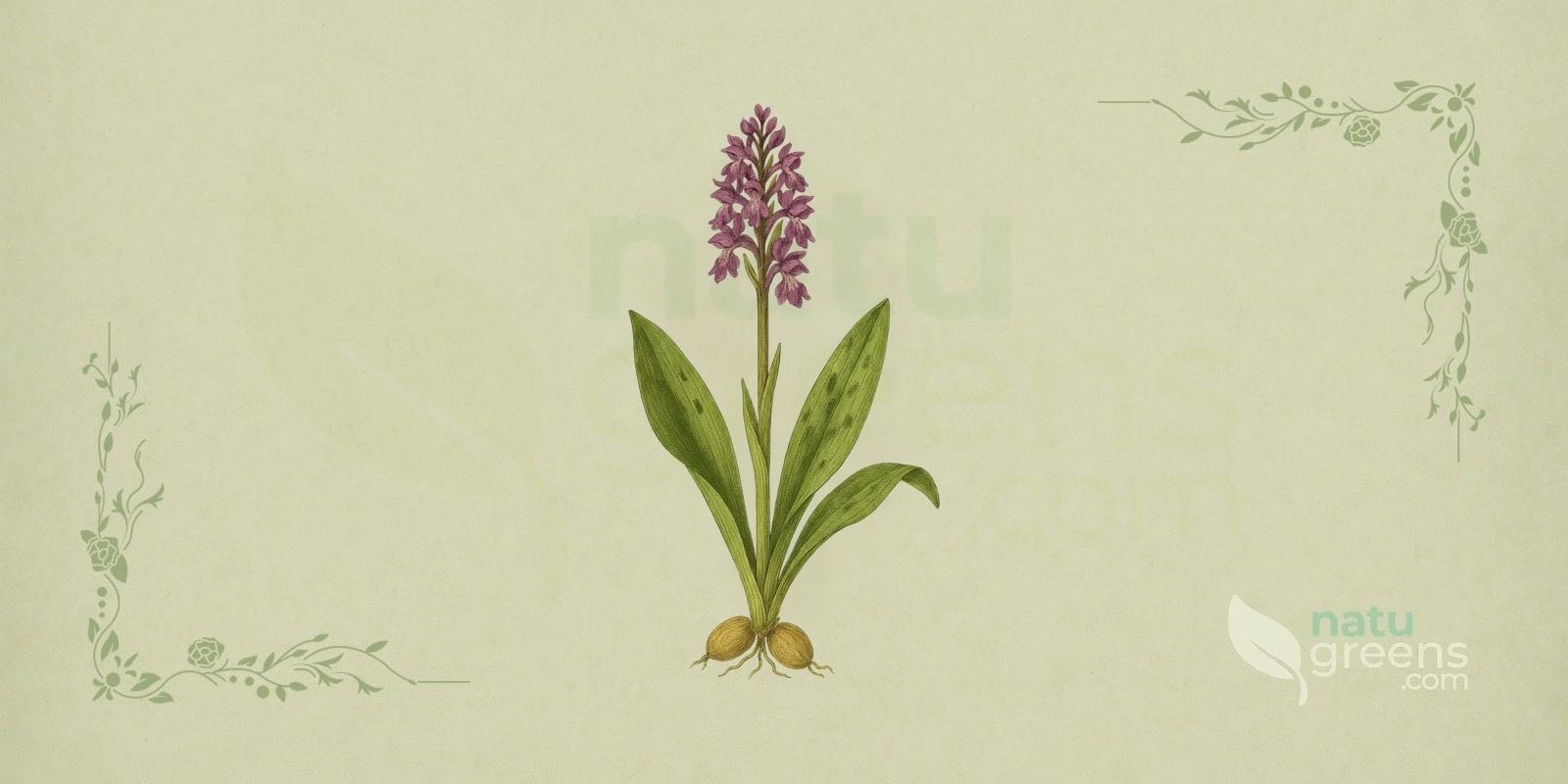
Orchis mascula (L.) L. / Early-Purple Orchid, known in English as the early-purple orchid and also called the male orchid, is a perennial herbaceous plant in the Orchidaceae family. Described by Carl Linnaeus, it is native to Europe, northwest Africa and parts of the Middle East. Valued for centuries in traditional medicine for its nourishing qualities, the plant is used above all for its tubers, which are mainly made into salep, a flour that thickens milk and water and gave rise to traditional drinks and desserts.
In European tradition, Orchis mascula was employed for a range of purposes, from gastrointestinal complaints to inflammatory conditions, as well as a general tonic. The plant contains glucomannan, flavonoids and alkaloids, and modern research has already investigated some of these uses. The available pharmacological results, however, come from laboratory assays and animal models, with no confirmation of efficacy in people. Because all orchids are protected under CITES and wild-sourced salep is linked to predatory harvesting, any interest in the plant also calls for responsible consumer choices, a topic covered in the sections on preparation and contraindications.
Popular and International Names of the Early-Purple Orchid
- English: early-purple orchid, early spring orchis, male orchid, salep.
- French: orchis mâle.
- German: Manns-Knabenkraut, Stattliches Knabenkraut.
- Italian: orchide maschia.
- Portuguese: dedos-de-homem-morto, orquídea-macho, orquídea-púrpura-precoce, salepo.
- Spanish: orquídea macho, salep.
Botanical Synonyms of Orchis mascula
Orchis mascula has accumulated many botanical synonyms through successive reclassifications, which reflects the taxonomic complexity of the genus Orchis. The basionym is Orchis morio var. mascula L., the name under which Linnaeus first treated the plant as a variety before raising it to species rank. Knowing these variants matters for identifying the species accurately in herbaria, older floras and historical texts, which is why the list below gathers the recorded synonyms in alphabetical order.
- Androrchis mascula (L.) D.Tyteca & E.Klein
- Orchis compressiflora Stokes
- Orchis fallax (De Not.) Willk.
- Orchis glaucophylla A.Kern.
- Orchis kromayeri M.Schulze
- Orchis mascula subsp. occidentalis O.Schwarz
- Orchis mascula var. acutiflora W.D.J.Koch
- Orchis mascula var. bicolor Balayer
- Orchis mascula var. fallax E.G.Camus
- Orchis mascula var. hostii Patze, E.Mey. & Elkan
- Orchis mascula var. maritzii J.A.Guim.
- Orchis mascula var. monsignatica Font Quer
- Orchis mascula var. obtusiflora W.D.J.Koch
- Orchis mascula var. speciosa Mutel
- Orchis mascula var. tenera Landwehr
- Orchis monsignatica (Font Quer) Rivas Goday
- Orchis morio f. mascula L.
- Orchis morio var. mascula L. (basionym)
- Orchis obtusa Schur
- Orchis obtusiflora Schur
- Orchis olivetorum Gren. ex Nyman
- Orchis ovalis F.W.Schmidt
- Orchis parreissii C.Presl
- Orchis patens var. fallax (De Not.) Rchb.f.
- Orchis pentecostalis Wettst. & Sennholz
- Orchis signifera Vest
- Orchis speciosa Host
- Orchis speciosissima Wettst. & Sennholz
- Orchis stabiana Tenore
- Orchis tenera (Landwehr) Kreutz
- Orchis untchji M.Schulze
- Orchis vernalis Salisbury
- Orchis wanjkovii E.Wulff
- Orchis wilmsii K.Richt.
Botanical Family: Orchidaceae
Orchidaceae is one of the largest and most diverse families of flowering plants, with around 28,000 species spread across almost the entire planet. Their complex, often ornamental flowers play a central role in attracting pollinators, and orchids stand out for their variety of life forms and highly distinctive reproductive strategies. This diversity helps explain the economic, ornamental and medicinal importance of many species in the group.
Orchis mascula shares the characteristic floral structure of the family, with one petal modified into a lip, and produces secondary metabolites of physiological and pharmacological interest, such as flavonoids and alkaloids, which drive chemical research on several orchids. The entire family is listed in Appendix II of CITES, the international convention that controls trade in threatened species. For this reason, the use of European terrestrial orchids in folk medicine is now discussed together with the conservation of wild populations.
Parts of the Early-Purple Orchid Used
- Flowers (rarely used)
- Leaves (rarely used)
- Tubers, popularly called roots, which are the raw material of salep
The ovoid tubers concentrate the glucomannan and starch that give salep its consistency, whereas leaves and flowers appear only occasionally in traditional preparations. Since removing the tuber destroys the whole plant, this is precisely the part whose collection puts the most pressure on wild populations of the species.
Ethnobotanical and Traditional Uses
The uses below belong to the traditional and folk record, handed down by old pharmacopoeias and by household medicine in different regions, and they are not equivalent to indications with proven efficacy in people.
- Abscesses, in folk use
- Astringent
- Blood circulation, as a form of support cited by tradition
- Cough
- Demulcent, soothing the gastrointestinal tract
- Diarrhea
- Expectorant
- Flatulence
- General digestive disorders
- General tonic for states of weakness
- Heartburn
- Indigestion
- Inflammation
- Intestinal cramps
- Mental well-being, according to the folk record
- Nerve tonic, for stress and mental disorders
- Nourishment for children and convalescents, in historical use
- Skin complaints, including boils
- Source of salep, a nutritious flour used in drinks and desserts
- Stomachaches
- Traditional aphrodisiac, especially for male sexual complaints
- Wounds, in folk use
The association with virility derives largely from the Doctrine of Signatures, which saw in the pair of tubers a resemblance to testicles. This symbolic origin helps explain why the aphrodisiac use has persisted for centuries without support from clinical studies.
Therapeutic Properties of the Early-Purple Orchid
None of the activities listed has been proven in people, because the available data come from laboratory assays and animal models, some of them using formulations that combine the orchid with other plants, which makes it impossible to attribute the effect to the orchid alone.
- Antibacterial (inhibition of bacteria observed in laboratory assays, without proof in humans)
- Antiepileptic (anticonvulsant effect described only in animal models)
- Anti-inflammatory (reduced inflammation observed in preclinical studies)
- Antimicrobial (inhibition of microorganisms in in vitro tests)
- Antioxidant (free radical scavenging in laboratory assays, including with combined formulations)
- Cardiovascular (lower blood pressure observed in hypertensive rats given four-plant formulations that include the orchid)
- Demulcent (the mucilage forms a layer that soothes mucous membranes, the basis of traditional use)
- DNA-protective (protection of genetic material observed in laboratory assays)
- Hypnotic (sleep induction reported in animal models, with no human data)
- Hypolipidemic (lower triglycerides and cholesterol in rats, with the same combined formulations)
- Immunostimulant (stimulation of the immune response described in preclinical studies)
- Neuroprotective (protection of nerve cells observed in experimental models)
- Sedative (calming effect reported in animal models, without clinical confirmation)
Detailed Phytochemical Profile of the Early-Purple Orchid
The compounds below have been reported in different parts of the plant, including the tubers, leaves and flowers, and the composition varies with population, environment and analytical method. In populations from northern Iran, for example, the glucomannan and starch content of the tubers changed considerably depending on the type of vegetation in which the plants grew.
- 3-Acetylthymine acid
- 4-Hydroxybenzyl alcohol (p-hydroxybenzyl alcohol)
- Alkaloids
- Allose (D-allose)
- Alpha-terpineol
- Anhydrogalactofuranose (1,6-anhydro-alpha-D-galactofuranose)
- Anthocyanins (chrysanthemin, cyanin, epipactin, mecocyanin, ophrysanin, orchicyanin I, orchicyanin II, seranin, serapianin)
- Anthraquinones
- Beta-farnesene
- Beta-pinene
- Cardiac glycosides
- Cyanogenic glycosides
- Diethoxyacetone (1,1-diethoxy-2-propanone)
- DL-4-amino-3-hydroxybutyric acid
- Eucalyptol
- Flavonoids
- Glucomannan
- Hexadecanoic acid
- Hircinol
- Hydroxymethylfurfural (5-hydroxymethyl-2-furaldehyde)
- Limonene
- Linalool
- Loroglossol
- Militarin
- Myrcene
- Orchinol
- Phenanthrenes
- Phenolic acids (caffeic acid, chlorogenic acid)
- Sabinene
- Saponins
- Terpenoids
Among these groups, glucomannan is the most relevant to traditional use, since it accounts for the ability of salep to form a gel in water or milk. The dihydrophenanthrenes, such as orchinol, hircinol and loroglossol, are defense compounds that orchids produce in response to fungal attack.
Preparation and Administration Forms of the Early-Purple Orchid
- Culinary desserts made with salep
- Decoction
- Hot salep drink with milk or plant-based milk
- Infusion
- Powder (salep)
The powder made from dried, ground tubers is the best-known form and must first be dissolved in a little cold liquid, because glucomannan swells quickly and forms lumps on direct contact with hot liquid. Before any preparation, it is worth checking the source, since commercial products sold as “salep” are often adulterated with ordinary starch. Only material of cultivated and certified origin avoids contributing to the predatory harvesting of wild populations.
Synergy with Other Medicinal Plants
Traditional Pairing with Ginseng and Maca
Since Orchis mascula appears in the traditional record as an aphrodisiac, one pairing proposed by analogy of use combines it with ginseng (Panax ginseng) or Peruvian maca (Lepidium meyenii), plants traditionally used for male sexual vitality. No study has evaluated these mixtures, and the hypothesis of effects on blood circulation or hormonal balance remains without experimental confirmation. In addition, ginseng has known interactions with anticoagulants and blood sugar-lowering drugs, so professional guidance is required before any combination.
Digestive Pairing with Chamomile and Peppermint
Because the tuber mucilage forms a soothing layer over mucous membranes, a second pairing suggested by analogy of use brings the orchid together with chamomile (Matricaria chamomilla) and peppermint (Mentha piperita). Both are traditionally used for gas, cramps and poor digestion. This combination has not been studied either, and peppermint can worsen heartburn and reflux in sensitive people, while chamomile can trigger allergies in those who react to plants of the Asteraceae family.
Recipes and Usage Protocols of the Early-Purple Orchid
Hot Salep Drink with Milk
Ingredients: salep powder of cultivated and certified origin, in a small amount, just enough to give a creamy consistency; 250 ml of milk or plant-based milk; sugar or honey to taste; ground cinnamon for dusting.
Preparation: Dissolve the salep powder in a little cold milk to avoid lumps. Heat the rest of the milk in a saucepan, add the mixture and stir constantly until it thickens. Sweeten to taste and serve hot, dusted with cinnamon. In the traditional record, the drink is presented as a nourishing, comforting food for convalescents and as a general tonic, but there are no human studies on this use, and anyone who has a chronic illness, takes medication, or is pregnant or breastfeeding should consult a health professional before consuming it.
Dried Tuber Infusion Traditionally Used for Coughs
Ingredients: a small portion of dried, crushed Orchis mascula tuber of cultivated and certified origin, and one cup of boiling water.
Preparation: Add the crushed tuber to the boiling water, cover and let it steep for 10 to 15 minutes. Strain and drink warm. This infusion is traditionally used to relieve coughs and internal inflammation, but there are no safety or efficacy data in people that would allow any amount or frequency of use to be indicated, so consult a health professional before preparing it.
The preparations above follow traditional records and do not replace professional guidance. Before any internal use, check the contraindications and interactions described in this article.
Associated Therapies
Clinical Phytotherapy
In phytotherapy, interest in Orchis mascula centers on the nourishing and demulcent properties attributed to glucomannan, the polysaccharide responsible for the mucilage of the tubers. Standardized extracts would be the way to ensure a known concentration of this and other compounds, but there are no clinical studies with standardized extracts of the species. Its use as an adjunct for gastrointestinal complaints or states of debility therefore remains confined to the traditional record and depends on professional guidance.
Unani and Ayurvedic Traditional Medicine
In the Unani and Ayurvedic systems, Orchis mascula is among the orchids associated with salab misri, the name given to tubers used as an aphrodisiac, tonic and rejuvenator. These traditional texts employ it for complaints related to male sexual function, sperm count and nervous exhaustion. Researchers in Pakistan tested multi-herb formulations that include it and that, in rats, lowered lipids and blood pressure, a result still unconfirmed in people.
Contraindications and Side Effects of the Early-Purple Orchid
Conservation, Origin and Authenticity of Salep
The entire Orchidaceae family is protected by international agreement (CITES, Appendix II), and wild-sourced salep (a product obtained from the tuber) involves predatory harvesting; some countries prohibit its export. Do not harvest or buy tubers of uncertified wild origin, since removing the tuber destroys the plant. Recent molecular studies also point to unsustainable harvesting of wild orchids for this trade. Commercial products sold as “salep” are often adulterated with ordinary starch, so choose suppliers whose label states the species, the cultivated origin and the certification.
General Contraindications
The literature describes no formal contraindications for Orchis mascula, which reflects the absence of clinical studies rather than any guarantee of safety. The available pharmacological evidence comes only from animal models, not from humans, and no effect described in this article should be understood as proven efficacy in people. With no safety data on pregnancy and breastfeeding, pregnant and breastfeeding women should avoid medicinal use. People with hormone-sensitive conditions or undergoing fertility treatment need to consult a health professional before any use, given the traditional reputation of the plant regarding the male reproductive system. Children should not be given medicinal preparations without pediatric guidance, even though salep was historically used as a food for infants.
Drug Interactions
Because animal models describe sedative, hypnotic and anticonvulsant effects, people taking sedatives, sleep medications or anticonvulsants should avoid combining them with this plant without medical guidance. The same applies to antihypertensives and blood sugar-lowering drugs, since formulations containing the orchid lowered blood pressure and glucose in rats. In addition, glucomannan may slow the absorption of sugars and oral medications, which is why it is recommended to space salep apart from other medicines, following the advice of a doctor or pharmacist. In combinations with ginseng, caution extends to those taking anticoagulants.
Common Side Effects
Side effects are considered rare and generally mild, such as bloating or abdominal discomfort caused by the high mucilage content when consumed in excess. The powder should never be swallowed dry or with too little liquid, because glucomannan absorbs a great deal of water and can swell in the throat or esophagus. Allergic reactions, although uncommon, may appear as skin rashes or itching, in which case use should be discontinued.
Historical Notes and Interesting Facts
Etymology and Symbolism
The genus name Orchis comes from the Greek órkhis, meaning testicle, in reference to the pair of rounded tubers of the plant. The epithet mascula means male or virile and may allude both to the sturdy appearance of the species and to the shape of its tubers. Through the Doctrine of Signatures, this resemblance fed the belief that the plant acted on virility. Many commentators also identify it with the “long purples” mentioned by Shakespeare in Hamlet, flowers that, according to the play, maidens called dead men’s fingers.
Salep: An Ancient Tradition
Salep, a flour made from the tubers of Orchis mascula and other orchids, has a long history of use in the Middle East and Europe, where it was considered a highly nutritious food for children and convalescents. Its ability to form a demulcent jelly when cooked in water or milk made it a popular remedy for gastrointestinal irritation. According to the most widely accepted etymology, the name itself comes from the Turkish salep, derived from an Arabic expression meaning fox testicles.
Deceptive Pollination Strategy
The early-purple orchid is a food-deceptive species, meaning that it attracts pollinating insects with the color and scent of its flowers without offering nectar as a reward. Analyses of its floral scent show wide variation from one individual to another, a trait typical of orchids that rely on deceptive pollination. Research on pollen and seed flow between isolated populations helps explain how the species persists in fragmented landscapes. In northern Iran, the plant is regarded as endangered, and growing demand for salep is cited as one of the factors that have pushed tuberous orchids to the brink of extinction in several regions.
Frequently Asked Questions about the Early-Purple Orchid
Can the Early-Purple Orchid Be Used as an Aphrodisiac?
Orchis mascula has a long history of traditional use as an aphrodisiac, especially for male sexual complaints, a reputation attributed to the shape of its tubers, which resemble testicles, and to the Doctrine of Signatures. No human studies confirm this effect and the available pharmacological data come only from animal models, so this use should be understood as part of the traditional record, not as proven efficacy.
Which Parts of the Early-Purple Orchid Are Used?
The most widely used part is the tubers, which are harvested, dried and ground to produce salep, a flour rich in glucomannan, the polysaccharide responsible for the demulcent and nourishing properties attributed to the plant. Leaves and flowers appear far less often in traditional preparations.
What Is Salep and What Is It Used For?
Salep is the flour obtained from the dried, ground tubers of Orchis mascula and other orchids, rich in glucomannan, a substance that forms a gel in water or milk. Traditionally, it serves as the base for hot drinks and desserts and was used as food for children and convalescents. It also had folk use for gastrointestinal irritation, coughs and inflammation, along with a reputation as an aphrodisiac and tonic, uses that lack clinical proof.
Are There Contraindications for the Early-Purple Orchid?
There are no safety data on pregnancy and breastfeeding, so pregnant and breastfeeding women should avoid medicinal use. People with hormone-sensitive conditions, undergoing fertility treatment or taking sedatives, anticonvulsants, antihypertensives or blood sugar-lowering drugs should consult a health professional first, and excessive consumption can cause mild gastrointestinal discomfort.
Is It Permitted to Harvest Wild Early-Purple Orchid Tubers?
The recommendation is not to do so, because the entire Orchidaceae family is protected under CITES (Appendix II), wild-sourced salep involves predatory harvesting and some countries prohibit its export. Moreover, removing the tuber destroys the whole plant. Do not harvest or buy tubers of uncertified wild origin, and choose only cultivated material with verified provenance.
Is Commercial Salep Always Authentic?
Not always, since commercial products sold as “salep” are often adulterated with ordinary starch, which alters the composition and misleads consumers about what they are buying. Choose suppliers that state the species, the cultivated origin and the certification, and be wary of cheap products of unknown origin, which may be either counterfeit or wild-harvested.
Notice: this content is for informational purposes and does not replace professional medical advice. Consult a physician or herbal practitioner before using medicinal plants, especially during pregnancy, breastfeeding, or alongside medication.
References and Scientific Studies
- PMC2016 Helsen K, et al. A direct assessment of realized seed and pollen flow within and between two isolated populations of the food-deceptive orchid Orchis mascula. Plant Biol (Stuttg). 2016.
- PMC2022 Mafakheri M, et al. The impact of environmental and climatic variables on genetic diversity and plant functional traits of the endangered tuberous orchid (Orchis mascula L.). Sci Rep. 2022.
- PMC2020 Rezaei Savadkouhi N, et al. The effect of encapsulated plant extract of hyssop (Hyssopus officinalis L.) in biopolymer nanoemulsions of Lepidium perfoliatum and Orchis mascula on controlling oxidative stability of soybean oil. Food science & nutrition. 2020.