



Quick summary
Arbutus unedo L. / Strawberry Tree, known in English as the strawberry tree and in Portugal and Brazil as medronheiro, with the regional Portuguese names ervedeiro and merodeiro, is an evergreen tree or shrub of the Ericaceae family, described by Carl Linnaeus in 1753. Native to the Mediterranean region and Western…
Main caution: Warning: the ripe fruit is a safe traditional food, eaten fresh, made into preserves and distilled into medronho brandy in Portugal. The leaf, on the other hand, contains arbutin, which the body converts into…
Arbutus unedo L. / Strawberry Tree, known in English as the strawberry tree and in Portugal and Brazil as medronheiro, with the regional Portuguese names ervedeiro and merodeiro, is an evergreen tree or shrub of the Ericaceae family, described by Carl Linnaeus in 1753. Native to the Mediterranean region and Western Europe, reaching as far as Ireland, the strawberry tree is valued for its ecological role and for its fruits, and it holds an old place in traditional medicine, which relies mainly on its leaves in infusions and decoctions.
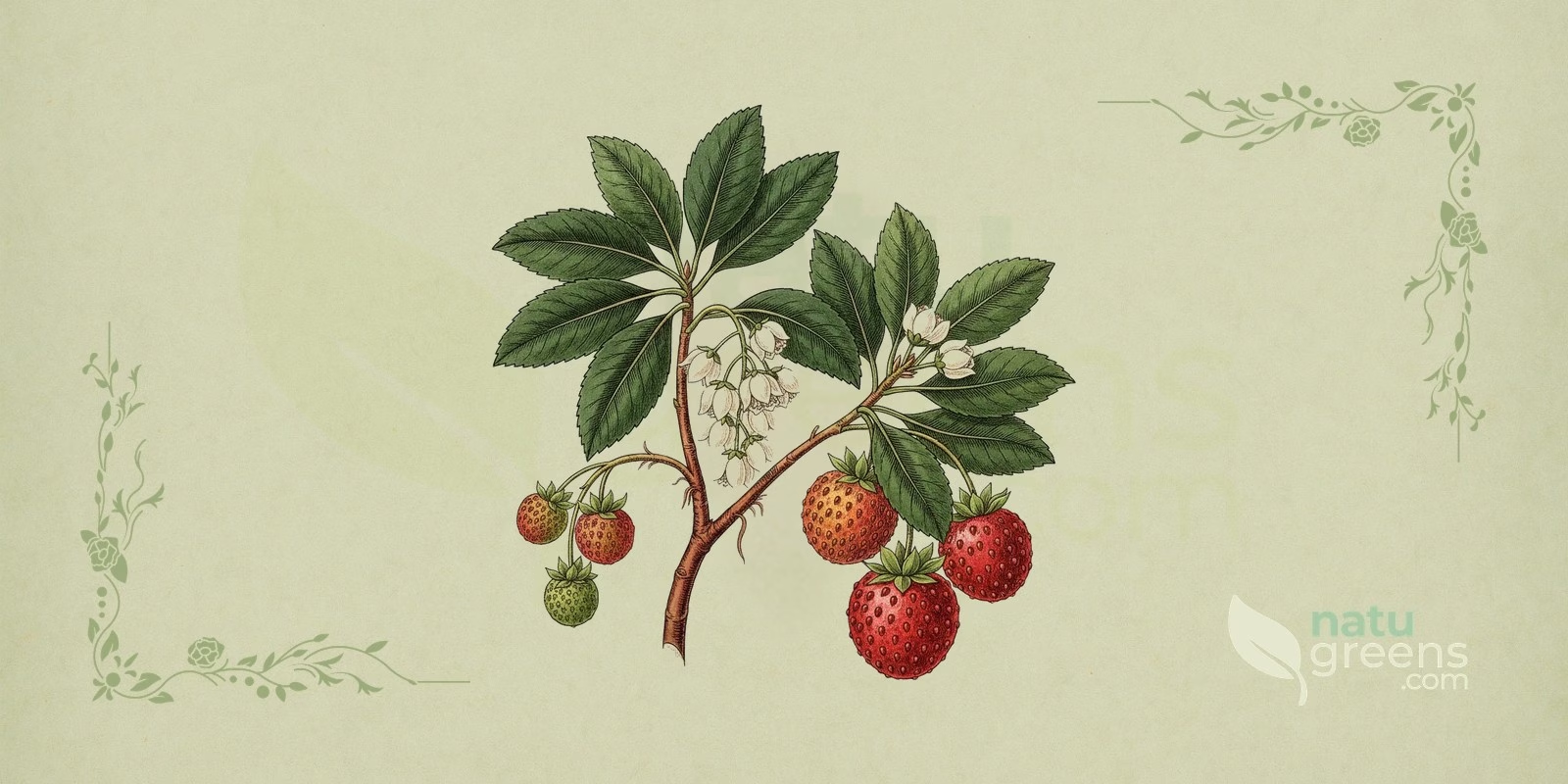
When discussing the strawberry tree, it is essential to keep the parts of the plant apart, because their profiles are very different. The ripe fruit is a safe traditional food, eaten fresh, made into preserves and distilled into medronho brandy in Portugal, whereas the leaf contains arbutin, which the body converts into hydroquinone, as well as tannins, which is why its medicinal use must be short-term. In Portuguese and European herbal tradition, the leaves are described as astringent, diuretic and antiseptic, traditional uses that do not amount to proven efficacy, and modern research is examining the plant's tannins, flavonoids and phenolic compounds in the laboratory.
Popular and International Names of the Strawberry Tree
- English: cane apple, Irish strawberry tree, strawberry tree.
- French: arbousier, arbre à fraises.
- German: Erdbeerbaum.
- Italian: corbezzolo.
- Portuguese: ervedeiro, medronheiro, merodeiro (Portugal); medronheiro (Brazil).
- Spanish: madroñero, madroño.
Botanical Synonyms of the Strawberry Tree
- Arbutus crispa Hoffmanns.
- Arbutus croomii T.Moore & Mast.
- Arbutus intermedia Heldr. ex Nyman
- Arbutus laurifolia L.f.
- Arbutus microphylla T.Moore & Mast.
- Arbutus nothocomaros Heldr. ex Nyman
- Arbutus procumbens Kluk ex Besser
- Arbutus salicifolia Cels ex Hoffmanns.
- Arbutus turbinata Pers. ex Rchb.
- Arbutus vulgaris Bubani
- Unedo edulis Hoffmanns. & Link
- Unedo globosa Jord.
- Unedo oviformis Jord.
The long list of synonyms reflects the natural variation of the species across its wide range. Forms with narrower leaves, more elongated fruits or a lower habit were once described as separate species, but today they are all grouped under Arbutus unedo L.
Botanical Family: Ericaceae
The Ericaceae family, to which the strawberry tree belongs, is a vast family of flowering plants with more than 4,000 species spread around the world, many of them adapted to acidic, nutrient-poor soils, such as blueberries, rhododendrons and azaleas. Its members are usually evergreen shrubs or trees with bell-shaped or urn-shaped flowers.
The strawberry tree displays these typical traits, with white or pinkish urn-shaped flowers gathered in drooping clusters and fleshy, round fruits with a granular surface that take about a year to ripen, so that flowers and ripe fruits share the tree in autumn. The family is known for producing tannins, flavonoids and, in several species, arbutin, the same substance that calls for caution in the medicinal use of strawberry tree leaves and of relatives such as bearberry.
Parts of the Strawberry Tree Used
- Bark (traditional use, rich in tannins)
- Leaves (traditional medicinal use, contain arbutin)
- Ripe fruits (food use)
- Root (occasional traditional use)
Ethnobotanical and Traditional Uses of the Strawberry Tree
- Astringent (traditional use of the leaves and bark)
- Diarrhea (traditional use of the leaves)
- Diuretic (traditional use of the leaves)
- Food, preserves and brandy (ripe fruit)
- Gout (traditional record)
- Kidney and bladder complaints (traditional record; these require medical assessment)
- Rheumatism (traditional record)
- Urinary antiseptic (traditional use of the leaves; infections require medical assessment)
Therapeutic Properties of the Strawberry Tree
- Anti-inflammatory (traditional use of the leaves; preliminary laboratory studies)
- Antioxidant (ability to neutralize free radicals in assays with leaves and fruits)
- Antiseptic (traditional use of the leaves, attributed to arbutin)
- Astringent (traditional use of the leaves, linked to tannins)
- Diuretic (traditional use of the leaves, without proven efficacy)
Rodent studies have looked at the effect of strawberry tree extracts on intestinal glucose absorption, and other research is testing plant fractions on cells in the laboratory, but these are preliminary results that do not translate into recommendations for use.
Detailed Phytochemical Profile of the Strawberry Tree
- Arbutin (mainly in the leaves)
- Essential oil
- Flavonoids (catechin, myricetin, quercetin)
- Phenolic compounds (ellagic acid, gallic acid)
- Tannins (gallotannins)
- Triterpenes
- Vitamin C (mainly in the fruits)
The ripe fruit stands out for its sugars, fiber, minerals and vitamin C, which make it an interesting food, while the leaves concentrate arbutin and tannins, compounds that account both for the traditional uses and for the safety precautions.
Preparation and Administration Forms of the Strawberry Tree
- Decoction (leaves)
- Infusion (leaves)
- Liqueur (fruit)
- Marmalade and preserves (fruit)
- Medronho brandy (fruit)
- Tincture (leaves)
Synergy with Other Medicinal Plants
Traditional Leaf Blends for the Urinary Tract
In herbal tradition, strawberry tree leaves are combined with bearberry (Arctostaphylos uva-ursi) and corn silk (Zea mays) in teas traditionally used for mild urinary complaints. The arbutin in strawberry tree and bearberry leaves is converted into hydroquinone in the body, and corn silk is known for its diuretic use, but this combination also increases exposure to hydroquinone, so the blend should be taken only for a very short time, avoided during pregnancy, breastfeeding and kidney disease, and it is no substitute for medical care of a bladder infection.
Traditional Astringent Combinations
For diarrhea, tradition pairs strawberry tree leaves with black mulberry leaves (Morus nigra) and oak bark (Quercus robur), all rich in tannins with an astringent action. This is a traditional combination without clinical studies, and persistent diarrhea, or diarrhea with blood, fever or signs of dehydration, especially in children and older adults, requires medical attention.
Recipes and Usage Protocols of the Strawberry Tree
Traditional Leaf Decoction
The leaf decoction is the traditional form of use for mild urinary complaints in Portuguese herbalism.
Ingredients: a small amount of dried strawberry tree leaves and water.
Preparation: boil the leaves in the water for 10 minutes and strain. Because of the arbutin in the leaves, use should be short-term, never continuous, and the amount and frequency should be agreed with a health professional. Fever, pain when urinating or blood in the urine require medical assessment.
Traditional Leaf Infusion
The leaf infusion is traditionally used as an astringent in mild episodes of diarrhea.
Ingredients: a small amount of dried strawberry tree leaves and 250 ml of boiling water.
Preparation: add the leaves to the boiling water, cover and let steep for 10 minutes, then strain and drink warm. Use should be occasional and limited to a few days, and the infusion is not suitable for pregnant or breastfeeding women or for people with kidney disease.
Homemade Strawberry Tree Fruit Preserve
The ripe fruits are traditionally used in sweets and preserves in regions where the strawberry tree is common.
Ingredients: fully ripe strawberry tree fruits, deep red in color, sugar to taste and a little water.
Preparation: wash the fruits, discard any that are green or bruised and cook them over low heat with the water and sugar, stirring until they break down and thicken. Pass through a sieve if you prefer a smooth texture and store in a clean glass jar in the refrigerator.
The preparations above follow traditional records and do not replace professional guidance. Before any internal use, check the contraindications and interactions described in this article.
Associated Therapies of the Strawberry Tree
Herbal Medicine
In traditional herbal medicine, strawberry tree leaves appear in infusions, decoctions and tinctures used for urinary complaints, diarrhea and some skin problems, following the astringent, diuretic and antiseptic uses that tradition ascribes to them. Scientific research is studying the active compounds of the leaves and fruits, but the results are still preliminary and do not prove clinical efficacy. Because they contain arbutin, the leaves follow the same safety logic as other Ericaceae such as bearberry, with short-term use only.
Traditional Mediterranean Diet
Outside the medicinal field, the ripe fruit is part of the traditional diet of the Mediterranean and Portugal, eaten fresh or made into preserves, marmalades and liqueurs. It is in this food context, and not in the use of the leaves, that the strawberry tree shows its safest profile.
Contraindications and Side Effects of the Strawberry Tree
Fruit and Leaf Are Not the Same Thing
Warning: the ripe fruit is a safe traditional food, eaten fresh, made into preserves and distilled into medronho brandy in Portugal. The leaf, on the other hand, contains arbutin, which the body converts into hydroquinone, as well as tannins, and its medicinal use must be short-term and avoided during pregnancy, breastfeeding and kidney disease, the same safety logic that applies to other arbutin-rich Ericaceae such as bearberry. The precautions for the leaf do not apply to the fruit, nor the other way around.
Precautions with the Fruit
- Unripe fruit: the green, unripe fruit is not edible and may cause gastrointestinal discomfort.
- Too much fruit: eating ripe fruits in large quantities may cause digestive upset.
- Fermented fruit and brandy: overripe fruits can ferment and contain alcohol, and medronho brandy is an alcoholic drink that calls for the usual precautions with alcohol.
Precautions with the Leaf
- Arbutin and hydroquinone: medicinal use only in the short term, never continuously.
- Children: there are no safety data for the medicinal use of the leaves.
- Gastric irritation: the tannins in the leaves may irritate the stomach of sensitive people, especially in excess or over long periods.
- Kidney disease: use of the leaves should be avoided.
- Pregnancy and breastfeeding: medicinal use of the leaves should be avoided.
Historical Notes and Interesting Facts about the Strawberry Tree
A Name That Discourages a Second Fruit
The epithet unedo comes from the Latin unum edo, roughly "I eat only one", and is traditionally read as a reference to fruits that are edible but not very tasty, so that one would eat only one. Anyone who tastes a fully ripe fruit tends to disagree, since the pulp is sweet and slightly mealy.
A Symbol of the Italian Colors
In Italy, the strawberry tree, called corbezzolo, is regarded as a patriotic symbol because it bears green leaves, white flowers and red fruits at the same time, the colors of the Italian flag.
The Brandy of the Algarve
In Portugal, the fermented and distilled fruits give rise to medronho brandy, a traditional drink especially associated with the Algarve hills, where the autumn harvest of the fruits is still a family activity in many villages.
Frequently Asked Questions about the Strawberry Tree
What Is Strawberry Tree Leaf Tea Used For?
The leaf tea is traditionally used as an astringent, diuretic and antiseptic for mild diarrhea and urinary complaints. These are traditional uses without proven efficacy, and urinary infections require medical assessment.
Can the Fruit Be Eaten Safely?
The ripe fruit is a safe traditional food, eaten fresh or as preserves. The green fruit is not edible and may cause gastrointestinal discomfort, and too much ripe fruit can also upset digestion.
Why Should Leaf Use Be Short-Term?
Because the leaves contain arbutin, which the body converts into hydroquinone. For that reason, medicinal use should be short-term and avoided during pregnancy, breastfeeding and kidney disease.
How Is Strawberry Tree Leaf Tea Prepared?
Traditionally, a small amount of dried leaves is steeped in boiling water for about 10 minutes, then strained and drunk warm. Use should be occasional and limited to a few days.
Do Fermented Strawberry Tree Fruits Contain Alcohol?
Yes. Overripe fruits can ferment naturally, and in Portugal the fruits are distilled to make medronho brandy, an alcoholic drink.
Do the Strawberry Tree and Bearberry Have Anything in Common?
Both belong to the Ericaceae family and have leaves containing arbutin, so they follow the same safety logic, with short-term medicinal use. In the strawberry tree, however, these precautions apply only to the leaf, and the ripe fruit is a traditional food.
Notice: this content is for informational purposes and does not replace professional medical advice. Consult a physician or herbal practitioner before using medicinal plants, especially during pregnancy, breastfeeding, or alongside medication.
How to cite this article
NATUGREENS. Strawberry Tree (Arbutus unedo): Properties and Benefits. Natugreens, 19 Nov. 2026. Disponível em: https://natugreens.com/arbutus-unedo-strawberry-tree/. Accessed: Nov. 20, 2026.
Natugreens. (2026). Strawberry Tree (Arbutus unedo): Properties and Benefits. Natugreens. https://natugreens.com/arbutus-unedo-strawberry-tree/
References and Scientific Studies
- PMC2014 Miguel MG, et al. Arbutus unedo L.: chemical and biological properties. Molecules. 2014.
- PMC2018 Morgado S, et al. Arbutus unedo L.: From traditional medicine to potential uses in modern pharmacotherapy. J Ethnopharmacol. 2018.
- PMC2022 Morales D. Use of Strawberry Tree (Arbutus unedo) as a Source of Functional Fractions with Biological Activities. Foods. 2022.
- PMC2019 Mrabti HN, et al. Arbutus unedo L., (Ericaceae) inhibits intestinal glucose absorption and improves glucose tolerance in rodents. J Ethnopharmacol. 2019.
- PMC2021 El Haouari M, et al. An Insight into Phytochemical, Pharmacological, and Nutritional Properties of Arbutus unedo L. from Morocco. Evid Based Complement Alternat Med. 2021.
You May Also Like
Take your time and tell us everything you think, details included. Every response is read by someone on our editorial team and goes into the article's revision. An honest critique helps us more than a polite compliment.
Take your time and tell us everything you think, details included. Every response is read by someone on our editorial team and goes into the article's revision. An honest critique helps us more than a polite compliment.