



Quick summary
Lycopodium clavatum L. / Clubmoss, also known as common clubmoss or wolf's-foot clubmoss, is a flowerless vascular plant of the Lycopodiaceae family. It is widespread across the temperate and cold regions of the Northern Hemisphere and also grows in mountainous areas of South America, Africa and tropical Asia.…
Main caution: Clubmoss calls for specific precautions both for internal use and for contact with the spores. The aerial parts contain alkaloids, with lycopodine as the main representative, so internal use of concentrated…
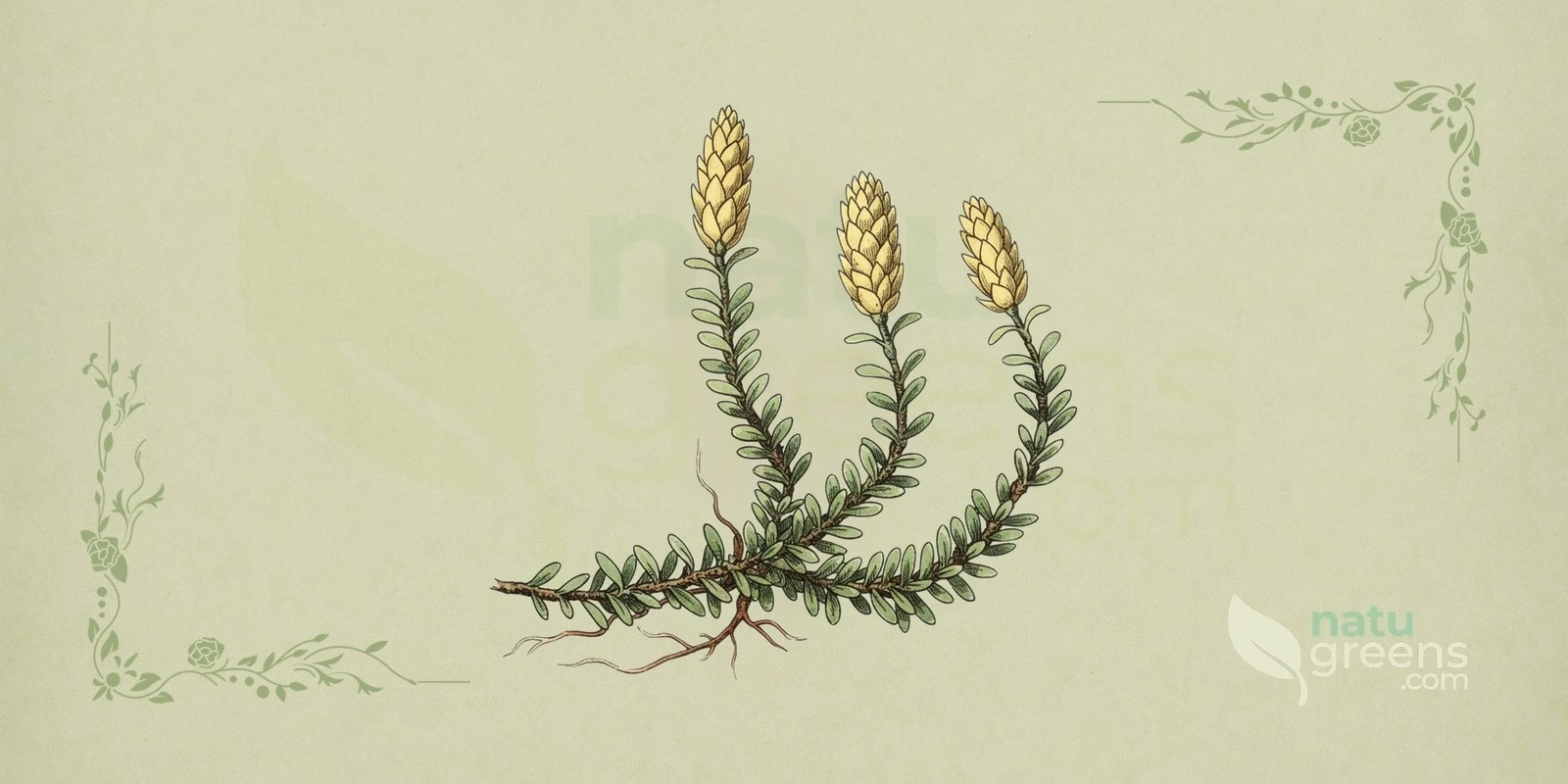
Lycopodium clavatum L. / Clubmoss, also known as common clubmoss or wolf's-foot clubmoss, is a flowerless vascular plant of the Lycopodiaceae family. It is widespread across the temperate and cold regions of the Northern Hemisphere and also grows in mountainous areas of South America, Africa and tropical Asia. Creeping and evergreen, it looks at first glance like an oversized moss, yet it belongs to a very ancient lineage of plants that reproduce by spores. Those spores, a fine, yellow and flammable powder, are what made clubmoss famous in European pharmacy, alongside the aerial parts, which were used in folk teas. The available research, however, comes almost entirely from laboratory or animal studies, and none of the properties attributed to the plant has been confirmed in clinical trials in humans, so everything said about it calls for a cautious reading.
Common and International Names of Clubmoss
- Danish: almindelig ulvefod.
- Dutch: grote wolfsklauw.
- English: common clubmoss, running clubmoss, stag's-horn clubmoss, wolf's-foot clubmoss.
- French: lycopode en massue.
- German: Keulen-Bärlapp.
- Italian: licopodio clavato.
- Japanese: hikage-no-kazura (ヒカゲノカズラ).
- Norwegian: myk kråkefot.
- Polish: widłak goździsty.
- Portuguese: licopódio, pé-de-lobo.
- Spanish: licopodio.
- Swedish: mattlummer.
Not to Be Confused with Huperzia serrata and Other Huperzias
For a long time, botanists grouped under the name Lycopodium several plants that are now placed in separate genera, among them the members of the genus Huperzia, such as Huperzia serrata, formerly called Lycopodium serratum. This Asian species is the source of huperzine A, an alkaloid studied as an acetylcholinesterase inhibitor and sold as a supplement in some countries, which is why many online texts credit common clubmoss with the effects of huperzine. The two plants, however, differ in appearance, habitat and chemistry: the alkaloid profile of Lycopodium clavatum is dominated by lycopodine, not by huperzine A. In a Turkish study comparing extracts from five species of the group, for example, the extract of Huperzia selago (then classified as Lycopodium selago) and that of L. clavatum behaved differently in laboratory tests, a further reminder that data from one plant should not be carried over to the other. When buying any product, checking the full scientific name on the label is the safest way to avoid a mix-up.
Botanical Synonyms of Clubmoss
The accepted name is Lycopodium clavatum L., published by Linnaeus in 1753 in Species Plantarum. Synonyms recorded in taxonomic databases include Lycopodium vulgare Dill., a pre-Linnaean name revived by some authors, Lycopodium tamariscispica Ces., Lycopodium trichophyllum C.Chr. and Copodium oxynemum Raf., along with several subspecies and varieties described from local populations, such as Lycopodium clavatum subsp. laurentianum Victorin. In Chinese literature, the medicinal herb known as shen jin cao comes from Lycopodium japonicum Thunb., a closely related plant that some authors regard as part of L. clavatum in the broad sense, which explains why Asian studies sometimes use both names for the same material.
Botanical Family: Lycopodiaceae
The Lycopodiaceae are one of the oldest surviving lineages of vascular plants, with relatives that, some 300 million years ago, grew to the size of trees in the forests of the Carboniferous period. Today's species are small, bear neither flowers nor seeds and reproduce by spores formed in structures called strobili. Clubmoss has stems that run along the ground for several meters, rooting here and there, and upright branches densely covered in tiny, narrow leaves, each ending in a whitish hair that gives the plant a soft look. The strobili, yellowish and shaped like small clubs, usually appear in groups of two or three at the top of long, almost leafless stalks, a feature that helps identify the species and that inspired the epithet clavatum, "club-shaped".
Parts of Clubmoss Used
Two parts of the plant appear in the records of use: the spores and the aerial parts. The spores, gathered in late summer when the strobili ripen, were for centuries the best-known product, sold in pharmacies as "lycopodium powder" and used as a drying powder and as an agent to keep pills from sticking together. The whole herb, stems and branches included, was dried to make teas in the folk medicine of Central and Eastern Europe. Because the plant grows slowly and takes years to establish itself, wild harvesting is restricted in several European countries, where clubmosses are legally protected.
Ethnobotanical and Traditional Uses of Clubmoss
In European folk medicine, clubmoss was used mainly as a plant acting on the urinary tract and the joints, and recent ethnopharmacological reviews also record uses in traditional systems of Asia, where related species go into preparations for aching and stiff limbs. The most frequently cited traditional uses, none of them clinically proven, are these:
- Cystitis and urinary discomfort (tea made from the aerial parts in Central European tradition)
- Diaper rash and moist skin (spores applied as a drying powder, a practice now abandoned because of the risk of reactions)
- Gastritis and digestive complaints (mentioned in surveys of folk use)
- Kidney problems (use as a folk diuretic)
- Rheumatism and joint pain (teas and compresses in European and Asian folk medicine)
Medicinal Properties of Clubmoss
The properties listed below come from cell experiments, animal tests or folk tradition alone, and none of them has been demonstrated in clinical studies in people, so they point to scientific interest rather than to any assured effect.
- Acetylcholinesterase inhibition (observed in laboratory extracts and fractions, with conflicting results between research groups for the same compound)
- Anti-inflammatory (in mice, the chloroform extract and the alkaloid fraction of the aerial parts reduced capillary permeability in an inflammation test, with a weaker effect than indomethacin; serratane triterpenes isolated from the plant lowered inflammatory mediators in cell cultures)
- Diuretic (based solely on traditional use, with no controlled studies to confirm it)
- Hepatoprotective (a spore extract altered markers of liver damage in mice exposed to liver-toxic substances; an isolated result limited to animals)
Detailed Phytochemical Profile of Clubmoss
The chemistry of clubmoss combines alkaloids typical of the genus with triterpenes of unusual structure and components specific to the spores. Chromatographic analyses have identified dozens of substances in the herb, and a 2026 review sums up the main groups as lycopodane-type alkaloids, triterpenoids, flavonoids and phenolics.
- Alpha-onocerin (triterpene described as an acetylcholinesterase inhibitor in a laboratory test, a finding another research group was unable to reproduce)
- Fixed spore oil (an abundant fatty fraction, removed when the spores are processed to make sporopollenin capsules)
- Flavonoids and phenolic acids (present in the aerial parts in smaller amounts)
- Lyclavatol (triterpene isolated from the plant, with weak acetylcholinesterase inhibition in vitro)
- Lycopodine (the main alkaloid of the species, which accounted for about 84% of the active alkaloid fraction in a study of plants from Turkey)
- Lycopodium alkaloids (a group of dozens of compounds with a tricyclic or tetracyclic skeleton, typical of the Lycopodiaceae and the reason for caution with internal use)
- Serratane triterpenes (a group of compounds that reduced nitric oxide, COX-2 and inflammatory cytokines in laboratory cells)
- Sporopollenin (a highly resistant polymer that forms the spore wall and is now being studied as a microscopic capsule for carrying drugs)
Preparation and Administration of Clubmoss
In traditional records, the dried aerial parts were prepared as an infusion or decoction and taken in small amounts, while the spores were used neat, externally, as a powder. There is currently no official European monograph defining a dose, method of preparation or approved indication for clubmoss, and the standardized extracts that appear in studies are research products with no regulated commercial equivalent. The most widespread use today is homeopathic: the spores go through successive dilutions until practically no plant material remains, which carries entirely different implications from those of a tea or an extract.
Synergy with Other Medicinal Plants
Traditional Pairing for the Urinary Tract
In European folk blends aimed at urinary comfort, clubmoss appeared alongside plants with a similar reputation, such as horsetail (Equisetum arvense) and goldenrod (Solidago virgaurea), the latter holding a European traditional-use monograph for increasing urine flow. These combinations grew out of folk experience and have never been evaluated in studies, so there are no data on the safety or benefit of the blend, and the alkaloid content of clubmoss makes it preferable to use, where appropriate, only the better-documented plants.
Traditional Pairing for Joint Pain
For rheumatic complaints, folk herbals mentioned clubmoss together with stinging nettle (Urtica dioica) and meadowsweet (Filipendula ulmaria), plants with their own history of use for joint pain. The pairing rests on tradition alone, with no studies showing any advantage in combining the herbs, and any blend containing clubmoss deserves the same reserve applied to the plant on its own.
Recipes and Usage Protocols for Clubmoss
Infusion of the Aerial Parts According to Historical Records
Old herbals describe a weak infusion of the dried herb, steeped in hot water for a few minutes and taken in small doses for short periods, with the aim of promoting urine flow or easing joint complaints, an effect that clinical research has never confirmed. The amounts given in these texts were not standardized, and since the herb contains alkaloids whose toxicity in humans is poorly studied, no dose is considered safe for home preparation, which is why this use should not be undertaken on your own.
Spore Powder for External Use
Until the mid-twentieth century, lycopodium powder was dusted on the skin to absorb moisture in rashes and skin folds, and hospitals used it on surgical gloves. The practice was abandoned because spores that enter wounds can cause granulomas, inflammatory nodules that sometimes appear years later, and because inhaled powder can trigger allergic attacks in sensitive people, so the powder should never be applied to open wounds or scattered into the air. These uses follow traditional records and are no substitute for professional advice from a doctor or pharmacist.
The preparations above follow traditional records and do not replace professional guidance. Before any internal use, check the contraindications and interactions described in this article.
Therapies Associated with Clubmoss
Clinical Herbal Medicine
In present-day clinical herbal medicine, clubmoss plays a minor role, precisely because human trials are lacking and because its alkaloid content calls for caution with internal use. Scientific interest centers on isolated compounds, such as the anti-inflammatory triterpenes and the alkaloids that act on acetylcholinesterase, and on an unexpected technological application: sporopollenin capsules, obtained from the spores once their inner contents have been removed, are being tested as vehicles for carrying drugs and releasing them in a controlled way.
Homeopathy
Lycopodium is one of the best-known remedies of classical homeopathy, prepared from the spores and prescribed by homeopaths mainly for digestive and urinary complaints within that system's own reasoning. High homeopathic dilutions contain no measurable amounts of the plant's alkaloids and are therefore not equivalent to herbal use, but they also lack robust clinical evidence of efficacy. A study in mice infected with Toxoplasma gondii even observed worsening kidney and liver lesions in animals given Lycopodium clavatum 200dH, a reminder that no preparation should replace medical care for an illness.
Contraindications and Side Effects of Clubmoss
Clubmoss calls for specific precautions both for internal use and for contact with the spores. The aerial parts contain alkaloids, with lycopodine as the main representative, so internal use of concentrated preparations, such as extracts and strong tinctures, requires caution and should only take place under the guidance of a qualified health professional, since the toxicity of these compounds in humans is poorly studied and no safe dose has been established. Use should be avoided during pregnancy and breastfeeding, because there are no safety data for these stages, and also in children for the same lack of information. The spores can be allergenic through the airways and through skin contact in sensitive people: occupational asthma has been reported in workers exposed to the powder used in condom manufacturing, and similar cases of sensitization have been described in other settings where the powder hangs in the air. People with asthma, allergic rhinitis or a history of allergy to pollen and dust should avoid handling or inhaling the powder. In addition, spores that get into surgical wounds or cuts can cause granulomas that mimic tuberculosis or a tumor and appear months or even decades later, which is why the powder was withdrawn from hospital use.
Drug Interactions
There are no human studies on interactions between clubmoss and medications, and the precautions below are theoretical, based on effects observed in the laboratory. Since extracts of the plant showed acetylcholinesterase inhibition in vitro, internal use is best avoided alongside drugs that act on the cholinergic system, both the inhibitors of this enzyme used in Alzheimer's disease, such as donepezil, rivastigmine and galantamine, and anticholinergics, whose effect could be altered. The herb's diuretic reputation also calls for prudence in anyone already taking diuretics or lithium, a medication sensitive to shifts in fluid balance. Anyone on long-term medication should talk to their doctor or pharmacist before taking clubmoss internally.
Curiosities and Historical Facts
The genus name comes from the Greek lykos, wolf, and pous, foot, an allusion to the branch tips, which resemble a wolf's furry paw, and the origin of the folk names wolf's-foot and, in Portuguese, pé-de-lobo. The spores are so fine and oil-rich that, when scattered in the air near a flame, they burn in an instant flash, a property that made them a raw material for theatrical pyrotechnics, early photographic flashes and fire-breathing tricks. In 1807, the brothers Nicéphore and Claude Niépce used lycopodium powder as fuel in the Pyréolophore, one of the first internal combustion engines in history. The same spores, which repel water and spread evenly, were also used in physics laboratories to make sound waves visible in Kundt's tube, and in forensic science as a powder for revealing fingerprints.
Frequently Asked Questions About Clubmoss
Is Clubmoss the Same Plant That Provides Huperzine A?
No. Huperzine A comes mainly from Huperzia serrata, an Asian species that was once classified in the genus Lycopodium but now sits in a genus of its own. Common clubmoss has a different alkaloid profile, dominated by lycopodine, and studies on huperzine supplements do not apply to it.
Is Clubmoss Tea Safe?
There are not enough data to consider the tea safe. The herb contains alkaloids whose toxicity in humans has been poorly studied, no dose has been established, and use is advised against during pregnancy, breastfeeding and in children. For that reason, internal use should only be considered under the supervision of a health professional.
Can Clubmoss Powder Cause Allergies?
Yes. The spores are a known allergen through the airways and the skin, with documented cases of occupational asthma in workers exposed to the powder and a risk of skin reactions in sensitized people. Anyone with asthma or other respiratory allergies should avoid contact with the powder, including in activities such as pyrotechnics and theater.
What Is the Difference Between Herbal and Homeopathic Clubmoss?
Herbal use employs the herb or the spores in real quantities, with their alkaloids and other compounds, whereas the homeopathic remedy goes through dilutions so extreme that practically no plant substance remains. These are different approaches with different risk profiles, and neither has efficacy proven by good-quality clinical trials.
Why Is Clubmoss Used in Research on New Medicines?
Current interest lies less in the plant as a remedy and more in the wall of its spores. Once emptied, the spores leave behind microscopic sporopollenin capsules, tough and uniform in size, which researchers are testing as vehicles for carrying drugs and nutrients and releasing them gradually in the body, a line of research that is still experimental.
Notice: this content is for information and prevention only and does not replace assessment by a healthcare professional. This plant must not be used for self-medication in any form. In case of contact or ingestion, seek emergency medical care immediately.
How to cite this article
NATUGREENS. Clubmoss (Lycopodium clavatum): Uses, Spores and Safety. Natugreens, 26 Nov. 2026. Disponível em: https://natugreens.com/lycopodium-clavatum-clubmoss/. Accessed: Nov. 26, 2026.
Natugreens. (2026). Clubmoss (Lycopodium clavatum): Uses, Spores and Safety. Natugreens. https://natugreens.com/lycopodium-clavatum-clubmoss/
References and Scientific Studies
View All 14 Cited References
- DOI2004 Ma, X., Gang, D. R. (2004). The Lycopodium alkaloids. Natural Product Reports, 21(6), 752-772. ↗
- DOI2022 Wang, B., Guan, C., Fu, Q. (2022). The traditional uses, secondary metabolites, and pharmacology of Lycopodium species. Phytochemistry Reviews, 21(1), 1-79. ↗
- DOI2026 Shi, G., Ni, L., Kong, X., Cai, M., Qu, Z., Wang, Y., Xu, Y., Zhou, H. (2026). From traditional medicine to modern therapeutics: phytochemistry, pharmacology, and innovative sporopollenin-based drug delivery systems of Lycopodium clavatum L. Journal of Pharmacy and Pharmacology, 78(3), rgag022. ↗
- DOI2007 Orhan, I., Küpeli, E., Sener, B., Yesilada, E. (2007). Appraisal of anti-inflammatory potential of the clubmoss, Lycopodium clavatum L. Journal of Ethnopharmacology, 109(1), 146-150. ↗
- DOI2020 Jo, A., Kim, C. E., Lee, M. (2020). Serratane triterpenoids isolated from Lycopodium clavatum by bioactivity-guided fractionation attenuate the production of inflammatory mediators. Bioorganic Chemistry, 96, 103632. ↗
- DOI2003 Orhan, I., Terzioglu, S., Sener, B. (2003). Alpha-onocerin: an acetylcholinesterase inhibitor from Lycopodium clavatum. Planta Medica, 69(3), 265-267. ↗
- DOI2005 Rollinger, J. M., Ewelt, J., Seger, C., Sturm, S., Ellmerer, E. P., Stuppner, H. (2005). New insights into the acetylcholinesterase inhibitory activity of Lycopodium clavatum. Planta Medica, 71(11), 1040-1043. ↗
- DOI2021 Dymek, A., Widelski, J., Wojtanowski, K. K., Vivcharenko, V., Przekora, A., Mroczek, T. (2021). Fractionation of Lycopodiaceae alkaloids and evaluation of their anticholinesterase and cytotoxic activities. Molecules, 26(21), 6379. ↗
- DOI2019 Li, X., Kang, M., Ma, N., Pang, T., Zhang, Y., Jin, H., Yang, Z., Song, L. (2019). Identification and analysis of chemical constituents and rat serum metabolites in Lycopodium clavatum using UPLC-Q-TOF/MS combined with multiple data-processing approaches. Evidence-Based Complementary and Alternative Medicine, 2019, 5165029. ↗
- PMC2009 Pathak, S., Banerjee, A., Paul, S., Khuda-Bukhsh, A. R. (2009). Protective potentials of a plant extract (Lycopodium clavatum) on mice chronically fed hepato-carcinogens. Indian Journal of Experimental Biology, 47(7), 602-607. ↗
- DOI1993 Cullinan, P., Cannon, J., Sheril, D., Newman Taylor, A. (1993). Asthma following occupational exposure to Lycopodium clavatum in condom manufacturers. Thorax, 48(7), 774-775. ↗
- DOI1988 Nadjem, M. A., Graham, J. H., Johnson, F. B. (1988). Lycopodium granuloma. Journal of Cutaneous Pathology, 15(2), 120-123. ↗
- DOI2014 Diego-Taboada, A., Beckett, S. T., Atkin, S. L., Mackenzie, G. (2014). Hollow pollen shells to enhance drug delivery. Pharmaceutics, 6(1), 80-96. ↗
- DOI2020 Pereira, A. V., Gois, M. B., Lera, K. R. J. L., et al. (2020). Treatment with Lycopodium clavatum 200dH intensifies kidney and liver injury in mice infected with Toxoplasma gondii. Archivum Immunologiae et Therapiae Experimentalis, 68(1), 3. ↗
You May Also Like
 Carambola (Averrhoa carambola): Uses, Kidney Risks and SafetyAverrhoa carambola
- Alisma (Ze Xie): Traditional Uses and ContraindicationsAlisma plantago-aquatica subsp. orientale
- Deadly NightshadeAtropa belladonna
- Cinchona officinalis (Loja Bark): History, Quinine and RisksCinchona officinalis
- BearberryArctostaphylos uva-ursi
Take your time and tell us everything you think, details included. Every response is read by someone on our editorial team and goes into the article's revision. An honest critique helps us more than a polite compliment.
Take your time and tell us everything you think, details included. Every response is read by someone on our editorial team and goes into the article's revision. An honest critique helps us more than a polite compliment.