Quick summary
Grapefruit (Citrus × paradisi Macfad.), the name printed on medication leaflets that warn about “grapefruit juice”, is an evergreen subtropical tree of the Rutaceae family, valued for its large fruits, whose flavor ranges from sour to semi-sweet with a characteristic bitterness. It is a hybrid that arose…
Main caution: This is the central safety issue with grapefruit. The furanocoumarins in the juice and pulp, such as bergamottin and 6′,7′-dihydroxybergamottin, irreversibly inhibit the CYP3A4 enzyme in the intestine and…
Grapefruit (Citrus × paradisi Macfad.), the name printed on medication leaflets that warn about “grapefruit juice”, is an evergreen subtropical tree of the Rutaceae family, valued for its large fruits, whose flavor ranges from sour to semi-sweet with a characteristic bitterness. It is a hybrid that arose in the West Indies from a cross between the pomelo (Citrus maxima) and the sweet orange (Citrus sinensis), two plants carried from Asia to the Caribbean by Europeans, and since its discovery it has been grown in tropical and subtropical regions around the world, appreciated both for its nutritional value and for the place it holds in folk medicine.
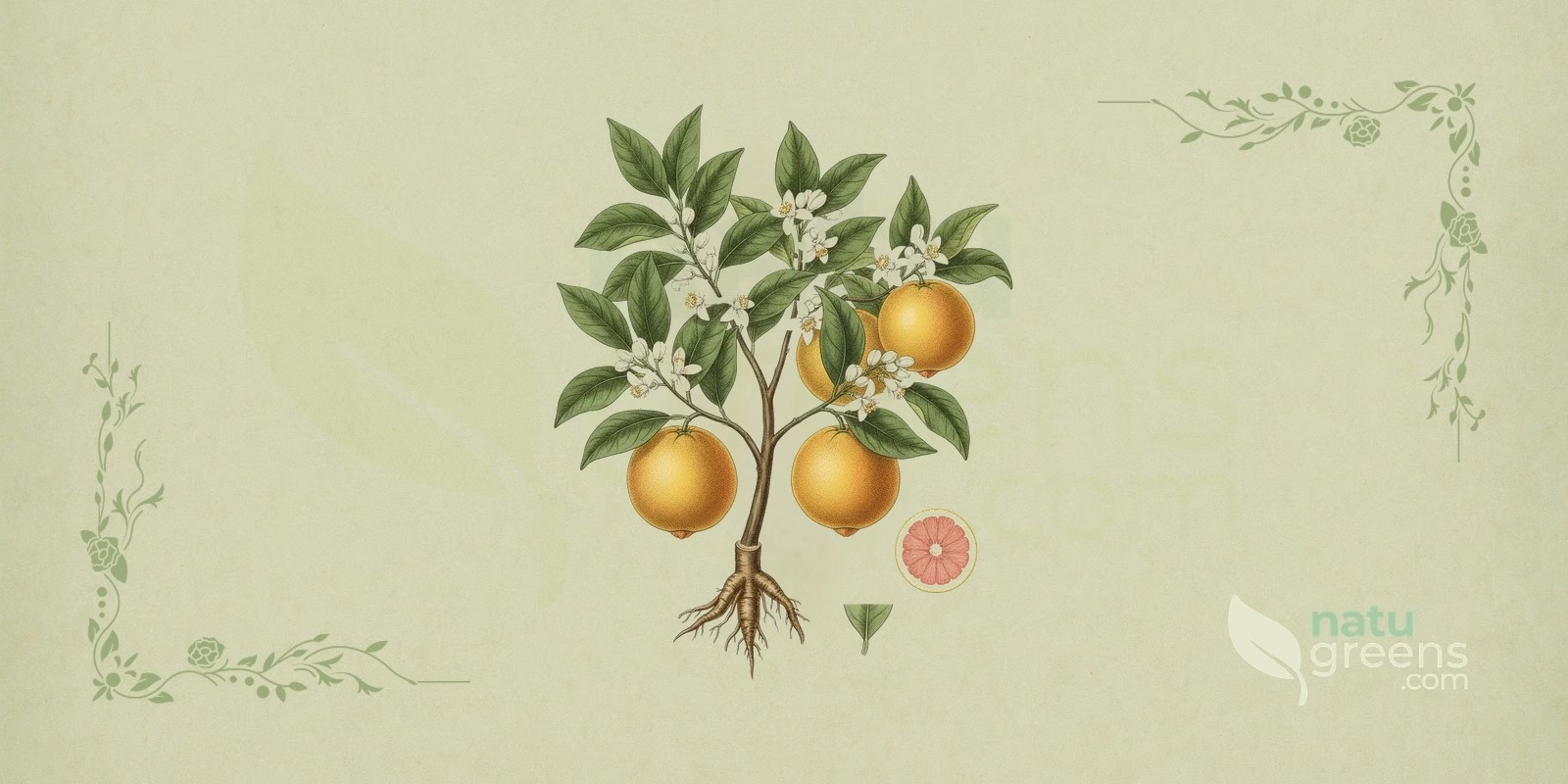
Rich in vitamin C and other bioactive compounds, grapefruit has been used in folk tradition for a range of purposes, from stimulating the appetite to easing digestive and urinary complaints, and modern research has been investigating some of these applications in laboratory studies and in trials that are still preliminary. The essential oil extracted from the peel has a place in aromatherapy and skin care, while the fruit became known in pharmacology for a very different reason: the juice and pulp interact with dozens of commonly used medications, which makes safety the central topic of any text about this plant.
Popular and International Names of Grapefruit
- English: Forbidden Fruit (historical name), Grapefruit, Pomelo (historical use, now reserved mainly for C. maxima).
- French: Pamplemousse (although, botanically, pamplemousse refers more to C. maxima), Pomelo.
- German: Grapefruit, Paradiesapfel.
- Italian: Pompelmo.
- Portuguese: grapefruit (Brazil, the term used on medication leaflets), jamboa (regional, Macau), pomelo (popular use, with the caveat that the botanical pomelo is Citrus maxima, a different species), toranja (Brazil and Portugal).
- Spanish: Pomelo, Toronja.
Botanical Synonyms of Citrus × paradisi
The name adopted in this article is Citrus × paradisi Macfad., written with the hybrid sign (×) to indicate its origin by crossing, following the same pattern as Citrus × limon and Citrus × aurantiifolia; it is the name found in pharmacopoeias, in trade and in the clinical literature on drug interactions. The form without the sign, Citrus paradisi Macfad., remains common in scientific papers and on labels and refers to the same plant.
Taxonomically, reference databases such as World Flora Online (WFO) and GBIF currently treat Citrus paradisi as a synonym within Citrus × aurantium L., the group that brings together the hybrids derived from crosses between C. maxima and C. reticulata. This broad circumscription does not change the identity of the fruit sold as grapefruit, but it explains why the same scientific name may appear in different forms depending on the source consulted.
Botanical Family: Rutaceae
Grapefruit belongs to the Rutaceae family, a diverse group that includes most citrus fruits and is recognized by the oil glands in the leaves and fruits, which produce the aromatic essential oils behind much of the family’s economic interest. The Rutaceae are widely distributed across tropical and subtropical regions, with many species valued for their edible fruits and their use in traditional medicine, and they are characterized by flowers with four or five petals and numerous stamens and by fruits of the hesperidium type, as is the case with grapefruit itself.
Parts of Grapefruit Used
- Essential oil (extracted from the peel)
- Fruit (pulp and juice)
- Fruit peel
- Leaves
- Seeds
Ethnobotanical and Traditional Uses
- Appetite stimulation (traditional record)
- Relief of digestive discomfort (traditional record)
- Scurvy prevention, as a dietary source of vitamin C (historical record)
- Skin problems such as acne and eczema (record in Eastern traditional medicine)
- Urinary complaints (traditional record)
Therapeutic Properties of Grapefruit
- Antibacterial (activity of the essential oil observed in the laboratory; does not apply to commercial seed extract)
- Antifungal (activity of the essential oil observed in the laboratory)
- Anti-inflammatory (effect of flavonoids observed in preliminary studies)
- Antimicrobial (activity of the essential oil observed in the laboratory, without clinical evidence)
- Antioxidant (antioxidant capacity of extracts measured in the laboratory)
- Antiviral (activity described only in laboratory studies)
- Appetite suppressant (popular record, without consistent confirmation)
- Astringent (traditional record attributed to the peel)
- Cardioprotective (hypothesis investigated in preliminary studies)
- Hypocholesterolemic (lipid reduction observed in animal studies)
- Hypoglycemic (effect of the seed extract observed in rats, without evidence in humans)
- Immunomodulatory (traditional record linked to the vitamin C content)
- Neuroprotective (effect investigated in laboratory studies)
Detailed Phytochemical Profile of Grapefruit
- Apigenin
- Bergamottin
- Carotenoids
- Citral
- Dihydroxybergamottin (6′,7′-dihydroxybergamottin)
- D-limonene
- Essential oils
- Esters
- Flavonoids (naringin, narirutin, poncirin)
- Furanocoumarins
- Lycopene (in red-fleshed varieties)
- Myrcene
- Pectin
- Phenolic acids
- Psoralens
- Sesquiterpenes
- Terpenes
- Vitamin C
Preparation and Administration Forms of Grapefruit
- Dry extract
- Essential oil (aromatherapy and diluted topical use, never ingested)
- Fluid extract
- Fresh juice
- Tea/Infusion (peel, leaves)
- Tincture
Whole grapefruits keep at room temperature for about a week or in the refrigerator for two to three weeks, and ideally they should be cut only when they are about to be eaten, to preserve the juice and nutrients. The peel can be dried and stored in a cool, airy place for use in infusions or as a seasoning, bearing in mind that it also contains furanocoumarins and falls under the same interaction precautions that apply to the juice.
Synergy with Other Medicinal Plants
Tradition in Weight Management Diets
In popular weight management diets, grapefruit often appears alongside green tea (Camellia sinensis) and garcinia (Garcinia cambogia), a combination that rests more on custom than on solid evidence. Preliminary studies are investigating how flavonoids such as naringin influence lipid metabolism and insulin sensitivity, but there is no proof that combining grapefruit with these plants produces weight loss, and garcinia has been linked to reports of adverse liver effects, which calls for professional guidance before any combined use.
Digestive Health
For digestive comfort, tradition pairs grapefruit with ginger (Zingiber officinale) and peppermint (Mentha × piperita), plants with a well-established carminative use, in preparations traditionally used against bloating, flatulence and indigestion. People with reflux or a sensitive stomach should keep in mind that the acidity of grapefruit juice can aggravate these symptoms, which is why an infusion of the peel is usually the preferred form in these combinations.
Immune Support
Because of its vitamin C content, grapefruit features in traditionally recorded combinations with echinacea (Echinacea purpurea) and elder (Sambucus nigra), two plants studied for their possible action on the immune response and traditionally used during the flu and cold season. Vitamin C contributes to the normal function of the immune system, but no studies have shown an added effect from this combination, which should be seen as a complement to a balanced diet and not as protection against infections.
Recipes and Usage Protocols of Grapefruit
Grapefruit Peel Infusion After Meals
A traditionally recorded preparation, traditionally taken after meals to ease the feeling of heaviness in the stomach and to stimulate the appetite. The peel concentrates essential oils and flavonoids, but also furanocoumarins, so anyone taking long-term medication should consult a doctor or pharmacist before drinking it.
Ingredients: 1 tablespoon of dried grapefruit peel, 250 ml of boiling water.
Preparation: Add the dried peel to the boiling water, cover and leave to infuse for 10 to 15 minutes. Strain and drink warm after meals.
Citrus Massage Oil for Relaxation
A blend with a traditional record in aromatherapy, in which the fresh citrus scent of grapefruit essential oil is traditionally used to encourage a feeling of relaxation during massage.
Ingredients: 5 drops of grapefruit essential oil, 30 ml of sweet almond or jojoba carrier oil.
Preparation: Mix the essential oil with the carrier oil in a dark glass bottle and apply to clean skin, gently massaging the neck, shoulders and temples. Do a patch test on a small area of skin first, never use the undiluted oil and avoid direct sun exposure on the treated areas for 12 hours, since the expressed oil contains traces of furanocoumarins.
Grapefruit Juice with Water and Honey
A food-use drink, traditionally consumed in the morning as a source of vitamin C and antioxidant compounds, and subject to the same drug interaction restrictions described under Contraindications.
Ingredients: 1 medium grapefruit, 1 glass of water, honey to taste (optional).
Preparation: Squeeze the grapefruit, mix the juice with the water and sweeten with honey if desired. Drink fresh. Honey should not be given to children under 1 year of age, and anyone taking any long-term medication needs clearance from their doctor or pharmacist before adding the juice to their routine.
The preparations above follow traditional records and do not replace professional guidance. Before any internal use, check the contraindications and interactions described in this article.
Associated Therapies
Aromatherapy
In aromatherapy, grapefruit essential oil is widely used for its invigorating scent, inhaled through diffusers or vaporizers with the traditional aim of supporting mood balance and easing the feeling of mental fatigue. In massage, always diluted in a carrier oil, tradition uses it for muscle relaxation, and aromatherapy values it for its stimulating character and sense of freshness, without these uses replacing professional care.
Clinical Phytotherapy
In clinical phytotherapy, standardized grapefruit extracts and supplements are being studied for possible antioxidant and anti-inflammatory actions and effects on blood lipids, with results that still come mostly from laboratory and animal studies. Precisely because of the risk of interaction with statins, antihypertensives and other drugs used for metabolic and cardiovascular disorders, any use in this context requires an individualized prescription and a review of all current medication.
Nutrition and Dietetics
In nutrition and dietetics, grapefruit is considered a low-calorie food with good nutrient density, providing vitamin C, fiber and antioxidants, which is why it often appears in eating plans focused on satiety and on cardiovascular and metabolic health. Regular consumption within a balanced diet can contribute to a feeling of fullness, but the decision to add the fruit to one’s routine must first take into account the person’s medication list, since a single glass of juice is enough to alter the effect of several drugs.
Contraindications and Side Effects of Grapefruit
Drug Interactions
This is the central safety issue with grapefruit. The furanocoumarins in the juice and pulp, such as bergamottin and 6′,7′-dihydroxybergamottin, irreversibly inhibit the CYP3A4 enzyme in the intestine and affect drug transporters (OATP and P-glycoprotein), and this effect can last up to 72 hours after a single glass of juice. As a result, the blood concentration of many medications can rise to dangerous levels, with a risk of serious side effects or toxicity.
Interactions are documented with statins (simvastatin, atorvastatin, lovastatin), calcium channel blockers (felodipine, nifedipine, amlodipine), immunosuppressants (cyclosporine, tacrolimus), benzodiazepines and other sedatives (midazolam, triazolam), amiodarone, ticagrelor, sildenafil, protease inhibitors, some oral chemotherapy drugs and fexofenadine, and in this last case the effect is the opposite, with grapefruit reducing the drug’s absorption. Anyone taking any long-term medication should consult their doctor or pharmacist BEFORE consuming grapefruit or its juice, and the medication leaflet has the final word. The same caution applies to anticoagulants, antidepressants and blood sugar-lowering drugs, whose effect can also be altered by grapefruit products.
Grapefruit Seed Extract (GSE)
So-called grapefruit seed extract (GSE) is sold as a natural antimicrobial, but this claim does not hold up: published analyses found benzethonium chloride and other synthetic preservatives, such as triclosan and methylparaben, in commercial GSE products, and the antimicrobial activity of these products was attributed to those substances and not to the seed. There is also a report of adverse effects from GSE products in patients taking warfarin, which reinforces that this extract should not be treated as a natural alternative to antiseptics or medicines.
Peel and Essential Oil
The essential oil expressed from the peel contains limonene, a substance that becomes a skin sensitizer when oxidized, along with traces of furanocoumarins, so it should only be used diluted and never ingested. Old or poorly stored oil increases the risk of irritation, and application without proper dilution can cause dermatitis, while sun exposure after topical use can lead to burns or skin discoloration.
Pregnancy, Breastfeeding and Children
During pregnancy, the fruit eaten as food is fine, but extracts and essential oil should not be used, and the same care applies during breastfeeding, owing to a lack of safety studies. Children can eat grapefruit in moderate amounts, and checking for allergies and drug interactions applies to them just as much as to adults.
Kidney Disease, Acidity and Allergy
People with kidney disease should talk to their doctor before eating grapefruit regularly, because of the fruit’s potassium content. The acidity of the juice can aggravate reflux and erode tooth enamel, which can be lessened by drinking it with meals and rinsing the mouth with water afterward. Anyone with a known citrus allergy should avoid the fruit, since reactions range from skin or mouth irritation and contact dermatitis to hives, breathing difficulty and, in rare cases, anaphylaxis, and eating large amounts can cause heartburn or diarrhea even in healthy people.
Not to Be Confused with Bitter Orange and Pomelo
Grapefruit should not be confused with Citrus aurantium (bitter orange), a species with a different use and safety profile, nor with the botanical pomelo (Citrus maxima), one of its parents, nor with the grapefruit seed extract described above, which is an industrial product and is not equivalent to the fruit.
Historical Notes and Interesting Facts
Hybrid Origin
Unlike ancestral citrus fruits such as the pomelo, grapefruit is not a species that arose independently in nature, but a hybrid believed to have originated from an accidental cross between the pomelo (Citrus maxima) and the sweet orange (Citrus sinensis) in the Caribbean islands, probably in Barbados, in the 18th century. At first it was mistaken for the pomelo itself and only later recognized as a distinct fruit, with characteristics that set it apart from both parents.
The Name Grapefruit
The English name grapefruit comes from the way the fruits grow in clusters on the tree, resembling bunches of grapes, and it became popular in the 19th century in English-speaking countries. In Portuguese the usual name is “toranja”, but “grapefruit” is well known in Brazil, to the point of being the term used in parentheses on medication leaflets that warn about the interaction.
Flesh Varieties
Grapefruit varieties differ mainly in the color of their flesh, which ranges from pale yellow to pink and deep red. White-fleshed varieties, such as Marsh, are the oldest and generally more acidic, while pink and red-fleshed ones, such as Ruby Red, Star Ruby and Rio Red, are sweeter and contain lycopene, the antioxidant pigment responsible for the color. Ruby Red arose from a spontaneous bud mutation, whereas Star Ruby and Rio Red were obtained through radiation-induced mutations to intensify the red.
Frequently Asked Questions about Grapefruit
Can Grapefruit Be Eaten Every Day?
For most people who do not take medication, grapefruit can be part of the daily diet, as a fruit rich in vitamin C and antioxidants within a balanced diet. Anyone taking any long-term medication, however, should consult their doctor or pharmacist first, because the effect of a single glass of juice on drug metabolism can last up to 72 hours.
Does Grapefruit Interact with Medications?
Yes, and this is the most important feature of the fruit. The furanocoumarins in the juice and pulp irreversibly inhibit the CYP3A4 enzyme in the intestine and affect drug transporters, raising the concentration of statins, calcium channel blockers, immunosuppressants, benzodiazepines, amiodarone, ticagrelor, sildenafil, protease inhibitors and some oral chemotherapy drugs, while in the case of fexofenadine absorption decreases. The advice is to consult a doctor or pharmacist BEFORE consuming grapefruit or its juice, always following what the medication leaflet says.
Is Grapefruit Seed Extract a Natural Antimicrobial?
That cannot be claimed. Published analyses found benzethonium chloride and other synthetic preservatives in commercial products sold as grapefruit seed extract (GSE), and the antimicrobial activity attributed to them was linked to those substances, not to the seed of the fruit.
Can Children Eat Grapefruit?
Children can eat grapefruit in moderate amounts, since the sour taste usually limits intake and the fruit is a good source of vitamin C. As with adults, a citrus allergy must be ruled out and the pediatrician should confirm whether the child takes any medication that could interact with the fruit.
What Is the Difference between Grapefruit, Pomelo and Bitter Orange?
The botanical pomelo (Citrus maxima) is an ancestral species, larger, with a thicker rind and sweeter, less juicy flesh, and it is one of the parents of grapefruit, which is a hybrid (Citrus × paradisi). Bitter orange (Citrus aurantium) is another citrus fruit, with its own use and safety profile, and in trade the name “pomelo” is sometimes applied to grapefruit, which causes confusion.
Does Grapefruit Help with Weight Loss?
Grapefruit is associated with weight management diets because it is low in calories, contains fiber and promotes satiety, and some preliminary studies are investigating how its compounds influence metabolism. There is no proof that it causes weight loss on its own, and its place is that of a food within a balanced diet and an active lifestyle.
Notice: this content is for informational purposes and does not replace professional medical advice. Consult a physician or herbal practitioner before using medicinal plants, especially during pregnancy, breastfeeding, or alongside medication.
How to cite this article
NATUGREENS. Grapefruit (Citrus × paradisi): Properties and Benefits. Natugreens, 4 Nov. 2026. Disponível em: https://natugreens.com/citrus-paradisi-grapefruit/. Accessed: Nov. 4, 2026.
Natugreens. (2026). Grapefruit (Citrus × paradisi): Properties and Benefits. Natugreens. https://natugreens.com/citrus-paradisi-grapefruit/
References and Scientific Studies
- PMC2013 Bailey DG, et al. Grapefruit-medication interactions: forbidden fruit or avoidable consequences?. CMAJ. 2013.
- PMC2007 Avula B, et al. Simultaneous identification and quantification by liquid chromatography of benzethonium chloride, methyl paraben and triclosan in commercial products labeled as grapefruit seed extract. Pharmazie. 2007.
- PMC2023 Stabrauskiene J, et al. Citrus × paradisi L. Fruit Waste: The Impact of Eco-Friendly Extraction Techniques on the Phytochemical and Antioxidant Potential. Nutrients. 2023.
- PMC2012 Uckoo RM, et al. Grapefruit (Citrus paradisi Macfad) phytochemicals composition is modulated by household processing techniques. J Food Sci. 2012.
- PMC2008 Adeneye AA. Methanol seed extract of Citrus paradisi Macfad lowers blood glucose, lipids and cardiovascular disease risk indices in normal Wistar rats. Nig Q J Hosp Med. 2008.
- PMC2013 Bailey DG, et al. Grapefruit-medication interactions: forbidden fruit or avoidable consequences?. CMAJ. 2013.
- PMC2007 Avula B, et al. Simultaneous identification and quantification by liquid chromatography of benzethonium chloride, methyl paraben and triclosan in commercial products labeled as grapefruit seed extract. Pharmazie. 2007.