Quick summary
Salvia miltiorrhiza Bunge / Danshen, a name that also appears in translations as red sage, is a deciduous perennial of the Lamiaceae family described by the botanist Alexander von Bunge. It is native to China and Japan, where it thrives at altitudes of 90 to 1,200 meters and favors grassy woodlands, hillsides and…
Main caution: Although danshen is widely used in Asia, knowing its contraindications is essential, because the plant has the best-documented drug interaction among the herbs in this group. Danshen potentiates warfarin, with clinical…
Salvia miltiorrhiza Bunge / Danshen, a name that also appears in translations as red sage, is a deciduous perennial of the Lamiaceae family described by the botanist Alexander von Bunge. It is native to China and Japan, where it thrives at altitudes of 90 to 1,200 meters and favors grassy woodlands, hillsides and stream banks. The specific epithet miltiorrhiza, meaning “red ochre root”, refers to the striking color of the roots, the most valued part in traditional Chinese medicine, and it is for these roots that the species has been grown and used in Asian herbal medicine for centuries.
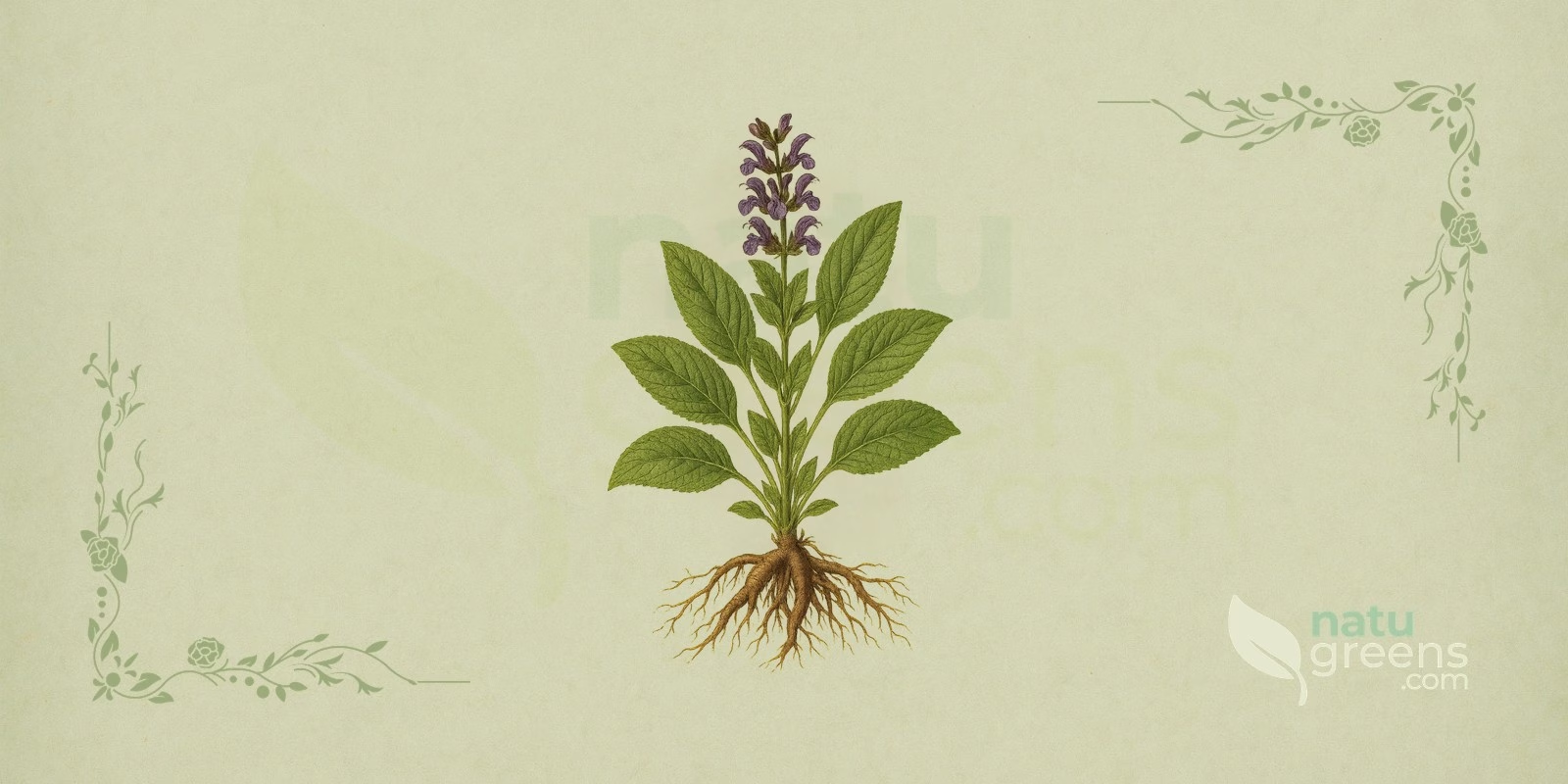
In traditional Chinese medicine (TCM), danshen holds a prominent place and is used above all for patterns the tradition describes as blood stasis, with a historical focus on cardiovascular and cerebrovascular complaints. The root contains lipophilic diterpenes, such as the tanshinones, and hydrophilic phenolic acids, such as the salvianolates, compounds to which laboratory studies attribute antioxidant, anti-inflammatory and cardioprotective activity. Modern scientific research is investigating these traditional uses intensively, but the available clinical trials were carried out with standardized Chinese preparations, and their results do not automatically apply to home-made tea.
Popular and International Names of Danshen
- English: Chinese sage, danshen, red sage, redroot sage, tan shen.
- French: danshen, sauge chinoise, sauge rouge.
- German: Chinesischer Salbei, danshen, Roter Salbei.
- Italian: danshen, salvia cinese, salvia rossa.
- Portuguese: danshen, sálvia-chinesa, sálvia-vermelha, tan shen.
- Spanish: danshen, salvia china, salvia roja, tan shen.
Botanical Synonyms of Salvia miltiorrhiza
The name Salvia miltiorrhiza Bunge is the accepted name in the reference taxonomic databases and the one most widely used in contemporary scientific literature. Although variants and historical references exist, Bunge’s classification remains the standard, and no botanical synonyms are used interchangeably with comparable frequency or recognition in recent publications.
Danshen should not be confused with other well-known sages. Salvia officinalis (common sage) and Salvia apiana (white sage) are different species whose leaves are the part used, and whose chemistry centers on an essential oil containing thujone, whereas in danshen the part used is the root, rich in tanshinones and salvianolic acids. For this reason danshen root is not equivalent to either of these sages, and information about one does not apply to the other.
Botanical Family: Lamiaceae
The Lamiaceae family, formerly known as Labiatae, is a vast and diverse group of flowering plants comprising about 236 genera and more than 7,000 species, many of them aromatic and used as culinary, medicinal and ornamental herbs, such as mint, rosemary, thyme and lavender. Lamiaceae are characterized by square stems, opposite leaves and two-lipped flowers, often grouped in whorled inflorescences.
Danshen shares the typical morphological features of the family, starting with the structure of its flowers, and also part of its profile of bioactive compounds. The family is notable for producing essential oils, flavonoids and diterpenes, and this chemical richness has been the subject of intense pharmacological research, contributing significantly to the development of herbal medicinal products and natural supplements.
Parts of Danshen Used
- Rhizomes
- Roots
Ethnobotanical and Traditional Uses
- Angina pectoris (under study with standardized preparations; chest pain is a medical emergency)
- Blood circulation (traditional record of “activating the blood” in TCM)
- Blood stasis (TCM concept)
- Cardiovascular complaints (under study, not transferable to home-made tea)
- Cerebrovascular complaints (under study with standardized preparations)
- Hyperlipidemia (preliminary studies)
- Menstrual problems (traditional record; contraindicated in pregnancy)
- Osteoporosis (preliminary studies)
- Pain and swelling (traditional record)
Therapeutic Properties of Danshen
- Anti-inflammatory (reduction of inflammatory markers in laboratory studies)
- Antioxidant (cellular protection against oxidative damage observed in the laboratory)
- Antiproliferative (activity observed in laboratory studies, without clinical evidence)
- Antithrombotic (antiplatelet effect observed in studies, which also explains the bleeding risk)
- Cardioprotective (effect investigated in experimental models and in standardized preparations)
- Neuroprotective (effect investigated in experimental models)
- Sedative (traditional record; drowsiness is among the adverse effects)
- Vasodilator (vascular relaxation observed in studies, with a possible blood pressure lowering effect)
Detailed Phytochemical Profile of Danshen
- Cryptotanshinone
- Danshensu (β-(3,4-dihydroxyphenyl)lactic acid)
- Dihydrotanshinone I
- Lithospermic acid
- Miltirone
- Rosmarinic acid
- Salvianolic acid A
- Salvianolic acid B
- Tanshinone I
- Tanshinone IIA
- Tanshinone IIB
Preparation and Administration Forms of Danshen
- Capsules
- Decoction
- Extracts (aqueous and ethanolic)
- Injections (hospital use in China, by prescription only)
- Tablets
Synergy with Other Medicinal Plants
Danshen and Notoginseng in the Cardiovascular Tradition
In traditional Chinese medicine, danshen is often combined with other herbs, and one of the best-known pairings is with notoginseng (Panax notoginseng), found in compound Chinese preparations traditionally used to support blood circulation and reduce what TCM calls stasis. The rationale behind this pairing is to add up the actions described for both roots on the blood and the vessels, but studies of these formulas involve standardized products, and because both plants interfere with blood clotting, the combination calls for even greater caution in people taking anticoagulants or antiplatelet drugs.
Danshen and Saffron in Microcirculation
Pairing danshen with other herbs that tradition links to circulation, such as saffron (Crocus sativus), has a traditional record focused on microcirculation, that is, blood flow in the capillaries. Preliminary studies are investigating whether the tanshinones in danshen and the carotenoids in saffron might act in a complementary way on tissue perfusion in models of ischemia and of diabetic complications, with no clinical evidence for this combination. Both plants are contraindicated in pregnancy.
Recipes and Usage Protocols of Danshen
Traditional Danshen Decoction
Decoction is the classic way of preparing the root in the Chinese tradition, traditionally used to support blood circulation and ease pain. Instead of a fixed amount of root, the guidance here is qualitative, because danshen interacts with several medications and the doses used in TCM are set case by case: consult a healthcare professional to find out whether use is appropriate and in what amount. The preparation consists of rinsing the dried roots, placing them in a pot with water, bringing it to a boil and then simmering over low heat for 20 to 30 minutes, straining and drinking the liquid warm.
Standardized Danshen Extract
Danshen extract is available in standardized capsules and tablets, a concentrated form traditionally used for chronic conditions within TCM. Because it is more potent than the decoction and carries the same drug interactions, this type of extract should only be used on the recommendation and under the supervision of a healthcare professional, who decides on the product and the dosage, and making home-made alcoholic extracts of the root is not advisable.
The preparations above follow traditional records and do not replace professional guidance. Before any internal use, check the contraindications and interactions described in this article.
Associated Therapies
Herbal Medicine
In herbal medicine, danshen is valued for the cardioprotective, anti-inflammatory and antioxidant actions described in studies, and it appears in decoctions, fluid extracts and capsules used in China for cardiovascular conditions such as angina pectoris and atherosclerosis. The scientific literature on the plant is vast, but clinical trials were conducted with standardized Chinese preparations, mainly injectables and compound tablets, and their results do not transfer to home-made tea, so cardiovascular use remains under study.
Traditional Chinese Medicine (TCM)
Danshen is one of the pillars of Traditional Chinese Medicine, in which it is known for “invigorating the blood and removing stasis”, and the tradition uses it in blood stasis syndromes said to manifest as chest pain, menstrual irregularities and abdominal masses. TCM uses the root both on its own and in complex formulations, with the aim of rebalancing the body’s energy, always within an individual diagnosis made by a practitioner trained in this tradition.
Contraindications and Side Effects of Danshen
Although danshen is widely used in Asia, knowing its contraindications is essential, because the plant has the best-documented drug interaction among the herbs in this group. Danshen potentiates warfarin, with clinical cases of elevated INR and bleeding, and has its own antiplatelet effect, which is why it is contraindicated with warfarin, direct oral anticoagulants and antiplatelet drugs (aspirin, clopidogrel), and its use must be stopped 2 weeks before surgery.
Other Drug Interactions
Danshen can interfere with laboratory measurement of digoxin by immunoassay, a reported analytical interference that can lead to misleading results in people taking this medication. It also has an additive blood pressure lowering effect with antihypertensives and nitrates, and studies have shown induction of CYP3A4, which calls for caution with any narrow therapeutic index medication. Since drowsiness has been reported, combining it with sedatives and other central nervous system depressants should also be avoided without professional guidance.
Cardiovascular Use and Emergencies
Cardiovascular clinical trials with danshen involve standardized Chinese preparations (injectables and compound tablets) and do not transfer to home-made tea, so cardiovascular use remains under study and the plant does not treat angina, heart attack or stroke. Chest pain is a medical emergency that requires immediate care, never self-medication with herbs.
Common Side Effects
Reported adverse effects include itching, stomach discomfort, drowsiness, dizziness, headache and nausea or indigestion, usually mild but in need of monitoring. If they persist or get worse, use should be stopped and medical advice sought, bearing in mind that individual sensitivity varies and that the dose influences how often these effects occur.
Allergic Reactions
Although rare, allergic reactions to danshen can occur, with skin rashes, itching, swelling or difficulty breathing, and in more severe cases anaphylaxis may occur, a serious reaction that requires immediate medical care. People with a history of allergy to plants of the Lamiaceae family or to other herbs should avoid using it and talk to a healthcare professional first.
Pregnancy, Breastfeeding and Children
During pregnancy and breastfeeding danshen is contraindicated, because it activates circulation and has emmenagogue use in the tradition, in addition to affecting blood clotting and having no established safety for the fetus or the breastfed baby. It should not be used in children. Always consult a healthcare professional before using any medicinal plant during these stages.
Historical Notes and Interesting Facts
The Red Ochre Root
The name miltiorrhiza, meaning “red ochre root”, highlights the most striking feature of danshen, its intensely orange-red roots, and this color is not just a visual quirk, since it signals the presence of tanshinones, the lipophilic diterpenoids credited with much of the pharmacological properties studied in the plant. It is no coincidence that the Chinese name itself, dan shen, is usually translated as “red root”.
A Pillar of Traditional Chinese Medicine
Danshen is one of the pillars of Traditional Chinese Medicine, with a very long history of use and a place in several classical formulas for heart and circulatory complaints, which shows the prestige the root has held over time. Modern science continues to investigate its mechanisms of action, and the plant has become an example of how traditional knowledge can guide research, without historical use alone proving efficacy.
Extensive Scientific Research
Salvia miltiorrhiza has been the subject of intense scientific research in recent decades, with thousands of studies published on its chemical constituents, pharmacological properties and clinical applications. This body of work reflects global interest in the plant, especially in cardiology, neurology and oncology, fields in which its compounds show biological activity in the laboratory that still awaits confirmation in high-quality clinical studies.
Frequently Asked Questions about Danshen
What Is Danshen and How Is It Used in Tradition?
Danshen, or Salvia miltiorrhiza, is a plant of the Lamiaceae family whose roots are widely used in Traditional Chinese Medicine, which employs it to activate blood circulation, dispel stasis and ease pain. In China, standardized preparations are being studied for cardiovascular and cerebrovascular conditions, but this use remains under study and does not apply to home-made tea.
What Are the Studied Benefits of Danshen?
Laboratory studies and experimental models describe antioxidant, anti-inflammatory, cardioprotective, vasodilating and neuroprotective activity, attributed to the tanshinones and salvianolic acids. Existing clinical trials use standardized Chinese preparations, so these findings should not be read as a promise of benefit for people drinking the tea at home.
Can Danshen Be Used with Warfarin or Other Anticoagulants?
No. Danshen potentiates warfarin, with clinical cases of elevated INR and bleeding, and has its own antiplatelet effect, so it is contraindicated with warfarin, direct oral anticoagulants and antiplatelet drugs (aspirin, clopidogrel). It must also be stopped 2 weeks before surgery, and anyone taking digoxin, antihypertensives, nitrates or narrow therapeutic index medications needs medical advice before any use.
Is Danshen the Same as Common Sage?
No. Salvia officinalis (common sage) and Salvia apiana (white sage) are other species, of which the leaf is used, with a chemistry based on an essential oil containing thujone. Danshen root has a different composition, rich in tanshinones, and is not equivalent to either of them.
How Is Danshen Traditionally Prepared?
Traditionally, the dried roots are prepared as a decoction, boiled in water and then simmered over low heat for a few minutes, and the plant is also available as extracts, capsules and tablets. In Traditional Chinese Medicine it is often combined with other herbs in complex formulas, and the appropriate amount should be set by a healthcare professional.
Can Pregnant Women, Breastfeeding Women and Children Use Danshen?
No. During pregnancy and breastfeeding danshen is contraindicated, because it activates circulation and has emmenagogue use in the tradition, and it should not be used in children. If in any doubt, see a healthcare professional before turning to medicinal plants.
Notice: this content is for informational purposes and does not replace professional medical advice. Consult a physician or herbal practitioner before using medicinal plants, especially during pregnancy, breastfeeding, or alongside medication.
How to cite this article
NATUGREENS. Danshen (Salvia miltiorrhiza): Properties and Benefits. Natugreens, 4 Nov. 2026. Disponível em: https://natugreens.com/danshen-salvia-miltiorrhiza/. Accessed: Nov. 4, 2026.
Natugreens. (2026). Danshen (Salvia miltiorrhiza): Properties and Benefits. Natugreens. https://natugreens.com/danshen-salvia-miltiorrhiza/
References and Scientific Studies
- PMC2016 Akaberi M, et al. Molecular Signaling Pathways Behind the Biological Effects of Salvia Species Diterpenes in Neuropharmacology and Cardiology. Phytother Res. 2016.
- PMC2001 Chan TY. Interaction between warfarin and danshen (Salvia miltiorrhiza). Ann Pharmacother. 2001.
- PMC2018 Shao H, et al. The Efficacy of Danshen Injection as Adjunctive Therapy in Treating Angina Pectoris: A Systematic Review and Meta-Analysis. Heart Lung Circ. 2018.
- PMC2015 Su CY, et al. Salvia miltiorrhiza: Traditional medicinal uses, chemistry, and pharmacology. Chin J Nat Med. 2015.
- PMC2007 Wu B, et al. Dan Shen agents for acute ischaemic stroke. Cochrane Database Syst Rev. 2007.