Quick summary
Houseleek (Sempervivum tectorum L.), also called common houseleek or Jove's beard, is a perennial succulent of the Crassulaceae family, described by Linnaeus in 1753 and native to the mountains of southern Europe, from where it spread across the whole continent thanks to its remarkable adaptability. Made up of compact…
Main caution: The folk practice of dropping houseleek juice into the ear is only a historical record, never a current recommendation. Nothing should ever be put into the ear when there is pain, discharge or suspected eardrum…
Houseleek (Sempervivum tectorum L.), also called common houseleek or Jove's beard, is a perennial succulent of the Crassulaceae family, described by Linnaeus in 1753 and native to the mountains of southern Europe, from where it spread across the whole continent thanks to its remarkable adaptability. Made up of compact rosettes of fleshy leaves, the plant has always been valued for its ornamental beauty and for a long history of folk uses, above all the application of fresh leaf juice to minor skin irritations such as mild burns and insect bites.
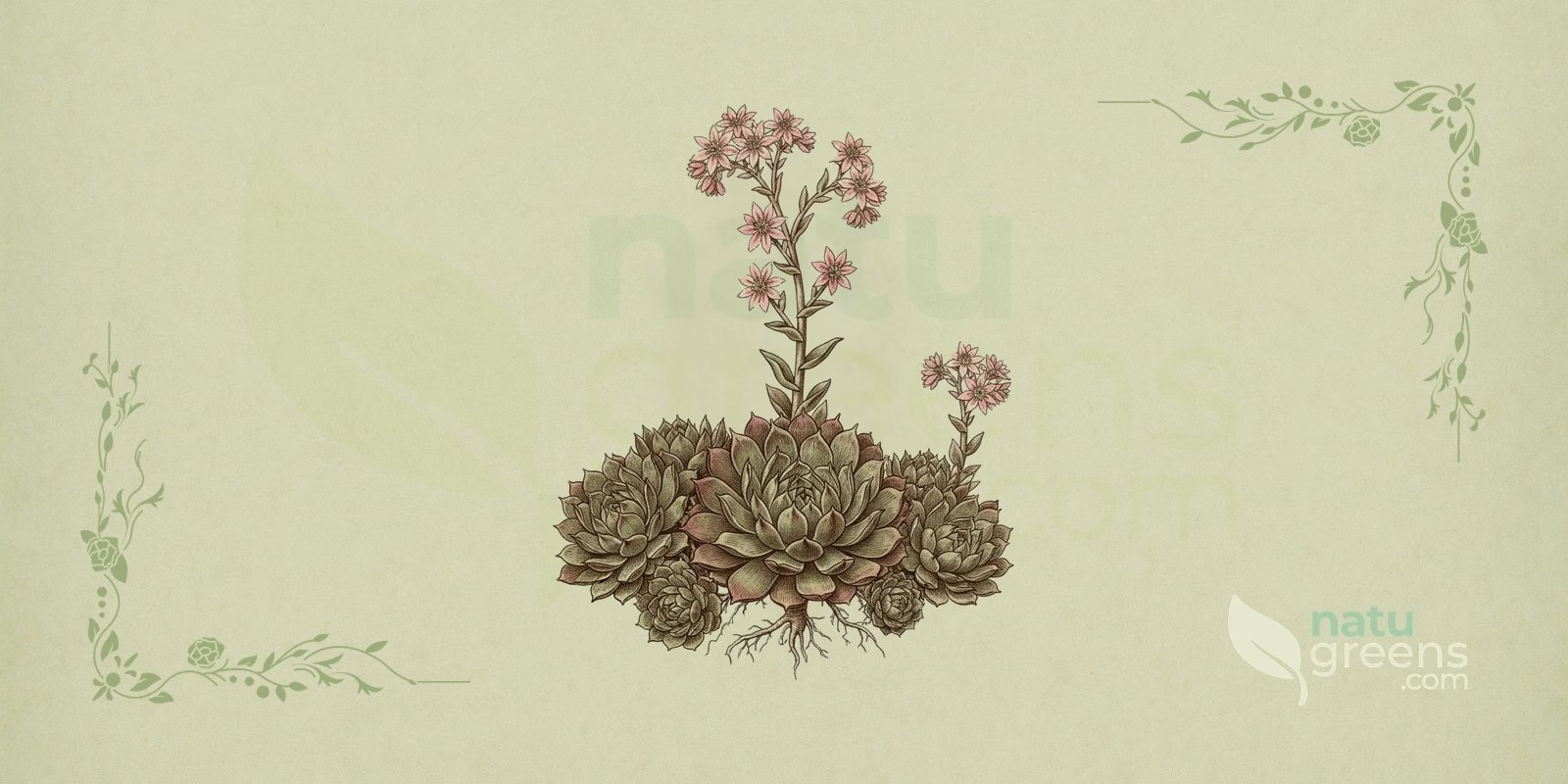
Records of houseleek use span centuries and appear in ancient authors such as Dioscorides, Galen and Pliny, as well as in the folk traditions of several European countries. These uses are a traditional and ethnobotanical record, with no clinical trial to confirm them, and modern research is limited to laboratory studies on antibacterial, antioxidant and wound-healing activity. Internal use is poorly studied and the plant causes vomiting at high doses, so this article covers external topical use only.
Popular and International Names of Houseleek
- English: bullock's beard, common houseleek, devil's beard, earwort, fuet, healing blade, hen and chicks, homewort, imbroke, Jove's beard, Jupiter's eye, poor Jan's leaf, red-leaved houseleek, roof foil, roof houseleek, sengreen, St. George's beard, St. Patrick's cabbage, Thor's beard, thunderplant, welcome-home-husband-though-never-so-drunk.
- French: artichaut des toits, herbe du tonnerre, joubarbe des toits.
- German: Dachwurz, Donnerwurz, Echte Hauswurz.
- Italian: barba di Giove, erba del fulmine, semprevivo maggiore.
- Portuguese: barba-de-júpiter, consolva, sempre-viva, sempre-viva-dos-telhados, sempre-viva-maior.
- Spanish: alcachofa de gatos, balsamina, barba de Júpiter, consolva, hierba puntera, siempreviva, siempreviva mayor, suelda.
Botanical Synonyms of Houseleek
The name Sempervivum tectorum L. was established by Linnaeus in 1753 and remains the accepted name in most contemporary botanical databases, although the plant has received other names over the history of taxonomy. Recorded synonyms include Sedum tectorum Scop., Sempervivum alpinum Griseb. & Schenk and Sempervivum glaucum Ten., which reflect differences in classification and identification across periods and regions. Synonyms are common in species with a wide distribution and a long history of cultivation, and knowing them helps identify the plant correctly in old and modern studies, especially because houseleek hybridizes easily with other species of the genus.
- Sedum tectorum Scop.
- Sempervivum alpinum Griseb. & Schenk
- Sempervivum glaucum Ten.
Botanical Family: Crassulaceae
Houseleek belongs to the Crassulaceae family, a group of succulent plants known for their ability to store water in their leaves, an adaptation that lets them thrive in arid, rocky environments such as the mountain slopes of southern Europe. The family is large and includes genera such as Crassula, Sedum and Echeveria, all marked by hardiness and ornamental value, and compact leaf rosettes are one of its most characteristic forms.
Because they need little maintenance and tolerate drought well, crassulas are widely used in rock gardens and green roofs, where their resistance to harsh conditions adds to their visual appeal. The family is also studied for crassulacean acid metabolism, known as CAM, a mechanism in which the stomata open at night to take in carbon dioxide and reduce water loss during the day, which explains much of their remarkable resilience.
Parts of Houseleek Used
- Fresh leaves
- Leaf juice
Ethnobotanical and Traditional Uses of Houseleek
- Folk amulet against witchcraft and decay.
- Grown on roofs as symbolic protection against thunderstorms and lightning.
- Historically recorded as juice mixed with honey applied to mouth ulcers.
- Historically recorded in Serbia as ear drops for inflammation (a use not recommended today) and applied to warts.
- In Ireland, where it is called tóirpín, placed over doors as symbolic protection against lightning and fire.
- Recorded by Galen and Dioscorides, the leaf juice as an astringent for skin and eye complaints.
- Recorded by Pliny and Marcellus Empiricus in external applications on bruises and abdominal pain.
- Traditionally recorded as a poultice on minor burns, insect bites, small wounds and abscesses.
- Traditionally recorded for mild skin inflammation.
Therapeutic Properties of Houseleek
- Anti-inflammatory (traditional record of topical use, no clinical trial)
- Antimicrobial (activity of extracts against bacteria linked to otitis in laboratory studies)
- Antioxidant (phenolic compounds active in in vitro assays)
- Anti-quorum-sensing (interference with bacterial communication observed in vitro)
- Astringent (traditional record of the leaf juice)
- Cooling (fresh feeling of the juice on the skin, folk record)
- Diuretic (traditional record)
- Wound-healing (leaf fractions stimulated cell proliferation and migration in the laboratory)
Detailed Phytochemical Profile of Houseleek
The fleshy leaves of houseleek accumulate large amounts of malic acid, typical of CAM plants, which store organic acids during the night and use them up during the day. The phenolic fraction is dominated by kaempferol-derived flavonol glycosides, notably kaempferol-3-O-rhamnosyl-glucoside-7-O-rhamnoside, identified as the main component in studies with purified leaf fractions. Recent research has shown that phenolic content and antioxidant activity vary with collection site and season, which helps explain differences between extracts of different origins. The plant's chemistry is still little explored compared with other medicinal species, and the effects observed come only from laboratory assays.
- Flavonol glycosides (with kaempferol-3-O-rhamnosyl-glucoside-7-O-rhamnoside as the main one)
- Malic acid
- Phenolic compounds (varying with site and season)
Preparation and Administration Forms of Houseleek
- Compress (topical use)
- Fresh leaf juice (topical use)
- Poultice (topical use)
All the forms described here are for external use. Teas and juices for drinking appear in old records, but internal use is poorly studied and can cause vomiting at high doses, so it is not recommended.
Synergy with Other Medicinal Plants
Topical Use with Calendula and Comfrey
In the European herbal tradition, houseleek juice or poultice is paired with calendula (Calendula officinalis) and comfrey (Symphytum officinale) ointments and oils, in preparations traditionally used on minor irritations, mild burns and scrapes. The flavonoids and triterpenes of calendula and the allantoin of comfrey have their own topical history, but the combination has never been studied, and comfrey should only be used on intact skin and for short periods, because it contains pyrrolizidine alkaloids that are toxic to the liver.
Soothing Compresses with Chamomile and Licorice
Another external pairing brings houseleek together with chamomile compresses (Matricaria chamomilla) and topical licorice preparations (Glycyrrhiza glabra), traditionally used on reddened, sensitive skin. Chamomile has a long tradition in soothing compresses, and licorice derivatives appear in cosmetics for irritated skin, but this pairing is a traditional record, with no studies of the combination, and people allergic to plants of the Asteraceae family should avoid chamomile.
Recipes and Usage Protocols of Houseleek
Fresh Leaf Compress for the Skin
A home preparation traditionally used on small burns, insect bites and mild irritations of intact skin.
Ingredients:
- Clean gauze or cloth
- Fresh Sempervivum tectorum leaves
Preparation:
- Wash the fresh leaves well under running water.
- Crush the leaves to release the juice.
- Do a test on a small area of skin first and wait a few hours.
- Apply the juice to the irritated area, avoiding deep or infected wounds.
- Cover with gauze or a clean cloth and leave on for 30 minutes to 1 hour.
- Stop if redness, burning or itching appears, and seek care if the lesion does not improve.
Split Leaf on Insect Bites
A folk garden use, traditionally applied to mosquito and small insect bites for an immediate cooling sensation.
Ingredients:
- 1 fresh, clean Sempervivum tectorum leaf
Preparation:
- Wash the leaf and cut it in half lengthwise.
- Press the moist inner surface against the bite for a few minutes.
- Repeat a few times a day if needed, always using a fresh leaf.
- Do not use on bites accompanied by extensive swelling, shortness of breath or other signs of allergy, which require immediate medical care.
The preparations above follow traditional records and do not replace professional guidance. Before any internal use, check the contraindications and interactions described in this article.
Therapies Associated with Houseleek
Homeopathy
Homeopathy uses preparations of Sempervivum tectorum in high dilutions, traditionally indicated for skin complaints, mouth ulcers and breast swelling, and in some repertories also for warts and corns. The efficacy of homeopathy is not supported by consistent scientific evidence, and none of these indications has been proven, so persistent skin lesions, breast lumps or mouth sores that do not heal need medical evaluation.
Traditional European Herbal Medicine
In European folk herbalism, houseleek holds the place of a garden home remedy, used mainly as fresh juice on the skin, much as other succulent leaves are used in other parts of the world. Laboratory studies have confirmed the activity of extracts against bacteria isolated from ear infections and an effect on cell migration, but there are no clinical trials, so use should be limited to mild irritations and never replace medical care.
Contraindications and Side Effects of Houseleek
Use in the Ear
The folk practice of dropping houseleek juice into the ear is only a historical record, never a current recommendation. Nothing should ever be put into the ear when there is pain, discharge or suspected eardrum perforation, and otitis (earache) in a child always requires medical evaluation, never home self-treatment.
Internal Use
Internal use is poorly studied and, at high doses, the plant has an emetic effect, meaning it induces vomiting, with sensitivity varying from person to person. For this reason there is no recipe for internal use in this article, and teas or juices for drinking should be avoided, especially during pregnancy, breastfeeding and in children, groups for which there is no safety data.
Precautions for Topical Use
Topical use is usually well tolerated, but a patch test on a small area of skin before the first application helps avoid allergic reactions. The juice should not be applied to deep wounds, extensive burns or infected lesions, and there is no claim that it cures warts, corns or any other skin lesion, which should be evaluated by a doctor if they persist or change in appearance. People with chronic skin conditions or using topical medicines should talk to a health professional before using the plant.
Not to Be Confused with Aloe Vera
Houseleek is not Aloe vera, a different species from another family, sometimes confused with it in folk use because both have succulent leaves applied to the skin. Information about aloe vera gel does not apply to houseleek, and vice versa.
Historical Notes and Interesting Facts about Houseleek
Protection against Lightning and Witchcraft
Houseleek has a long history of association with folk beliefs. In Europe it was grown on roofs because it was believed to protect houses from lightning and thunderstorms, a custom that gave rise to the English name houseleek, literally the leek of the house, and to the epithet tectorum, meaning of the roofs. The plant was also seen as an amulet against witchcraft and decay, and it can still be found growing on old roofs in many regions today, keeping that tradition alive.
Longevity and Resilience
The name of the genus comes from the Latin semper, always, and vivus, alive, a reference to the plant's longevity and hardiness, as it can survive poor soils, drought and extreme temperatures. The herbalist William Fernie tells of a botanist who tried for eighteen months to dry a specimen for his herbarium without success, and when he returned it to the soil the plant started growing again as if nothing had happened, an anecdote that made it a symbol of persistence.
Ancient Uses and Common Names
Known for thousands of years, the plant has gathered a vast collection of common names, many linked to thunder gods, such as Jupiter, present in the Latin barba Jovis and the French joubarbe, and Thor, remembered in the German Donnerbart. Other names, such as the Anglo-Saxon singrēne and the English aye-green, allude to its longevity, and the plant's presence in the texts of Galen, Dioscorides, Pliny and Marcellus Empiricus shows that it has been used as a home remedy since antiquity.
Frequently Asked Questions about Houseleek
Is Houseleek Safe to Take Internally?
It is not recommended for internal use. Although it appears in old records of teas and juices, internal use is poorly studied and the plant causes vomiting at high doses, so safe use is limited to external application.
What Are the Main Topical Uses of Houseleek?
Fresh leaf juice is traditionally applied to small burns, insect bites and mild skin irritations. This use is a traditional record, with no clinical trial, and it should not be applied to deep or infected wounds; before the first application, it is wise to test it on a small area of skin.
Can Houseleek Be Grown at Home?
Yes, it is a very hardy succulent that is easy to grow in gardens and pots, preferring direct sun and well-drained soil. It tolerates drought and intense cold and multiplies easily through its side offsets, which gave rise to the English name hen and chicks.
Can I Put Houseleek Juice in My Ear?
No. Ear drops are only a historical record, and nothing should ever be put into the ear when there is pain, discharge or suspected eardrum perforation. Earache in a child always requires medical evaluation, never home self-treatment.
Are Houseleek and Aloe Vera the Same Plant?
No. Aloe vera (Aloe vera) is a different species from another family, and the confusion comes from the fact that both have succulent leaves applied to the skin. Information about one does not apply to the other.
Can Houseleek Be Used during Pregnancy or in Children?
Internal use should be avoided in these groups, because there is no safety data and the plant can cause vomiting. Topical use on small areas is usually well tolerated, but it should be discussed with a health professional, especially for young children.
Notice: this content is for informational purposes and does not replace professional medical advice. Consult a physician or herbal practitioner before using medicinal plants, especially during pregnancy, breastfeeding, or alongside medication.
How to cite this article
NATUGREENS. Houseleek (Sempervivum tectorum): Properties and Benefits. Natugreens, 10 Nov. 2026. Disponível em: https://natugreens.com/sempervivum-tectorum-houseleek/. Accessed: Nov. 10, 2026.
Natugreens. (2026). Houseleek (Sempervivum tectorum): Properties and Benefits. Natugreens. https://natugreens.com/sempervivum-tectorum-houseleek/
References and Scientific Studies
- PMC2019 Cattaneo F, et al. Wound healing activity and phytochemical screening of purified fractions of Sempervivum tectorum L. leaves on HCT 116. Phytochem Anal. 2019.
- PMC2023 Jankov M, et al. Assessing radical scavenging capacity of Sempervivum tectorum L. leaf extracts: An integrated high-performance thin-layer chromatography/in silico/chemometrics approach. J Chromatogr A. 2023.
- PMC2026 Mitić SS, et al. Influence of location and season on phenolic composition and antioxidant activity of Sempervivum tectorum. Nat Prod Res. 2026.
- PMC2015 Stojković D, et al. Ethnopharmacological uses of Sempervivum tectorum L. in southern Serbia: Scientific confirmation for the use against otitis linked bacteria. J Ethnopharmacol. 2015.
Take your time and tell us everything you think, details included. Every response is read by someone on our editorial team and goes into the article's revision. An honest critique helps us more than a polite compliment.
Take your time and tell us everything you think, details included. Every response is read by someone on our editorial team and goes into the article's revision. An honest critique helps us more than a polite compliment.
You May Also Like