



Quick summary
Coix lacryma-jobi L., known as Job's tears, adlay or coix seed, is a robust grass of the Poaceae family described by Linnaeus in 1753. Native to South and Southeast Asia, it has spread across tropical regions worldwide, including Brazil, where it grows along riverbanks and in damp ground. The species has two sides: a…
Main caution: In excess, like any fiber-rich cereal, it can cause gas and abdominal discomfort.
Coix lacryma-jobi L., known as Job's tears, adlay or coix seed, is a robust grass of the Poaceae family described by Linnaeus in 1753. Native to South and Southeast Asia, it has spread across tropical regions worldwide, including Brazil, where it grows along riverbanks and in damp ground. The species has two sides: a cultivated form with a soft, edible grain, which is a cereal and traditional food in China, Japan and Korea, and a wild form with hard, glossy beads that are used for rosaries and handicrafts. As a cooked food, the grain has a long history of consumption, while the health effects attributed to it are still being studied.
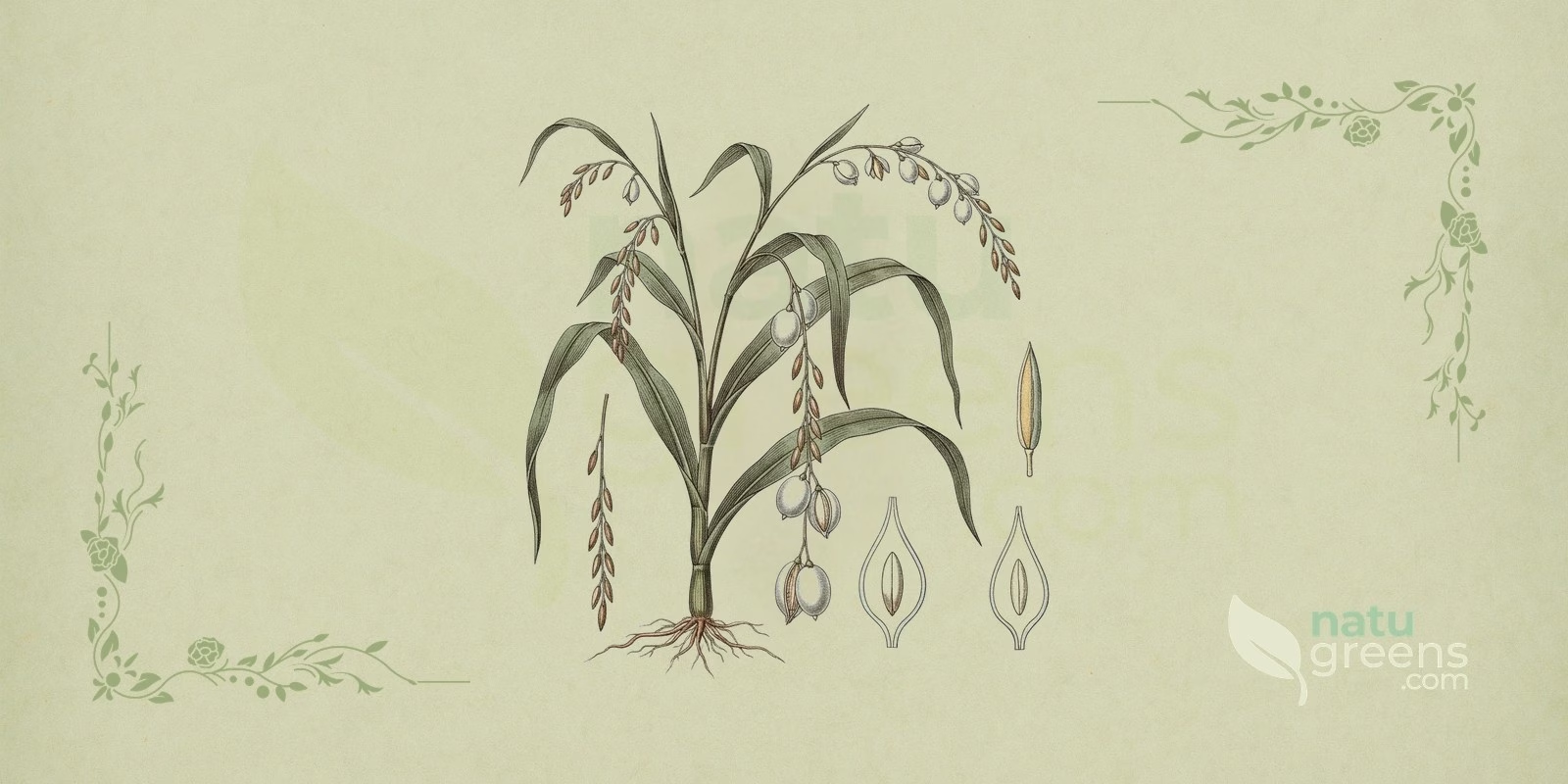
Popular and International Names of Job's Tears
- Chinese: yi yi ren (the cultivated grain).
- Dutch: jobstranen.
- English: adlay, coix seed, Job's tears.
- French: herbe à chapelets, larmes de Job.
- German: Hiobsträne.
- Italian: lacrime di Giobbe.
- Japanese: hatomugi (edible form), juzudama (wild beaded form).
- Portuguese: capim-miçanga, erva-dos-rosários, lágrima-de-jó, lágrima-de-nossa-senhora.
- Spanish: camándula, lágrimas de Job.
It Is Not Barley
In Asian grocery stores, the cultivated grain is often sold as Chinese pearl barley or simply pearl barley. The name is misleading: Job's tears is not barley (Hordeum vulgare) but a different grass from another genus. Anyone looking for barley for a recipe, or anyone who needs to avoid it, should check the scientific name on the package.
Botanical Synonyms of Job's Tears
The accepted name is Coix lacryma-jobi L. The cultivated edible form, with a thin husk, is treated as Coix lacryma-jobi var. ma-yuen (Rom.Caill.) Stapf and is known as adlay. The wild form with hard beads corresponds to var. lacryma-jobi. Synonyms recorded in the literature include:
- Coix agrestis Lour.
- Coix arundinacea Lam.
- Coix exaltata Jacq.
- Coix ma-yuen Rom.Caill.
- Coix pendula Salisb.
- Lithagrostis lacryma-jobi (L.) Gaertn.
Botanical Family: Poaceae
Job's tears belongs to the Poaceae, or Gramineae, the family of grasses and of the major cereals such as rice, wheat, corn and barley. Grasses have jointed stems, long narrow leaves that wrap around the stem with a sheath, and reduced flowers grouped in spikelets. In Coix, the female flower is enclosed in a hardened, teardrop-shaped structure called the involucre, which gives the plant its look of a necklace bead.
Parts of Job's Tears Used
The hulled grain of the cultivated form is the part used as food and in tradition. The beads of the wild form, with a husk as hard as porcelain, are used for handicrafts and are not meant to be eaten. Roots and leaves turn up only occasionally in folk remedies, with no studies to support them.
Ethnobotanical and Traditional Uses of Job's Tears
In China, the cooked grain goes into soups, porridges and grain teas, and in Traditional Chinese Medicine it is associated with swelling, diarrhea and joint pain. In Japan, roasted hatomugi is made into a grain tea drunk every day, and there is a tradition of using it in skin care. In India and Southeast Asia, the grain has also been eaten for a very long time.
Beyond the kitchen, the wild beads have been used to make rosaries, necklaces and percussion instruments in many parts of the world, including Indigenous communities in the Americas. These are traditional and cultural uses, and they do not amount to medical indications.
Medicinal Properties of Job's Tears
The activities below were observed in laboratory and animal studies, or belong to traditional use. Studies in people are few:
- Anti-inflammatory (grain extracts in experimental models, under study)
- Antioxidant (phenolic compounds active in laboratory assays)
- Diuretic (traditional use in Chinese medicine)
- Effect on blood glucose (reduction in animals, under study)
- Effect on cholesterol (observed in animals, under study)
- Effect on the skin (traditional use in Japan, under study)
The Grain Does Not Fight Cancer
In China there is an injectable emulsion made from the seed oil, called Kanglaite, which is used in hospitals as an adjuvant in the treatment of some types of cancer. It is a pharmaceutical drug, given intravenously under oncological supervision, and a subject of research. This does not mean that eating the grain, drinking the tea or using the seed at home has any effect against cancer. There is no equivalence between the injectable drug and oral consumption, and no food replaces cancer treatment.
Detailed Phytochemical Profile of Job's Tears
The grain is mostly starch, with a higher protein content than rice, along with lipids and minor compounds:
- Coixenolide (a lipid ester characteristic of the genus, studied in the laboratory)
- Phenolic compounds (concentrated in the hull and bran, linked to antioxidant activity)
- Phytosterols (present in the oil)
- Polysaccharides (of interest in preclinical immunological studies)
- Prolamins (storage proteins specific to the genus, called coixins)
- Unsaturated fatty acids (such as oleic and linoleic acids, which predominate in the seed oil)
Preparation and Administration Forms of Job's Tears
The reference form is food: the grain of the cultivated form, cooked like rice or pearl barley, in soups, porridges, salads and roasted grain teas. Flours made from the grain are also used in breads and biscuits in Asia.
Medicinal amounts, such as concentrated decoctions or extracts, should be avoided during pregnancy and used only with professional guidance. The hard beads of the wild form are not suitable for cooking.
Synergy with Other Medicinal Plants
In the Kitchen and in Tea
In grain teas and porridges, the grain pairs well with ginger (Zingiber officinale), cardamom (Elettaria cardamomum) and cinnamon (Cinnamomum verum). These are flavor pairings rooted in culinary tradition.
Traditional Combinations
Folk formulas combine the grain with astragalus (Astragalus membranaceus), echinacea (Echinacea purpurea) and fenugreek (Trigonella foenum-graecum). No studies have evaluated these blends. Fenugreek and cinnamon are also being studied for their effect on blood glucose, and adding them to the grain may raise the risk of hypoglycemia in people taking diabetes medication.
Recipes and Usage Protocols of Job's Tears
Cooked Grain
Rinse the grains, soak them for a few hours and cook them in water until tender, just as you would pearl barley. The result can go into soups, salads and sautéed dishes.
Sweet Porridge
Soaked grains simmered slowly in water or plant milk until creamy make a traditional porridge in several Asian countries. It can be served with fruit or a little honey, which should not be given to children under one year of age.
Roasted Grain Tea
In Japan, roasted hatomugi is boiled in water to make a grain tea with a toasty flavor, drunk hot or iced. During pregnancy, the most prudent choice is to avoid regular use of this drink as well, as a precaution.
The preparations above follow traditional records and do not replace professional guidance. Before any internal use, check the contraindications and interactions described in this article.
Associated Therapies of Job's Tears
Traditional Chinese Medicine
In Traditional Chinese Medicine, yi yi ren is described as an herb that strengthens the Spleen and drains Dampness, according to the concepts of that system. It is used in formulas for edema, diarrhea and joint pain, and Chinese tradition contraindicates it as a remedy during pregnancy.
Nutrition
As a cereal, the grain provides starch, protein and fiber, and it can add variety to the diet in place of rice or pearl barley. Claims about controlling blood glucose, cholesterol or weight still lack sufficient evidence in humans.
Contraindications and Side Effects of Job's Tears
- Pregnancy: Traditional Chinese Medicine contraindicates the grain as a remedy during pregnancy, and a study in rats observed an effect on the uterus. Avoid medicinal amounts, extracts and concentrated decoctions.
- Diabetes medication: animal studies suggest a reduction in blood glucose. People taking insulin or oral diabetes drugs should talk to their doctor because the effects may add up, and should never adjust their medication on their own.
- Gluten and celiac disease: the grain is not wheat, barley or rye, but it has its own prolamins and may be cross-contaminated during processing. It cannot be stated that it is safe for people with celiac disease. Anyone with celiac disease should consult their doctor or dietitian and choose only certified gluten-free products.
- Wild beads: they are not edible and pose a choking hazard for young children. Necklaces and toys made with these beads should be kept out of their reach.
- Allergy: people allergic to grasses or cereals should be cautious.
In excess, like any fiber-rich cereal, it can cause gas and abdominal discomfort.
Historical Notes and Interesting Facts about Job's Tears
The name lacryma-jobi, Latin for Job's tear, refers to the biblical figure known for his suffering, and the teardrop shape of the beads completes the image. In countries with a Catholic tradition, the same beads became Our Lady's tears and were used to make rosaries.
The hard involucre already has an opening at each end, through which the flower parts emerged, so the beads can be strung on a thread without drilling. Thanks to this feature, Coix beads appear in the handicrafts of peoples in Asia, Africa and the Americas. The edible form, meanwhile, is one of the longest-cultivated cereals in East Asia.
Frequently Asked Questions about Job's Tears
Is Job's Tears Safe to Eat Every Day?
As a cooked food, within a varied diet, the grain of the cultivated form has been eaten in Asia for a long time. During pregnancy, as a precaution, avoid regular consumption and any medicinal use.
What Is the Difference between Job's Tears and Barley?
They are different plants. Barley is Hordeum vulgare, while Job's tears is Coix lacryma-jobi, sometimes sold as Chinese pearl barley or pearl barley, names that cause confusion.
Does Job's Tears Fight Cancer?
No. In China there is an injectable drug made from the seed oil, used in hospitals as an adjuvant in some cancer treatments and studied as such. Eating the grain or drinking the tea has no proven effect against cancer and does not replace treatment.
Can People with Celiac Disease Eat Job's Tears?
There is no way to guarantee it. The grain is not wheat, barley or rye, but it has its own proteins and a risk of cross-contamination. Talk to your doctor and choose a product with gluten-free certification.
Does Job's Tears Help with Weight Loss?
There is no evidence in humans. The fiber promotes satiety, as with other whole grains, but that does not make the grain a weight-loss product.
Can I Eat the Hard Beads of Wild Job's Tears?
No. The wild beads have a very hard shell and are not food. They also pose a choking hazard for children.
How Is Job's Tears Used in Traditional Chinese Medicine?
As yi yi ren, in traditional formulas for swelling, diarrhea and joint pain. Chinese tradition itself contraindicates its medicinal use during pregnancy.
Notice: this content is for informational purposes and does not replace professional medical advice. Consult a physician or herbal practitioner before using medicinal plants, especially during pregnancy, breastfeeding, or alongside medication.
How to cite this article
NATUGREENS. Job's Tears (Coix lacryma-jobi): Uses and Precautions. Natugreens, 20 Nov. 2026. Disponível em: https://natugreens.com/coix-lacryma-jobi-jobs-tears/. Accessed: Nov. 20, 2026.
Natugreens. (2026). Job's Tears (Coix lacryma-jobi): Uses and Precautions. Natugreens. https://natugreens.com/coix-lacryma-jobi-jobs-tears/
References and Scientific Studies
- DOI2012 Kuo, C. C., Chen, H. H. and Chiang, W. (2012). Adlay ("soft-shelled job's tears"; the seeds of Coix lachryma-jobi L. var. ma-yuen Stapf) is a potential cancer chemopreventive agent toward multistage carcinogenesis processes. Journal of Traditional and Complementary Medicine, 2(4), 267-275. Review of preclinical studies on the cultivated form, with no conclusions for clinical use. ↗
- DOI2016 Xi, X. J. et al. (2016). Assessment of the genetic diversity of different Job's tears (Coix lacryma-jobi L.) accessions and the active composition and anticancer effect of its seed oil. PLoS One, 11(4), e0153269. Compares accessions of the species and tests the seed oil on cells in the laboratory. ↗
- DOI2020 Devaraj, R. D., Jeepipalli, S. P. K. and Xu, B. (2020). Phytochemistry and health promoting effects of Job's tears (Coix lacryma-jobi): a critical review. Food Bioscience, 36, 100619. Critical review highlighting the lack of clinical trials. ↗
You May Also Like



Take your time and tell us everything you think, details included. Every response is read by someone on our editorial team and goes into the article's revision. An honest critique helps us more than a polite compliment.
Take your time and tell us everything you think, details included. Every response is read by someone on our editorial team and goes into the article's revision. An honest critique helps us more than a polite compliment.