



Quick summary
Casearia sylvestris Sw. / Guaçatonga, known in Brazil as guaçatonga (often spelled guacatonga in English), erva-de-lagarto or cafezinho-do-mato, is a shrub or small tree of the Salicaceae family, native to a vast stretch of Latin America, from Mexico to Argentina. Its glossy green leaves, dotted with tiny translucent…
Main caution: Warning: the folk use of guaçatonga against snakebite is only an ethnobotanical record. A snakebite is a medical emergency: the person must be taken immediately to a health facility, where antivenom is given. Teas…
Casearia sylvestris Sw. / Guaçatonga, known in Brazil as guaçatonga (often spelled guacatonga in English), erva-de-lagarto or cafezinho-do-mato, is a shrub or small tree of the Salicaceae family, native to a vast stretch of Latin America, from Mexico to Argentina. Its glossy green leaves, dotted with tiny translucent points that show up when held against the light, and its small whitish or greenish flowers, clustered in the leaf axils, help identify it in dry and moist forests, in secondary scrub and along roadsides.
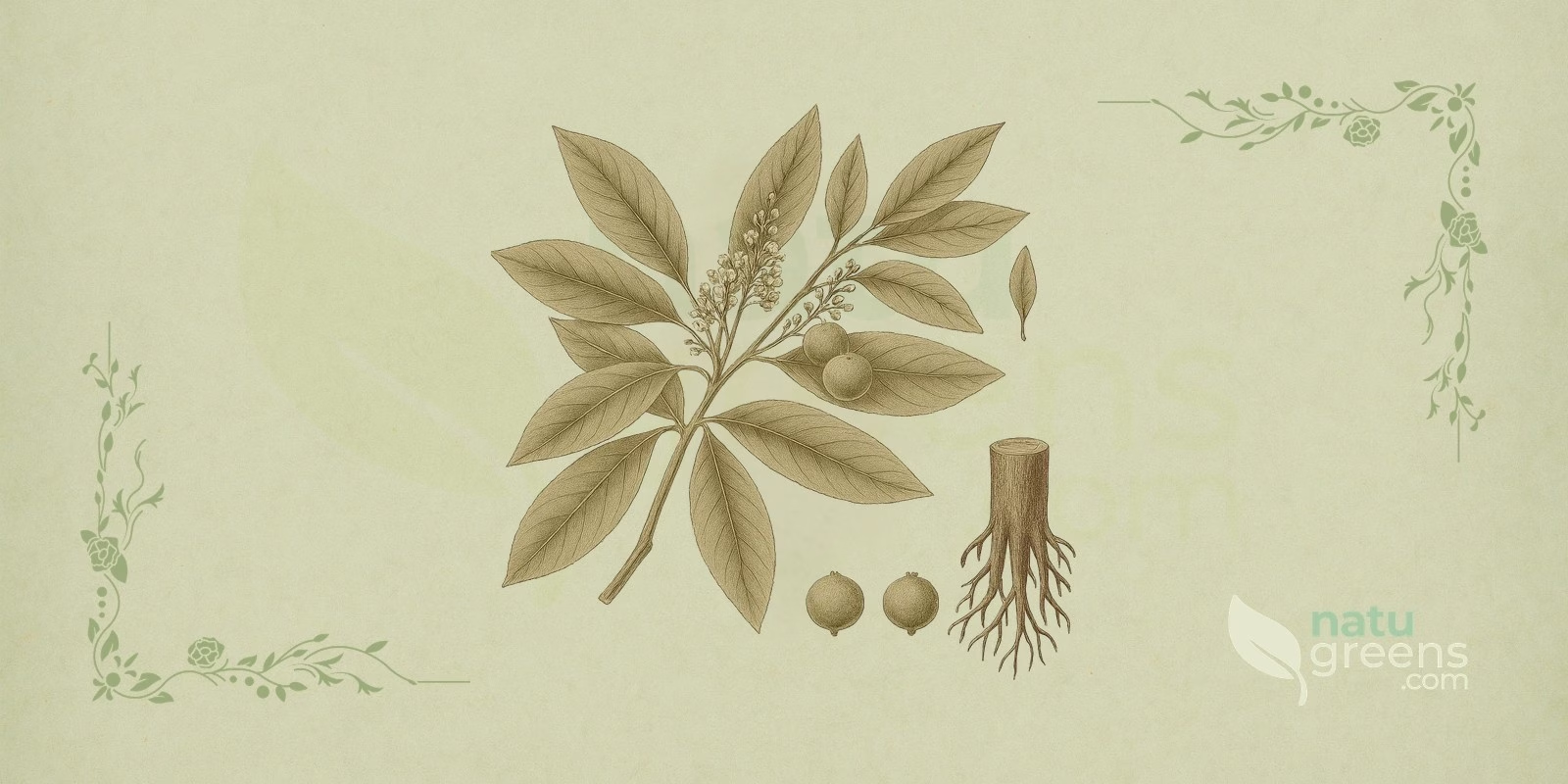
In Brazilian folk medicine, guaçatonga leaves are made into teas for gastritis, ulcers and digestive problems, and applied as compresses on wounds and cold sores. Modern research is investigating these uses, but the data come mainly from laboratory and animal studies, with no clinical trials proving efficacy in humans. The very compounds that attract scientific interest, diterpenes known as casearins, are toxic to cells in the laboratory, which is a reason for caution rather than a promise.
Popular and International Names of Guaçatonga
- English: crackopen, wild sage.
- French: sauge sauvage.
- German: wilder Salbei.
- Italian: salvia selvatica.
- Portuguese: baga-de-pomba, cafezeiro-do-mato, cafezinho-do-mato, caiubim, erva-de-lagarto, guaçatonga, língua-de-tiú, pau-de-lagarto, são-gonçalo.
- Spanish: botoncillo, cafecillo cimarrón, corta lengua, hierba de burro, huesillo.
A Note on the Name Chá-de-Bugre
In some regions, guaçatonga is also called chá-de-bugre or erva-de-bugre, but these names, like porangaba, mainly refer to a different plant, Cordia salicifolia (synonym Cordia ecalyculata), of the Boraginaceae family, which is sold with weight-loss promises. They are different species, with different compositions and different risks. Guaçatonga is not a weight-loss plant, and anyone buying "chá-de-bugre" may be getting either of the two.
Botanical Synonyms of Guaçatonga
Because of its wide distribution and great variation in form, guaçatonga has received many names over two centuries of botany. Although Casearia sylvestris Sw. is the accepted name, the names below appear in older works and in herbarium records, and they help identify the plant in the literature.
- Anavinga parvifolia Lam.
- Anavinga samyda C.F.Gaertn.
- Casearia affinis Gardner
- Casearia attenuata Rusby
- Casearia benthamiana Miq.
- Casearia celtidifolia de Vriese
- Casearia integrifolia Vahl ex DC.
- Casearia parvifolia Willd.
- Casearia samyda (P.Gaertn.) DC.
- Casearia serrulata Sw.
- Chaetocrater capitatus Ruiz & Pav.
- Crateria capitata Pers.
- Guidonia sylvestris (Sw.) M.Gómez
- Samyda sylvestris (Sw.) Poir.
Botanical Family: Salicaceae
Guaçatonga belongs to the Salicaceae family in its current circumscription, the same family as willows (Salix) and poplars (Populus). In older works, the genus Casearia is placed in another family that has since been broken up, but DNA studies led to its inclusion in the Salicaceae, which also comprise many tropical trees and shrubs.
The family is known for its variety of secondary compounds, such as the salicylates of willows. Guaçatonga, however, has a chemical profile of its own, dominated by clerodane-type diterpenes, the casearins, which set it apart from its temperate relatives.
Parts of Guaçatonga Used
- Bark (traditional use)
- Leaves (the most widely used part, in teas and extracts)
- Root (occasional traditional use)
Ethnobotanical and Traditional Uses of Guaçatonga
- Cold sores (traditional external use)
- Colic and digestive disorders (traditional use of the leaves)
- Gastritis and ulcers (traditional use, under study in animals)
- Inflammation (traditional use)
- Laxative (traditional record)
- Rheumatism (traditional record)
- Snakebite (ethnobotanical record; a snakebite is a medical emergency)
- Wounds and healing (traditional external use, under study)
These records document how people have used the plant and still use it, and they do not amount to proven efficacy. Its use against snakebite, in particular, appears here only as historical information: a snakebite is a medical emergency, treated with antivenom in hospital, and no tea, poultice or extract can replace that care.
Medicinal Properties of Guaçatonga
- Anti-inflammatory (traditional use; effects observed in laboratory and animal studies)
- Antimicrobial (activity of extracts observed in the laboratory)
- Antioxidant (observed in chemical and cell-based assays)
- Antiulcer (under study; data from rodent experiments)
- Wound-healing (traditional use; under study in animal models)
In the laboratory, aqueous leaf extracts inhibited enzymes found in snake venoms, a finding that explains the scientific interest in the folk use but in no way justifies any use in people who have been bitten. Likewise, casearins are cytotoxic, meaning they kill cells in culture, and this does not mean an effect against cancer: it means the plant contains potent compounds that call for care.
Detailed Phytochemical Profile of Guaçatonga
The most studied compounds in guaçatonga are the clerodane diterpenes, which include dozens of casearins as well as the casearvestrins. These compounds stand out for their strong cytotoxicity in cells grown in the laboratory, a property that reinforces the need for caution with high doses, prolonged use and pregnancy.
Besides diterpenes, the plant contains flavonoids, tannins and essential oil. Ethanolic extracts and the essential oil of the leaves showed antiulcer activity in rodents, reducing the volume of gastric juice without changing its pH, and aqueous extracts inhibited phospholipase A2, an enzyme linked to inflammation and present in snake venoms. These are experimental results that have not yet been confirmed in clinical studies.
- Casearins
- Casearvestrins
- Clerodane diterpenes
- Essential oil
- Flavonoids
- Tannins
Preparation and Administration Forms of Guaçatonga
- Aqueous, ethanolic and hydroalcoholic extracts
- Compress (external use)
- Leaf infusion
- Tincture
Synergy with Other Medicinal Plants
Traditional Combination with Espinheira-Santa and Boldo
In Brazilian folk tradition, guaçatonga appears in blends with espinheira-santa (Maytenus ilicifolia, now also called Monteverdia ilicifolia) and boldo (Peumus boldus) for digestive complaints. Espinheira-santa is traditionally used to protect the stomach and boldo as a digestive aid, but the combination has not been evaluated in studies and brings together plants that carry their own precautions, such as boldo, which should not be used during pregnancy. Stomach pain that lasts more than a few days, vomiting or blood in the stool call for a medical consultation, and no tea blend can replace treatment for an ulcer.
Recipes and Usage Protocols of Guaçatonga
Traditional Leaf Infusion
A leaf infusion is the most common folk form of use for mild digestive complaints.
Ingredients: a small amount of dried guaçatonga leaves and a cup of boiling water.
Preparation: place the leaves in the cup, pour the boiling water over them, cover and let steep for about 5 minutes, then strain. Use should be occasional and short-term, with no prolonged use without professional supervision, and it is contraindicated during pregnancy and breastfeeding and in children.
Traditional Skin Compress
The compress is the traditional external use on small wounds and cold sores.
Ingredients: dried guaçatonga leaves and water.
Preparation: boil the leaves for a few minutes, strain and let the liquid cool completely. Soak a clean gauze pad in it and apply it to the area for a few minutes. Large, deep, infected or non-healing wounds, as well as frequent cold sores or sores near the eyes, require medical assessment.
The preparations above follow traditional records and do not replace professional guidance. Before any use, read the contraindications described in this article.
Associated Therapies of Guaçatonga
Herbal Medicine
In Brazilian herbal medicine, guaçatonga is traditionally used for digestive complaints and in applications on the skin. Research is studying its extracts and diterpenes in the laboratory and in animals, but the results are still preliminary and do not prove clinical efficacy.
Public Medicinal Plant Programs
In Brazil, guaçatonga appears on official lists of medicinal plants of interest to the Unified Health System (SUS), such as RENISUS, which encourages research into its safety and efficacy. Being on these lists means that the plant deserves to be studied, not that its uses have been proven.
Contraindications and Side Effects of Guaçatonga
Snakebite Requires a Hospital
Warning: the folk use of guaçatonga against snakebite is only an ethnobotanical record. A snakebite is a medical emergency: the person must be taken immediately to a health facility, where antivenom is given. Teas, poultices or extracts of any plant do not neutralize venom, and they delay treatment.
Do Not Confuse It with Weight-Loss Chá-de-Bugre
Products sold as chá-de-bugre or porangaba for weight loss are usually made from Cordia salicifolia, a different plant. Guaçatonga has no use for weight loss, and neither of the two should be used for that purpose without professional guidance.
Pregnancy, Breastfeeding and Children
- Pregnancy: contraindicated. The plant has a folk use as an abortifacient, and findings in animals reinforce the risk.
- Breastfeeding: not recommended, because safety data are lacking.
- Children: not recommended, for the same reason.
Prolonged Use and Cytotoxicity
Casearins are cytotoxic in the laboratory, and there are no long-term safety studies in humans. For this reason, guaçatonga should not be used for long periods without professional supervision, nor taken in high doses or as concentrated extracts on one's own initiative.
Warning Signs That Require a Doctor
Persistent stomach pain, blood in the stool or dark stools, vomiting blood or repeated vomiting should not be treated with teas: these are signs that require medical assessment.
Medications
There are few studies on interactions. Anyone taking anticoagulants, stomach medications or other long-term medications should tell their doctor or pharmacist before using the plant.
Historical Notes and Interesting Facts about Guaçatonga
A Tupi Name
The name guaçatonga comes from Tupi, like many names of plants native to Brazil, and it coexists with dozens of regional names, from cafezinho-do-mato to pau-de-lagarto, a sign of how well known the plant is in the Brazilian countryside.
Described in the Antilles
The species was described in the late 18th century by the Swedish botanist Olof Swartz from plants of the Antilles, which explains the abbreviation "Sw." that follows the scientific name.
Interest from Brazilian Science
Guaçatonga is one of the native plants most researched by Brazilian universities, with studies on its diterpenes, its essential oil and its toxicity, many of them prompted precisely by its folk uses.
Frequently Asked Questions about Guaçatonga
Can Guaçatonga Tea Be Taken Every Day?
Using the plant for long periods without professional supervision is not recommended, because there are no long-term safety studies and its diterpenes are cytotoxic in the laboratory. Traditional use is occasional and short-term.
Does Guaçatonga Help with Gastritis and Ulcers?
It is a traditional use, and rodent studies have observed a protective effect on the stomach, but there are no clinical trials in humans. Gastritis and ulcers require medical diagnosis and treatment.
Does Guaçatonga Work for Snakebite?
No. This use is only a folk record. A snakebite is a medical emergency, treated with antivenom in hospital, and no tea can replace that care.
Are Guaçatonga and Chá-de-Bugre the Same Plant?
Not necessarily. The name chá-de-bugre is used mainly for Cordia salicifolia, which is sold for weight loss, and sometimes also for guaçatonga. They are different plants, and guaçatonga has no use for weight loss.
Can Pregnant Women Use Guaçatonga?
No. The plant is contraindicated during pregnancy because of its folk use as an abortifacient and because of findings in animals. It is also not recommended while breastfeeding or for children.
Does Guaçatonga Work against Cancer?
There is no evidence of this in humans. Casearins kill cells in laboratory cultures, which shows that they are potent compounds and therefore call for caution, but that is a long way from being a treatment.
Notice: this content is for informational purposes and does not replace professional medical advice. Consult a physician or herbal practitioner before using medicinal plants, especially during pregnancy, breastfeeding, or alongside medication.
How to cite this article
NATUGREENS. Guaçatonga (Casearia sylvestris): Uses and Precautions. Natugreens, 20 Nov. 2026. Disponível em: https://natugreens.com/guacatonga-casearia-sylvestris/. Accessed: Nov. 20, 2026.
Natugreens. (2026). Guaçatonga (Casearia sylvestris): Uses and Precautions. Natugreens. https://natugreens.com/guacatonga-casearia-sylvestris/
References and Scientific Studies
- DOI2011 Ferreira PMP, et al. (2011). Folk uses and pharmacological properties of Casearia sylvestris: a medicinal review. Anais da Academia Brasileira de Ciências, 83(4), 1373-1384. Review of folk uses and pharmacological studies, mostly preclinical. ↗
- DOI1990 Basile AC, et al. (1990). Pharmacological assay of Casearia sylvestris. I: Preventive anti-ulcer activity and toxicity of the leaf crude extract. Journal of Ethnopharmacology, 30(2), 185-197. Antiulcer activity and toxicity of the leaf extract in rodents. ↗
- DOI2000 Borges MH, et al. (2000). Effects of aqueous extract of Casearia sylvestris (Flacourtiaceae) on actions of snake and bee venoms and on activity of phospholipases A2. Comparative Biochemistry and Physiology Part B, 127(1), 21-30. Inhibition of venom enzymes in experimental models. ↗
- DOI1990 Itokawa H, et al. (1990). New antitumor principles, casearins A-F, for Casearia sylvestris Sw. (Flacourtiaceae). Chemical and Pharmaceutical Bulletin, 38(12), 3384-3388. Isolation of the casearins and description of their cytotoxicity in cells. ↗
- DOI2015 Ameni AZ, et al. (2015). Toxicity study about a medicinal plant Casearia sylvestris: A contribution to the Brazilian Unified Health System (SUS). Journal of Ethnopharmacology. Toxicity assessment of the plant in rodents. ↗
You May Also Like
Take your time and tell us everything you think, details included. Every response is read by someone on our editorial team and goes into the article's revision. An honest critique helps us more than a polite compliment.
Take your time and tell us everything you think, details included. Every response is read by someone on our editorial team and goes into the article's revision. An honest critique helps us more than a polite compliment.