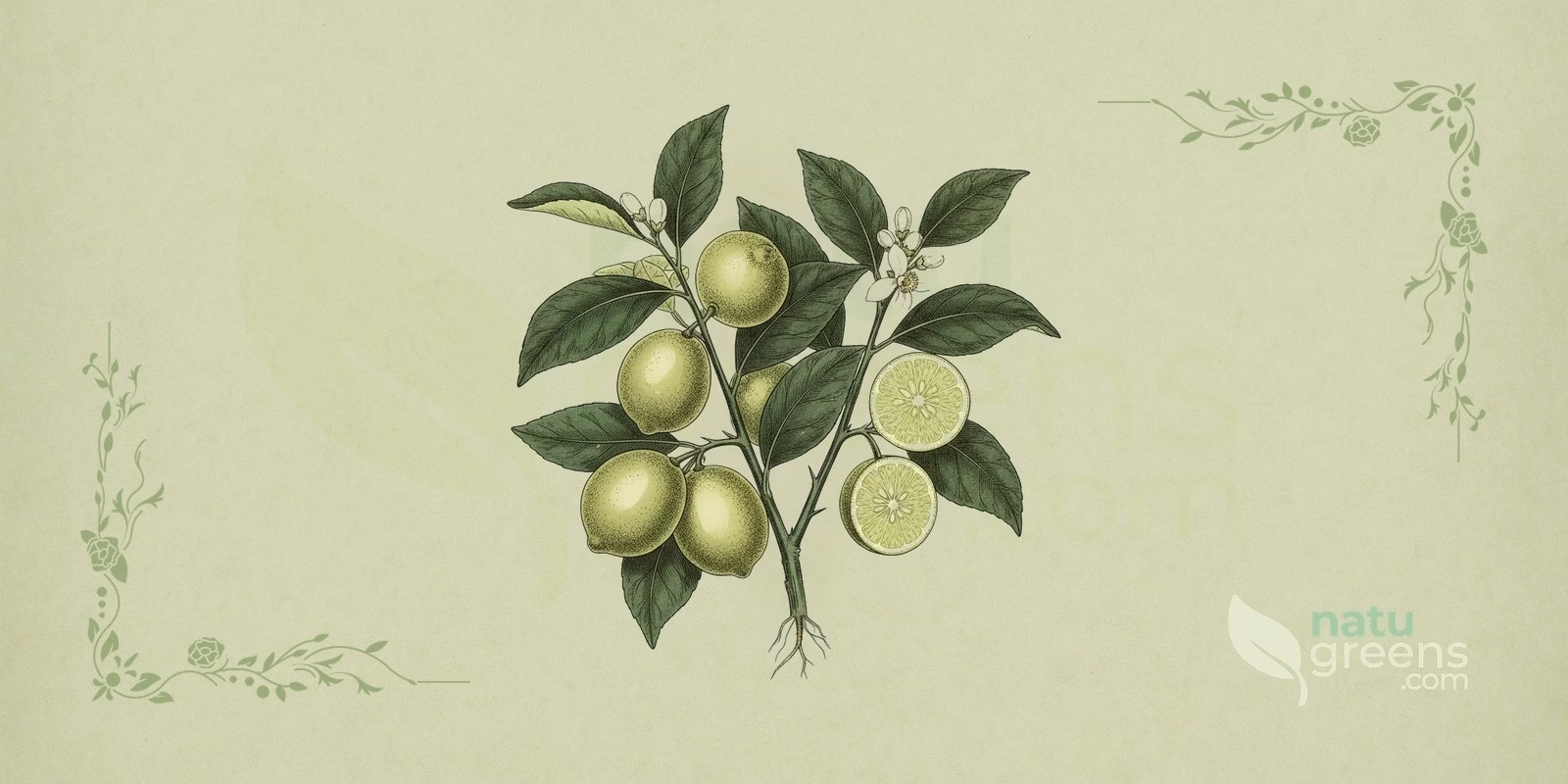
Citrus × aurantiifolia (Christm.) Swingle / Key Lime, known in English as key lime and in Brazil as limão-galego or lima-ácida, is a hybrid citrus plant of the Rutaceae family. Although botanical classification treats it as a species, it arose from a natural cross between Citrus micrantha, a wild papeda, and Citrus medica, the citron. Native to Southeast Asia, the plant spread across the Middle East, North Africa, Sicily and Andalusia. It later reached the West Indies, including the Florida Keys, with Spanish explorers, and the botanist Henry Perrine is often credited with introducing it to Florida.
Key lime differs from the Persian or Tahiti lime (Citrus × latifolia) in its thinner peel, smaller size, sharper acidity and stronger aroma. These qualities make it a prized ingredient in cooking and in drinks. In traditional medicine, the fruit, peel and leaves have a long history of use. Laboratory studies and recent reviews have been looking into part of this record, especially the antioxidant, anti-inflammatory and antimicrobial actions attributed to its compounds, although clinical trials confirming these effects in people are still lacking. Because the juice and peel contain furanocoumarins, skin contact followed by sun exposure calls for specific precautions, which are gathered in the contraindications section.
Popular and International Names of Key Lime
The Persian or Tahiti lime, called limão-taiti in Brazil, belongs to another species, Citrus × latifolia, and is therefore not included in the list below. The two fruits are nonetheless often confused in markets and in everyday speech.
- English: Egyptian lime, Key lime, Mexican lime, West Indian lime.
- Filipino: dayap.
- French: citron vert, lime.
- German: Limette, Mexikanische Limette.
- Italian: lime, limetta.
- Portuguese: lima, lima-ácida (BR), limão-galego (BR), limoeiro.
- Spanish: lima ácida, limón criollo, limón mexicano.
- Thai: manao.
- Vietnamese: chanh.
Botanical Synonyms of Citrus × aurantiifolia
The accepted scientific name for key lime is Citrus × aurantiifolia (Christm.) Swingle, spelled with a double i. The species has gathered a series of botanical synonyms that reflect its complex taxonomic history and regional differences in classification. Those most often found in the scientific and popular literature are listed below, including the spelling with a single i, which is only an orthographic variant of the same name:
- Citrus × acida Roxb.
- Citrus aurantifolia (Christm.) Swingle (orthographic variant)
- Citrus × aurantium lima (Lunan) Guillaumin
- Citrus javanica Blume
- Citrus lima Lunan
- Citrus medica aurantiifolium (Christm.) M.Hiroe
- Citrus notissima Blanco
- Limonia aurantifolia Christm.
Two names appear in some lists as if they were synonyms, Citrus maxima (Burm. ex Rumph.) Merr. and Citrus limetta Risso. They actually belong to other plants of the genus, the pomelo and a sweet-fleshed lime, and have therefore been left out of this list.
Botanical Family: Rutaceae
The Rutaceae family brings together a diverse group of flowering plants, found mainly in tropical and temperate regions. It is characterized by oil glands in the leaves and fruits, the structures responsible for the citrus aromas that make these species so recognizable. Among its economically important genera is Citrus, which includes oranges, lemons, grapefruits and key lime itself. The Rutaceae as a whole produce a wide range of bioactive compounds, such as flavonoids, coumarins and essential oils, which explain the medicinal and aromatic interest in many of them.
The place of Citrus × aurantiifolia in this family helps explain its phytochemical richness and the role it plays in both food and herbal medicine. The structure of its flowers and fruits, along with its chemical makeup, brings it close to other prominent members of the Rutaceae. This same chemical heritage includes furanocoumarins, substances common in several citrus fruits that deserve attention because of their potential to sensitize the skin to sunlight.
Parts of Key Lime Used
Tradition makes use of virtually the whole fruit as well as the leaves, and each part concentrates different compounds. This affects both how each part is used and the precautions it requires, especially in the case of the peel and the essential oil extracted from it, which concentrate the photosensitizing substances.
- Essential oil
- Fruit juice
- Fruit peel
- Fruits
- Leaves
Ethnobotanical and Traditional Uses
The following list gathers records from folk medicine and the ethnobotanical literature on key lime and should not be read as a treatment recommendation. Most of these uses have not been confirmed in clinical trials in people. Serious diseases such as cancer, diabetes, diphtheria, typhoid fever, malaria, typhus, tuberculosis and diseases of the heart, liver and kidneys require medical diagnosis and follow-up, which the fruit does not replace under any circumstances.
- Absorption of iron from food
- Acne
- Anxiety and nervousness
- Arteriosclerosis
- Arthritis
- Ascites
- Asthenia
- Asthma
- Biliary tract disorders and excess bile
- Bladder diseases
- Blood impurities
- Bowel upsets
- Cancer (folk record without clinical evidence; only laboratory studies exist)
- Cholelithiasis
- Cirrhosis
- Common cold
- Cough
- Culinary use, as in Persian cuisine
- Dandruff
- Diabetes mellitus
- Diarrhea
- Digestive disorders
- Diphtheria
- Dropsy
- Dysentery
- Fever
- Flu
- Gastroenteritis
- Gastrointestinal fermentation
- Gout
- Gouty dyspepsia
- Headaches (leaves)
- Heart disease
- Hiccups
- High blood pressure
- High cholesterol
- Infections in general
- Inflammation in general
- Insomnia and sleep disorders
- Intestinal cramps and flatulence
- Irritable bowel syndrome
- Jaundice
- Kidney stones (nephrolithiasis)
- Liver disease
- Lymphatism
- Malaria (paludism)
- Migraine
- Natural exfoliant
- Nausea
- Nephritis
- Neuralgia
- Obesity
- Pharyngitis
- Premenstrual tension and menstrual cramps
- Pyorrhea
- Queasiness
- Rheumatism
- Scurvy
- Stomach acidity, heartburn, gastritis and pyrosis (a controversial folk record, since the fruit’s acidity can worsen reflux and gastritis)
- Stomatitis
- Tired skin
- Tonsillitis
- Tuberculosis
- Typhoid fever
- Typhus
- Ulcers in general (in gastric ulcer, the fruit’s acidity can worsen the condition)
- Wounds and skin inflammation
Two records found in older sources have been removed from this list for safety reasons. The first is the use of the juice against caustic soda or potash poisoning, a dangerous practice in which the correct response is to seek emergency care immediately. The second is application to eye irritation and conjunctivitis, since the acidic juice must not come into contact with the eyes.
Therapeutic Properties of Key Lime
The properties below combine folk tradition with effects observed in laboratory studies and animal models. Each description states the level of evidence available, since few of these effects have been tested in clinical trials in people.
- Alkalizing (a folk-medicine notion without physiological support, since the body regulates its own pH)
- Antianemic (vitamin C aids the absorption of iron from food, without replacing anemia treatment)
- Antidepressant (traditional record linked to the aroma of the essential oil, without clinical evidence)
- Antiemetic (traditional use for nausea and vomiting)
- Anti-inflammatory (effect observed in experimental studies)
- Antimicrobial (activity against bacteria and fungi observed in laboratory studies)
- Antioxidant (neutralizes free radicals in laboratory assays)
- Antiproliferative (activity observed in laboratory studies, without clinical evidence)
- Antipyretic (traditional use in feverish states)
- Antiscorbutic (a source of vitamin C, the nutrient whose deficiency causes scurvy)
- Antiseptic (inhibits microorganisms in laboratory tests)
- Antispasmodic (traditional use for spasms and cramps)
- Aperitive (traditionally used to stimulate the appetite)
- Astringent (tends to tighten tissues, according to traditional use)
- Bactericidal (action against bacteria observed in vitro)
- Cardioprotective (effect investigated in preliminary studies)
- Depurative (traditional notion of cleansing the body)
- Diaphoretic (traditional use to induce sweating in feverish states)
- Diuretic (effect traditionally attributed to the juice and teas)
- Expectorant (traditional use in cough syrups)
- Hypocholesterolemic (effect on cholesterol investigated in preliminary studies)
- Hypoglycemic (effect on blood glucose investigated in preliminary studies, without replacing diabetes treatment)
- Immunomodulatory (effect on the immune system investigated in experimental studies)
- Neuroprotective (effect investigated in experimental models)
- Refreshing (provides a feeling of freshness)
- Sedative (traditional record of a relaxing effect)
- Stomach tonic (traditional use as a digestive stimulant)
- Thermogenic (effect claimed in weight-loss diets, without clinical evidence)
- Vermifuge (folk-medicine record, without clinical evidence)
- Vitamin-rich (dietary source of vitamin C)
Detailed Phytochemical Profile of Key Lime
Key lime (Citrus × aurantiifolia) is a rich source of bioactive compounds, unevenly distributed among the juice, peel, leaves and essential oil. This complex composition brings together substances whose pharmacological activities have been described in laboratory studies. The variety of these compounds helps explain the fruit’s wide use in traditional medicine and in the food, beverage and perfume industries. Even so, the mere presence of a substance in the plant does not, by itself, mean a proven effect in the human body.
- Alkaloids
- Bioflavonoids (hesperidin)
- Chlorine
- Coumarins
- Essential oil (citronellal, geranial, limonene, β-pinene, γ-terpinene)
- Furanocoumarins (bergapten)
- Iron
- Limonin
- Magnesium
- Mineral salts
- Niacin
- Organic acids (citric and malic)
- Pectins
- Phellandrene
- Potassium
- Quinones
- Sodium
- Sulfur
- Tannins
- Terpene hydrocarbons
- Vitamins (A, B1, B2, C)
Two of these components deserve special attention, for opposite reasons. Vitamin C gives the fruit its best-documented nutritional value. Furanocoumarins such as bergapten, present in the juice and peel, cause the phytophotodermatitis that appears when the skin touches the fruit and is then exposed to the sun. Limonene, the main constituent of the essential oil, accounts for much of the characteristic aroma and comes up often in research on the oil’s antimicrobial and antioxidant activity.
Preparation and Administration Forms of Key Lime
Key lime can be used in many ways, both in the kitchen and in folk medicine. The choice of preparation depends on its purpose and on the part of the plant involved, since the juice, peel, leaves and essential oil differ in composition and in the precautions they call for.
- Decoction (traditional record in feverish states; malaria and other infectious fevers require medical treatment)
- Essential oil (aromatherapy, perfumery and personal care products; the expressed oil must never go on the skin before sun exposure)
- Folk juice-based weight-loss regimens (without scientific support and not advised, since they wear down tooth enamel and may worsen reflux and gastritis)
- Gargles (traditional use for mouth and throat irritation, followed by rinsing the mouth with water)
- Homemade scrub (juice, almond oil and sugar, always rinsed off thoroughly and followed by sun protection)
- Juice or cold drink (limeade, cocktails, sorbets, caipirinha and seasoning)
- Peel (seasoning, sweets, compotes, puddings, pies, candies, creams, fillings, meringues, dessert syrups and preserves)
- Syrup or fluid extract (traditional use as an expectorant and mucus thinner)
- Teas and syrups (with peel, leaves and flowers)
There are no standardized doses established for the medicinal uses of key lime. The safest approach is therefore to regard the fruit as a food, in the usual culinary amounts, and to reserve concentrated teas, syrups, extracts and essential oil for occasional use under the guidance of a health professional. With any preparation taken internally, rinse the mouth with water after consumption and do not brush the teeth right away. With topical preparations, the skin should be washed and protected from the sun for the following hours.
Synergy with Other Medicinal Plants
Synergy for Digestive Health
In folk tradition, key lime is combined with peppermint (Mentha × piperita) and ginger (Zingiber officinale) in teas and infusions traditionally used for indigestion, flatulence and nausea. The reasoning behind this pairing is that the limonene in key lime would add to the essential oils of peppermint and the gingerols of ginger in stimulating digestion and easing abdominal discomfort. This combined effect belongs to the traditional record, has not yet been evaluated in clinical studies and may not suit people with reflux or gastritis.
Synergy for the Immune System
In homemade preparations for the cold and flu season, key lime appears alongside echinacea (Echinacea purpurea) and elder (Sambucus nigra). The combination is traditionally used to support the body’s defenses during common respiratory infections. According to this use, the vitamin C and bioflavonoids of key lime would join the compounds studied for their immunomodulatory action in echinacea and for their antiviral activity in the laboratory in elder. The association of the three plants, however, is a traditional record, with no clinical evidence of added benefit. Only the flowers and the ripe, cooked berries of elder go into these preparations, since the other parts of the plant and the raw berries can cause poisoning.
Synergy for Skin Health
In topical applications, key lime is traditionally combined with aloe (Aloe vera) and calendula (Calendula officinalis) in the care of oily skin, acne and minor skin irritations. The idea is to pair the astringent action attributed to the fruit with the soothing and healing properties that tradition recognizes in the other two plants. This combination calls for extra caution, because the juice and peel contain furanocoumarins, and skin contact followed by sun exposure causes phytophotodermatitis, with burns and long-lasting dark spots. For this reason, the mixture should be applied at night, removed completely with water and followed by protection from sun exposure over the following hours.
Recipes and Usage Protocols of Key Lime
Morning Key Lime and Ginger Drink
Ingredients: juice of 1 key lime, 200 ml of warm water, 1 teaspoon of honey (optional) and a pinch of grated ginger.
Preparation: Squeeze the key lime juice into the warm water, add the honey and grated ginger, and stir well. The drink is traditionally taken in the morning as a digestive stimulant, and folk tradition credits it with an invigorating effect. People with reflux, gastritis or ulcers, however, should avoid it on an empty stomach. After drinking, rinse the mouth with water and do not brush the teeth right away, to protect tooth enamel from the acidity of the juice.
Green Clay Face Mask for Oily Skin
Ingredients: juice of half a key lime, 1 tablespoon of green clay and 1 teaspoon of honey.
Preparation: Mix all the ingredients into a smooth paste and apply it to the clean face, preferably at night, avoiding the eye and lip area. Leave on for 10 to 15 minutes, rinse with cold water until no residue is left, and repeat no more than once or twice a week. The mask is traditionally used for oily, acne-prone skin. The juice, however, contains furanocoumarins, and skin contact followed by sun exposure causes phytophotodermatitis, with burns and long-lasting dark spots. A patch test beforehand is therefore essential, as is avoiding sun exposure for the hours following application.
Homemade Syrup for Coughs and Colds
Ingredients: juice of 3 key limes, 1 cup of honey and 1 small piece of grated ginger, about 2 cm long.
Preparation: Combine the juice, honey and ginger in a container and warm in a double boiler for about 10 minutes, without letting it boil, just long enough for the ingredients to blend. Then strain and store in a sterilized glass jar in the refrigerator. The syrup is traditionally taken in small portions to relieve coughs, sore throats and the discomfort of colds. In this recipe, key lime is included as a source of vitamin C, while honey and ginger help soothe the throat. How often and for how long to use it should be agreed with a health professional. Do not give it to children under one year of age because of the honey, and rinse the mouth with water after each portion, without brushing the teeth right away.
The preparations above follow traditional records and do not replace professional guidance. Before any internal use, check the contraindications and interactions described in this article.
Associated Therapies
Aromatherapy
Key lime essential oil is widely used in aromatherapy for its invigorating, refreshing profile. In aromatherapy practice, inhalation through diffusers or vaporizers is often associated with a sense of well-being, stress relief and a greater readiness to concentrate, effects reported by tradition and still little studied in clinical trials. In massage, the oil is used diluted in vegetable carrier oils, traditionally for muscle discomfort and to stimulate circulation. Expressed essential oil, however, must never be applied to the skin before sun exposure, because the furanocoumarins it concentrates can cause phytophotodermatitis.
Clinical Herbal Medicine
In clinical herbal medicine, key lime appears in formulations that include extracts and supplements. These generally aim to draw on the antioxidant, anti-inflammatory and antimicrobial properties described in laboratory studies. Practitioners may consider it as an adjunct for digestive complaints, for immune support and in traditional body-cleansing protocols. Use should always be individualized, with an assessment of each patient’s condition and attention to possible drug interactions, and it never replaces conventional treatment.
Contraindications and Side Effects of Key Lime
Photosensitivity and Phytophotodermatitis
The juice and peel contain furanocoumarins (bergapten): skin contact followed by sun exposure causes phytophotodermatitis, with burns and long-lasting dark spots that can take weeks or months to fade. The risk is not limited to cosmetic recipes, because simply handling the fruit outdoors, when squeezing limes for juices and cocktails, is enough to cause lesions on the hands, the arms and around the mouth. For this reason, every topical recipe and all handling of the fruit carry the same warning: wash the skin thoroughly with soap and water right after contact and avoid direct sun for the following hours.
Expressed essential oil must never be applied to the skin before sun exposure, nor used as a skin lightener. Instead of evening out skin tone, it can trigger the very spots one was trying to avoid. People with sensitive skin should do a patch test on a small area before any topical use. Allergic reactions, although rare, can also occur in people sensitive to citrus fruits.
Tooth Enamel, Reflux and Gastritis
Acidity erodes tooth enamel: rinse the mouth after use and do not brush the teeth right away. This applies to the plain juice, the morning drink, gargles and the syrup. The fruit can also worsen reflux and gastritis. People with these conditions, a gastric ulcer or digestive sensitivity should avoid consuming it on an empty stomach and stay away from folk regimens based on heavy juice intake, and they should talk to their doctor before adding concentrated preparations to their routine.
Drug Interactions and Health Conditions
In high doses, key lime may in theory interact with anticoagulants because of the coumarins present in the plant. People taking these medicines should avoid concentrated preparations, extracts and supplements without medical guidance. Because its effects on blood glucose are still being investigated, people with diabetes who take glucose-lowering drugs should consult their doctor before turning to extracts or the essential oil. Folk sources also advise caution for diabetics specifically when using the oil in aromatherapy. Out of the same prudence, anyone taking sedatives or antidepressants should talk to a health professional before combining concentrated preparations of the plant with their treatment. People with low blood pressure, in turn, should avoid excessive consumption, which may accentuate the condition. Folk medicine sources also report that very high doses can cause tremors, delirium and dizziness.
Pregnancy, Breastfeeding and Children
Ordinary culinary use of the fruit should not be confused with medicinal use. Pregnant women, breastfeeding women and children should not use the essential oil, concentrated extracts or heavy-consumption regimens without guidance from a health professional, given the lack of safety data for these situations. Recipes with honey, such as the syrup and the morning drink, should not be given to children under one year of age, an age group for which honey is contraindicated.
Correct Identification of the Species
The information in this article refers to Citrus × aurantiifolia (Christm.) Swingle, spelled with a double i, and should not be automatically transferred to other citrus fruits. The Persian or Tahiti lime (limão-taiti in Brazil) is Citrus × latifolia, a different species with a larger, less acidic and usually seedless fruit. It therefore appears here only as a point of comparison, never as a common name for key lime.
Historical Notes and Interesting Facts
Origin of the Name and History
The name Key lime, by which Citrus × aurantiifolia is known in English, comes from its association with the Florida Keys, where the fruit became naturalized and eventually turned into a culinary symbol of the region. The word lime, in turn, derives from the Arabic līma, an adaptation of the Persian limu. This linguistic path mirrors the long history of citrus cultivation and trade across cultures and continents, from Southeast Asia to the Americas.
Culinary and Cultural Use
Beyond its place in folk medicine, key lime is a versatile ingredient appreciated around the world. It is the star of Key lime pie, the traditional pie of the Florida Keys, and an essential component of classic cocktails such as the margarita and the daiquiri. The popularity of these drinks even gave its name to so-called margarita dermatitis, a term used in the medical literature for the burns and spots caused by lime juice squeezed in the sun. In Persian cuisine, the fruit is dried and used as a spice in many dishes, giving them a very distinctive sour and aromatic flavor. In some traditions, the leaves of the plant are also used to ease headaches, which shows the breadth of uses accumulated over time.
Frequently Asked Questions about Key Lime
Are Key Lime and Persian Lime the Same Plant?
Although the two are often confused in Brazil, key lime (Citrus × aurantiifolia) and Persian or Tahiti lime (Citrus × latifolia) are distinct plants. The former has a smaller, more acidic fruit with a thinner peel and seeds, while the latter is larger, less acidic and usually seedless. Persian lime is a triploid hybrid that results from a cross between key lime and lemon (Citrus × limon).
Which Uses of Key Lime Are Supported by Science?
The strongest support lies in the fruit’s nutritional value as a source of vitamin C, the nutrient whose deficiency causes scurvy and which aids the absorption of iron from food. The antioxidant, anti-inflammatory and antimicrobial actions attributed to the juice, peel and essential oil appear mainly in laboratory studies and animal models. Most folk uses, such as digestive, respiratory and skin uses, have not yet been confirmed by clinical trials. For this reason, key lime does not replace medical treatment, and any health-related use should be discussed with a professional.
Can Key Lime Juice Be Applied to the Skin?
The juice can be used on the skin only with great caution, because it contains furanocoumarins that, under sunlight, cause phytophotodermatitis, with burns and long-lasting dark spots. Anyone who wants to use it in masks or scrubs should first do a patch test on a small area and prefer applying it at night. Afterward, the skin must be rinsed thoroughly and direct sun exposure avoided for several hours. Expressed essential oil, for its part, must never be applied before sunbathing nor used as a skin lightener.
Can Handling Key Limes in the Sun Stain the Skin?
Yes, and this is one of the most common accidents involving the fruit. Anyone who squeezes limes for juices or cocktails outdoors is left with juice residue on the hands and arms, which can cause burns and dark spots when exposed to the sun. The medical literature describes many cases of this kind, known as margarita dermatitis. Prevention consists of washing the skin thoroughly with soap and water right after handling the fruit and avoiding direct sun for the following hours.
Can Key Lime Juice Wear Down Tooth Enamel?
It can, because the acidity of the juice erodes tooth enamel, especially when it is consumed often, undiluted or on an empty stomach. The recommendation is to rinse the mouth with water after use and not to brush the teeth right away, since enamel is more vulnerable just after contact with acid. People with sensitive teeth should talk to their dentist about a suitable frequency of consumption.
Does Key Lime Have Contraindications?
Yes, and the main ones involve photosensitivity caused by furanocoumarins, tooth enamel erosion and the possibility of worsening reflux and gastritis. People with low blood pressure, people with diabetes who take glucose-lowering drugs and people taking anticoagulants, sedatives or antidepressants should avoid concentrated preparations without medical guidance, as should pregnant women, breastfeeding women and children, while anyone allergic to citrus fruits should avoid the fruit itself. Before starting any medicinal use of plants, consult a health professional.
Notice: this content is for informational purposes and does not replace professional medical advice. Consult a physician or herbal practitioner before using medicinal plants, especially during pregnancy, breastfeeding, or alongside medication.
References and Scientific Studies
- PMC2021 Alessandrello C, et al. A spotlight on lime: a review about adverse reactions and clinical manifestations due to Citrus aurantiifolia. Clin Mol Allergy. 2021.
- PMC2023 Paisey EK, et al. Long-reads-based transcriptome dataset from leaves of lime, Citrus aurantiifolia (Christm.) Swingle treated by ethephon and abscisic acid. Data in brief. 2023.
- PMC2021 Gusella G, et al. Unusual Stylar-End Breakdown and Sour Rot on Key Lime (Citrus aurantiifolia) in Pre-Harvest Condition in Italy. Plants (Basel, Switzerland). 2021.